Risk Tone Across The Market
The broader cryptocurrency market is currently exhibiting a mildly negative short-term bias, reflecting a cautious risk tone among participants. With a global market capitalization standing at approximately $2.33 trillion, the average 24-hour price change across the top assets is a decline of around 4.19%. This observed downturn suggests a prevailing risk-off sentiment, where investors are pulling back from speculative assets or taking profits.
While Bitcoin (BTC) has shown some resilience over the 7-day period with a slight gain of 0.27%, its 24-hour performance, along with that of Ethereum (ETH) and most other major altcoins, indicates a move lower. Ethereum, for instance, has seen a 3.78% decrease over 24 hours and a 2.99% decline over the past week. This divergence between Bitcoin's relative stability on a weekly basis and the broader market's daily depreciation points to a nuanced environment where capital may be consolidating into perceived safer assets within the crypto sphere, or exiting the market entirely. The strongest 24-hour negative moves are concentrated in Uniswap (UNI), Cardano (ADA), and Dogecoin (DOGE), underscoring heightened volatility and risk aversion in specific altcoin segments.
Macro and Flow Signals
Recent headlines underscore a complex interplay of institutional flows, regulatory developments, and broader macro considerations shaping current market sentiment.
In the institutional arena, Bitcoin ETFs have shown a notable rebound, attracting $119 million in net inflows on a recent Tuesday, following earlier inflows of $134.4 million over the first two trading days of October. This suggests a persistent institutional appetite for Bitcoin, even amidst price declines. Conversely, Ether funds have experienced a six-session outflow streak, totaling $408 million, indicating a potential shift in institutional preference or a reaction to specific Ethereum-related dynamics. Further institutional integration was signaled by the SEC clearing 3x leveraged Bitcoin and Ethereum funds for trading, allowing these products to list on a U.S. exchange. This development provides new avenues for sophisticated investors to gain exposure, albeit with amplified risk.
Regulatory developments continue to cast a shadow over certain assets and market segments. The appointment of Jay Clayton, the former SEC Chair who initiated the lawsuit against Ripple, to lead President Trump's AI push, has brought renewed attention to regulatory uncertainties surrounding XRP. While his new role is not directly crypto-related, his past actions serve as a reminder of the regulatory environment's influence. Separately, the Department of Justice's invocation of a Bitcoin Fog ruling in the Roman Storm acquittal bid highlights ongoing legal scrutiny within the crypto space, particularly concerning privacy-enhancing tools.
From a macro perspective, Bitmine's continued accumulation of Ethereum, reaching 99% of its "Alchemy of 5%" target with an additional $41 million purchase, reflects strong corporate conviction in Ethereum's long-term value. Bitmine chairman Tom Lee reportedly suggested Ethereum is "dwarfing" other macro assets. This corporate bullishness offers a counterpoint to the recent ETF outflows. Moreover, Real Vision founder Raoul Pal has posited that a pause in the AI stock rally could redirect capital back into crypto, with AI agents potentially boosting Ethereum and Solana adoption. This suggests a narrative of sector rotation that could influence future flows.
Finally, protocol-level developments for Ethereum continue, with the "Glamsterdam" upgrade launching on the Sepolia testnet, marking a significant step towards mainnet efficiency and scalability. Additionally, EEZ has tested an atomic L1-to-L2 transaction, aiming to unify the Ethereum ecosystem. While these are fundamental improvements, their immediate impact on short-term sentiment is typically less pronounced than macro or flow-driven news.
What Sentiment Is Doing To Major Coins
The current market sentiment, characterized by a generally risk-off tone with specific institutional flows, is manifesting differently across major cryptocurrencies.
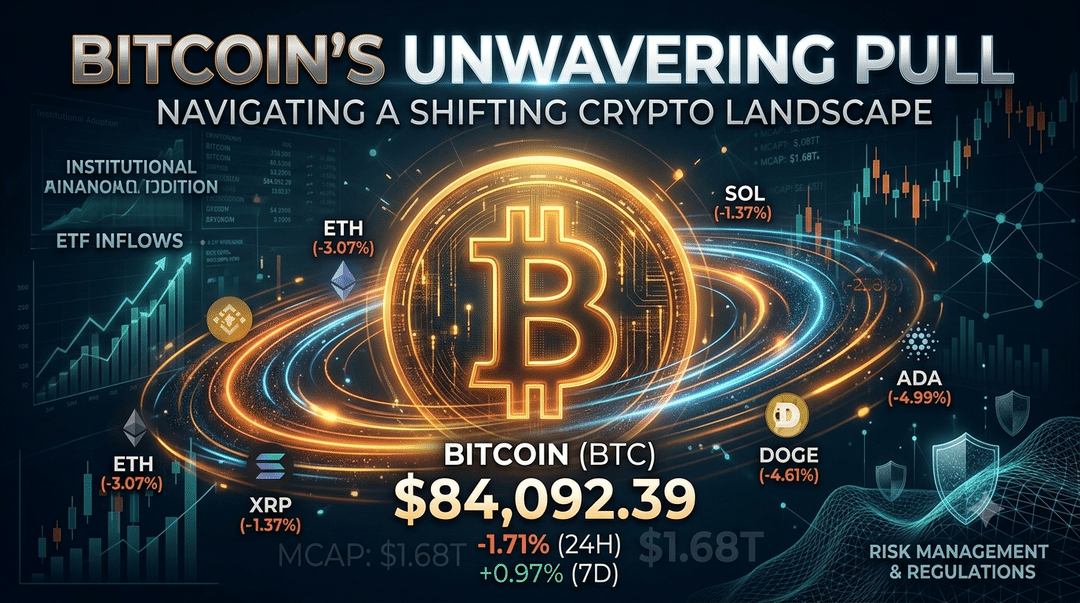
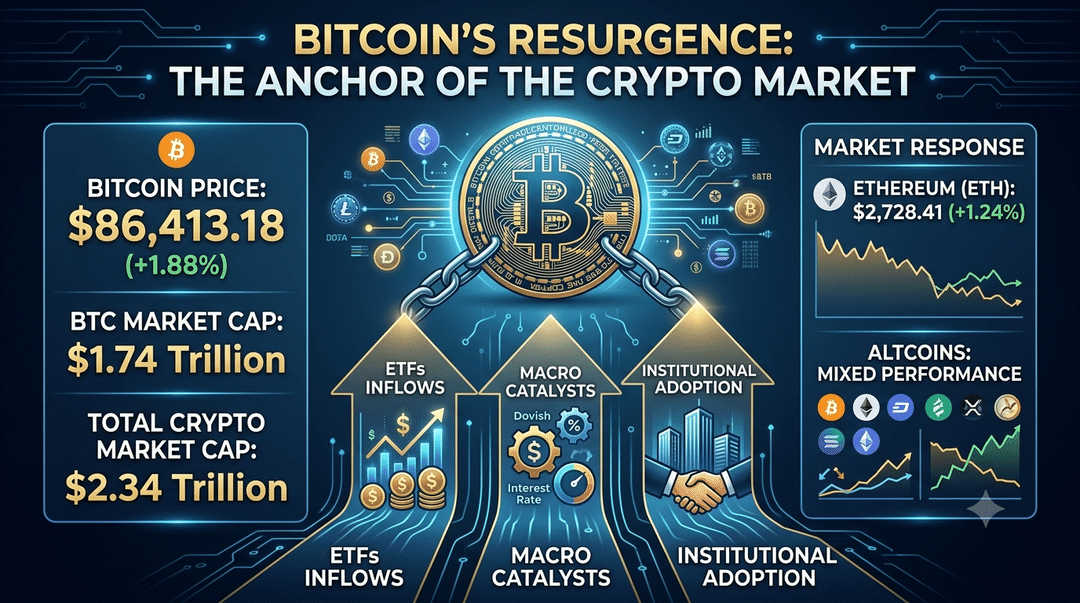
Bitcoin (BTC), despite the broader market's negative lean, has demonstrated relative resilience. Its 24-hour decline of 2.44% is less severe than many altcoins, and its 7-day performance shows a modest gain of 0.27%. This observed stability can be interpreted as a flight to quality within the crypto market, with the consistent institutional inflows into Bitcoin ETFs providing a foundational layer of demand that appears to temper downside volatility. The narrative around Bitcoin as a digital store of value continues to attract capital, particularly when other assets face greater uncertainty.
Ethereum (ETH), however, is feeling the brunt of current sentiment shifts. Experiencing a 3.78% drop over 24 hours and a 2.99% dip over seven days, Ethereum's performance is notably weaker than Bitcoin's. This weakness coincides with significant Ether ETF outflows totaling $408 million across six sessions. While institutional players like Bitmine continue to accumulate ETH, the broader ETF trend suggests a more cautious or rotational stance from a segment of institutional capital. The recent news of Kalshi's 15-minute gold markets surpassing Ether in contract volume and fees further illustrates a competitive landscape for capital allocation, potentially impacting ETH's short-term appeal.
For XRP, a 2.94% decline in 24 hours and a 3.25% drop over seven days reflect a continued sensitivity to regulatory discussions. The news concerning Jay Clayton's new advisory role, given his history with the Ripple lawsuit, likely reinforces existing regulatory concerns for XRP holders, contributing to a cautious sentiment around the asset.
Solana (SOL) has shown comparatively contained movement, with a 1.36% decrease over 24 hours and a 0.86% decrease over seven days. While still negative, its performance is less volatile than many other altcoins. Raoul Pal's suggestion that AI agents could boost Solana adoption presents a forward-looking positive narrative, but current price action suggests that this potential is not yet fully influencing immediate sentiment or mitigating broader market pressures.
Among the more volatile assets, Uniswap (UNI), Cardano (ADA), and Dogecoin (DOGE) have experienced significant 24-hour declines of 8.98%, 8.04%, and 5.12% respectively. These pronounced drops indicate that capital is rapidly exiting these segments, likely due to their higher perceived risk profiles in a generally cautious market. Such sharp pullbacks in these assets underscore the current low-risk appetite for more speculative or less institutionally-backed altcoins. Other assets like Stellar (XLM) and Zcash (ZEC) also registered notable 24-hour declines of 4.93% and 2.81%, respectively, consistent with the overall negative sentiment affecting a broad range of altcoins. BNB, while a major player, saw a more modest 1.52% dip, suggesting some comparative stability within the top ranks.
Conclusion and Risk Management
The current cryptocurrency market is operating under a mixed but predominantly risk-off sentiment, driven by a confluence of macroeconomic pressures and distinct institutional flow dynamics. While Bitcoin continues to attract significant institutional capital through its ETF products, suggesting a degree of underlying conviction, Ethereum is facing headwinds with notable ETF outflows. This divergence highlights a potential re-evaluation of risk within institutional portfolios, with a preference for Bitcoin's established position.
The broader altcoin market, particularly the more volatile assets like UNI, ADA, and DOGE, is experiencing sharper corrections, indicating that general risk appetite remains subdued. Regulatory uncertainties and the competitive landscape for capital, as evidenced by gold markets gaining traction, add layers of complexity to market positioning.
Looking ahead, the market's direction will likely continue to be shaped by these crosscurrents. Sustained institutional inflows into Bitcoin could provide a floor for the market leader, potentially cushioning against severe downturns. However, continued outflows from Ethereum funds and significant sell-offs in altcoins suggest that broader market confidence is fragile. Investors should monitor key macro indicators, ongoing regulatory developments, and institutional flow metrics closely. A sustained shift in macro sentiment towards risk-on could spark a broader recovery, particularly in altcoins. Conversely, continued uncertainty may lead to further consolidation around Bitcoin or a deeper retreat across the board. Prudent risk management involves acknowledging these sentiment shifts and positioning accordingly, rather than relying on isolated asset performance.
Source Data Reference
Market Snapshot Input
| Asset | Symbol | Price (USD) | 24h Change | Market Cap (USD) |
|---|---|---|---|---|
| Ethereum | ETH | 2,609.272077 | -3.78% | 318,626,826,496 |
| Bitcoin | BTC | 83,912.447803 | -2.44% | 1,686,198,066,149 |
| XRP | XRP | 1.460673 | -2.94% | 92,158,189,016 |
| Solana | SOL | 118.237287 | -1.36% | 69,652,949,949 |
| Cardano | ADA | 0.25575 | -8.04% | 9,954,326,445 |
| Stellar | XLM | 0.204868 | -4.93% | 7,178,470,538 |
| Dogecoin | DOGE | 0.090316 | -5.12% | 15,483,378,630 |
| Uniswap | UNI | 8.087951 | -8.98% | 5,055,862,434 |
| Zcash | ZEC | 1,319.139805 | -2.81% | 21,539,269,582 |
| BNB | BNB | 772.371937 | -1.52% | 102,848,212,980 |
Trending Headlines Input
- Bitcoin ETFs rebound with $119M inflow as Ether extends losses
- SEC Clears 3x Leveraged Bitcoin and Ethereum Funds for Trading
- Bitmine Buys $41M More Ethereum, Reaching 99% of Its 'Alchemy of 5%' Target
- Trump Taps Jay Clayton, the SEC Chair Who Sued Ripple, to Lead AI Push
- DOJ invokes Bitcoin Fog ruling in potential blow to Roman Storm acquittal bid
- Ethereum’s Glamsterdam upgrade launches on Sepolia testnet
- 'Uptober' Starts Green as Bitcoin ETFs Draw $134 Million
- Kalshi’s 15-min gold markets overtake Ether just weeks after launch
- Capital starting to rotate back to crypto from AI: Raoul Pal
- EEZ tests atomic L1-to-L2 transaction in push to unify Ethereum