Bitcoin Price Structure
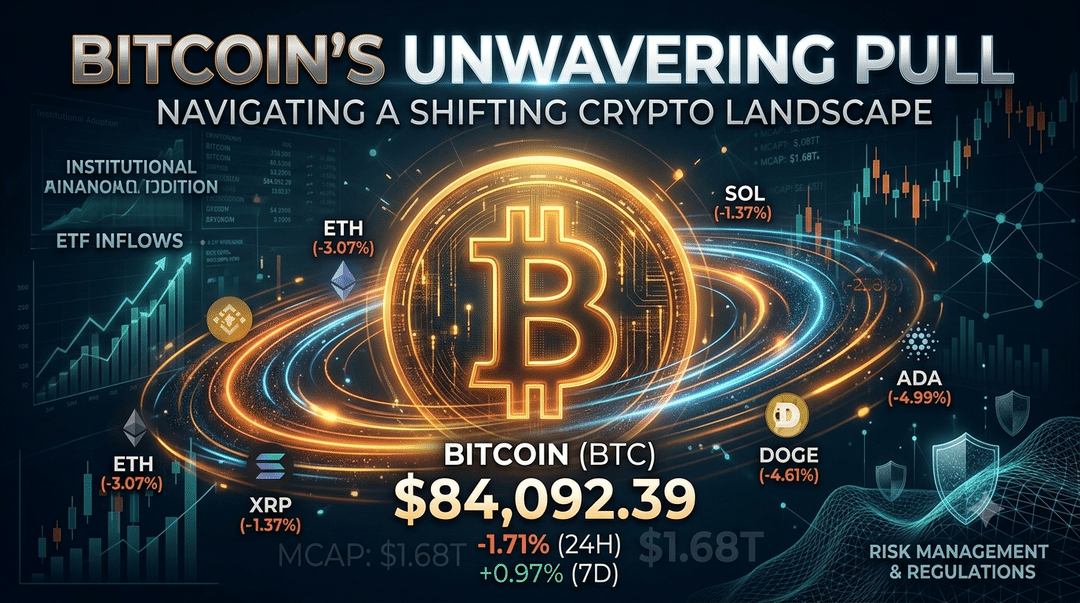
Bitcoin, the undisputed leader by market capitalization, is currently trading at approximately $84,092.39. This valuation places its market capitalization at a substantial $1,689,803,922,170, anchoring a global crypto market cap of $2,333,313,970,369. Over the past 24 hours, Bitcoin has experienced a modest downturn, with its price decreasing by -1.71%. However, a broader perspective reveals a more resilient picture, as the asset has posted a positive 7-day change of +0.97%. This suggests that while there has been some short-term selling pressure, Bitcoin has largely maintained its value over the past week, demonstrating a degree of underlying stability compared to the average market movement. The 24-hour trading volume for BTC stands at $23,328,082,667.93, indicating continued significant liquidity and trading interest. This combination of short-term volatility within a slightly positive weekly trend positions Bitcoin as the focal point, with its movements often signaling potential shifts for the entire digital asset space.
Why Bitcoin Is Driving The Tape
Bitcoin's current market leadership is not merely a function of its size but is deeply intertwined with a series of significant catalysts, ranging from institutional adoption to regulatory developments and macro-economic factors. These external signals are shaping investor sentiment and capital flows directly into BTC, subsequently influencing the broader market.
One notable development is the recent approval by the SEC for 3x leveraged Bitcoin and Ethereum funds to begin trading. This decision, allowing Volatility Shares funds to list on a U.S. exchange, marks a significant step in the institutionalization of crypto derivatives. While these are leveraged products, their approval by a major regulator suggests increasing mainstream acceptance and provides sophisticated investors with new avenues to gain exposure to Bitcoin's price movements. This regulatory clarity, even for complex products, tends to be viewed as a bullish signal for the asset class.
Further bolstering the institutional narrative, Bitcoin spot Exchange-Traded Funds (ETFs) have continued to attract substantial capital. The start of "Uptober" saw Bitcoin ETFs draw in $134.4 million over the first two trading days of October. This rebound in inflows, following a September 30 outflow, was reportedly influenced by a weak jobs report that cooled expectations for further Federal Reserve rate hikes. This connection underscores Bitcoin's growing sensitivity to traditional macro-economic indicators and its increasing integration into conventional financial markets. Sustained ETF inflows represent a consistent demand channel for Bitcoin from institutional participants.
However, the regulatory landscape remains nuanced and presents mixed signals. The news of Bitcoin.de's trading remaining halted due to the German regulator's rejection of its MiCA (Markets in Crypto-Assets) application highlights ongoing regulatory hurdles in specific jurisdictions. This incident serves as a reminder that while some regulatory bodies are opening doors for crypto products, others are maintaining stringent oversight, potentially creating localized friction points for market access and operations. This particular event points to the complex and fragmented nature of global crypto regulation.
Finally, Bitcoin's price action has been observed grinding toward the $87,000 mark even as US equities reached new record highs. This indicates a degree of correlation with traditional markets, where Bitcoin may be seen by some as a risk-on asset. While Bitcoin's upward momentum was reportedly kept in check by overhead ask liquidity, its general movement in concert with broader market strength, particularly in equities, reinforces its position within the global financial landscape. These combined factors — institutional product approvals, ETF inflows driven by macro shifts, and ongoing regulatory navigation — collectively contribute to Bitcoin's prominent role in driving the overall crypto market narrative.
How The Rest Of The Market Is Responding
The broader cryptocurrency market is largely reflecting Bitcoin's lead, exhibiting a "mildly negative short-term bias" as observed in recent market data. While Bitcoin itself has seen a 24-hour dip of -1.71%, many altcoins, particularly the larger cap assets, are experiencing more pronounced pullbacks or struggling to maintain positive momentum.
Ethereum (ETH), the second-largest cryptocurrency, has registered a 24-hour decline of -3.07% and a 7-day decrease of -2.00%. This indicates that ETH is currently lagging Bitcoin's performance over both short and medium timeframes, experiencing a deeper correction. Similarly, XRP is down -2.36% over 24 hours and -1.90% over 7 days, aligning with the trend of altcoins underperforming BTC in the current environment. BNB, another significant player, has seen a -1.91% dip in 24 hours, closely mirroring Bitcoin's short-term movement, but holds a slight 7-day gain of +0.66%.
Solana (SOL) presents a slightly different picture, with a 24-hour change of -1.37%, performing marginally better than Bitcoin over this period. However, its 7-day performance shows a decline of -0.62%, suggesting that while it might be showing relative strength in very short windows, it has also faced headwinds over the past week.
Looking at the broader market, particularly the most volatile assets, the impact of Bitcoin's movements becomes even clearer. Near Protocol (NEAR), Cardano (ADA), and Dogecoin (DOGE) are among the top volatile assets, exhibiting significantly stronger 24-hour negative moves. NEAR is down -5.07%, ADA has dropped -4.99%, and DOGE is lower by -4.61%. These figures are considerably steeper than Bitcoin's -1.71% decline, reinforcing the observation that while Bitcoin experiences a relatively contained short-term correction, altcoins are more susceptible to larger percentage losses. This divergence suggests a flight to quality or a reduction in speculative appetite for higher-risk assets when the market leader shows signs of weakness. The derived insights confirm this, stating that "the strongest 24h moves are concentrated in NEAR, ADA, DOGE," indicating that capital is flowing out of these more volatile assets at a faster rate than from Bitcoin. This overall market response underscores Bitcoin's continued role as the primary indicator of market health and direction, with altcoins generally amplifying its trends.
Conclusion and Risk Management
The current cryptocurrency market environment is unequivocally Bitcoin-centric. Bitcoin's price structure, characterized by short-term volatility within a resilient weekly trend, continues to set the pace for the entire digital asset space. Key catalysts, including the approval of leveraged Bitcoin ETFs, sustained institutional inflows into spot Bitcoin ETFs, and its evolving relationship with macro-economic indicators, underscore its foundational role. While regulatory developments present a mixed bag, with some advancements and some localized setbacks, the overarching narrative points towards increasing institutional integration and a growing recognition of Bitcoin's position in the broader financial ecosystem.
The response from the rest of the market largely confirms Bitcoin's leadership. Most major altcoins are either lagging Bitcoin's short-term performance or experiencing more significant pullbacks, particularly the more volatile assets. This "mildly negative short-term bias" observed across the market suggests that capital tends to flow out of riskier altcoins more rapidly when Bitcoin shows signs of correction or consolidation.
For market participants, this Bitcoin-led dynamic necessitates a focus on BTC's price structure and its associated catalysts. Should Bitcoin demonstrate continued strength and attract further institutional capital, it could provide a stable foundation for the broader market to eventually recover or gain momentum. Conversely, any significant weakness in Bitcoin, especially if driven by adverse regulatory news or macro shifts, would likely lead to more pronounced corrections across the altcoin spectrum.
In terms of risk management, the inherent volatility of the crypto market, particularly among altcoins, remains a critical consideration. Given Bitcoin's current influence, monitoring its price action, institutional flows, and key regulatory developments should be prioritized. Investors should approach the market with a balanced perspective, acknowledging both the potential for growth driven by increasing adoption and the risks associated with regulatory uncertainty and market-wide sensitivity to Bitcoin's performance. Diversification and a clear understanding of individual asset risk profiles, especially in relation to Bitcoin's movements, are prudent strategies in this evolving landscape.
Source Data Reference
Market Snapshot Input
| Asset | Symbol | Price (USD) | 24h Change | Market Cap (USD) |
|---|---|---|---|---|
| Bitcoin | BTC | 84,092.388655 | -1.71% | 1,689,803,922,170 |
| Ethereum | ETH | 2,618.762594 | -3.07% | 319,785,744,828 |
| XRP | XRP | 1.464847 | -2.36% | 92,421,553,899 |
| Solana | SOL | 118.51575 | -1.37% | 69,817,018,031 |
| Cardano | ADA | 0.253893 | -4.99% | 9,882,058,690 |
| Dogecoin | DOGE | 0.090364 | -4.61% | 15,491,590,841 |
| Stellar | XLM | 0.206626 | -3.78% | 7,240,074,488 |
| Near Protocol | NEAR | 4.981966 | -5.07% | 6,517,860,540 |
| Hyperliquid | HYPE | 91.019714 | -2.84% | 20,246,945,211 |
| BNB | BNB | 766.80701 | -1.91% | 102,107,201,671 |
Trending Headlines Input
- SEC Clears 3x Leveraged Bitcoin and Ethereum Funds for Trading
- Trump Taps Jay Clayton, the SEC Chair Who Sued Ripple, to Lead AI Push
- Solana Debuts Institutional Settlement Standard With J.P. Morgan Input
- Bitcoin.de trading remains halted as German regulator rejects MiCA application
- DeFi Development Corp Adds $3 Million in Solana as SOL Buys Slow
- 'Uptober' Starts Green as Bitcoin ETFs Draw $134 Million
- Bitmine Buys $41M More Ethereum, Reaching 99% of Its 'Alchemy of 5%' Target
- Ripple expands Brevan Howard deal with prime brokerage services
- Ethereum’s Glamsterdam upgrade launches on Sepolia testnet
- Bitcoin grinds toward $87K as US equities hit new record highs