Risk Tone Across The Market
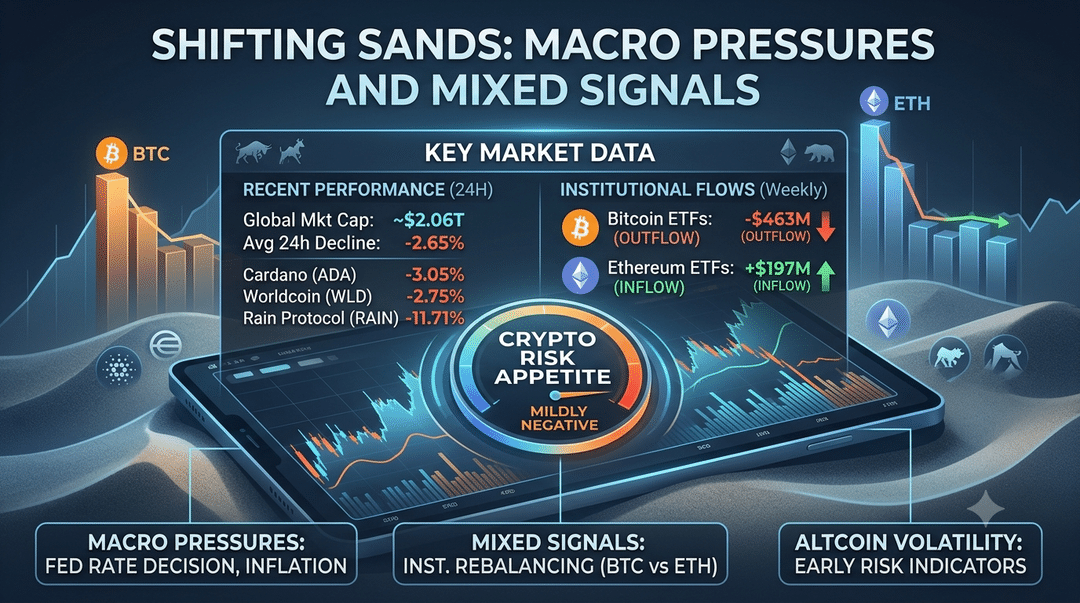
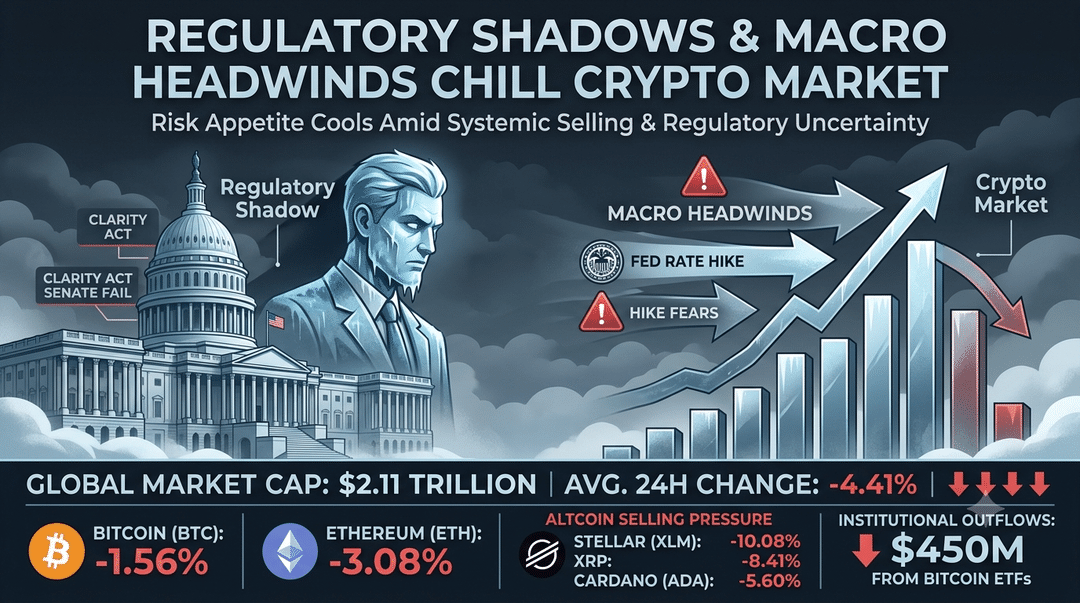
The broader cryptocurrency market is currently exhibiting a decidedly cautious, if not outright risk-off, sentiment. With a global market capitalization standing at approximately $2.11 trillion and an average 24-hour price change across the top assets of -4.41%, the prevailing mood signals retreat rather than expansion. Our analysis of the selected editorial asset basket confirms a mildly negative short-term bias across the board. This observed downturn is not isolated to a few outliers but rather reflects a systemic shift in investor appetite for risk assets.
Specific asset performance underscores this sentiment. While Bitcoin (BTC) and Ethereum (ETH) registered declines of -1.56% and -3.08% respectively over the past 24 hours, the selling pressure was more pronounced in several altcoins. Stellar (XLM) led the declines among major assets, dropping over 10% in 24 hours, followed closely by XRP, which saw an 8.41% decrease. Cardano (ADA) also experienced significant volatility, falling 5.60%. These stronger moves, concentrated in XLM, XRP, and ADA, indicate that speculative capital is being withdrawn from higher-beta assets, a classic sign of diminishing risk appetite. The general trend suggests that market participants are de-risking positions amidst a landscape of heightened uncertainty.
Macro and Flow Signals
The current market sentiment is heavily influenced by a confluence of macroeconomic pressures, institutional flow dynamics, and critical regulatory developments. These external catalysts are shaping positioning and tempering enthusiasm.
A significant factor contributing to the prevailing cautious tone is the failure of the CLARITY Act to advance in the Senate. This legislative setback has weighed heavily on crypto-linked equities, with reports indicating declines of approximately 10% for companies like Circle and Coinbase. The direct impact of this regulatory hurdle on traditional crypto stocks signals a broader institutional concern about the lack of clear regulatory frameworks, which in turn dampens overall market confidence. The news suggests that the path to regulatory certainty remains fraught, leading to hesitation among investors who prefer a more defined operating environment.
Adding to the pressure are notable institutional outflows from Bitcoin Exchange-Traded Funds (ETFs). The market witnessed a significant withdrawal of $450 million from Bitcoin ETFs, marking the largest outflow since June. Funds from major players like Fidelity and BlackRock were among those leading the outflows. This observed institutional capital flight coincided with Bitcoin's 2.5% drop and directly reflects a reduction in institutional risk exposure to the crypto asset class. It suggests that institutional investors are either taking profits or reducing positions in response to the broader market and regulatory signals.
Furthermore, the macroeconomic outlook continues to cast a shadow. Wall Street banks are increasingly anticipating a Federal Reserve rate hike, which would be the first in three years. While markets have largely priced in this expectation, the implications for risk assets, including cryptocurrencies, remain a key concern. Historically, tighter monetary policy tends to reduce liquidity and make riskier assets less attractive compared to safer alternatives, contributing to the current conservative positioning.
A separate development, though less directly impactful on overall market sentiment, involved an exploit on the Ethereum network where an MEV bot successfully intercepted $7.7 million in rsETH from an attacker. While this event highlights ongoing security challenges within the DeFi ecosystem, the swift action by the MEV bot and Kelp to freeze the address mitigated broader market panic, keeping its impact largely localized to the specific protocol rather than driving widespread ETH sentiment.
What Sentiment Is Doing To Major Coins
The pervasive risk-off sentiment and macro pressures are evident in the price action of major cryptocurrencies, shaping their short-term trajectory.
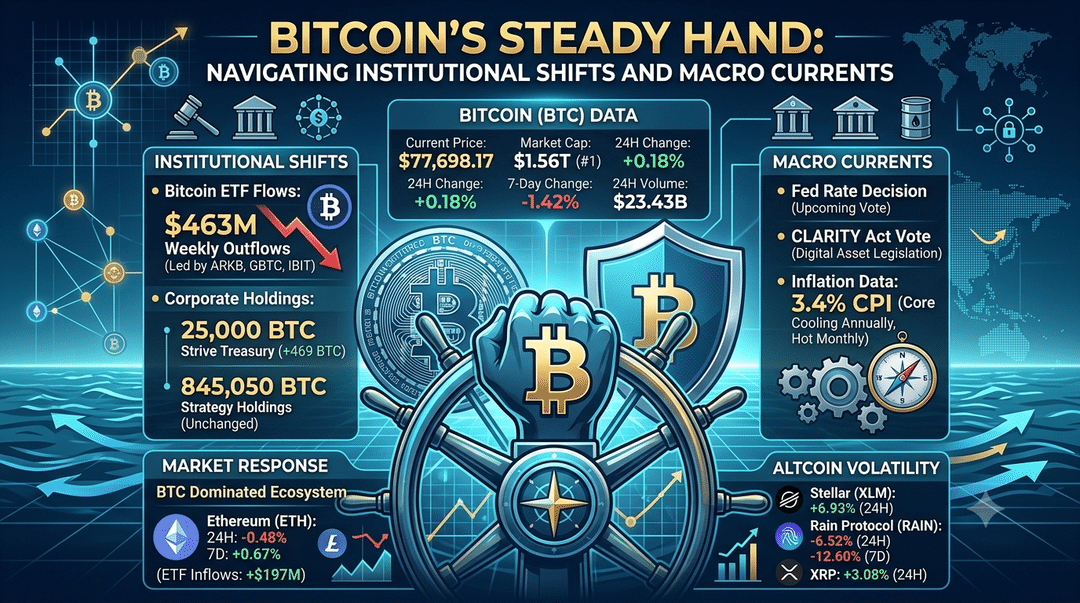
Bitcoin (BTC), as the market leader, has felt the brunt of institutional re-positioning and regulatory disappointment. Despite a prior brief flirtation with the $79,000 mark following geopolitical hints, BTC subsequently dipped, reflecting the $450 million in ETF outflows and the failure of the CLARITY Act. Its 24-hour decline of -1.56% and a 7-day drop of -4.05% illustrate a market that is taking profits and reducing exposure, rather than accumulating. The price action suggests that even Bitcoin's resilience is being tested by significant external catalysts.
Ethereum (ETH) has also experienced downward pressure, recording a -3.08% decline over 24 hours and a -3.66% drop over seven days. While an MEV bot's interception of an exploit on the network demonstrated some ecosystem resilience, the broader market sentiment stemming from macro and regulatory concerns appears to be the dominant force. The BIS paper on on-chain transfer estimates, which also mentioned Ethereum, is more of a research note than an immediate market mover, but it adds to the narrative of evolving scrutiny over crypto metrics.
Among the altcoins, the impact of cautious sentiment is more pronounced, particularly in the most volatile assets. XRP recorded an 8.41% drop in 24 hours and a 9.60% decline over seven days. This significant drawdown suggests that investors are rotating out of assets perceived as higher risk or those that have historically been sensitive to regulatory ambiguity. The lack of specific positive news for XRP amidst a broader negative climate likely exacerbated its decline.
Stellar (XLM) mirrored XRP's volatility, experiencing the sharpest 24-hour decline among the top assets at -10.08%, with a 7-day drop of -7.06%. Such substantial movements indicate that XLM is highly susceptible to shifts in general market risk appetite, with capital flowing out rapidly when sentiment sours.
Cardano (ADA) also saw a considerable 24-hour decrease of -5.60% and an 11.38% drop over seven days. This performance aligns with the broader altcoin market's sensitivity to a risk-off environment, where investors are less willing to hold assets with higher inherent volatility.
Other notable assets like Solana (SOL), Chainlink (LINK), and Dogecoin (DOGE) also registered declines ranging from -3.76% to -5.20% over 24 hours, and more substantial drops over the 7-day period (e.g., LINK -11.81%, DOGE -11.95%). These movements collectively underscore a market-wide trend where even established altcoins are struggling to maintain value against the backdrop of reduced risk appetite and prevailing external pressures. TRON (TRX) showed a comparatively smaller 24h decline of -1.11%, potentially indicating a degree of relative stability, though it is still within the overall negative trend. The recent integration of TRX into Tonkeeper's expanded multi-chain wallet offers a minor positive development but appears insufficient to counteract the dominant market sentiment.
Conclusion and Risk Management
The cryptocurrency market is navigating a challenging period, with its short-term direction largely dictated by broader risk sentiment and cross-market catalysts rather than isolated asset-specific developments. The observed mildly negative short-term bias across the market, coupled with significant outflows from Bitcoin ETFs and the failure of key crypto legislation, points to a clear reduction in risk appetite. Macroeconomic signals, particularly the anticipation of a Fed rate hike, continue to loom large, reinforcing a cautious stance among investors.
The concentration of volatility in assets like XLM, XRP, and ADA highlights their sensitivity to these overarching sentiment shifts, making them bellwethers for the market's willingness to embrace risk. While Bitcoin and Ethereum have shown relative resilience compared to some altcoins, they are not immune to the gravitational pull of institutional deleveraging and regulatory uncertainty.
For market participants, separating sentiment signals from confirmed trend continuation is crucial. The current environment suggests that external factors—macroeconomic policy, regulatory progress (or lack thereof), and institutional investment flows—will continue to be primary drivers. As such, monitoring these signals for potential reversals or further deterioration is paramount. Risk management in this climate necessitates a heightened awareness of these macro and policy headwinds. Diversification, careful position sizing, and a clear understanding of personal risk tolerance are essential, as the market remains highly susceptible to headline-driven volatility and shifts in the broader financial landscape. The current market mood warrants prudence, with a focus on capital preservation until clearer signals emerge regarding a sustained return of risk appetite.
Source Data Reference
Market Snapshot Input
| Asset | Symbol | Price (USD) | 24h Change | Market Cap (USD) |
|---|---|---|---|---|
| Bitcoin | BTC | 75,770.80512 | -1.56% | 1,521,870,335,357 |
| Ethereum | ETH | 2,400.780047 | -3.08% | 293,022,606,289 |
| XRP | XRP | 1.284965 | -8.41% | 80,797,612,445 |
| TRON | TRX | 0.334772 | -1.11% | 31,787,356,878 |
| Stellar | XLM | 0.174452 | -10.08% | 6,078,318,246 |
| Cardano | ADA | 0.193682 | -5.60% | 7,529,014,589 |
| Chainlink | LINK | 10.794777 | -5.20% | 8,075,572,630 |
| Dogecoin | DOGE | 0.07959 | -3.79% | 13,644,640,208 |
| Solana | SOL | 97.073877 | -3.76% | 56,988,647,794 |
| BNB | BNB | 707.355331 | -1.52% | 94,191,900,547 |
Trending Headlines Input
- Bitcoin ETFs shed $450M in biggest outflow since June
- Wall Street Bets on Fed Rate Hike: Here's What It Means for Bitcoin, Bonds and Trump
- Crypto stocks slide after CLARITY Act fails to advance in Senate
- Crypto Reacts: Bitcoin Slides as Clarity Act Fails to Clear Senate Vote
- 'It's Now or Never' for Clarity Act, Says 'Bitcoin Senator' Lummis
- ETH wallet exploit backfires as MEV bot captures $7.7M, Kelp freezes address
- BIS paper finds major gap in Bitcoin onchain transfer estimates
- Bitcoin tops $79K, oil falls as Trump says Iran war could end
- Tonkeeper Becomes Keeper as Wallet Adds Bitcoin, Ethereum, and Tron
- Balancer eyes wind-down after restructuring fails to revive revenue