Risk Tone Across The Market
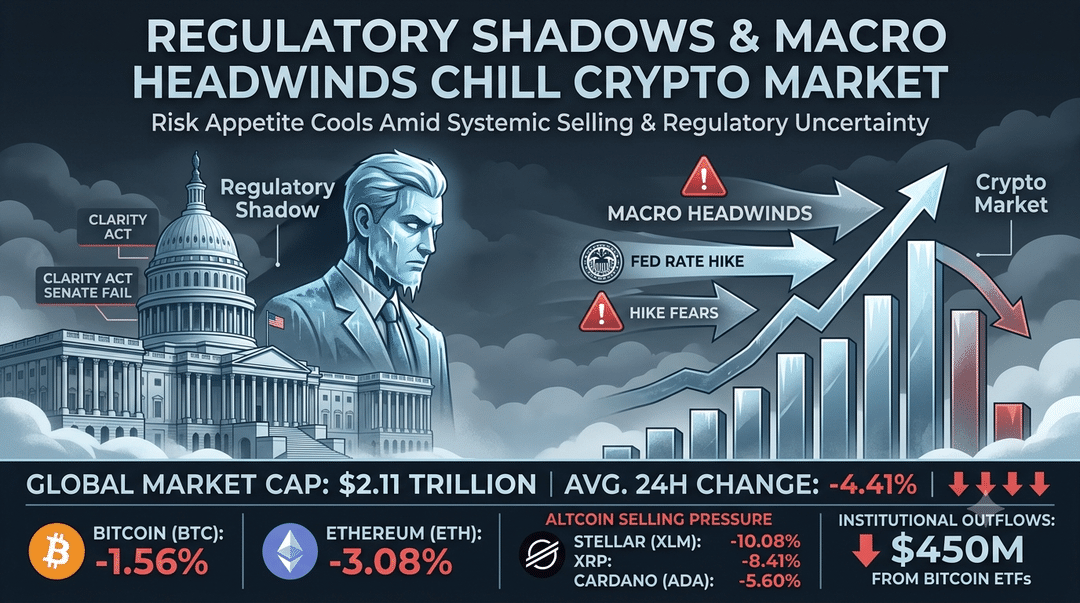
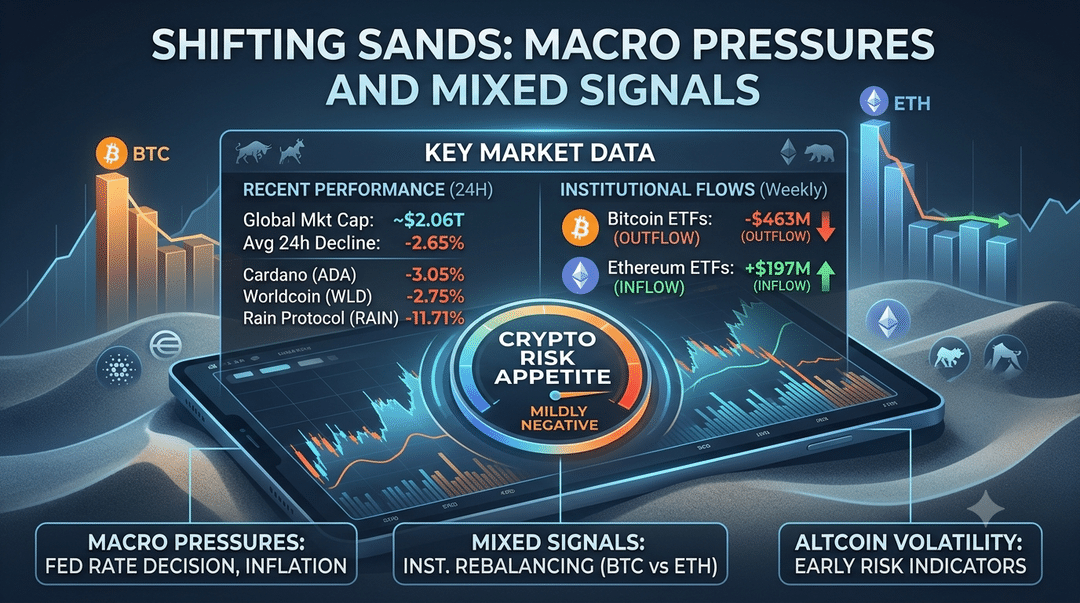
The overall tone across the crypto market exhibits a mildly negative short-term bias, as indicated by recent observations. The global market capitalization stands at approximately $2.06 trillion, with an average 24-hour move across the top assets showing a decline of around 2.65%. This generalized pullback suggests a prevailing cautiousness among participants, with capital flows reflecting a tempered appetite for risk.
This cautious sentiment is particularly visible in the performance of several altcoins. Rain Protocol (RAIN) has experienced a significant 24-hour downturn of 11.71% and a 7-day drop of 21.25%, making it one of the most volatile assets. Cardano (ADA) also saw a 3.05% decline over 24 hours and 7.33% over seven days, while Worldcoin (WLD) registered a 2.75% decrease in 24 hours and a substantial 22.25% over the week. These sharper declines in altcoins often serve as an early indicator of broader risk-off sentiment, as investors tend to de-risk from more speculative assets first. While major assets like Bitcoin (BTC) and Ethereum (ETH) have also seen declines, their movements are comparatively more moderate, suggesting a shift towards consolidation rather than outright panic. The market appears to be in a phase where participants are recalibrating positions in response to external factors, leading to a defensive posture across many digital assets.
Macro and Flow Signals
The current market sentiment is heavily influenced by a confluence of macro, institutional, and policy-related headlines, which together paint a picture of uncertainty and strategic repositioning.
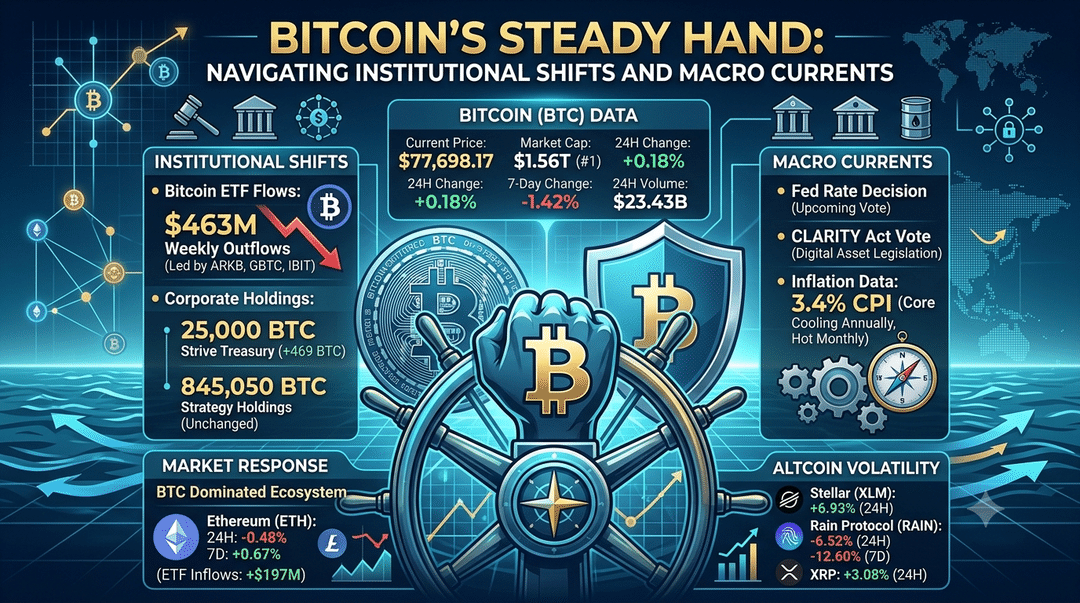
On the institutional front, Bitcoin exchange-traded funds (ETFs) have experienced a notable reversal, shedding $463 million in the past week. This outflow, led by funds like ARKB, GBTC, and IBIT, marks a significant shift from previous bullish trends. Conversely, Ether ETFs recorded weekly inflows of $197 million, primarily driven by BlackRock’s ETHA. This divergence suggests a rebalancing of institutional capital, with some rotation out of Bitcoin and into Ethereum, potentially reflecting shifting narratives or tactical plays ahead of anticipated ETH ETF developments. Further institutional activity includes Strive adding 469 Bitcoin to reach a 25,000 BTC treasury, funded through preferred stock, indicating continued long-term accumulation by some corporate holders. However, another Bitcoin treasury firm, Strategy, bought back $139 million of its preferred stock while leaving its substantial 845,050 BTC stack untouched for a second week. These actions suggest a mixed institutional landscape, where some entities are accumulating, while others are managing their balance sheets through different mechanisms, potentially signaling a pause in aggressive BTC accumulation for some.
Macroeconomic factors continue to exert a strong influence. The anticipation of a Federal Reserve rate decision and the market's digestion of recent inflation data are key drivers of volatility. While inflation held at 3.4% and core inflation cooled annually, a "hot" monthly core reading has kept Fed hike odds elevated, currently near 62%. Such signals from traditional finance often prompt a cautious stance in risk assets like crypto. Geopolitical developments also play a role, with Bitcoin's price movements observed in correlation with news such as hints from former US President Donald Trump about a potential end to the US-Iran conflict, which reportedly led to lower oil prices and a temporary rise in BTC. This underscores Bitcoin's growing sensitivity to global events that impact broader financial markets.
Regulatory and security concerns are also shaping the narrative. The impending CLARITY Act vote in the Senate, alongside the Fed rate hike decision, is contributing to trader apprehension, particularly concerning potential legislative impacts on the crypto ecosystem. Security incidents, such as Blockstream's refusal to pay a ransom for $47 million in Bitcoin from the Liquid hack and Symbiosis recovering 15 BTC from a bridge hack while offering a bounty, highlight ongoing risks within the decentralized space. These events, while sometimes specific to individual protocols, can collectively dampen overall market confidence, particularly when they involve significant amounts of capital.
Finally, specific protocol developments, such as Bitmine adding $68 million in Ethereum to near 6 million ETH in holdings, demonstrate continued confidence in the Ethereum ecosystem from some large players, with a focus on staking rewards. This contrasts with news of Balancer potentially winding down after restructuring failed to revive revenue, illustrating the varied health and resilience of different projects within the broader crypto landscape.
In summary, the market is grappling with conflicting signals: institutional rebalancing between BTC and ETH, persistent macroeconomic uncertainty surrounding interest rates and inflation, regulatory oversight, and isolated security challenges. This complex interplay of factors is leading to a more discerning and cautious positioning across the market.
What Sentiment Is Doing To Major Coins
The prevailing sentiment, characterized by a mild short-term negative bias and macro-driven caution, is manifesting in varied price actions across major cryptocurrencies.
Bitcoin (BTC), despite its status as the market leader, has not been immune to the broader sentiment. It is currently trading at approximately $76,864, reflecting a 24-hour decline of 1.44% and a 7-day drop of 2.34%. While these movements are relatively modest compared to some altcoins, they occur against a backdrop of significant institutional rebalancing. The observed weekly outflows from Bitcoin ETFs, totaling $463 million, indicate a reduction in aggressive institutional accumulation, which historically has been a strong bullish catalyst. Corporate treasury additions, such as Strive's continued BTC purchases, offer a counterpoint, suggesting long-term conviction from some entities. However, the overall sentiment for BTC appears to be one of consolidation and reaction to macro headlines rather than strong, independent directional momentum.
Ethereum (ETH), trading at around $2,472, has seen a 24-hour decrease of 1.84% and a 7-day decline of 0.64%. Interestingly, ETH ETFs have attracted $197 million in inflows over the past week, primarily driven by BlackRock’s ETHA. This contrasts sharply with Bitcoin ETF outflows and suggests a potential rotation of institutional capital or a forward-looking positioning ahead of anticipated regulatory clarity for spot ETH ETFs. The news of Bitmine adding $68 million in Ethereum, moving closer to its goal of owning 5% of Ethereum's supply with a focus on staking rewards, further underscores a strategic, long-term institutional interest in the asset, potentially cushioning its downside compared to BTC in this particular period.
Rain Protocol (RAIN) stands out as a prime example of altcoin sensitivity to the current risk-off environment. With no specific project-centric news identified, its substantial 24-hour decline of 11.71% and a 7-day drop of 21.25% can be largely attributed to the broader market's cautious sentiment. As a smaller-cap asset, RAIN is more susceptible to capital flight when overall risk appetite diminishes, illustrating how a general market mood can significantly impact assets without direct headline triggers.
Dogecoin (DOGE), another priority asset, has also experienced a notable downturn, falling 2.15% in 24 hours and 8.76% over the past seven days. As a meme coin, DOGE's price action is often highly correlated with speculative sentiment. Its current decline reflects a general retreat from higher-risk, sentiment-driven assets within the crypto space, consistent with a market that is leaning towards caution.
Beyond the priority assets, other major cryptocurrencies like Cardano (ADA) and Worldcoin (WLD) have also shown significant weakness, with ADA down 3.05% in 24 hours and WLD down 2.75%. These movements further reinforce the observation that the current sentiment is broadly impacting altcoins, pushing them lower as investors seek to reduce exposure to more volatile positions. Even assets like BNB, Solana (SOL), Chainlink (LINK), and Hyperliquid (HYPE) have recorded daily declines, ranging from 0.95% to 1.21%, indicating a pervasive downward pressure across the top-ranked cryptocurrencies.
Conclusion and Risk Management
The cryptocurrency market is currently defined by a delicate balance of forces, where a mildly negative short-term bias is being shaped by significant macroeconomic pressures and mixed institutional flows. The aggregate market tone suggests a period of heightened caution, with participants actively recalibrating their risk exposure. While Bitcoin faces headwinds from ETF outflows, Ethereum shows signs of resilient institutional interest, indicating a nuanced divergence in sentiment between the two largest assets. Altcoins, particularly those with higher volatility like RAIN, ADA, and WLD, are bearing the brunt of the risk-off environment, experiencing more pronounced declines.
Observing these dynamics, it is clear that short-term crypto direction is being shaped less by the isolated performance of a single coin and more by broader risk sentiment and cross-market catalysts. The influence of upcoming Fed decisions, inflation data, and the evolving institutional landscape for crypto products will continue to be paramount.
For market participants, separating observed facts—such as specific price movements and confirmed fund flows—from interpretation of sentiment is crucial. The current environment calls for a focus on risk management, recognizing that headline-driven volatility and shifts in macro outlook can rapidly alter market conditions. While some institutional players continue long-term accumulation, the immediate horizon suggests a need for vigilance. Potential scenarios include a continuation of the cautious trend if macro pressures intensify, or a swift reversal if positive catalysts, such as clearer regulatory frameworks or a more dovish Fed stance, emerge. Investors should remain attuned to these external signals, as they are currently the dominant drivers of positioning and overall market sentiment.
Source Data Reference
Market Snapshot Input
| Asset | Symbol | Price (USD) | 24h Change | Market Cap (USD) |
|---|---|---|---|---|
| Bitcoin | BTC | 76,864.37873 | -1.44% | 1,543,797,295,699 |
| Ethereum | ETH | 2,472.720398 | -1.84% | 301,795,922,691 |
| Rain Protocol | RAIN | 0.013389 | -11.71% | 9,495,935,481 |
| Dogecoin | DOGE | 0.082581 | -2.15% | 14,157,283,692 |
| Cardano | ADA | 0.20451 | -3.05% | 7,949,941,675 |
| BNB | BNB | 716.842967 | -0.95% | 95,455,373,675 |
| Worldcoin | WLD | 0.374545 | -2.75% | 1,346,208,961 |
| Solana | SOL | 100.526725 | -1.21% | 59,012,017,516 |
| Chainlink | LINK | 11.370584 | -0.25% | 8,506,333,691 |
| Hyperliquid | HYPE | 78.792875 | -1.19% | 17,527,137,262 |
Trending Headlines Input
- Bitcoin ETFs shed $463M in weekly reversal as Ether ETFs gain $197M
- Strive adds 469 Bitcoin to reach 25,000 BTC treasury
- Strategy Buys Back $139 Million of STRC, Bitcoin Stack Frozen for Second Week
- CLARITY Act vote meets Fed rate hike: Five things to know in Bitcoin this week
- Blockstream Refuses Ransom for Return of $47M in Bitcoin from Liquid Hack: 'It Is Theft'
- Symbiosis says recovered 15 BTC from bridge hack, offers 20% bounty
- Bitcoin tops $79K, oil falls as Trump says Iran war could end
- Bitcoin Rises as Markets Digest Inflation Data Ahead of Fed Rate Decision
- Balancer eyes wind-down after restructuring fails to revive revenue
- Bitmine Adds $68 Million in Ethereum as Holdings Near 6 Million ETH