Bitcoin Price Structure
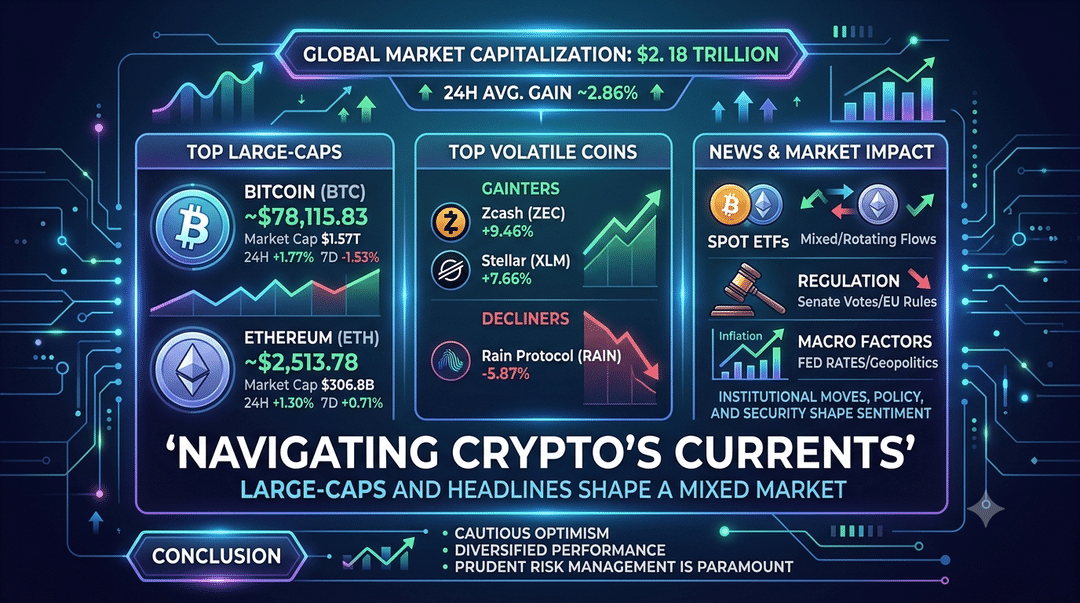
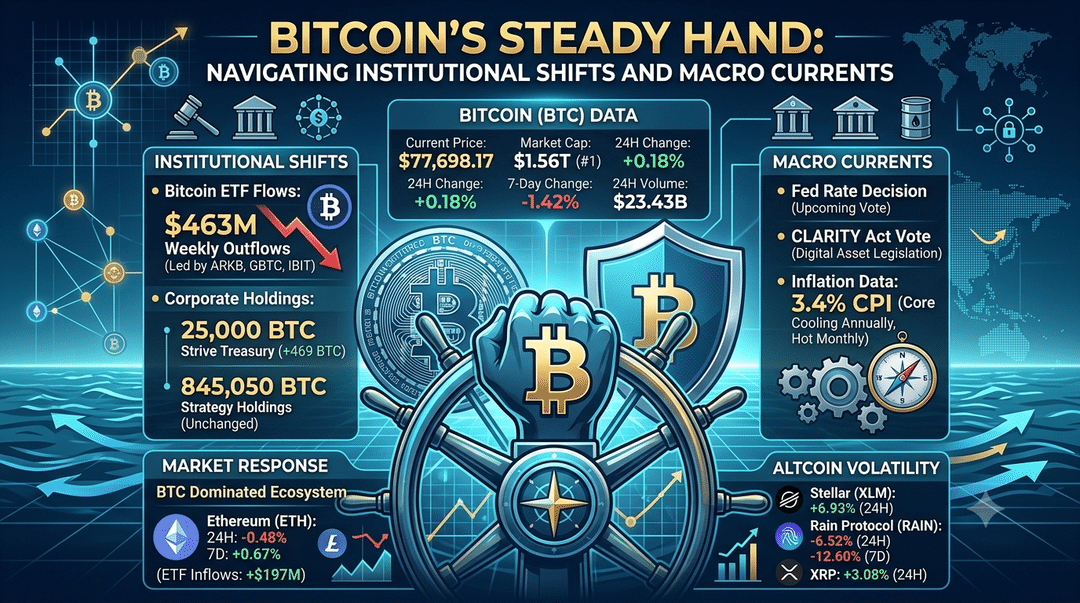
Bitcoin (BTC), the market's leading cryptocurrency, currently commands a price of $77,698.17, maintaining its rank as the number one asset by market capitalization, standing at approximately $1.56 trillion. Over the past 24 hours, BTC has registered a modest increase of 0.18%, indicating a period of relative stability in the immediate term. However, looking at the weekly performance, Bitcoin has experienced a slight retracement, showing a decline of 1.42%. Its 24-hour trading volume remains substantial at $23.43 billion, underscoring its liquidity and continued investor interest. This short-term positioning, characterized by minor daily fluctuations within a slightly negative weekly trend, suggests a market grappling with various influences, with Bitcoin serving as the primary anchor for the broader crypto ecosystem. The global market capitalization for all cryptocurrencies currently stands at $2.13 trillion, with Bitcoin contributing the dominant share.
Why Bitcoin Is Driving The Tape
Bitcoin's price movements and market sentiment are demonstrably influenced by a confluence of institutional, regulatory, and macroeconomic factors. Recent developments highlight a mixed picture, yet reinforce Bitcoin's role as the central driver of market direction.
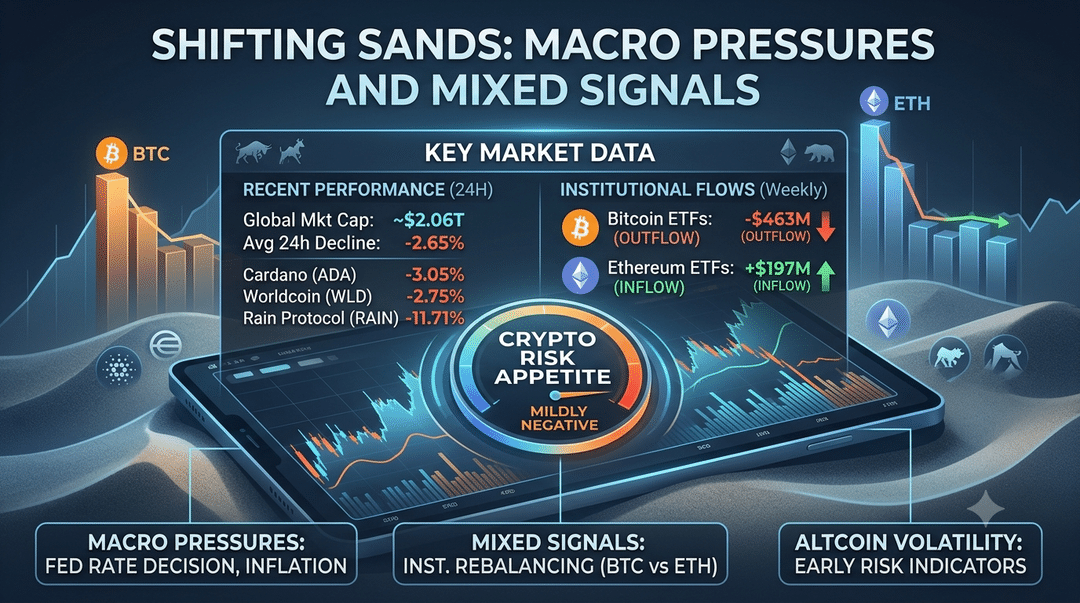
A significant point of focus has been the performance of Bitcoin Exchange-Traded Funds (ETFs). Observed data indicates that Bitcoin ETFs collectively shed $463 million in a weekly reversal. This outflow was notably led by products such as ARKB, GBTC, and IBIT. This trend, while specific to the ETF vehicle, suggests a reallocation or profit-taking among institutional holders, impacting direct demand for BTC. In contrast, Ether ETFs, particularly BlackRock's ETHA, recorded weekly inflows of $197 million, presenting a divergence in institutional sentiment between the two largest cryptocurrencies.
Despite the ETF outflows, institutional interest in Bitcoin appears multifaceted. Strive, a corporate holder, notably added 469 Bitcoin to its treasury, bringing its total holdings to 25,000 BTC. This acquisition was entirely funded through its SATA preferred stock, signaling a continued strategic accumulation by some entities. Conversely, another Bitcoin treasury firm, Strategy, bought back $139 million of its STRC preferred stock but left its substantial 845,050 BTC stack untouched for the second consecutive week, as per an SEC filing. These actions collectively illustrate a nuanced institutional landscape: while some funds are experiencing outflows, corporate entities continue to either accumulate or firmly hold their Bitcoin reserves, indicating long-term conviction from certain players.
Regulatory and macroeconomic developments also cast a significant shadow over Bitcoin's immediate outlook. The impending CLARITY Act vote in the Senate and the Federal Reserve's upcoming rate decision are key events that traders are monitoring for potential volatility. Legislative clarity regarding digital assets could provide a more stable operating environment, while the Fed's stance on interest rates directly impacts the broader financial market's appetite for risk assets like Bitcoin. Recent inflation data, which showed inflation holding at 3.4% with core cooling annually, yet a "hot" monthly core reading, kept Fed hike odds near 62%. Bitcoin's price movements have been observed to react to these economic indicators, with general crypto markets broadly rallying on certain inflation data releases. Furthermore, geopolitical factors, such as hints from former US President Donald Trump about a potential end to the US-Iran conflict, have also been cited as influencing Bitcoin's price, pushing it towards $80,000 in one instance as oil prices cooled.
Security concerns, though less directly market-moving at a macro scale, also contribute to the narrative. Blockstream's refusal of a ransom for $47 million in Bitcoin from the Liquid hack, asserting it as "theft," and Symbiosis's recovery of 15 BTC from a bridge hack while offering a 20% bounty, underscore ongoing efforts to secure the ecosystem and address illicit activities. These incidents, while not driving broad price action, highlight the evolving risk landscape and the industry's response to maintain integrity.
How The Rest Of The Market Is Responding
The broader cryptocurrency market is largely reacting to Bitcoin's lead, albeit with varying degrees of correlation and independent volatility in certain assets. The overall selected editorial asset basket exhibits a mildly positive short-term bias, as per derived insights, suggesting a cautious optimism across the market despite Bitcoin's mixed signals.
Ethereum (ETH), the second-largest cryptocurrency, shows a notable divergence from Bitcoin's recent performance. While Bitcoin registered a slight 24-hour gain of 0.18% and a 7-day loss of 1.42%, Ethereum experienced a 24-hour decline of 0.48% but a 7-day gain of 0.67%. This indicates that ETH is not perfectly mirroring BTC's short-term movements, potentially influenced by its own ecosystem developments or specific institutional interest, such as the observed inflows into Ether ETFs.
Beyond the majors, volatility is concentrated in several altcoins. Stellar (XLM) stands out with a significant 24-hour gain of 6.93%, suggesting specific catalysts or investor interest driving its price independently of Bitcoin's more contained movement. XRP also saw a positive 24-hour change of 3.08%, indicating some strength among larger-cap altcoins. In contrast, Rain Protocol (RAIN) experienced a substantial 24-hour decline of 6.52%, alongside a 12.60% drop over seven days, positioning it among the most volatile assets on the downside. Other assets like Chainlink (LINK), Dogecoin (DOGE), Hyperliquid (HYPE), and BNB showed minor fluctuations, largely in negative territory over the past 24 hours, but without the pronounced moves seen in XLM or RAIN.
This mixed response indicates that while Bitcoin sets the overall tone and market direction, capital is actively flowing into or out of specific altcoins based on their unique narratives, technical structures, or smaller market capitalizations that can amplify price swings. The market's overall "mildly positive short-term bias" is therefore a composite, with Bitcoin's relative stability acting as a foundational element, while select altcoins exhibit more pronounced, and at times divergent, movements.
Conclusion and Risk Management
Bitcoin continues to be the primary barometer for the cryptocurrency market, with its price structure and associated catalysts dictating the broader trend. The current landscape is characterized by Bitcoin's slight 24-hour appreciation juxtaposed with a modest weekly decline, indicating a period of consolidation amidst significant institutional and macroeconomic crosscurrents.
Key drivers for Bitcoin's immediate future include the ongoing dynamics of spot Bitcoin ETF flows, which recently saw notable outflows, contrasting with some corporate entities' continued accumulation and steadfast holding of BTC. The upcoming Federal Reserve rate decision and the vote on the CLARITY Act are critical events that could introduce volatility by altering the macroeconomic risk appetite or providing regulatory clarity. Geopolitical developments and inflation data also remain influential, demonstrating Bitcoin's increasing interconnectedness with global financial markets.
For market participants, understanding these Bitcoin-centric dynamics is paramount. While the broader market, as indicated by derived insights, shows a mildly positive short-term bias, this sentiment is not uniformly distributed. Altcoins may exhibit heightened volatility, either confirming or diverging from Bitcoin's trajectory. Ethereum's recent performance, with 7-day gains despite daily losses, suggests some independent strength, while highly volatile assets like Stellar (XLM) and Rain Protocol (RAIN) underscore the amplified risks and opportunities present in the altcoin space.
In managing risk, it is crucial to recognize that Bitcoin's price stability can be deceptive. The underlying institutional and regulatory narratives carry significant potential for sudden shifts. Investors should remain attentive to the outcomes of the CLARITY Act vote and the Fed's monetary policy announcements, as these events are likely to shape Bitcoin's trajectory and, consequently, the broader market's direction. Given the mixed signals—ETF outflows against corporate accumulation, and macro uncertainty—a balanced and cautious approach is advised, focusing on Bitcoin's foundational role while acknowledging the amplified movements in other digital assets.
Source Data Reference
Market Snapshot Input
| Asset | Symbol | Price (USD) | 24h Change | Market Cap (USD) |
|---|---|---|---|---|
| Bitcoin | BTC | 77,698.169049 | 0.18% | 1,560,533,227,354 |
| Ethereum | ETH | 2,499.706169 | -0.48% | 305,089,540,383 |
| Rain Protocol | RAIN | 0.014225 | -6.52% | 10,088,667,684 |
| Stellar | XLM | 0.194317 | 6.93% | 6,770,048,756 |
| XRP | XRP | 1.414541 | 3.08% | 88,945,207,513 |
| Chainlink | LINK | 11.497278 | 1.06% | 8,601,113,005 |
| Dogecoin | DOGE | 0.083444 | -0.64% | 14,305,303,352 |
| Zcash | ZEC | 1,147.89834 | 2.06% | 18,743,192,883 |
| Hyperliquid | HYPE | 79.389488 | -0.86% | 17,659,851,255 |
| BNB | BNB | 719.795379 | -0.44% | 95,848,548,626 |
Trending Headlines Input
- Bitcoin ETFs shed $463M in weekly reversal as Ether ETFs gain $197M
- Strive adds 469 Bitcoin to reach 25,000 BTC treasury
- Strategy Buys Back $139 Million of STRC, Bitcoin Stack Frozen for Second Week
- CLARITY Act vote meets Fed rate hike: Five things to know in Bitcoin this week
- Blockstream Refuses Ransom for Return of $47M in Bitcoin from Liquid Hack: 'It Is Theft'
- Symbiosis says recovered 15 BTC from bridge hack, offers 20% bounty
- Bitcoin tops $79K, oil falls as Trump says Iran war could end
- Bitcoin Rises as Markets Digest Inflation Data Ahead of Fed Rate Decision
- EU cyber rules put crypto wallet makers on 24-hour reporting clock
- Bitmine Adds $68 Million in Ethereum as Holdings Near 6 Million ETH