Bitcoin Price Structure
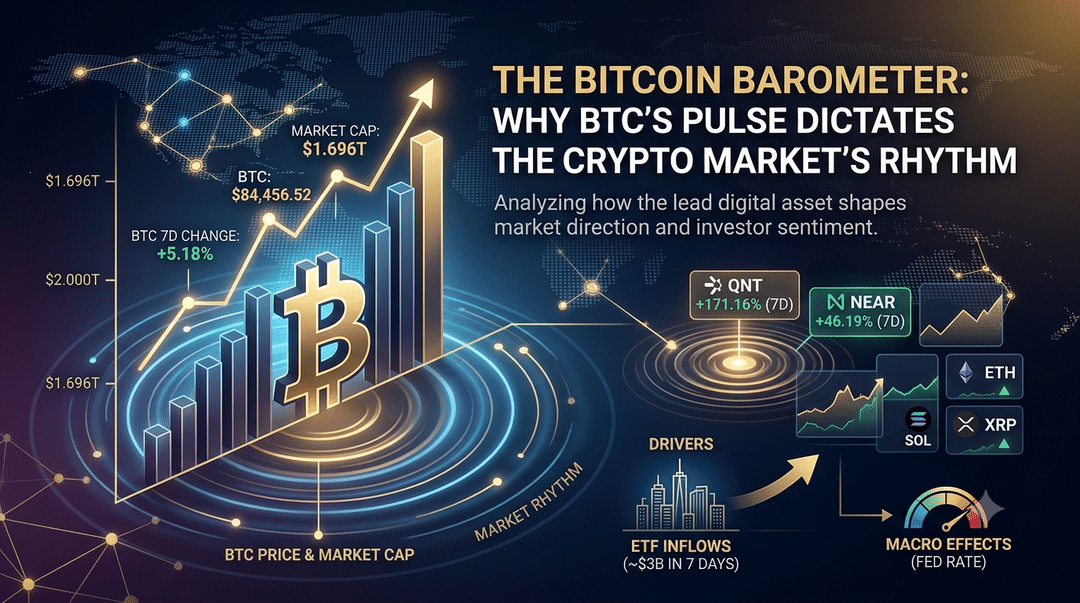
Bitcoin (BTC) is currently trading at approximately $79,815, maintaining its position as the undisputed market leader with a substantial market capitalization of over $1.6 trillion. Over the past 24 hours, BTC has experienced a decline of -1.34%, extending its weekly losses to -3.64%. This performance is observed against a backdrop where the overall crypto market has seen an average 24-hour move of approximately -3.05%.
Factually, Bitcoin's 24-hour decline is less severe than the broader market average, which could be interpreted as a degree of relative resilience in the face of general market pressure. However, the sustained negative movement over the past seven days indicates a persistent downward pressure. Bitcoin's dominant market capitalization means its price movements inherently exert a significant gravitational pull on the entire ecosystem, with its performance often setting the tone for altcoins. Traders and investors are closely watching key support and resistance levels as BTC navigates a period of consolidation following its recent dips. The sheer volume of $19.7 billion traded in the last 24 hours underscores continued active participation, even amidst correctional phases.
Why Bitcoin Is Driving The Tape
Bitcoin's market leadership is not merely a function of its size but is deeply intertwined with a series of significant institutional and macroeconomic catalysts. These factors are currently shaping its price trajectory and, by extension, the broader crypto market.
On the institutional front, there's a discernible shift in the landscape of Bitcoin Spot ETF holdings. Galaxy Research noted that "fast money" entities, specifically nine hedge funds and banks, have reduced their exposure by cutting approximately 68,000 BTC worth of spot ETF positions. This move is attributed to the drying up of cash-and-carry arbitrage opportunities. However, this outflow has been partially offset by an observed inflow from wealth platforms and sovereign funds, suggesting a rebalancing of institutional interest rather than a complete withdrawal. This dynamic indicates a maturing market where different types of institutional capital are finding their long-term positions, influencing BTC's demand structure.
Further institutional developments present a mixed picture. Wall Street veteran Jordi Visser, a former Morgan Stanley and Weiss executive, suggested that crypto, including Bitcoin, could "outperform AI stocks" as AI agents boost demand. This perspective, while optimistic, highlights the growing cross-asset class comparisons and the potential for new demand drivers. Conversely, a cautionary tale emerged with Datavault AI, a Bitcoin treasury holder, reporting an inability to access its BTC from Biconomy since June, leading to a stock tank and a need to restate financial reports. Such incidents, while specific, can contribute to broader institutional caution regarding custody and operational risks in the crypto space. Adding to security concerns, Bitcoin wallet maker Keystone recalled devices after a factory key was stolen, potentially enabling fake hardware wallets, although the company assured recovery phrases and private keys were not compromised. These security incidents, even if contained, can impact institutional confidence and adoption timelines.
From a macroeconomic perspective, the Federal Reserve's recent "hawkish rate hold" is exerting fresh pressure on Bitcoin. Analysts indicate that traders are now pricing in a 78% chance of a December rate hike. This hawkish stance, combined with rising Treasury yields and a strengthening US dollar, typically creates a less favorable environment for risk assets like Bitcoin. Upcoming inflation data is also flagged as a critical determinant for Bitcoin's next move, underscoring the asset's sensitivity to traditional financial market indicators. The interplay between these macro forces and evolving institutional flows is paramount in understanding Bitcoin's current market direction. Concerns about Bitcoin's quantum security, as raised by Stacks founder Muneeb Ali, also highlight potential long-term institutional deterrents, adding another layer to the complex risk assessment.
How The Rest Of The Market Is Responding
The broader cryptocurrency market is largely responding to Bitcoin's lead, with most major altcoins mirroring its downward trend, albeit with varying degrees of volatility. The global market capitalization of all cryptocurrencies stands at approximately $2.17 trillion, reflecting the overall market size and the significant influence of Bitcoin within it.
Ethereum (ETH), the second-largest cryptocurrency, is trading around $2,306, experiencing a -1.99% decline over 24 hours and a more significant -5.57% drop over the last seven days. Its performance generally tracks Bitcoin's, suggesting a correlation in market sentiment. Solana (SOL), currently at $99.84, has seen a -1.90% dip in 24 hours and a -5.37% fall over seven days. Despite this, Solana has seen some independent institutional activity, with Mirae Asset Securities issuing tokenized notes on Solana, extending blockchain-based distribution to institutional investors. This suggests that while broader market trends are dictated by BTC, specific altcoins can still attract targeted institutional interest.
XRP, priced at $1.29, recorded a -2.84% decline over 24 hours and a -3.83% drop over seven days, closely aligning with the general market downturn. Ripple's ecosystem did receive positive news with Robinhood tapping its RLUSD stablecoin, treasury software, and trading loans, deepening ties in institutional trading. This indicates ongoing utility and adoption for XRP, even as its price follows the prevailing market sentiment.
Notably, BNB stands out as an outlier, showing a positive 0.39% gain over 24 hours and a 0.90% increase over seven days, trading at $748. This resilience suggests independent drivers potentially related to its ecosystem or exchange dynamics, contrasting with the general market trend.
Beyond the core majors, the market has seen concentrated volatility in other assets. Zcash (ZEC) experienced a -5.92% drop in 24 hours, Worldcoin (WLD) fell by -5.06%, and Near Protocol (NEAR) declined by -4.55%. These assets represent some of the strongest negative 24-hour moves, indicating that smaller-cap or more speculative assets tend to amplify the market's overall directional bias when Bitcoin is under pressure. Cardano (ADA) and Chainlink (LINK) also recorded negative 24-hour and 7-day performances, further reinforcing the notion that most altcoins are currently confirming Bitcoin's lead, with some exhibiting higher beta to its movements.
Conclusion and Risk Management
The current crypto market narrative is firmly centered on Bitcoin, which continues to act as the primary barometer for overall market health and direction. Its price structure, characterized by recent short-term negative movements, is a direct reflection of the interplay between evolving institutional adoption patterns and persistent macroeconomic pressures.
Observed facts indicate a mildly negative short-term bias across the selected editorial asset basket. Bitcoin's relative resilience in its 24-hour performance compared to the broader market average suggests underlying demand, yet its 7-day decline points to sustained selling pressure. The shift in Bitcoin ETF holdings from "fast money" to sovereign funds, coupled with the Fed's hawkish stance, underscores the complex environment Bitcoin is navigating. While specific altcoins like Solana and XRP are seeing targeted institutional developments, their price action largely remains tethered to Bitcoin's trajectory, with most exhibiting correlating or amplified downward movements. BNB stands as a notable exception, demonstrating independent strength.
Looking ahead, Bitcoin's path will likely continue to be shaped by the delicate balance between increasing institutional integration and the prevailing global macroeconomic climate. Further clarity on interest rate policies and inflation data will be crucial. For market participants, prudent risk management remains paramount. Given the mixed signals from institutional flows and the ongoing macro headwinds, maintaining a balanced portfolio, understanding asset correlations, and closely monitoring Bitcoin-specific catalysts are essential. Diversification and a clear understanding of individual asset volatility, particularly for altcoins, can help navigate the current market conditions without overstating certainty in any single directional outcome. This period calls for a measured approach, prioritizing capital preservation amidst a market led by Bitcoin's complex dynamics.
Source Data Reference
Market Snapshot Input
| Asset | Symbol | Price (USD) | 24h Change | Market Cap (USD) |
|---|---|---|---|---|
| Bitcoin | BTC | 79,815.172459 | -1.34% | 1,604,692,742,150 |
| Solana | SOL | 99.844107 | -1.90% | 58,906,418,654 |
| XRP | XRP | 1.294361 | -2.84% | 81,999,312,885 |
| Ethereum | ETH | 2,306.769989 | -1.99% | 281,825,309,740 |
| Near Protocol | NEAR | 4.45831 | -4.55% | 5,841,453,548 |
| Worldcoin | WLD | 0.415513 | -5.06% | 1,548,425,955 |
| Zcash | ZEC | 1,238.940604 | -5.92% | 20,229,755,456 |
| Cardano | ADA | 0.19762 | -4.43% | 7,699,415,178 |
| Chainlink | LINK | 11.373484 | -2.85% | 8,721,755,983 |
| BNB | BNB | 748.479349 | 0.39% | 98,433,644,869 |
Trending Headlines Input
- Crypto could outperform AI stocks: Wall Street veteran Jordi Visser
- Wall Street’s Fast Money Fled Bitcoin ETFs, Sovereign Funds Stepped In
- Fed’s hawkish rate hold keeps pressure on Bitcoin: Analysts
- Bitcoin Treasury Datavault AI Says It Can’t Access Its BTC, Stock Tanks
- Robinhood Taps Ripple's Stablecoin, Treasury Software and Trading Loans
- Bitcoin Wallet Maker Keystone Pulls Devices as Stolen Key Opens Door to Fakes
- Mirae Asset Securities issues tokenized notes on Solana
- Quantum fears already limiting Bitcoin’s growth, Stacks founder says
- Coinbase denies systems breach, says vendor exposed customer data
- China's Stock Market Has Lost $2.4 Trillion as Investors Doubt Its AI Boom Will Ever Pay Off