Bitcoin Price Structure
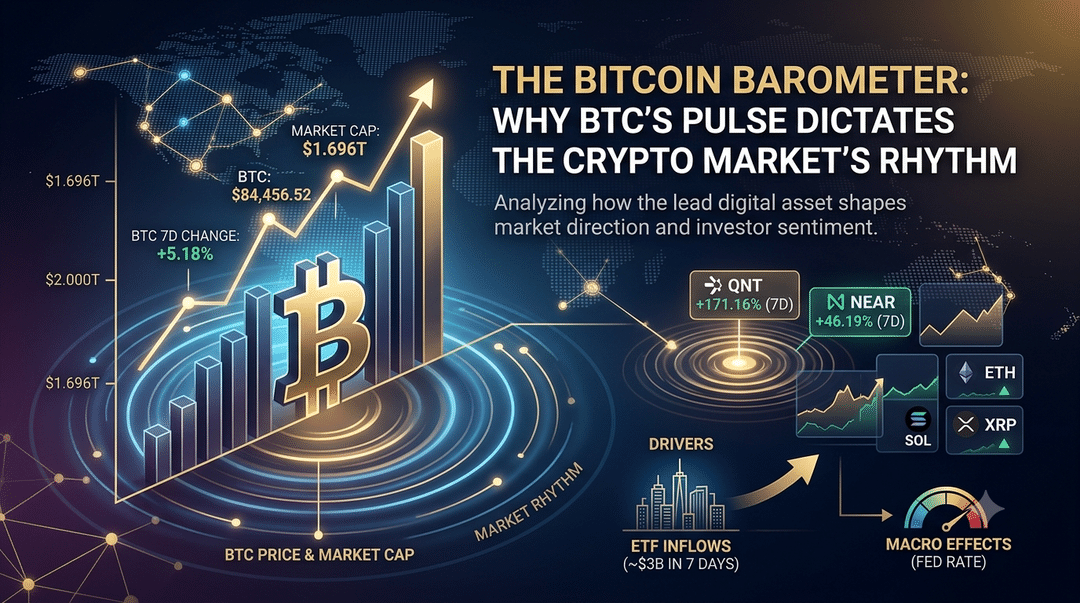
Bitcoin (BTC), currently ranked as the number one cryptocurrency by market capitalization, is trading at approximately $84,456.52. Over the last 24 hours, BTC has registered a modest increase of 0.59%. Looking at the weekly performance, Bitcoin has shown more significant strength, climbing 5.18%. This places its market capitalization at an impressive $1.696 trillion, anchoring a global crypto market cap of $2.327 trillion.
Despite its positive weekly trajectory, Bitcoin's 24-hour movement is notably subdued compared to the broader market's average 24-hour change of approximately 8.95%. This observed fact suggests a period of relative consolidation for BTC, even as the overall market experiences higher average volatility. Recent reports from market analysts indicate that Bitcoin's rally has shown signs of slowing, with some attributing this to a significant $15.6 billion options expiry event. Additionally, a recent "breakout" cooled after BTC briefly tagged an eight-month high near $87,400, subsequently slipping back below the $85,000 mark. This suggests that while Bitcoin maintains a dominant position, its immediate upward momentum faces resistance, potentially influenced by external factors. Despite these cooling signals, the overall short-term bias for Bitcoin, as derived from market observations, appears mildly positive.
Why Bitcoin Is Driving The Tape
Bitcoin's market leadership is not merely a function of its size but is actively reinforced by several BTC-specific catalysts that are currently shaping market dynamics. Institutional adoption and macro-economic factors stand out as particularly influential.
A significant driver of Bitcoin's recent performance has been the sustained inflow into Bitcoin Exchange-Traded Funds (ETFs). Observed data indicates that Bitcoin ETFs have notched a seven-day winning streak, drawing in nearly $3 billion over this period. These inflows have been substantial enough to erase previous post-Clarity Act losses, pushing 2026 flows back into positive territory. This consistent institutional demand underscores a growing mainstream acceptance and integration of Bitcoin into traditional finance, providing a robust floor and potential upward pressure on its price. Further institutional interest is evidenced by reports of Strategy seeking shareholder approval for daily preferred stock dividends, a move that parallels similar actions by other Bitcoin treasury firms. The options market for IBIT, a prominent Bitcoin ETF, is also reportedly trading more calmly after Bitcoin's rebound, suggesting a stabilization of institutional investor sentiment around the asset.
On the macroeconomic front, Bitcoin's price action remains sensitive to broader financial indicators. The recent cooling of Bitcoin's breakout, for instance, has been linked to rising odds of an October Federal Reserve rate hike. This correlation highlights how traditional monetary policy decisions continue to exert influence on the crypto market, with tighter financial conditions generally perceived as a headwind for risk assets like Bitcoin.
Regulatory developments, while often impacting the broader crypto space, frequently have a magnified effect on Bitcoin due to its status as the industry's bellwether. While the Clarity Act failed in the Senate, regulators like the SEC, CFTC, and the Fed have reportedly moved to establish crypto rules themselves. In a notable instance of growing mainstream recognition, a recent filing revealed that Defense Secretary Pete Hegseth holds Bitcoin in a Coinbase wallet. These developments, whether through direct regulation or increasing political awareness, contribute to a maturing market environment that can either foster or constrain Bitcoin's growth.
How The Rest Of The Market Is Responding
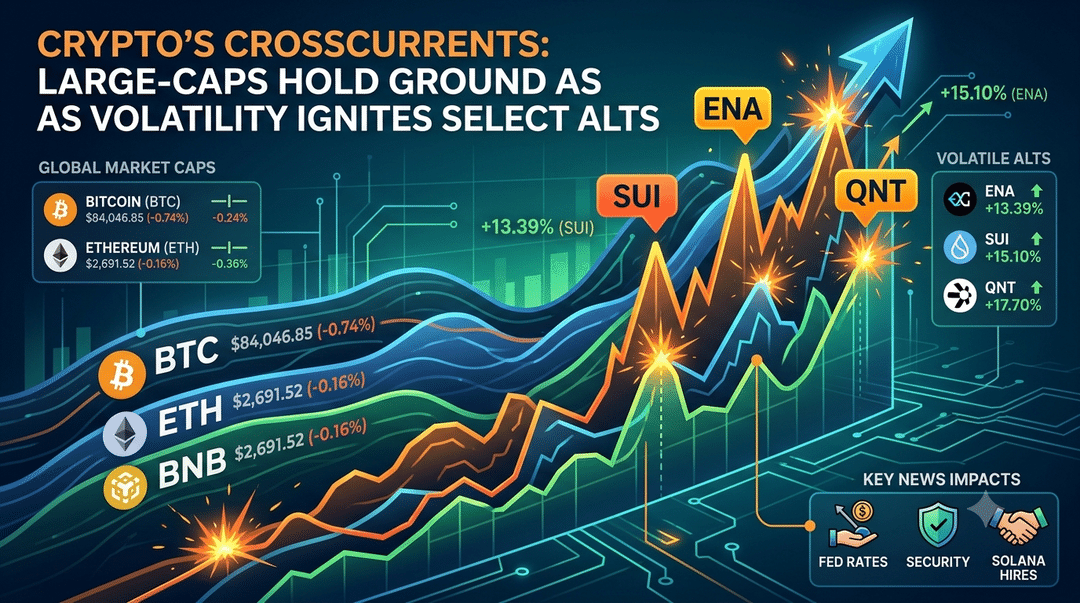
The broader cryptocurrency market is exhibiting a mixed response to Bitcoin's lead, with some assets mirroring BTC's consolidation while others demonstrate significant independent volatility. The global market cap, at $2.327 trillion, reflects the overall scale, but the average 24-hour move of 8.95% across the market highlights a divergence from Bitcoin's more modest 0.59% gain over the same period.
Among the priority assets, Quant (QNT) stands out with an extraordinary performance, surging 74.68% in the last 24 hours and a remarkable 171.16% over the past seven days. This substantial move positions QNT as a clear outlier, exhibiting momentum largely independent of Bitcoin's immediate price action. Similarly, Near Protocol (NEAR) has seen a 24-hour gain of 3.54% and a 7-day increase of 46.19%, indicating strong individual traction. Rain Protocol (RAIN) also showed significant 24-hour volatility with a 16.31% increase. These instances confirm the observation that the strongest 24-hour moves are currently concentrated in specific altcoins like QNT, RAIN, and NEAR.
Other major cryptocurrencies present a more varied picture. Solana (SOL) has posted a marginal 0.21% gain in 24 hours but a robust 11.52% increase over seven days, suggesting it has maintained upward momentum even as Bitcoin's rally slowed. Similarly, XRP, despite a 2.58% dip in the last 24 hours, recorded a 10.22% gain over the past week. News reports explicitly noted that "XRP and Solana Keep Climbing" even when Bitcoin's rally experienced a slowdown, indicating a degree of decoupling in their short-term trajectories.
Ethereum (ETH), the second-largest cryptocurrency, moved 0.37% higher in 24 hours and 4.65% over seven days, broadly aligning with Bitcoin's more subdued recent 24-hour performance but showing slightly less weekly strength. Binance Coin (BNB) experienced a slight dip of 0.26% in 24 hours, with a 3.33% gain over the week, indicating it is largely tracking Bitcoin's recent consolidation phase, albeit with slightly less weekly upside. Meanwhile, assets like Stellar (XLM) and Bitcoin Cash (BCH) saw 24-hour declines of 1.97% and 1.35% respectively, despite stronger weekly gains, suggesting that not all major altcoins are universally confirming Bitcoin's short-term "mildly positive" bias.
Conclusion and Risk Management
Bitcoin's current market behavior underscores its continued role as the primary market mover, with its price structure and specific catalysts largely dictating the broader crypto landscape. The observed "mildly positive short-term bias" for BTC is primarily fueled by robust institutional ETF inflows, which have successfully erased prior yearly losses and set a positive tone. However, this bullish momentum is tempered by macro-economic headwinds, particularly the rising probabilities of further Fed rate hikes, which historically tend to dampen enthusiasm for risk assets.
The market's response reveals a nuanced picture: while some altcoins, notably QNT, RAIN, and NEAR, have demonstrated significant independent rallies, many larger-cap assets like Ethereum and BNB appear to be largely tracking Bitcoin's more consolidated movements. Assets such as Solana and XRP have shown resilience, continuing to climb even as Bitcoin's rally showed signs of cooling, indicating that specific project developments or market narratives can create localized strength.
Looking ahead, the trajectory of Bitcoin will likely remain contingent on the interplay between sustained institutional demand and evolving macroeconomic conditions. Continued strong ETF inflows could provide a consistent tailwind, potentially enabling Bitcoin to overcome resistance levels. Conversely, any further tightening of monetary policy by central banks could introduce renewed pressure.
For market participants, effective risk management in this Bitcoin-led environment involves closely monitoring BTC's price structure, especially in relation to key support and resistance levels. Attention should also be paid to incoming data regarding ETF flows, Federal Reserve policy statements, and significant options expiry events, as these factors have demonstrably impacted Bitcoin's recent performance. Diversification across a range of assets, coupled with an awareness of the varying correlations and independent catalysts within the altcoin market, remains crucial. As always, the cryptocurrency market is subject to rapid changes, and past performance is not indicative of future results. This information is for educational purposes only and does not constitute financial advice.
Source Data Reference
Market Snapshot Input
| Asset | Symbol | Price (USD) | 24h Change | Market Cap (USD) |
|---|---|---|---|---|
| Quant | QNT | 173.686804 | 74.68% | 2,096,875,278 |
| Bitcoin | BTC | 84,456.520438 | 0.59% | 1,696,723,810,061 |
| Solana | SOL | 121.053906 | 0.21% | 71,144,849,937 |
| XRP | XRP | 1.519779 | -2.58% | 95,562,498,762 |
| Near Protocol | NEAR | 5.068155 | 3.54% | 6,626,102,836 |
| Stellar | XLM | 0.214964 | -1.97% | 7,517,341,333 |
| Rain Protocol | RAIN | 0.012793 | 16.31% | 9,073,620,577 |
| Bitcoin Cash | BCH | 333.692521 | -1.35% | 6,701,578,275 |
| Ethereum | ETH | 2,699.518755 | 0.37% | 329,569,877,917 |
| BNB | BNB | 772.577089 | -0.26% | 102,876,181,354 |
Trending Headlines Input
- Circle and Tether Freeze Stablecoins Tied to Bitget Hack—But Most Funds Slip Away
- Bitcoin Rally Slows as $15.6 Billion Options Expiry Hits—XRP and Solana Keep Climbing
- Bitcoin ETFs Notch Seven-Day Winning Streak as 2026 Flows Turn Green
- Bitcoin Breakout Cools as Fed Rate-Hike Bets Climb
- Former Hack VC partner Hsin-Ju Chuang’s death ruled a suicide
- Strategy seeks shareholder approval for daily preferred stock dividends
- Defense Secretary Pete Hegseth Holds Bitcoin in a Coinbase Wallet, Filing Shows
- How Crypto Stopped Waiting for Congress and Learned to Love the Regulators
- IBIT options price trading more calmly after Bitcoin rebound
- Researchers propose Zcash-style private Bitcoin transfers without a soft fork