Bitcoin Price Structure
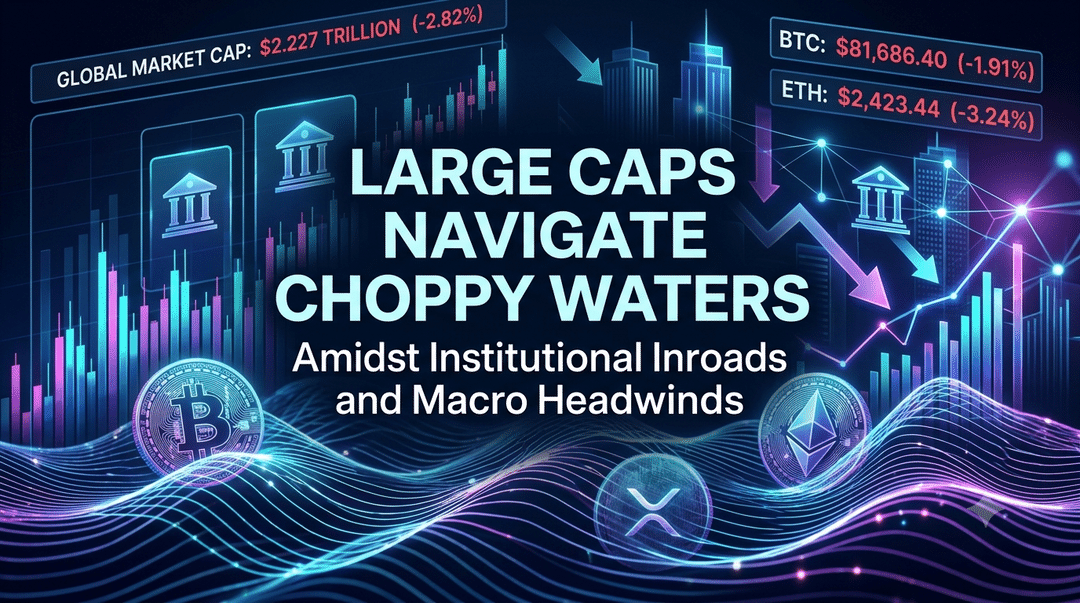
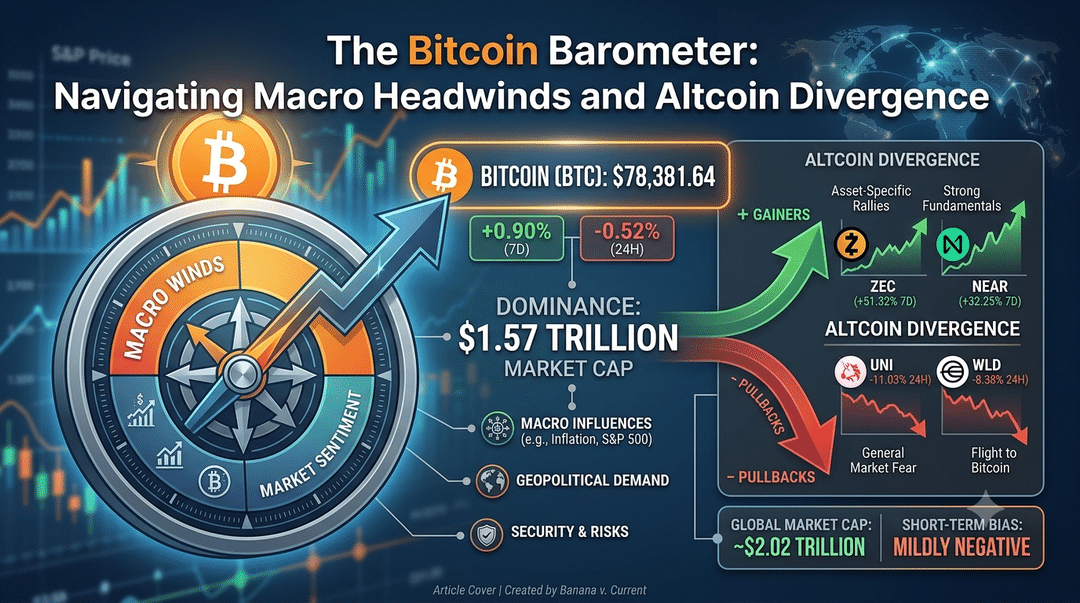
Bitcoin, the market's leading digital asset, is presently trading at approximately $81,088.39, reflecting a 24-hour decline of 3.07% and a 7-day dip of 1.93%. Despite these short-term corrections, Bitcoin maintains a commanding market capitalization of over $1.62 trillion, anchoring a global crypto market cap that stands at $2.19 trillion. This substantial valuation underscores Bitcoin's foundational role and its considerable influence over overall market sentiment and liquidity.
In the context of the broader market, the average 24-hour move across the top assets is a more pronounced -7.79%. Bitcoin's comparatively smaller percentage decline suggests a degree of relative strength or resilience compared to many other digital assets during this period. Its significant volume over the last 24 hours, at $28.72 billion, further indicates sustained trading activity, affirming its position as the primary liquidity hub within the crypto ecosystem. Short-term positioning appears to be consolidating following recent highs, with market participants closely watching for cues from both macro indicators and Bitcoin-specific developments.
Why Bitcoin Is Driving The Tape
Bitcoin's recent price action and market leadership are a direct consequence of several prominent catalysts, ranging from significant institutional adoption news to broader macroeconomic headwinds. These factors collectively explain why Bitcoin is currently driving the tape.
A notable positive development comes from the institutional sphere, with Standard Chartered receiving regulatory approval in Dubai to offer Bitcoin and Ethereum trading services to its wealthy clients in the UAE. This move allows affluent individuals to purchase BTC and ETH directly from their bank accounts, with custody and settlement managed in-house. This expansion of traditional finance into crypto assets, specifically targeting Bitcoin, signals growing institutional confidence and opens new avenues for capital inflow into the digital asset space.
Further reinforcing this institutional trend, Russia's largest bank, Sberbank, has also secured approval to trade Bitcoin. Sberbank now holds both custody and exchange status under Russia's new crypto regulations, with plans to integrate Bitcoin, Ethereum, and USDT into applications serving its vast retail client base of 110 million. These developments from Standard Chartered and Sberbank highlight a global trend of increasing regulatory clarity and institutional acceptance, positioning Bitcoin as a key beneficiary of this mainstream integration. Such moves are interpreted as long-term bullish signals for Bitcoin's adoption and market depth.
However, Bitcoin's ascent is not without its challenges, particularly from the macroeconomic front. Recent reports indicate that Bitcoin's price dipped below $82,000 as high oil prices fueled US CPI inflation, subsequently causing bond yields to surge. This direct correlation illustrates Bitcoin's increasing sensitivity to traditional financial market indicators and inflationary pressures. As a perceived hedge against inflation, Bitcoin's reaction to CPI data suggests that its narrative is evolving, and it is not entirely decoupled from broader economic forces. The market's interpretation of these macro signals directly influences investor appetite for risk assets, including Bitcoin.
Other less immediate but structurally important discussions also center on Bitcoin. Coinbase has pressed for the immediate commencement of Bitcoin's quantum migration, emphasizing the multi-year effort required to transition to quantum-resistant cryptography before any theoretical "Q-Day." While not a short-term price driver, this highlights ongoing efforts to secure Bitcoin's future resilience, a fundamental aspect of its long-term value proposition. Furthermore, discussions around Bitcoin's long-term volatility and its potential to surpass gold as a store of value, as posited by "The Bitcoin Standard" author Saifedean Ammous, contribute to the narrative of Bitcoin's maturing role in the global financial system.
These interwoven factors — robust institutional adoption, the influence of macroeconomic data, and ongoing structural discussions — collectively position Bitcoin as the primary determinant of current market direction.
How The Rest Of The Market Is Responding
The broader cryptocurrency market is largely reflecting Bitcoin's lead, exhibiting a "mildly negative short-term bias" as identified by market insights. While Bitcoin experienced a 24-hour decline of 3.07%, many altcoins and major assets are registering more significant losses, indicating a general lagging effect and increased volatility in the wake of BTC's movement.
Ethereum (ETH), the second-largest cryptocurrency by market cap, is trading around $2,366.13, having seen a 24-hour decline of 5.76% and a 7-day drop of 7.70%. This performance suggests that even major altcoins are feeling a greater impact from the prevailing market sentiment than Bitcoin itself. Similarly, BNB, another core major, experienced a 3.61% drop over 24 hours and a 6.62% decline over seven days, reinforcing the trend of majors following Bitcoin's downward momentum, often with amplified percentage losses.
Among other priority assets, Chainlink (LINK) recorded a 24-hour decrease of 6.61% and a 7-day decline of 7.75%, while Solana (SOL) saw a 5.13% drop in 24 hours and a notable 11.51% over seven days. XRP also followed suit with a 4.73% 24-hour decrease and a 7.56% 7-day decline. These figures illustrate a consistent pattern: when Bitcoin faces downward pressure, the majority of the market tends to follow, often with higher volatility.
The market's most volatile assets further underscore this dynamic. Pump.fun (PUMP) led the declines with a 12.85% drop in 24 hours and a 26.92% drop over seven days. Zcash (ZEC) also saw a significant 12.40% decrease in 24 hours and a 14.50% drop over seven days. Bitway (BTW), despite a strong 7-day gain of 70.27%, experienced a sharp 12.04% decline in the last 24 hours. These larger percentage swings among more volatile assets suggest that capital is flowing out of higher-risk altcoins at a faster rate during periods of Bitcoin-led market uncertainty. The observed "strongest 24h moves are concentrated in PUMP, ZEC, BTW" aligns with the interpretation that altcoins are generally more susceptible to market corrections.
Collectively, the market data indicates that while Bitcoin's decline is relatively moderate, it triggers a more pronounced negative reaction across the altcoin spectrum. This confirms Bitcoin's role as the primary market bellwether, with other assets largely confirming its trend, albeit with heightened volatility and larger percentage shifts.
Conclusion and Risk Management
Bitcoin is currently the dominant force in the cryptocurrency market, with its price structure and associated catalysts dictating the broader trend. The interplay of increasing institutional adoption, exemplified by Standard Chartered and Sberbank expanding crypto services, provides a foundational bullish narrative for Bitcoin. However, this is counterbalanced by macroeconomic headwinds, such as rising US CPI inflation and oil prices, which have demonstrated a direct impact on Bitcoin's price movements.
The market's short-term bias is observed to be mildly negative, with Bitcoin's relatively contained decline leading to more significant percentage drops across major altcoins and higher volatility in smaller-cap assets. This confirms the thesis that the broader market is reacting around Bitcoin, rather than establishing independent trends.
Looking forward, the market's direction will likely continue to hinge on Bitcoin's ability to navigate these dual forces. Sustained institutional inflows could provide a robust floor and impetus for growth, while persistent macroeconomic pressures may introduce further volatility and price corrections. Market participants should monitor Bitcoin's price action closely, alongside key macro indicators like inflation reports and central bank policies, as well as further developments in institutional crypto adoption.
From a risk management perspective, the current environment underscores the importance of understanding Bitcoin's central role. Given the amplified volatility observed in altcoins during Bitcoin's downturns, a focus on the primary asset's stability and directional cues is prudent. Diversification, while always a consideration, should be approached with an awareness of how closely altcoin performance is tied to Bitcoin's trajectory. As always, past performance is not indicative of future results, and market participants should conduct their own thorough research and consider their individual risk tolerance.
Source Data Reference
Market Snapshot Input
| Asset | Symbol | Price (USD) | 24h Change | Market Cap (USD) |
|---|---|---|---|---|
| Bitcoin | BTC | 81,088.395999 | -3.07% | 1,629,749,288,625 |
| Ethereum | ETH | 2,366.131409 | -5.76% | 288,991,198,085 |
| Bitway | BTW | 2.292194 | -12.04% | 5,042,826,257 |
| Chainlink | LINK | 12.131401 | -6.61% | 9,302,964,673 |
| XRP | XRP | 1.306462 | -4.73% | 82,476,527,555 |
| Solana | SOL | 102.159098 | -5.13% | 60,199,212,754 |
| Zcash | ZEC | 1,106.792486 | -12.40% | 18,072,005,436 |
| Rain Protocol | RAIN | 0.008758 | -11.72% | 6,211,806,688 |
| Pump.fun | PUMP | 0.0044 | -12.85% | 2,037,846,958 |
| BNB | BNB | 717.753144 | -3.61% | 95,574,959,274 |
Trending Headlines Input
- Standard Chartered Will Hold Ripple's Stablecoin in Dubai—And Let Clients Trade With It Without Moving It
- Standard Chartered Opens Bitcoin and Ethereum Trading to Wealthy UAE Clients
- Russia's Biggest Bank Sberbank Wins Approval to Trade Bitcoin
- Solana Sets a Date for Its Next Major Upgrade
- 'It Can Take Years': Coinbase Presses for Bitcoin Quantum Migration to Start Now
- Bitcoin will become ‘less volatile’ and larger than gold: ‘The Bitcoin Standard’ author
- Bitcoin price dips below $82K as high oil prices spike US CPI inflation
- Standard Chartered expands Bitcoin and Ether trading to professional investors in UAE
- BitMEX Sued in UK for Return of $27M in Bitcoin Over Unlicensed Derivatives
- Is Bitcoin kidding itself about the Lightning Network?