Bitcoin Price Structure
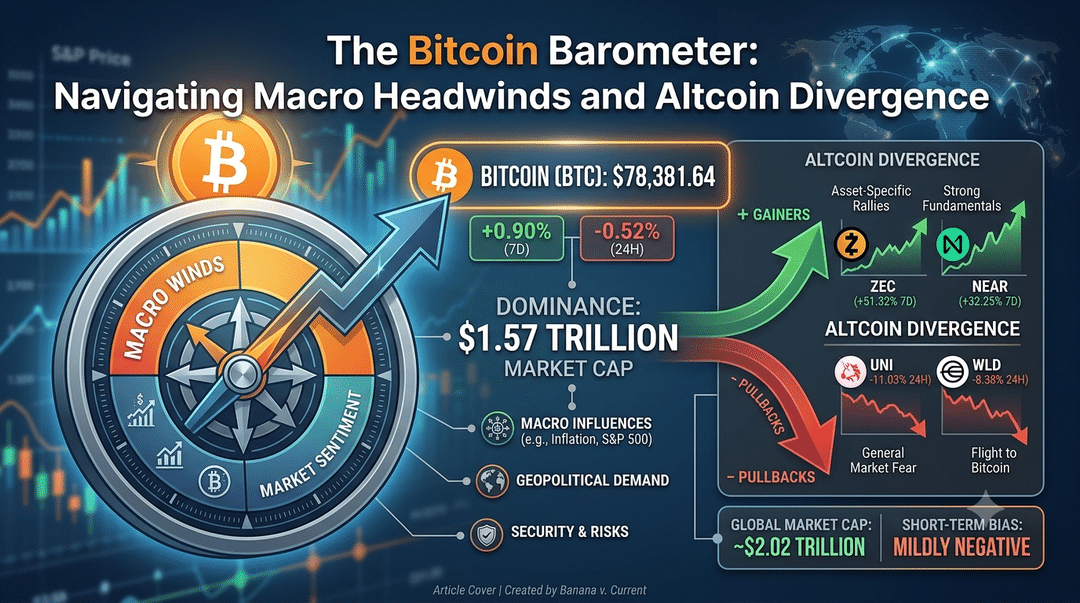
Bitcoin (BTC), the world's largest cryptocurrency by market capitalization, is presently trading at approximately $78,381.64. Over the past 24 hours, BTC has experienced a modest decline of -0.52%. However, looking at the weekly performance, Bitcoin has posted a gain of +0.90%, indicating a degree of underlying stability or accumulation despite short-term fluctuations. This measured performance stands in contrast to the overall market, which shows a mildly negative short-term bias across the selected asset basket.
Bitcoin's market capitalization stands at a substantial $1.57 trillion, anchoring a global crypto market cap of approximately $2.02 trillion. This dominance underscores its role as the primary benchmark for the industry. The relatively contained 24-hour price movement, coupled with a positive 7-day trend, suggests that Bitcoin is currently holding key support levels and absorbing selling pressure more effectively than many other digital assets. Its trading volume over the last 24 hours was reported at $30.26 billion, reflecting continued liquidity and investor interest.
Why Bitcoin Is Driving The Tape
Bitcoin's current market behavior is demonstrably influenced by a confluence of macro-economic factors and specific security-related incidents, solidifying its role as the primary driver of market sentiment.
A significant catalyst is the ongoing interplay between Bitcoin and traditional financial markets, particularly concerning macroeconomic indicators. As observed, "Bitcoin is defending its golden zone support while the S&P 500 grinds inside its tightest range yet, both waiting on Friday's inflation report before the Fed's September 16 rate call." This highlights Bitcoin's sensitivity to broader economic conditions and central bank policy, particularly interest rate expectations. The "oil shock" reviving Fed hike bets creates an environment of caution, where investors may view Bitcoin as a potential hedge or a risk asset depending on their interpretation of the macro outlook. This direct link to Wall Street's movements positions Bitcoin as a bellwether for risk appetite within the digital asset space.
Furthermore, geopolitical developments are contributing to Bitcoin's narrative. A report indicates that "Middle East Crypto Activity Triples to $350 Billion Amid Ongoing Conflict," suggesting an increased demand for digital assets, including Bitcoin, for wealth preservation and transfer in regions experiencing instability. This reinforces Bitcoin's utility as a censorship-resistant and accessible store of value, particularly in times of conflict or economic uncertainty.
Security concerns, while potentially negative in isolation, also underscore Bitcoin's perceived value and the importance of robust safeguards. Recent headlines include reports of a "Mexican Musician and Family Killed Over Bitcoin Cold Wallet Believed to Hold Millions," highlighting the extreme value attributed to BTC holdings. Additionally, the ongoing situation surrounding the "$47M Still Missing After Liquid Hack as Blockstream Bargains With 'White Hats'" and the news that "Bitcoin Wallet Maker Trezor Says Hackers Breached Its Email Provider" serve as stark reminders of the security risks inherent in the ecosystem. While these events can cause short-term apprehension, they also prompt enhanced security measures and reinforce the asset's high-value status. The demand for secure storage solutions often rises in response, indirectly affirming Bitcoin's long-term appeal.
Finally, regulatory discourse, such as a "New York town weighs crypto mining and AI data center ban," contributes to the overall narrative surrounding Bitcoin's operational environment, influencing investor confidence in its long-term viability and adoption. These diverse factors collectively converge to make Bitcoin the central focus, with its reactions dictating the broader market's direction.
How The Rest Of The Market Is Responding
While Bitcoin maintains a relatively stable posture, the broader cryptocurrency market is exhibiting a more varied and often more volatile response, largely reacting to Bitcoin's lead but also showing signs of independent movement. The overall market, as indicated by derived insights, currently shows a "mildly negative short-term bias" across the selected editorial asset basket.
Ethereum (ETH), the second-largest cryptocurrency, has experienced a 24-hour decline of -0.79%, slightly more pronounced than Bitcoin's. However, ETH's 7-day performance stands at a positive +3.01%, outperforming Bitcoin over the same period. This suggests that while Ethereum might be experiencing similar short-term pressures, it holds a stronger weekly momentum, potentially due to its own ecosystem developments. News of "Consensys Is Splitting in Two as MetaMask Goes Its Own Way" and the formation of a new institutional blockchain infrastructure business could be contributing to this distinct long-term outlook, signaling growth and specialization within the Ethereum ecosystem.
Beyond the majors, altcoins are demonstrating significant divergence. Among the priority assets, Zcash (ZEC) and Near Protocol (NEAR) stand out with remarkable gains. ZEC has surged by +3.42% in 24 hours and an impressive +51.32% over the past 7 days. Similarly, NEAR has seen a substantial +9.62% increase in 24 hours and a +32.25% rally over the week. These strong performances suggest asset-specific catalysts or rotations of capital into projects perceived to have strong fundamentals or upcoming developments, allowing them to decouple from the broader market's negative bias.
Conversely, many other altcoins are experiencing more significant downturns, reflecting the general market's negative short-term sentiment and a potential flight of capital towards Bitcoin or out of riskier assets. Uniswap (UNI) has recorded a notable -11.03% decline in 24 hours, making it one of the top volatile assets on the downside. Worldcoin (WLD) also saw a significant drop of -8.38%. Other prominent assets like BNB, Dogecoin (DOGE), Chainlink (LINK), and Venice Token (VVV) have also registered 24-hour losses ranging from -3.51% to -6.71%. These more substantial pullbacks indicate that Bitcoin's relative stability is not translating into broad-based strength for many altcoins, instead highlighting a cautious environment where capital is being selectively deployed or withdrawn from riskier positions. The strongest 24-hour moves, as observed, are indeed concentrated in UNI, NEAR, and WLD, underscoring this period of divergent performance.
Conclusion and Risk Management
Bitcoin currently functions as the primary compass for the cryptocurrency market, with its price structure and response to macro-economic and security-related events largely dictating broader sentiment. While BTC has exhibited relative stability over the past week, maintaining a positive 7-day trend despite minor daily fluctuations, the overall market shows a "mildly negative short-term bias."
The key drivers for Bitcoin remain firmly rooted in macro-economic developments, particularly the Federal Reserve's monetary policy and the impact of global events like the oil shock. These factors continue to influence investor risk appetite across both traditional and digital asset classes. Additionally, ongoing security incidents, while challenging, reinforce the high value and critical importance of robust safeguards within the Bitcoin ecosystem. Geopolitical demand further highlights Bitcoin's utility as a global, censorship-resistant asset.
Looking ahead, two primary scenarios emerge. In the first, Bitcoin could continue its current consolidation, potentially absorbing further selling pressure from the broader market. This could lead to a 'flight to quality' where capital flows into BTC from more volatile altcoins, or it could set the stage for a more sustained market recovery if macro conditions improve. In the second scenario, a significant shift in macro sentiment, such as unexpected inflation data or aggressive Fed action, could challenge Bitcoin's current stability, potentially leading to a broader market re-evaluation.
For risk management, market participants should closely monitor Bitcoin's ability to hold its current price levels and key technical supports. Given the strong influence of macro factors, keeping abreast of global economic indicators and central bank communications is crucial. The divergence seen in altcoin performance, with some like ZEC and NEAR rallying strongly while others like UNI and WLD face significant headwinds, underscores the importance of asset-specific research. Investors are advised to manage exposure to highly volatile altcoins, recognizing that their movements may not always correlate directly with Bitcoin's, particularly during periods of uncertainty. The market's "mildly negative short-term bias" suggests a need for caution and a focus on assets demonstrating clear strength or fundamental drivers.
Source Data Reference
Market Snapshot Input
| Asset | Symbol | Price (USD) | 24h Change | Market Cap (USD) |
|---|---|---|---|---|
| Bitcoin | BTC | 78,381.642412 | -0.52% | 1,574,074,565,144 |
| Ethereum | ETH | 2,475.962844 | -0.79% | 302,155,504,823 |
| Zcash | ZEC | 1,239.494326 | 3.42% | 20,238,796,774 |
| Near Protocol | NEAR | 2.513858 | 9.62% | 3,282,885,932 |
| Venice Token | VVV | 23.96918 | -6.71% | 1,154,917,784 |
| Chainlink | LINK | 11.844672 | -4.92% | 8,860,998,995 |
| Uniswap | UNI | 6.064508 | -11.03% | 3,779,477,039 |
| BNB | BNB | 724.780932 | -3.51% | 96,512,762,458 |
| Worldcoin | WLD | 0.41492 | -8.38% | 1,526,997,723 |
| Dogecoin | DOGE | 0.08616 | -4.34% | 14,770,914,903 |
Trending Headlines Input
- Mexican Musician and Family Killed Over Bitcoin Cold Wallet Believed to Hold Millions
- Consensys Is Splitting in Two as MetaMask Goes Its Own Way
- $47M Still Missing After Liquid Hack as Blockstream Bargains With 'White Hats'
- Bitcoin Holds, Wall Street Stalls as Oil Shock Revives Fed Hike Bets
- Middle East Crypto Activity Triples to $350 Billion Amid Ongoing Conflict, Report Finds
- Bitcoin Wallet Maker Trezor Says Hackers Breached Its Email Provider
- Consensys to split into MetaMask and institutional blockchain company
- 10 of the greatest unsolved crypto mysteries
- Is Bitcoin too volatile to risk your retirement on?
- New York town weighs crypto mining and AI data center ban