Risk Tone Across The Market
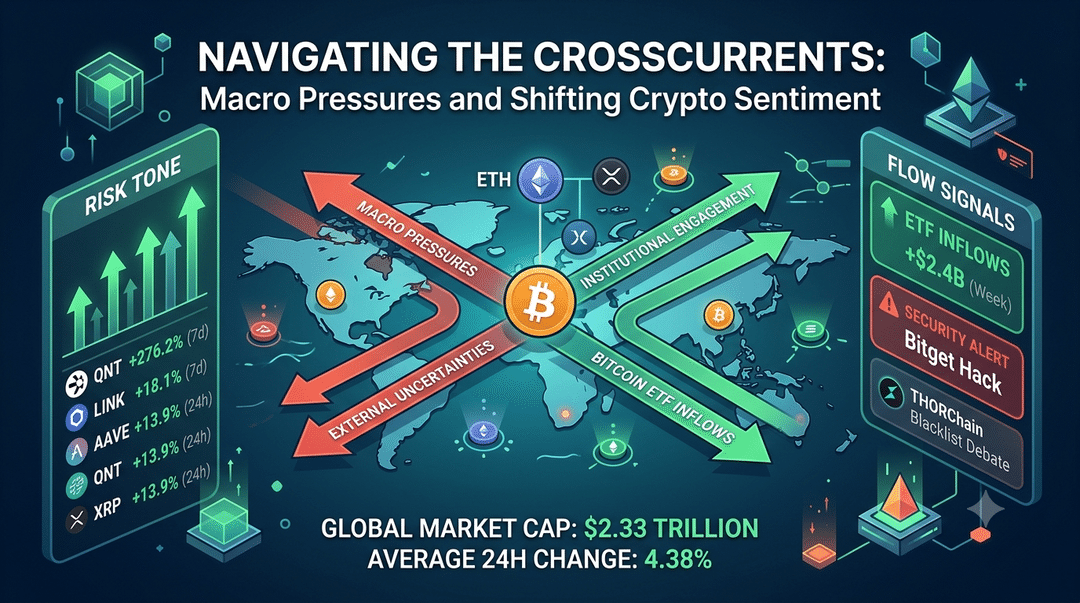
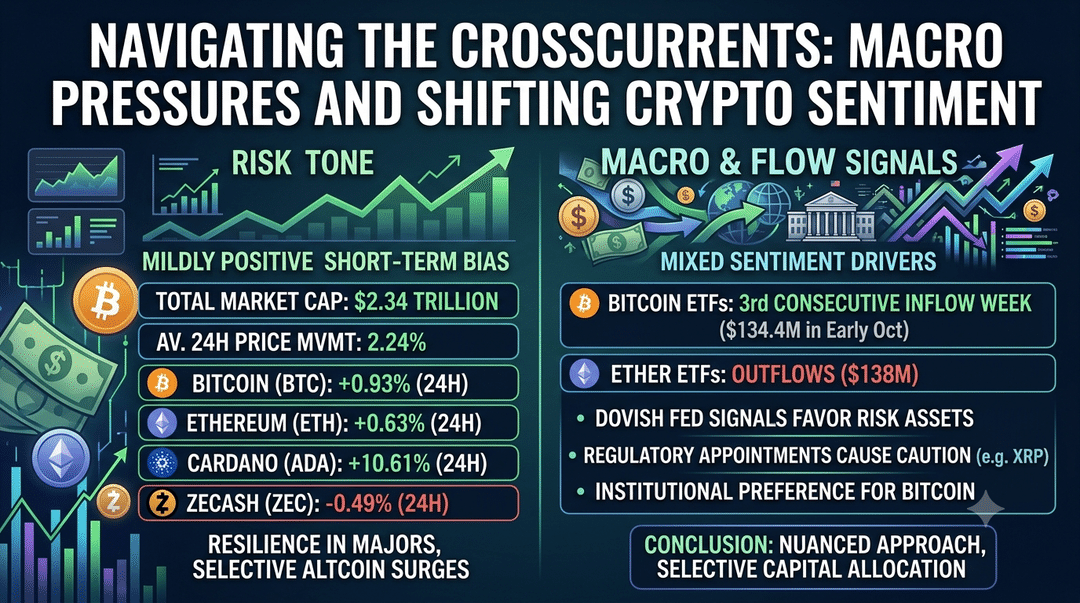
The prevailing risk tone across the crypto market exhibits a mildly positive short-term bias, yet this is underpinned by a cautious undercurrent. The total global market capitalization stands at approximately $2.34 trillion, with an average 24-hour price movement of around 2.24% across the analyzed assets. This indicates a market that is not undergoing extreme shifts but shows selective upward momentum.
Observed facts reveal that Bitcoin (BTC) has seen a modest 24-hour gain of 0.93%, extending its 7-day increase to 4.05%. Ethereum (ETH) similarly posted a 0.63% rise over 24 hours and 2.72% over seven days. XRP shows comparable stability with a 0.86% 24-hour increase and 2.10% over seven days. These core assets suggest a relatively stable, albeit slightly upward, trajectory.
However, the market's volatility is not uniformly distributed. Cardano (ADA) stands out with a significant 24-hour surge of 10.61%, contributing to an 11.32% gain over the past seven days. Other notable movers include Dogecoin (DOGE) with a 3.61% 24-hour increase and Near Protocol (NEAR) rising by 3.96%. Conversely, Zcash (ZEC) has seen a 0.49% decline over 24 hours and a more substantial 13.98% drop over seven days, indicating pockets of concentrated selling pressure or profit-taking.
Interpretation suggests that while major assets are maintaining a gentle upward trend, indicating a degree of underlying resilience or sustained interest, the significant movements in assets like ADA point to localized speculative interest or project-specific developments rather than a broad, universal surge in risk-on sentiment. The mixed performance, particularly the notable decline in ZEC, reinforces the idea that capital flows are selective, and investors are discerning in their allocation strategies.
Macro and Flow Signals
The current market sentiment is heavily influenced by a blend of macro pressures and institutional flow signals, with several key headlines shaping investor positioning. The news landscape presents a predominantly mixed sentiment, reflecting the complex interplay of these factors.
A significant regulatory development is the appointment of former SEC Chair Jay Clayton to lead President Trump's "Super Intelligence Force" for AI policy. This news carries a mixed sentiment, particularly for assets like XRP. While unrelated to crypto enforcement directly, Clayton's past tenure at the SEC saw the initiation of lawsuits against several crypto entities, including Ripple. The "XRP army" is noted to be unhappy with this appointment, suggesting that even an indirect connection to a figure associated with past regulatory scrutiny can stir concerns among specific asset holders. This highlights how regulatory figures, even in new roles, can influence sentiment due to their historical actions.
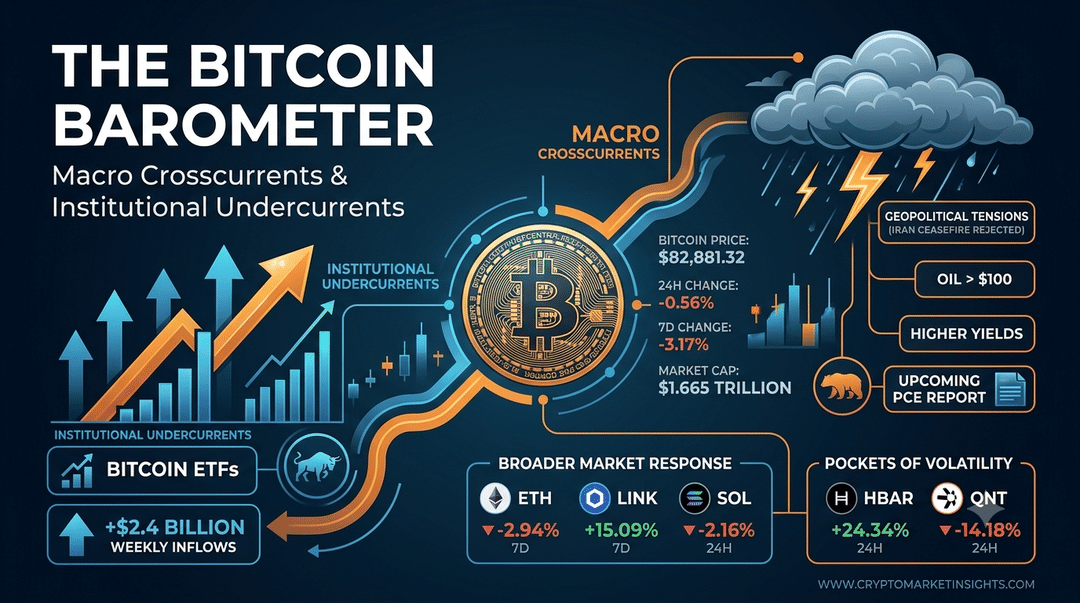
Institutional flows continue to be a dominant narrative. Bitcoin (BTC) ETFs have notably recorded a third consecutive week of inflows, attracting $134.4 million in the first two trading days of October alone. This rebound from a prior outflow period is interpreted as a positive signal for institutional confidence in Bitcoin, particularly as a weak jobs report has cooled Federal Reserve rate-hike bets. This suggests that macro data influencing traditional financial markets directly impacts Bitcoin's institutional appeal. The narrative around "Uptober" starting strong for Bitcoin, driven by these inflows and dovish Fed speakers, underscores a cautiously optimistic institutional outlook for the asset.
In contrast, Ether (ETH) ETFs have experienced outflows, shedding $138 million. This divergence in institutional interest between Bitcoin and Ether ETFs indicates a selective preference for Bitcoin as the primary institutional crypto exposure, possibly due to its perceived safe-haven characteristics or clearer regulatory standing in the ETF space compared to Ether. Zcash (ZEC) funds also posted their first weekly outflow, contributing to its observed negative price action.
Further institutional commentary notes that Bitcoin treasuries may struggle to match the scale and cash reserves of larger entities like MicroStrategy, according to Saifedean Ammous. While not immediately impacting price, this observation adds a layer of nuance to the institutional adoption narrative, suggesting that not all corporate treasury strategies are equally viable or impactful.
On the macroeconomic front, cooler inflation data and dovish statements from Federal Reserve speakers have shifted the odds toward a rate hold. This easing of hawkish monetary policy expectations is generally viewed as favorable for risk assets, including cryptocurrencies, as it reduces the cost of capital and increases liquidity. Bitcoin's push towards $87,000, accompanied by short liquidations topping $120 million, is framed within this macro context, with the immediate area above $87,800 identified as a new resistance hurdle.
Finally, while less directly tied to broad market sentiment, reports of Chainalysis using AI to trace the $387 million Bitget hack back to North Korea, and California subpoenaing OpenAI over AI model security, contribute to a background hum of security and technological governance concerns. These headlines, while not moving the overall crypto market significantly, underscore ongoing challenges in the digital asset space and broader tech sector.
What Sentiment Is Doing To Major Coins
The prevailing sentiment, influenced by macro signals and specific news, is driving varied responses across major cryptocurrencies.
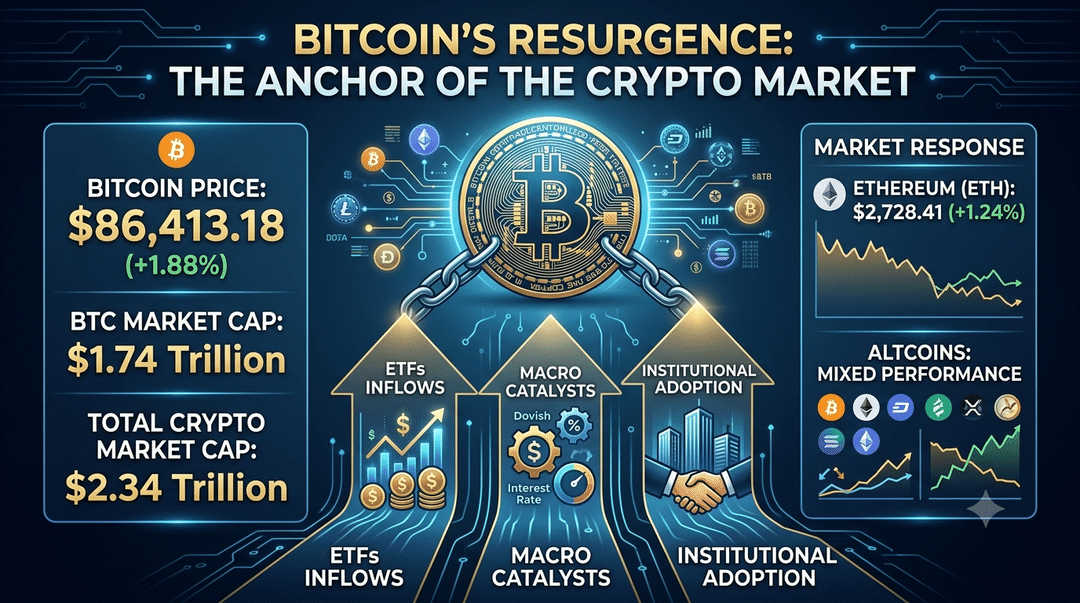
Bitcoin (BTC) is exhibiting resilience, with its price reaching $86,038.34, reflecting a modest 0.93% gain in 24 hours and a 4.05% increase over seven days. The positive sentiment around Bitcoin is largely driven by sustained institutional interest, evidenced by the third consecutive week of inflows into Bitcoin ETFs. This inflow, totaling $134.4 million in early October, suggests that institutional players are viewing Bitcoin favorably, especially amidst a macro backdrop of cooled Fed rate-hike bets. The narrative of "Uptober" starting strong for BTC is directly linked to these capital flows and a more accommodating monetary policy outlook. The price action indicates a steady accumulation phase, with buyers breaking through resistance levels and pushing towards new October highs near $87,800, leading to significant short liquidations.
Ethereum (ETH), currently priced at $2,719.36, has seen a 0.63% 24-hour gain and a 2.72% 7-day increase. While showing positive momentum, ETH's sentiment is somewhat tempered compared to Bitcoin's. This is primarily due to the observed outflows from Ether ETFs, which contrast sharply with Bitcoin's inflows. This divergence indicates that institutional capital might be prioritizing Bitcoin as a direct exposure, while sentiment around Ether could be more complex, potentially reflecting ongoing debates about its staking yield, regulatory clarity, or competition from other Layer-1s. Furthermore, the news of Blast, once a significant Ethereum Layer-2 network, winding down operations due to costs outpacing revenue, could introduce a slight cautionary note for the broader Ethereum ecosystem, even if it doesn't directly impact ETH's core valuation significantly.
XRP, trading at $1.51, recorded a 0.86% 24-hour gain and a 2.10% 7-day increase. XRP's price action appears relatively stable, but its sentiment is notably affected by regulatory developments. The appointment of former SEC Chair Jay Clayton to a new AI role, despite being unrelated to crypto enforcement, has generated a "mixed" sentiment among the XRP community. Clayton's history with the Ripple lawsuit means his continued presence in a high-profile government position is viewed with apprehension by some, potentially capping upside momentum as regulatory uncertainty remains a key overhang for the asset.
Cardano (ADA) stands out as a top performer, priced at $0.27 with a substantial 10.61% 24-hour increase and an 11.32% 7-day gain. This significant upward movement suggests strong asset-specific bullish sentiment, potentially driven by project developments, ecosystem growth, or renewed speculative interest. Its performance largely outstrips the more modest gains seen in BTC and ETH, indicating that capital is flowing into specific altcoins with perceived catalysts, independent of the broader, more cautious sentiment around the majors.
Other volatile assets like Dogecoin (DOGE), up 3.61% in 24 hours, and Near Protocol (NEAR), up 3.96% in 24 hours, also show localized positive sentiment. These movements suggest that while macro factors are at play, specific narratives or technical breakouts can still drive significant short-term gains in individual assets.
Conclusion and Risk Management
The current crypto market is characterized by a mildly positive short-term bias, yet this optimism is carefully balanced against a backdrop of mixed signals from macroeconomics, institutional flows, and regulatory developments. Bitcoin's sustained ETF inflows and a more dovish stance from the Federal Reserve are providing a tailwind for the broader market, suggesting an underlying resilience in investor confidence, particularly for the leading cryptocurrency. However, the divergence in institutional interest, with Ether ETFs experiencing outflows, indicates a selective allocation of capital and highlights differing sentiment across major assets.
The influence of regulatory figures, even in new capacities, continues to shape sentiment for specific assets like XRP, reminding investors of the persistent regulatory overhang in the crypto space. Meanwhile, assets such as Cardano are demonstrating that specific catalysts or speculative interest can lead to significant independent rallies, even within a market that is otherwise moving with cautious optimism.
For risk management, it is crucial to recognize that the market's direction is being shaped less by singular events and more by aggregate sentiment derived from cross-market catalysts. Investors should monitor key indicators: continued Bitcoin ETF flows as a barometer for institutional risk appetite, evolving macroeconomic data for shifts in monetary policy expectations, and any new regulatory pronouncements that could impact specific asset classes or the broader digital asset ecosystem. The current environment calls for a nuanced approach, separating broad market trends from asset-specific narratives. Maintaining a diversified portfolio and understanding the distinct drivers behind individual asset movements will be critical in navigating these complex crosscurrents. Potential reversals remain a consideration, particularly if macro conditions shift or if institutional flows reverse course.
Source Data Reference
Market Snapshot Input
| Asset | Symbol | Price (USD) | 24h Change | Market Cap (USD) |
|---|---|---|---|---|
| Bitcoin | BTC | 86,038.342164 | 0.93% | 1,728,828,894,058 |
| XRP | XRP | 1.514664 | 0.86% | 95,564,680,916 |
| Ethereum | ETH | 2,719.364482 | 0.63% | 332,054,923,592 |
| Cardano | ADA | 0.271298 | 10.61% | 10,556,816,148 |
| Pump.fun | PUMP | 0.006367 | -0.38% | 2,956,361,661 |
| Zcash | ZEC | 1,331.23276 | -0.49% | 21,736,726,614 |
| Dogecoin | DOGE | 0.096782 | 3.61% | 16,591,975,054 |
| Hyperliquid | HYPE | 93.436524 | 2.95% | 20,784,554,220 |
| Near Protocol | NEAR | 5.041052 | 3.96% | 6,594,375,065 |
| BNB | BNB | 788.967025 | -0.29% | 105,058,109,052 |
Trending Headlines Input
- Former SEC boss made AI Czar, Bitcoin may hit $600K this cycle: Hodler’s Digest
- Trump Taps Jay Clayton, the SEC Chair Who Sued Ripple, to Lead AI Push
- Bitcoin ETFs notch third inflow week as Ether ETFs shed $138M
- 'Uptober' Starts Green as Bitcoin ETFs Draw $134 Million
- Bitcoin treasuries may struggle to match Strategy, says Ammous
- Bitcoin reaches for $87K as short liquidations top $120M
- 'Uptober' Off With a Bang as Bitcoin Surges to $86K
- Chainalysis Used AI to Trace the $387M Bitget Hack Back to North Korea
- California Subpoenas OpenAI Over AI Models That Hacked Their Way Out of a Test
- Blast to wind down Ethereum L2 after costs outpace revenue