Risk Tone Across The Market
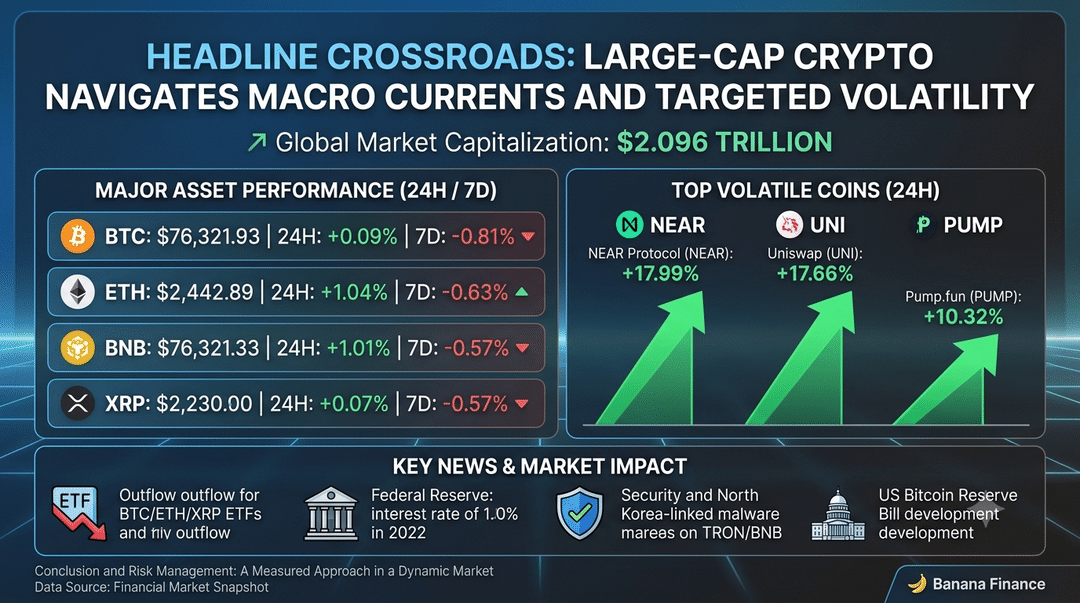
The broader digital asset market, with a global market capitalization standing at approximately $2.15 trillion, is exhibiting a mildly positive short-term bias, as indicated by recent observations. The average 24-hour price change across a selection of assets is around 11.63%, suggesting a general upward trend, albeit with significant dispersion. This overall positive lean, however, is not uniformly distributed, pointing to a selective rather than broad-based risk-on environment.
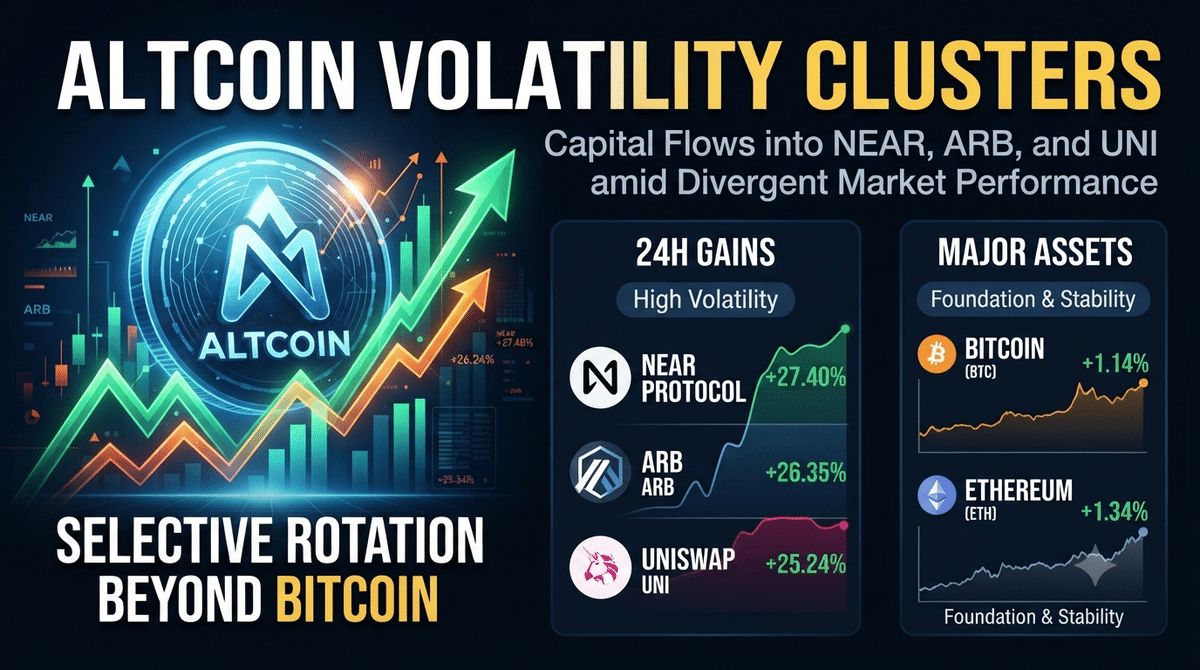
A closer look at market performance reveals distinct areas of elevated risk-taking. Uniswap (UNI) has demonstrated exceptional strength, surging over 30% in the last 24 hours and nearly 48% over the past week. Arbitrum (ARB) follows a similar trajectory, with a 24-hour gain of over 27% and a weekly increase of approximately 46.6%. Near Protocol (NEAR) also shows considerable momentum, up over 23.5% in 24 hours and 37.5% over seven days. These significant moves in specific altcoins suggest a willingness among some market participants to engage with higher-beta assets, potentially chasing localized narratives or technical breakouts.
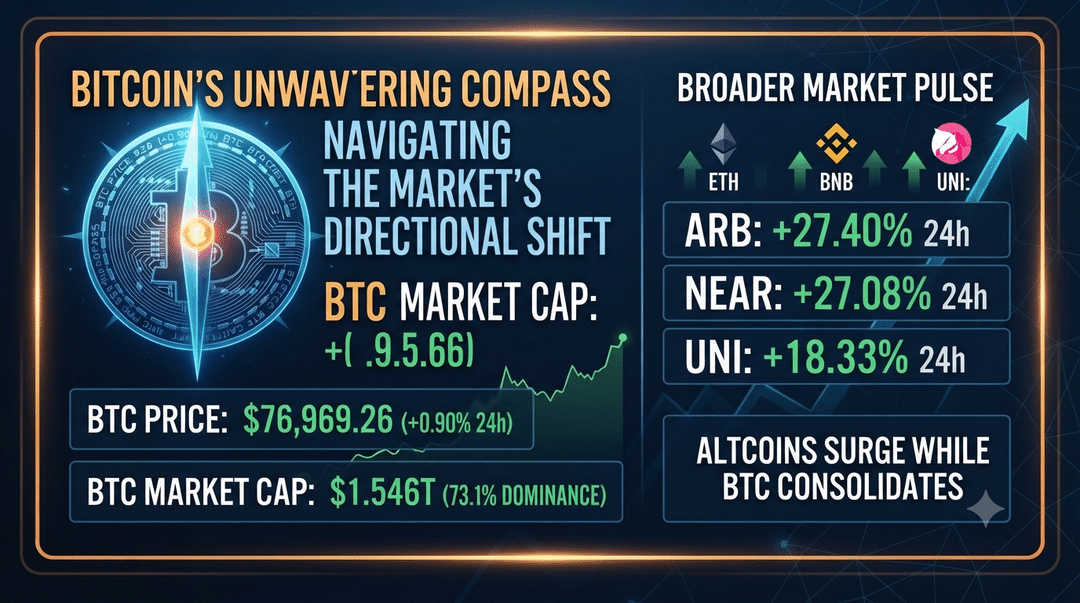
In contrast, bellwether assets like Bitcoin (BTC) and Ethereum (ETH) have posted more modest gains of 2.67% and 3.17% respectively over the past 24 hours, with similar percentage increases over the 7-day period. While positive, their performance is less emphatic than the leading altcoins, indicating that broader market sentiment for the foundational assets is more tempered. This divergence implies a market where capital is rotating into specific sectors or smaller-cap assets perceived to have higher upside potential, even as overall caution remains due to external factors. The observed risk tone is therefore mixed: cautiously optimistic for the majors, but with pronounced risk-on behavior in select altcoin categories.
Macro and Flow Signals
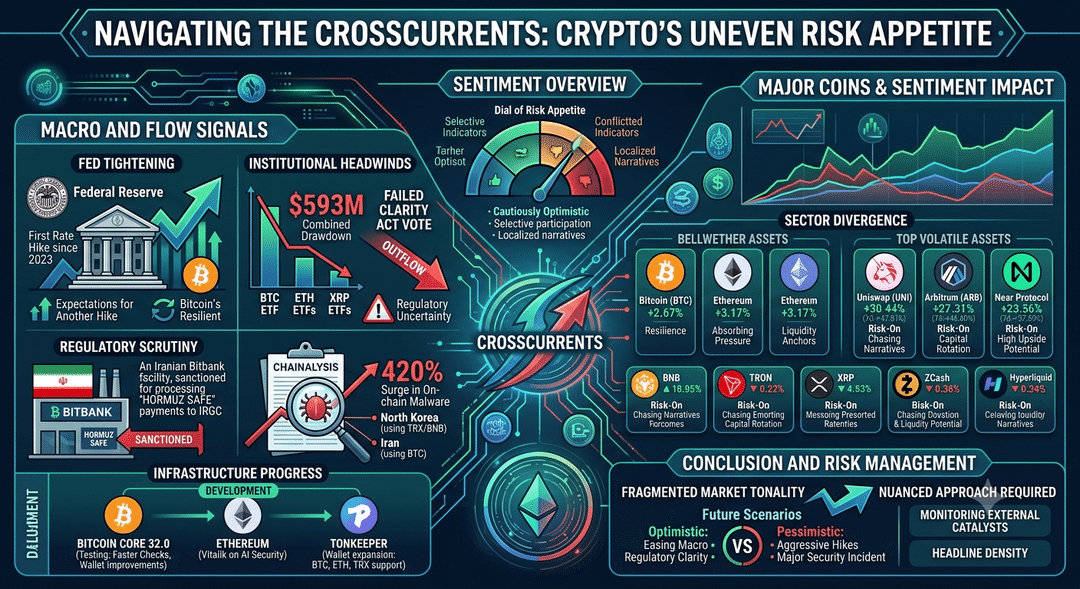
The current market sentiment is heavily influenced by a series of macro, institutional, and policy-related headlines, creating a backdrop of cautious positioning. A key development was the Federal Reserve's recent rate increase, the first since 2023, coupled with officials signaling expectations for at least one more hike before year-end. Despite this tightening posture, Bitcoin showed little immediate reaction, absorbing the news without a significant downturn. This suggests a degree of resilience in the crypto market, or perhaps that the rate hike was largely priced in. However, the prospect of further tightening could continue to temper broader risk appetite.
Institutional flows have presented a more immediate headwind. Bitcoin, Ethereum, and XRP ETFs collectively experienced their heaviest single-day drawdown since June, shedding approximately $593 million combined. This outflow was attributed to a "Failed Clarity Act Vote," highlighting how policy and regulatory uncertainty can directly impact institutional participation and investor confidence. The news of the US sanctioning Iran’s BitBank for processing "Hormuz Safe" Bitcoin payments and facilitating movement of funds to the IRGC further underscores the ongoing regulatory scrutiny on crypto, particularly concerning illicit finance. Such actions can contribute to a cautious institutional stance, even if their direct market impact isn't always immediately apparent.
Security concerns have also been prominent. Chainalysis reported a 420% surge in on-chain malware linked to state hackers, with North Korea-linked actors using Tron (TRX) and BNB Chain (BNB) infrastructure, and suspected Iran-linked actors embedding directions in Bitcoin (BTC) transactions. Separately, a data breach at Revolut saw ransom demands for Monero and Bitcoin, although Revolut stated no direct contact was made. These incidents, while not directly impacting core protocol security, heighten fears around the broader ecosystem's integrity and regulatory oversight, potentially prompting a flight to perceived quality or a reduction in speculative activity.
On the development front, Bitcoin Core 32.0 is entering final testing, promising faster block checks and wallet improvements. Ethereum co-founder Vitalik Buterin also weighed in on AI's potential to enhance crypto security by helping mathematically verify software systems. These technical advancements and forward-looking discussions, while positive for long-term health, tend to have a more gradual impact on short-term market sentiment compared to immediate macro or regulatory news. Lastly, the expansion of the Tonkeeper wallet to support Bitcoin, Ethereum, and Tron signals growing interoperability and accessibility, a positive for ecosystem growth, yet its impact on immediate sentiment is likely moderate.
Overall, the macro and flow signals present a mixed picture: a resilient crypto market absorbing Fed tightening, but facing significant institutional outflows and ongoing regulatory/security concerns that could dampen enthusiasm and prompt careful positioning.
What Sentiment Is Doing To Major Coins
Current market sentiment, heavily influenced by the macro backdrop and specific headlines, is manifesting in varied price action across major cryptocurrencies.
Bitcoin (BTC), despite facing institutional ETF outflows and negative headlines related to sanctions and security, has shown a notable resilience. Its 24-hour gain of 2.67% and 7-day increase of 1.64% indicate that while not leading the charge, it is absorbing macro pressures effectively. The bounce observed after the Fed's rate hike suggests that some of the negative news may have been priced in, or that underlying demand remains robust enough to prevent significant downturns. Its position as the market's primary liquidity hub means its mild upward trajectory sets a stable, if not explosive, tone for the broader market.
Ethereum (ETH) mirrors Bitcoin's resilience, posting a 3.17% gain over 24 hours and a 1.64% rise over seven days. Like BTC, ETH also saw outflows from its associated ETFs, yet its price action suggests that the fundamental strength of the network and ongoing development (such as Vitalik Buterin's comments on AI for security) are providing a floor. Its correlation with Bitcoin remains strong, with both acting as anchors in a volatile environment.
Uniswap (UNI) stands out as a strong performer, with a remarkable 30.44% surge in 24 hours and a 47.81% increase over seven days. This significant upward movement suggests a renewed risk appetite specifically within the DeFi sector or for established decentralized exchange protocols. While no specific news for UNI was highlighted in the packet, its performance indicates capital rotation into high-growth potential altcoins, possibly driven by technical factors or broader positive sentiment towards decentralized finance infrastructure.
Arbitrum (ARB) also exhibited substantial gains, climbing 27.31% in 24 hours and 46.60% over the week. As a prominent Layer 2 scaling solution, ARB's strong performance likely reflects growing confidence in the Ethereum scaling ecosystem and a willingness to take on risk in projects addressing network efficiency. This aligns with the broader altcoin momentum seen in UNI.
Near Protocol (NEAR) joined the ranks of top volatile assets, with a 23.56% increase in 24 hours and a 37.59% rise over seven days. This strong showing points to a diversified altcoin rally, indicating that capital is flowing into various promising ecosystems beyond just DeFi and Layer 2s, suggesting a broader, albeit selective, appetite for higher-risk, higher-reward assets.
BNB recorded a moderate 4.22% gain in 24 hours and 5.63% over the week. Despite being mentioned in the context of state-linked malware infrastructure, its price action suggests that its utility within the Binance ecosystem and its market position as a top-tier exchange token are providing support, allowing it to maintain a positive trajectory.
TRON (TRX) saw a marginal 0.56% increase in 24 hours, but a slight decline of 0.65% over seven days. Its mixed performance could be a reflection of the negative association with malware infrastructure offsetting any positive sentiment from its inclusion in the Tonkeeper wallet expansion. The market appears to be weighing these factors carefully.
XRP posted a 3.44% gain in 24 hours but a 0.31% decline over seven days. Its inclusion in the ETF outflow data, coupled with ongoing regulatory uncertainties, likely continues to cap its upside potential, leading to a largely flat weekly performance despite a recent daily bump.
Zcash (ZEC) experienced a significant 9.96% gain in 24 hours and a 32.62% increase over seven days. This strong performance, though not directly tied to specific ZEC news in the packet, suggests a potential rotation into privacy-focused assets or it may be benefiting from the broader altcoin strength, indicating a more diversified risk appetite.
Hyperliquid (HYPE), a newer asset, gained 11.01% in 24 hours and 11.48% over the week. Its positive, albeit less dramatic, movement compared to the top volatile assets, indicates that investors are selectively exploring newer or smaller-cap opportunities, showcasing a measured but present speculative interest.
Conclusion and Risk Management
The current cryptocurrency market sentiment is best characterized as a cautiously optimistic environment, punctuated by significant, selective risk-taking in certain altcoin sectors. While the overall market exhibits a mildly positive short-term bias, this is occurring against a backdrop of persistent macroeconomic tightening signals from the Federal Reserve, substantial institutional ETF outflows, and ongoing regulatory and security concerns. Bitcoin and Ethereum have demonstrated resilience, absorbing external pressures with modest gains, while assets like Uniswap, Arbitrum, and Near Protocol have seen substantial rallies, indicating a concentrated appetite for higher-beta opportunities.
Looking ahead, several scenarios could shape future sentiment. An easing of macro pressures, such as a clearer signal from the Fed regarding future rate policy or an improvement in global liquidity conditions, could broaden the current altcoin momentum and potentially catalyze stronger upward movements in BTC and ETH. Furthermore, increased regulatory clarity, particularly concerning institutional products and illicit finance, could reverse the recent ETF outflows and attract fresh capital.
Conversely, a more aggressive stance from central banks, continued institutional reticence due to regulatory uncertainty, or a major security incident could quickly shift sentiment to risk-off. The observed headline density, with 10 recent headlines available, underscores the importance of monitoring external catalysts. These factors, ranging from geopolitical events to specific project-level exploits, retain the potential to trigger rapid market reversals.
For participants, risk management in this environment necessitates a nuanced approach. It involves closely monitoring macroeconomic indicators and central bank communications, staying informed on regulatory developments impacting institutional flows, and assessing the specific narratives driving individual altcoin surges. Given the fragmented nature of current sentiment, a diversified strategy that balances exposure to resilient foundational assets with carefully selected higher-beta opportunities, while remaining highly adaptive to shifting headline risks, appears prudent. The market's short-term direction will likely remain sensitive to these external forces, demanding vigilance and a dynamic perspective.
Source Data Reference
Market Snapshot Input
| Asset | Symbol | Price (USD) | 24h Change | Market Cap (USD) |
|---|---|---|---|---|
| Bitcoin | BTC | 78,356.598041 | 2.67% | 1,573,873,840,875 |
| Uniswap | UNI | 8.922655 | 30.44% | 5,541,935,996 |
| Arbitrum | ARB | 0.208489 | 27.31% | 1,414,720,245 |
| Ethereum | ETH | 2,511.441385 | 3.17% | 306,543,850,781 |
| Near Protocol | NEAR | 3.430796 | 23.56% | 4,482,761,190 |
| TRON | TRX | 0.336718 | 0.56% | 31,973,037,743 |
| Zcash | ZEC | 1,468.345274 | 9.96% | 23,975,536,619 |
| BNB | BNB | 754.826431 | 4.22% | 100,513,028,007 |
| XRP | XRP | 1.338631 | 3.44% | 84,172,072,070 |
| Hyperliquid | HYPE | 88.653553 | 11.01% | 19,720,602,804 |
Trending Headlines Input
- State hackers drive 420% surge in onchain malware, Chainalysis finds
- Bitcoin ETFs Had Their Worst Day Since June Following Failed Clarity Act Vote
- Ethereum Founder Vitalik Buterin Says AI Won’t Doom Crypto Security
- US sanctions Iran’s BitBank, saying it processes ‘Hormuz Safe’ Bitcoin payments
- Bitcoin Bounces as Markets Brace for the Fed’s Next Move
- Bitcoin absorbs Fed rate hike as officials see more tightening
- Bitcoin Core Software Update Aims for Speed and Security Patches
- Revolut says no direct contact from hackers after $3M public ransom demand
- Tonkeeper Becomes Keeper as Wallet Adds Bitcoin, Ethereum, and Tron
- Fed Chair Implies Trump Is Only Half Right on the Economy Following Rate Hike