Bitcoin Price Structure
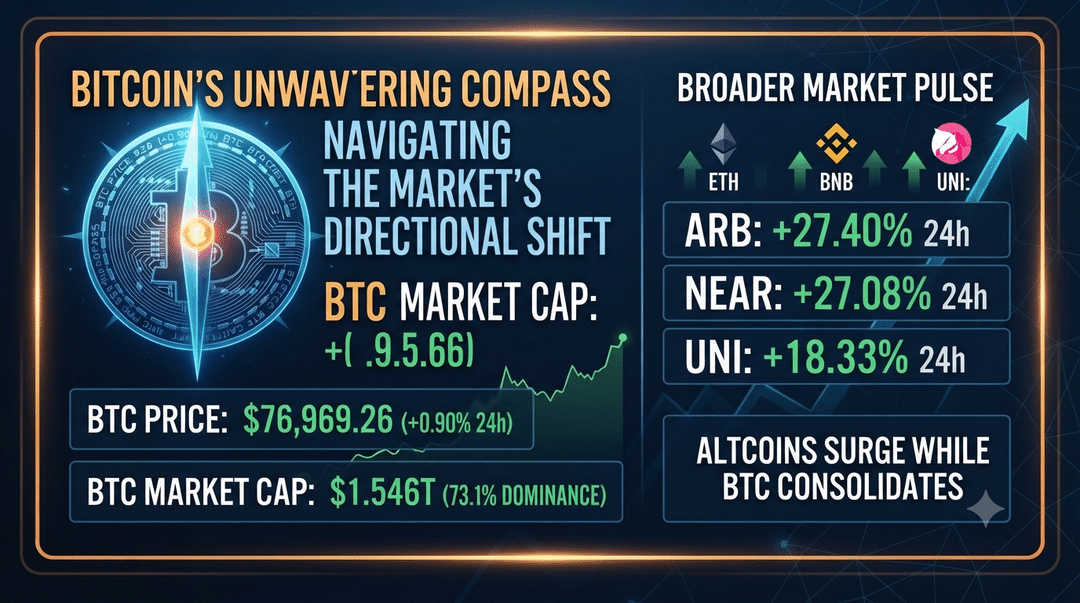
Bitcoin (BTC) currently trades at approximately $76,969.26, maintaining its position as the top-ranked cryptocurrency by market capitalization. Over the past 24 hours, BTC has registered a modest increase of around 0.90%. Looking at the weekly performance, Bitcoin has shown marginal growth, with a change of approximately 0.04%. This relatively stable short-term price action, particularly over the last seven days, suggests a period of consolidation following recent movements.
Bitcoin's market capitalization stands at a substantial $1.546 trillion, representing a significant portion of the total crypto market cap of $2.115 trillion. This dominance reinforces its status as the bellwether asset, with its movements often preceding or influencing trends across the wider market. Observed facts indicate that despite recent market events, Bitcoin has largely held its ground, absorbing various macro and institutional pressures without significant deviation. This resilience suggests underlying demand or at least a balanced tug-of-war between buying and selling pressures at current levels.
Why Bitcoin Is Driving The Tape
Bitcoin's price structure and overall market influence are currently being shaped by a confluence of institutional, regulatory, and macroeconomic factors. These catalysts, primarily centered around BTC, are dictating the broader market's tone.
A significant institutional development impacting Bitcoin sentiment was the recent performance of Bitcoin ETFs. Following a failed Clarity Act vote, Bitcoin, Ethereum, and XRP ETFs collectively experienced their heaviest single-day drawdown since June, shedding approximately $593 million. This event highlights the sensitivity of institutional investment vehicles to regulatory outcomes and underscores how legislative hurdles can directly translate into negative market pressure for Bitcoin and, by extension, other major cryptocurrencies. The initial optimism surrounding institutional adoption via ETFs is clearly tempered by such setbacks.
Macroeconomic forces, particularly the actions of the Federal Reserve, continue to be a critical driver for Bitcoin. The market has observed Bitcoin absorbing the Fed's first rate increase since 2023, with officials indicating expectations for further tightening. Although Bitcoin's immediate reaction to the rate hike was muted, the broader economic outlook shaped by monetary policy decisions inevitably influences investor appetite for risk assets like cryptocurrencies. Prior to the decision, analyses had largely discounted the odds of a "dovish surprise," with markets pricing in a high probability of a 0.25% rate hike. This expectation management likely contributed to Bitcoin's measured response, as the outcome was largely anticipated.
Regulatory and security concerns also remain pertinent to Bitcoin's narrative. Recent reports indicate a surge in on-chain malware, with suspected Iran-linked actors reportedly embedding directions in Bitcoin transactions. Furthermore, the U.S. Treasury sanctioned Iran’s BitBank for allegedly processing "Hormuz Safe" Bitcoin payments and facilitating the movement of hundreds of millions of dollars in BTC to the IRGC. These events, while not directly impacting Bitcoin's protocol, introduce regulatory scrutiny and reinforce narratives around illicit use, which can affect institutional perception and the broader regulatory environment for digital assets.
On a more fundamental level, the ongoing development of Bitcoin's core software provides a positive undercurrent. The Bitcoin Core 32.0 update, currently in final testing, aims to bring enhancements in speed and security, including faster block checks and changes to how wallets prepare payments. These continuous improvements to Bitcoin's underlying technology reinforce its long-term robustness and security, which are foundational to its value proposition. Additionally, the expansion of self-custodial wallets like Tonkeeper (now Keeper) to support Bitcoin, Ethereum, and Tron, signals growing infrastructure and accessibility, contributing to its fundamental strength.
How The Rest Of The Market Is Responding
The broader cryptocurrency market is largely reacting to Bitcoin's lead, with varying degrees of correlation and independent volatility. While Bitcoin itself has shown relatively stable movement over the past 24 hours (+0.90%) and 7 days (+0.04%), the rest of the market presents a more dynamic picture.
Ethereum (ETH), the second-largest cryptocurrency, mirrors Bitcoin's short-term stability to some extent, recording a 24-hour gain of approximately 1.35% and a 7-day gain of about 0.58%. This indicates a general alignment with Bitcoin's mild upward bias, suggesting that the foundational majors are moving in tandem, albeit with ETH showing slightly more immediate momentum. Other core majors like BNB also posted a 3.45% gain over 24 hours, further supporting a mildly positive short-term bias across the larger cap assets.
However, the most significant moves in the broader market are concentrated in specific altcoins, which are exhibiting substantial independent volatility. Arbitrum (ARB) has surged by approximately 27.40% in 24 hours and 44.64% over seven days, making it one of the top volatile assets. Similarly, Near Protocol (NEAR) has seen a 27.08% increase in 24 hours and 40.63% over the week. Uniswap (UNI) also stands out with an 18.33% 24-hour gain and a 32.69% weekly increase. These considerable percentage changes indicate that capital is flowing into specific narratives or projects within the altcoin space, potentially seeking higher returns once Bitcoin establishes a stable base.
Despite these impressive altcoin rallies, it is observed that these movements typically occur within a market structure where Bitcoin sets the overall risk appetite. While ARB, NEAR, and UNI are showing strong individual momentum, their sustained performance often depends on Bitcoin maintaining its stability or continuing a gradual ascent. Assets like XRP, which saw a 0.77% gain in 24 hours but a 2.63% decline over seven days, illustrate that not all major altcoins are universally confirming the mild positive bias, suggesting selective capital allocation. The overall market, as indicated by derived insights, shows a mildly positive short-term bias across the selected asset basket, with the strongest 24-hour moves clearly concentrated in these high-momentum altcoins.
Conclusion and Risk Management
Bitcoin currently serves as the critical barometer for the cryptocurrency market, with its price structure and associated catalysts dictating the overall sentiment and direction. Observed facts suggest a period of relative stability for BTC, absorbing significant macroeconomic and institutional pressures, including a Federal Reserve rate hike and setbacks for Bitcoin ETFs. This resilience, alongside ongoing fundamental software improvements, paints a picture of a robust underlying asset, even if immediate price appreciation is modest.
The broader market, particularly certain altcoins like ARB, NEAR, and UNI, is demonstrating considerable independent volatility and strong percentage gains. These movements, while notable, are interpreted as occurring within the risk framework established by Bitcoin. Should Bitcoin maintain its current stability or embark on a more definitive trend, these altcoin rallies could either consolidate or extend. Conversely, any significant negative shift in Bitcoin's price structure, especially due to further institutional or macroeconomic headwinds, would likely cascade across the altcoin market.
Looking ahead, the market will likely continue to monitor Bitcoin's reaction to future macroeconomic policy decisions and any further developments regarding institutional adoption, particularly concerning ETF flows and regulatory clarity. While the current short-term bias for the overall market appears mildly positive, participants should be mindful of the inherent volatility. Risk management strategies should acknowledge Bitcoin's foundational role and consider potential impacts from ongoing regulatory scrutiny and broader economic conditions. It is important to remember that past performance is not indicative of future results, and all cryptocurrency investments carry substantial risk. This article does not constitute financial advice.
Source Data Reference
Market Snapshot Input
| Asset | Symbol | Price (USD) | 24h Change | Market Cap (USD) |
|---|---|---|---|---|
| Bitcoin | BTC | 76,969.262561 | 0.90% | 1,545,996,679,965 |
| Arbitrum | ARB | 0.211046 | 27.40% | 1,432,066,875 |
| Near Protocol | NEAR | 3.402662 | 27.08% | 4,446,000,834 |
| Ethereum | ETH | 2,463.728434 | 1.35% | 300,720,058,945 |
| TRON | TRX | 0.335544 | -0.03% | 31,861,433,003 |
| Uniswap | UNI | 7.992934 | 18.33% | 4,964,510,471 |
| Zcash | ZEC | 1,489.205226 | 8.83% | 24,316,143,531 |
| BNB | BNB | 749.361754 | 3.45% | 99,785,377,603 |
| XRP | XRP | 1.308755 | 0.77% | 82,293,450,102 |
| Hyperliquid | HYPE | 86.368738 | 9.00% | 19,212,355,662 |
Trending Headlines Input
- State hackers drive 420% surge in onchain malware, Chainalysis finds
- Bitcoin ETFs Had Their Worst Day Since June Following Failed Clarity Act Vote
- Ethereum Founder Vitalik Buterin Says AI Won’t Doom Crypto Security
- US sanctions Iran’s BitBank, saying it processes ‘Hormuz Safe’ Bitcoin payments
- Bitcoin Bounces as Markets Brace for the Fed’s Next Move
- Bitcoin absorbs Fed rate hike as officials see more tightening
- Bitcoin Core Software Update Aims for Speed and Security Patches
- Revolut says no direct contact from hackers after $3M public ransom demand
- Bitcoin awaits Fed rate decision below $76K as analysis discounts ‘dovish surprise’ odds
- Tonkeeper Becomes Keeper as Wallet Adds Bitcoin, Ethereum, and Tron