Global Market Capitalization
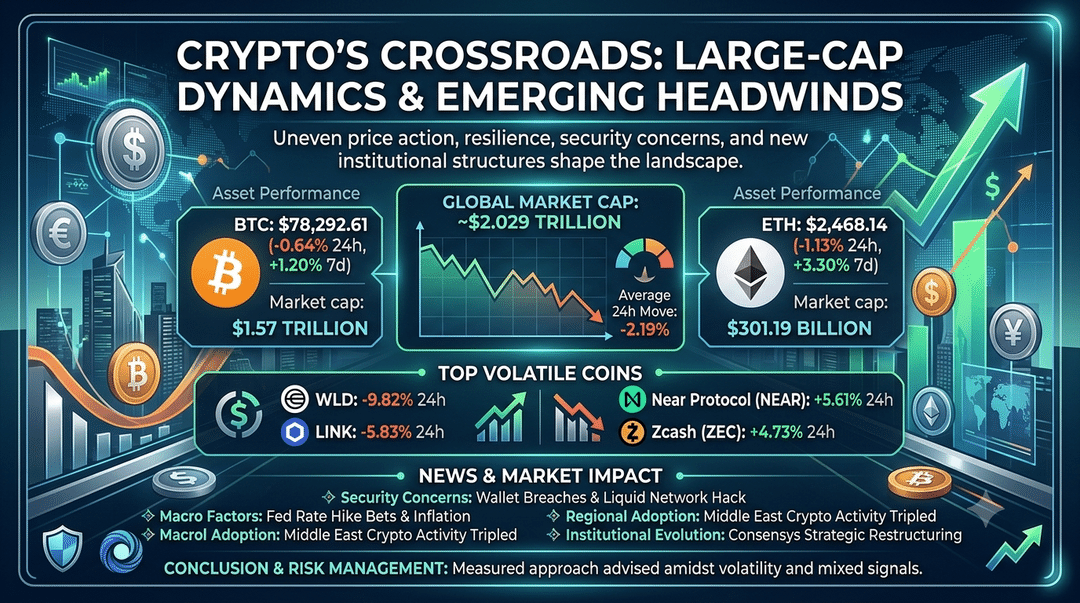
The total cryptocurrency market capitalization stands at approximately $2.029 trillion, reflecting a slightly negative short-term bias across the board, with the average 24-hour move for tracked assets being -2.19%. This indicates a market in a state of mild contraction over the most recent daily period, though longer-term trends for some assets remain positive.
Bitcoin (BTC), the market's leading cryptocurrency, is currently priced at $78,292.61. Over the past 24 hours, BTC experienced a modest decline of -0.64%, yet it maintains a positive weekly trajectory with a 7-day gain of +1.20%. Its substantial market capitalization of $1.57 trillion continues to anchor the digital asset ecosystem, making its movements a primary indicator for overall market health.
Ethereum (ETH), the second-largest cryptocurrency, is trading at $2,468.14. It has seen a 24-hour decrease of -1.13%, slightly underperforming Bitcoin in the immediate term. However, Ethereum has demonstrated stronger weekly growth, posting a +3.30% increase over the last seven days, with a market cap of $301.19 billion. This suggests sustained interest in the Ethereum ecosystem despite recent daily fluctuations.
Among other significant large-cap assets, BNB, ranked 4th, recorded a 24-hour decline of -3.93% to a price of $723.16, with a market cap of $96.29 billion. Dogecoin (DOGE), a prominent meme coin, also saw a -4.89% drop over 24 hours, trading at $0.086 and holding a market cap of $14.75 billion. WhiteBIT Coin (WBT) experienced a minor dip of -0.99% to $80.80, with its market cap at $9.52 billion. These movements highlight a general cooling trend among several top assets in the short term, contrasting with their generally positive weekly performances.
Top Volatile Coins
While the broader market showed a slight downturn, several assets exhibited notable volatility, indicating concentrated trading activity and potentially shifting sentiment. The strongest 24-hour moves were observed in Worldcoin (WLD), Chainlink (LINK), and Near Protocol (NEAR), alongside Zcash (ZEC).
Worldcoin (WLD), ranked 54th, was among the most volatile, experiencing a significant 24-hour decline of -9.82% to a price of $0.413. Despite this sharp daily drop, WLD still holds a positive 7-day change of +11.78%, suggesting that recent selling pressure followed a period of upward momentum. Its market cap stands at $1.51 billion. Such pronounced short-term dips, even within a positive weekly trend, can indicate profit-taking or reactions to specific project-related news not immediately apparent.
Chainlink (LINK), ranked 19th, also saw considerable negative volatility, falling -5.83% over the past 24 hours to $11.78. Its 7-day performance remains positive at +5.91%, with a market cap of $8.81 billion. This pattern, similar to WLD, suggests that LINK is undergoing short-term price discovery or re-evaluation after recent gains.
In contrast to the downward movements, Near Protocol (NEAR) and Zcash (ZEC) demonstrated strong positive volatility. Near Protocol (NEAR), ranked 38th, posted an impressive +5.61% gain in 24 hours, reaching $2.47. This daily surge contributes to a robust +31.76% increase over the past seven days, positioning NEAR as a significant outperformer with a market cap of $3.23 billion. This sustained upward momentum could signal growing investor confidence or specific developments within the Near ecosystem attracting capital.
Zcash (ZEC), ranked 10th, also showed strong upward movement, with a +4.73% increase in 24 hours, trading at $1,242.44. More strikingly, ZEC has recorded a substantial +52.20% gain over the last seven days, indicating a strong bullish trend for the privacy-focused asset, with its market cap now at $20.28 billion. The significant weekly performance of ZEC and NEAR stands out against the general market's mild contraction and suggests that capital is flowing into these specific protocols, potentially driven by project-specific catalysts or renewed interest in their underlying technologies.
News and Market Impact
Recent headlines have introduced a mix of regulatory, security, and institutional developments, primarily impacting Bitcoin and Ethereum, while contributing to the overall market's cautious sentiment.
For Bitcoin (BTC), security concerns have been a recurring theme. News reports indicate that the hardware wallet maker Trezor experienced a breach of its email provider, leading to fake security alerts. Separately, the Liquid Network hack continues to see $47 million still missing, with doubts cast on the "white hat" claims of the actors involved. These incidents, while not directly impacting Bitcoin's protocol, can erode investor confidence in the broader crypto infrastructure and security ecosystem, potentially leading to cautious trading behavior.
Macroeconomic factors also continue to influence Bitcoin's price action. Reports suggest that Bitcoin is "defending its golden zone support" as Wall Street stalls amidst oil shock-revived Federal Reserve rate hike bets. This highlights the ongoing correlation between traditional financial markets and Bitcoin, with upcoming inflation reports and Fed rate decisions keenly watched by crypto investors. Furthermore, a New York town is weighing another ban on crypto mining and AI data centers, which could signal increasing regulatory scrutiny and potential operational challenges for mining operations in certain regions.
More concerning headlines for Bitcoin include a tragic report of a Mexican musician and his family being killed over a Bitcoin cold wallet believed to hold millions. This extreme event underscores the real-world risks associated with holding significant amounts of crypto, particularly for high-net-worth individuals, and could contribute to broader concerns about security and privacy. On a more positive note, a report found that Middle East crypto activity tripled to $350 billion amid ongoing conflict, with increased demand for digital assets to preserve and transfer wealth. This suggests that in certain geopolitical contexts, Bitcoin and other cryptocurrencies are finding utility as safe havens or tools for financial autonomy, presenting a complex and often contradictory narrative for the asset.
For Ethereum (ETH), a significant institutional development has emerged with Consensys announcing its split into two entities: MetaMask, focusing on its consumer business, and a newly formed Consensys, which will handle Ethereum protocols and institutional blockchain infrastructure. This strategic restructuring is likely viewed as a move to streamline operations and better serve distinct market segments. While the immediate price impact on ETH may be mixed, such a move by a prominent ecosystem player could signal a maturation of the institutional crypto space and potentially foster more focused development and adoption of Ethereum-based solutions in the long term.
Conclusion and Risk Management
The current cryptocurrency market presents a complex picture, characterized by a mildly negative short-term bias across many large-cap assets, yet punctuated by strong individual performances in select altcoins. The global market capitalization remains robust, but the average 24-hour price movement indicates a period of slight contraction. Bitcoin and Ethereum, while showing modest daily declines, maintain positive weekly trends, underscoring their foundational roles in the market.
The observed volatility in assets like Worldcoin and Chainlink, alongside the notable upward momentum of Near Protocol and Zcash, highlights a market where capital is actively reallocating. These movements suggest that while major assets consolidate, specific narratives or technological developments are driving significant interest in certain projects.
Recent news flow, particularly concerning Bitcoin, introduces elements of caution, ranging from security breaches and tragic real-world incidents to ongoing macroeconomic uncertainties and potential regulatory headwinds. Conversely, the reported surge in Middle East crypto activity and the strategic restructuring within the Ethereum ecosystem point to underlying growth and maturation in different facets of the industry.
Given these mixed signals, a measured approach to the market remains prudent. Investors should acknowledge the inherent volatility of digital assets and the influence of both macro-economic factors and crypto-specific events. Effective risk management involves understanding individual asset fundamentals, staying informed about market-moving news, and considering diversification to mitigate exposure to single-asset fluctuations. As the market continues to react to both headline-driven catalysts and evolving technical landscapes, maintaining a long-term perspective while adapting to short-term dynamics will be key.
Source Data Reference
Market Snapshot Input
| Asset | Symbol | Price (USD) | 24h Change | Market Cap (USD) |
|---|---|---|---|---|
| Bitcoin | BTC | 78,292.615173 | -0.64% | 1,572,283,572,048 |
| Ethereum | ETH | 2,468.14274 | -1.13% | 301,193,942,366 |
| Zcash | ZEC | 1,242.446562 | 4.73% | 20,287,001,685 |
| Near Protocol | NEAR | 2.47412 | 5.61% | 3,230,923,234 |
| Chainlink | LINK | 11.78393 | -5.83% | 8,815,557,774 |
| Venice Token | VVV | 22.998283 | -5.02% | 1,108,120,813 |
| Worldcoin | WLD | 0.41316 | -9.82% | 1,519,945,065 |
| BNB | BNB | 723.16433 | -3.93% | 96,297,505,234 |
| Dogecoin | DOGE | 0.086078 | -4.89% | 14,756,865,101 |
| WhiteBIT Coin | WBT | 80.805604 | -0.99% | 9,528,594,194 |
Trending Headlines Input
- Mexican Musician and Family Killed Over Bitcoin Cold Wallet Believed to Hold Millions
- Consensys Is Splitting in Two as MetaMask Goes Its Own Way
- $47M Still Missing After Liquid Hack as Blockstream Bargains With 'White Hats'
- Bitcoin Holds, Wall Street Stalls as Oil Shock Revives Fed Hike Bets
- Middle East Crypto Activity Triples to $350 Billion Amid Ongoing Conflict, Report Finds
- Bitcoin Wallet Maker Trezor Says Hackers Breached Its Email Provider
- Consensys to split into MetaMask and institutional blockchain company
- 10 of the greatest unsolved crypto mysteries
- Is Bitcoin too volatile to risk your retirement on?
- New York town weighs crypto mining and AI data center ban