The Core Narrative
The current crypto market narrative is largely defined by a concentrated cluster of themes: persistent security vulnerabilities, an evolving and often uncertain regulatory landscape, and the overarching influence of global macroeconomic pressures. These factors are not isolated but rather intertwine, creating a climate of heightened risk awareness and shaping both institutional and individual engagement with digital assets.
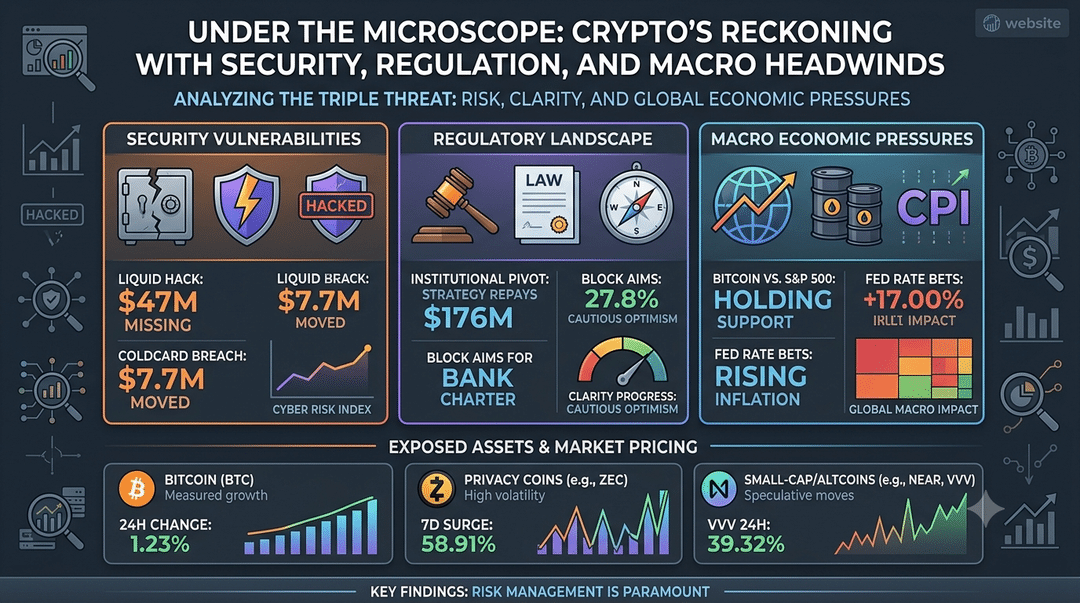
Recent headlines underscore this multi-faceted challenge. On the security front, the crypto space continues to grapple with significant breaches. The Liquid hack, for instance, saw $47 million still missing, with approximately 600 BTC outstanding even after some funds were returned. Similarly, the Coldcard hacker moved $7.7 million, nearly half of a substantial Bitcoin haul, emptying stolen vaults in order of size. These incidents serve as stark reminders of the inherent operational risks in the digital asset ecosystem, raising questions about custodial safety and the resilience of infrastructure. The prevalence of such events, particularly involving Bitcoin, inevitably casts a shadow over broader market confidence, compelling market participants to scrutinize security protocols more rigorously.
Simultaneously, regulatory considerations are deeply influencing market dynamics and corporate strategy. Strategy, a prominent institutional player, recently opted to repurchase $176 million of its preferred shares and doubled its digital securities repurchase program to $2 billion, pausing on new Bitcoin buys. This decision, following a brief return to Bitcoin purchasing, suggests a strategic pivot potentially driven by a re-evaluation of capital allocation in the face of market conditions or pending regulatory clarity. Such moves by institutional entities are closely watched, as they can signal shifts in confidence or a more cautious approach to crypto exposure. Adding to this, Jack Dorsey's Block has applied for a bank charter to custody Bitcoin, aiming to consolidate its custody work under a single regulatory framework. This move highlights a growing trend among crypto firms to seek formal integration into traditional financial systems, driven by a desire for legitimacy, scale, and clear regulatory oversight. The report of Middle East crypto activity tripling to $350 billion amid ongoing conflict also falls into this narrative, demonstrating how geopolitical tensions can drive demand for digital assets as a means of wealth preservation and transfer, simultaneously attracting increased regulatory scrutiny and debate about the role of crypto in conflict zones.
Finally, the macroeconomic environment continues to exert significant influence. Bitcoin's ability to hold its "golden zone support" while the S&P 500 stalls, coupled with renewed Fed hike bets driven by an oil shock, illustrates the persistent interplay between traditional finance and crypto. The market is keenly awaiting Friday's inflation report ahead of the Fed's September 16 rate call, indicating that broader monetary policy and economic stability remain critical determinants of crypto market sentiment. Even localized macro events, such as a quadruple homicide in Mexico allegedly tied to a Bitcoin robbery attempt, underscore the real-world implications and risks associated with high-value digital assets, further contributing to a narrative of external pressures and scrutiny. This confluence of security breaches, a shifting regulatory landscape, and macroeconomic uncertainties forms the bedrock of the current crypto market narrative, demanding a careful evaluation of risk and opportunity.
Which Coins Or Segments Are Most Exposed
Given the dominant narrative, certain assets and segments are demonstrably more exposed to these prevailing themes of security, regulation, and macro pressure.
Bitcoin (BTC) stands at the forefront of this exposure. As the largest cryptocurrency by market capitalization, Bitcoin is consistently the target of high-profile security breaches, as evidenced by the Liquid hack and the Coldcard hacker's activities, both involving substantial amounts of BTC. Its status as the primary institutional entry point also means it is directly affected by corporate strategic shifts, such as Strategy's decision to pause Bitcoin buys, and by regulatory efforts like Block's bank charter application. Furthermore, Bitcoin's perceived role as a "digital gold" or inflation hedge means its price action is closely observed in response to macroeconomic indicators like Fed rate hike bets and inflation reports. Its relatively modest 24-hour gain of 1.23% and 7-day gain of 3.46% might reflect a market digesting these mixed signals, showing some resilience but not outright bullish momentum in the face of uncertainty.
Privacy coins, exemplified by Zcash (ZEC), are inherently exposed to the regulatory narrative. Jurisdictions globally are increasingly scrutinizing cryptocurrencies that offer enhanced anonymity, viewing them as potential tools for illicit finance. While Zcash has seen a significant 24-hour price increase of 9.80% and a 7-day surge of 58.91%, this could be interpreted as speculative interest rather than a clear endorsement of its long-term regulatory viability. The heightened regulatory focus on privacy features means ZEC and similar assets face an elevated risk of delisting or restrictions in certain markets, despite their technological advantages.
Beyond these specific assets, the broader market, particularly smaller-cap and more volatile assets, can be seen as exposed to the general climate of uncertainty. Venice Token (VVV), for example, exhibited a remarkable 24-hour increase of 39.32% and a 7-day gain of 69.78%. Similarly, Near Protocol (NEAR) saw a 24-hour jump of 13.34% and a 7-day rise of 41.38%. While these assets are not directly mentioned in the security or regulatory news, their significant volatility suggests that market participants are either seeking out high-risk, high-reward opportunities amidst broader market indecision, or that these assets are more susceptible to price swings driven by shifts in overall risk appetite that stem from the dominant macro and regulatory narratives. Their price movements could be indicative of a market segment that is highly reactive to the prevailing sentiment of caution and opportunity.
How The Market Is Pricing It
The market appears to be pricing in this complex narrative with a blend of cautious optimism and concentrated volatility, rather than a uniform reaction. While the overall editorial asset basket shows a mildly positive short-term bias, the underlying dynamics reveal a nuanced response to the security, regulatory, and macroeconomic pressures.
Bitcoin (BTC), despite being central to many of the security and institutional headlines, has demonstrated relatively stable, albeit positive, price action. Its 24-hour change of 1.23% and 7-day change of 3.46% indicate a degree of resilience. This could suggest that the market views these security incidents as isolated events or that institutional players, while cautious, are not entirely withdrawing. Jack Dorsey's Block seeking a bank charter, for instance, could be interpreted as a long-term positive for Bitcoin's institutional integration, balancing out immediate concerns from corporate strategy shifts like Strategy's pause on BTC buys. The market's ability to maintain Bitcoin's "golden zone support" amidst Fed hike bets further points to a degree of underlying strength or a wait-and-see approach regarding macro developments.
In contrast, the strongest 24-hour moves are concentrated in Venice Token (VVV), Near Protocol (NEAR), and Zcash (ZEC). VVV surged by 39.32% in 24 hours and 69.78% over seven days, while NEAR gained 13.34% in 24 hours and 41.38% in seven days. ZEC also saw a substantial 9.80% increase in 24 hours and 58.91% over seven days. This pronounced volatility in these assets, particularly VVV and NEAR, which are not directly tied to the dominant news signals, suggests a market segment that is highly reactive to broader sentiment. It could imply that some investors are rotating into higher-beta assets, seeking outsized gains in a market that is otherwise grappling with uncertainty. This behavior might be a form of speculative pricing, where the general "risk-on" appetite for certain altcoins coexists with a more cautious stance on the foundational assets like Bitcoin, which are more directly exposed to the core narrative's challenges.
For Zcash, its significant upward movement, despite its exposure to regulatory scrutiny as a privacy coin, might be interpreted as a short-term speculative play or a belief that its technology offers value irrespective of potential future regulatory hurdles. However, the absence of direct news signals for ZEC's rally means its price action is more likely a reflection of broader market sentiment or technical factors, rather than a direct response to the regulatory narrative. The market is evidently not pricing in a uniform risk premium across all assets; instead, it is exhibiting a bifurcation, with major assets showing measured growth and specific altcoins displaying high volatility, potentially driven by a combination of speculative interest and the general market's ongoing search for direction amidst a complex tapestry of security risks, regulatory considerations, and macroeconomic uncertainties.
Conclusion and Risk Management
The crypto market is currently operating under the pervasive influence of a triple threat: persistent security vulnerabilities, an evolving regulatory landscape, and significant macroeconomic headwinds. This narrative, centered on risk and scrutiny, is the primary lens through which recent market movements can be understood, even if not all price action directly correlates with specific headlines. The ongoing Liquid and Coldcard hacks underscore fundamental security risks, while institutional decisions like Strategy's pause on Bitcoin buys and Block's pursuit of a bank charter highlight the critical role of regulatory clarity and corporate caution. Simultaneously, broader economic indicators continue to exert a gravitational pull, reminding the market that crypto does not exist in a vacuum.
To confirm the continued dominance of this narrative, further high-profile security breaches or successful regulatory enforcement actions would likely reinforce market apprehension and potentially lead to more cautious institutional positioning. Conversely, significant breakthroughs in regulatory clarity, such as the successful granting of Block's bank charter or the establishment of robust, widely adopted security standards, could begin to weaken the narrative's more bearish implications. A sustained period of macroeconomic stability, coupled with a clear signal from central banks, would also help alleviate one of the key pressures on the market.
For market participants, prudent risk management remains paramount. Given the ongoing security threats, a critical assessment of custodial solutions and personal security practices is essential. From a regulatory perspective, staying informed about evolving frameworks and understanding the potential impact on specific assets, particularly those with privacy features like Zcash, is crucial. Investors should recognize that while major assets like Bitcoin may exhibit resilience, the broader market, as shown by the volatility in assets like VVV and NEAR, remains susceptible to sharp movements driven by both speculative interest and the prevailing climate of uncertainty. Diversification, careful position sizing, and a clear understanding of one's risk tolerance in the face of these intertwined narratives are advisable. The market is not merely reacting to news; it is actively pricing in the complex and often unpredictable interplay of security, regulation, and macro forces.
Source Data Reference
Market Snapshot Input
| Asset | Symbol | Price (USD) | 24h Change | Market Cap (USD) |
|---|---|---|---|---|
| Bitcoin | BTC | 79,402.367588 | 1.23% | 1,594,548,897,024 |
| Venice Token | VVV | 26.839633 | 39.32% | 1,292,951,037 |
| Zcash | ZEC | 1,269.438557 | 9.80% | 20,727,734,237 |
| Near Protocol | NEAR | 2.608676 | 13.34% | 3,406,567,817 |
| Ethereum | ETH | 2,502.314887 | 1.22% | 305,364,059,222 |
| Arbitrum | ARB | 0.167304 | -2.78% | 1,117,266,368 |
| Lighter | LIT | 5.118645 | 6.04% | 1,279,661,154 |
| WhiteBIT Coin | WBT | 82.025848 | 2.92% | 9,672,485,274 |
| Chainlink | LINK | 12.135544 | -3.15% | 9,078,599,890 |
| BNB | BNB | 750.873562 | -0.14% | 99,987,354,442 |
Trending Headlines Input
- $47M Still Missing After Liquid Hack as Blockstream Bargains With 'White Hats'
- Bitcoin Holds, Wall Street Stalls as Oil Shock Revives Fed Hike Bets
- Strategy skips Bitcoin buy to repurchase $176M of STRC preferred shares
- Middle East Crypto Activity Triples to $350 Billion Amid Ongoing Conflict, Report Finds
- Coldcard Hacker Moves $7.7M, Nearly Half of Third-Wave Bitcoin Haul
- Strategy's Return to Bitcoin Buying Lasted Exactly One Week
- Jack Dorsey's Block Applies for Bank Charter to Custody Bitcoin
- Mexico quadruple homicide tied to alleged Bitcoin robbery attempt
- Ethereum Foundation names 2 ‘must ship’ EIPs for Hegotá upgrade
- Is Bitcoin too volatile to risk your retirement on?