Bitcoin Price Structure
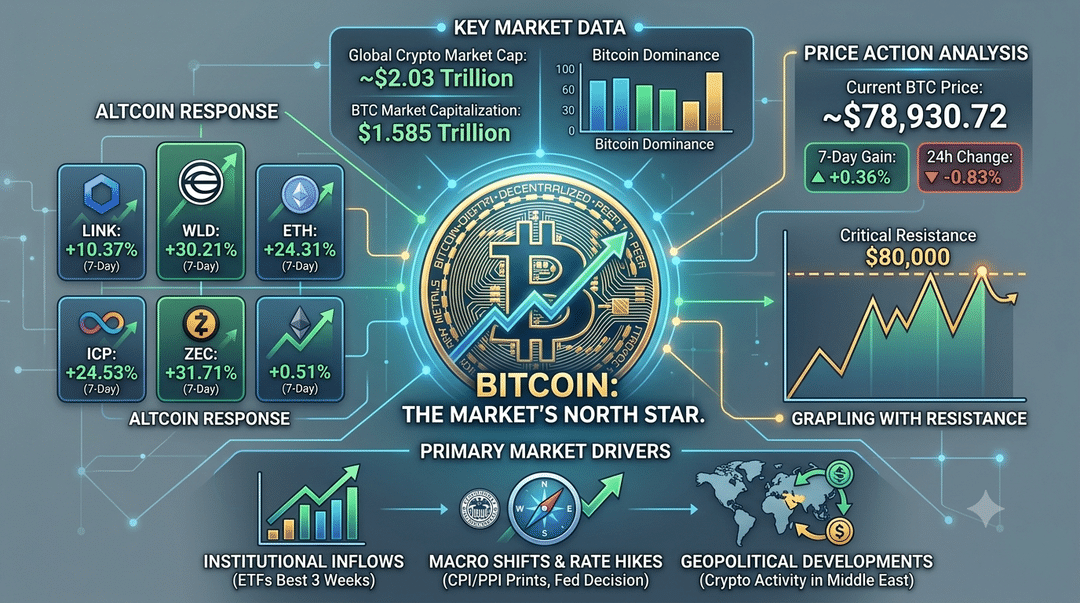
Bitcoin, the leading cryptocurrency by market capitalization, is currently trading at approximately $78,930.72. Over the last 24 hours, BTC has seen a modest decline of -0.83%, while its performance over the past seven days indicates a slight gain of +0.36%. This relatively subdued short-term movement contrasts with its substantial market capitalization of $1.585 trillion and a 24-hour trading volume of approximately $19.21 billion.
A key observation in Bitcoin's recent price action is its persistent struggle to firmly establish the $80,000 mark as a support level. Recent market commentary highlights Bitcoin's challenge in breaking past this threshold, with price movements chipping away at weekend upside attempts. This resistance is further emphasized by instances where a stronger-than-expected jobs report contributed to Bitcoin retreating back under $80,000. This suggests that while Bitcoin maintains its dominant market position, it is navigating a crucial resistance zone, with both technical and fundamental factors influencing its immediate trajectory.
Why Bitcoin Is Driving The Tape
Bitcoin's role as the primary driver of market sentiment is underpinned by a confluence of institutional, macro, and security-related developments. These factors collectively shape its price structure and, by extension, influence the broader crypto ecosystem.
One significant positive signal for Bitcoin comes from institutional investment vehicles. Bitcoin Exchange-Traded Funds (ETFs) have recorded their best three consecutive weeks of inflows in 2026, indicating sustained institutional interest and capital allocation into the asset. This inflow trend, however, is observed to be highly sensitive to broader economic conditions. A report by CoinShares noted that Bitcoin fund flows suggest investors are actively trading the Federal Reserve's rate path rather than exiting the market entirely. This implies that while capital is flowing into BTC products, it is doing so with a keen eye on monetary policy.
Macroeconomic factors are playing a particularly critical role in Bitcoin's current positioning. The market is increasingly tilting towards the possibility of September rate hikes by the Fed. Upcoming Consumer Price Index (CPI) and Producer Price Index (PPI) prints, alongside the Fed's September 16 rate decision, are widely anticipated to be decisive in determining whether Bitcoin can secure $80,000 as a stable support level. The recent retreat from $80,000 following a robust jobs report underscores this sensitivity to economic data and central bank policy.
Geopolitical developments are also contributing to Bitcoin's demand narrative. A recent report indicated that crypto activity in the Middle East has tripled to $350 billion amidst ongoing conflict, with an increased demand for digital assets to preserve and transfer wealth. As the largest and most liquid cryptocurrency, Bitcoin is often the primary beneficiary of such shifts in demand for digital stores of value. Furthermore, the International Monetary Fund (IMF) has reportedly acknowledged that donations funded El Salvador's Bitcoin growth, a notable shift from previous claims and a potential positive for Bitcoin's perception as a sovereign asset.
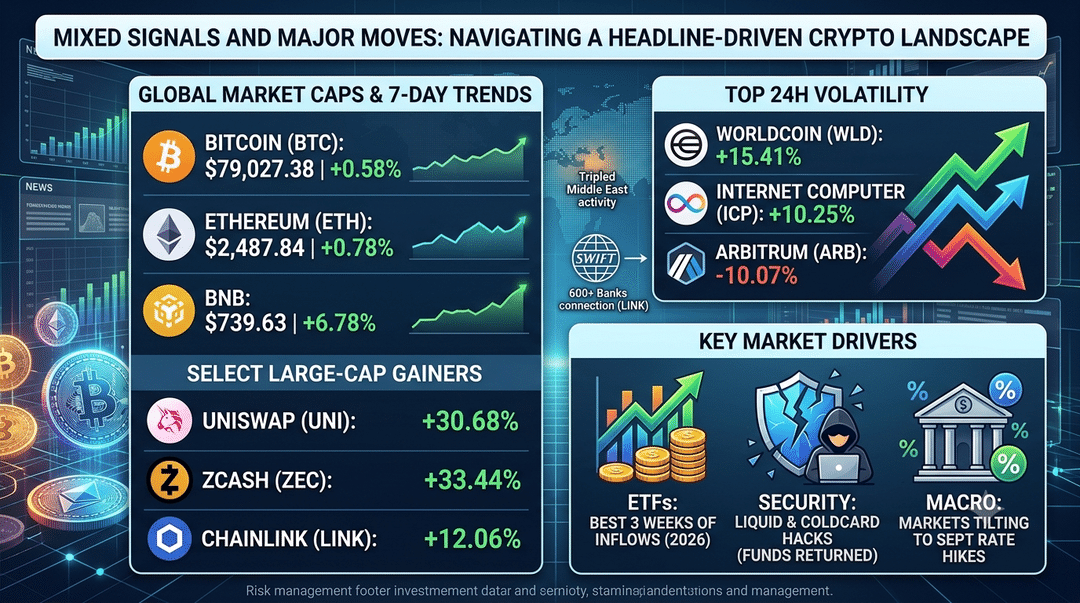
On the security front, recent incidents have introduced a layer of mixed sentiment. Purported "white hat" hackers initially took 4,000 BTC from the Liquid sidechain, a significant security breach. However, a substantial portion, $270 million in Bitcoin, was subsequently returned by the Liquid hackers after Blockstream confirmed patching of the bridge nodes. Simultaneously, a separate incident involved a Coldcard hacker moving $7.7 million in stolen Bitcoin, systematically emptying vaults. While these events highlight ongoing security challenges within the crypto space, the partial return of funds from the Liquid hack offers a nuanced perspective on the resilience and response mechanisms within the Bitcoin ecosystem.
How The Rest Of The Market Is Responding
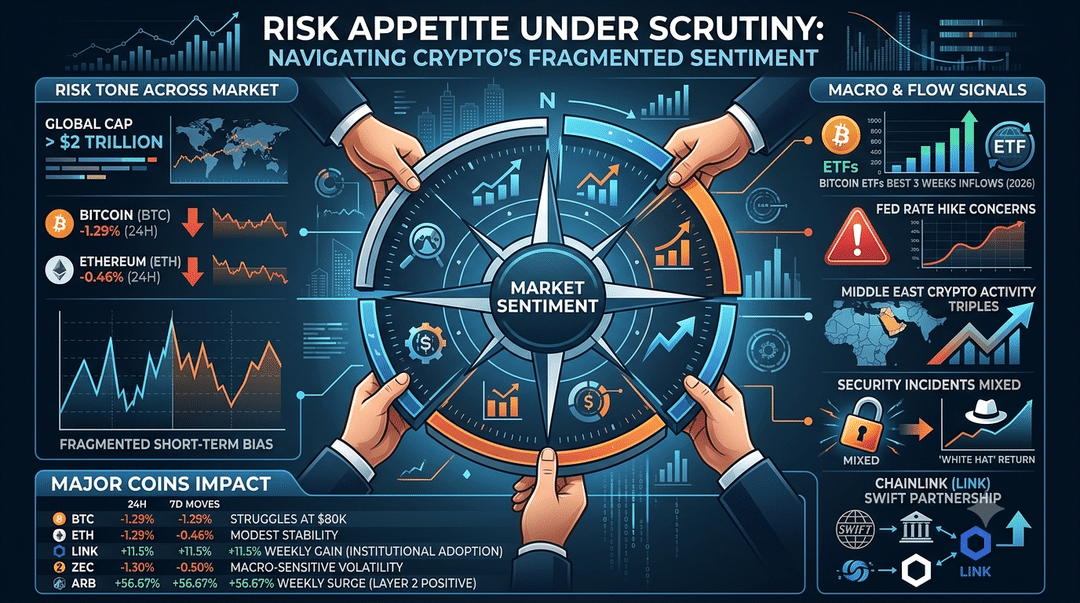
The broader cryptocurrency market's response to Bitcoin's lead is varied, with some assets mirroring BTC's consolidation while others exhibit independent momentum driven by unique catalysts. The overall market shows a mildly positive short-term bias, despite Bitcoin's recent 24-hour dip.
Ethereum (ETH), the second-largest cryptocurrency, largely tracked Bitcoin's recent performance, recording a -0.45% change over 24 hours and a modest +0.51% over seven days. Similarly, BNB saw a -1.01% decline in 24 hours, though it maintained a stronger +6.58% gain over the week. These movements suggest that major cryptocurrencies are generally moving in correlation with Bitcoin, especially during periods of macro uncertainty.
However, several altcoins have demonstrated significant independent volatility. Worldcoin (WLD) emerged as a top performer, surging +15.84% in 24 hours and +30.21% over seven days, indicating strong project-specific momentum not directly tied to immediate BTC movements. Internet Computer (ICP) also showed considerable strength, with a +9.48% increase in 24 hours and +24.53% over the week.
Chainlink (LINK) experienced a -3.51% dip in 24 hours but maintained a robust +10.37% gain over seven days. Its strong weekly performance is directly attributable to specific news: LINK hit an eight-month high after Bottomline, a major SWIFT services provider, tapped Chainlink to connect over 600 banks to blockchain settlement. This highlights how strong fundamental developments can drive altcoin performance even when Bitcoin is consolidating.
Zcash (ZEC) presented a more complex picture. While it saw a -5.08% decline in 24 hours, it posted an impressive +31.71% gain over seven days. Its rally was explicitly linked to a "Fed-driven crypto rally" that quickly reversed after the stronger-than-expected jobs report, which also sent Bitcoin back under $80,000. This illustrates how some altcoins, particularly those with strong narratives, can amplify Bitcoin's macro-driven moves, both to the upside and downside. Other assets like Arbitrum (ARB) and Uniswap (UNI) also showed strong weekly gains (+53.89% and +29.86% respectively) despite experiencing 24-hour pullbacks. WhiteBIT Coin (WBT) posted more moderate gains of +4.11% in 24 hours and +5.30% in 7 days.
The observed market behavior indicates a nuanced environment: while Bitcoin's price structure and macro catalysts provide a foundational context, individual altcoins can carve out significant moves based on their unique narratives or specific market conditions, sometimes amplifying or diverging from Bitcoin's immediate direction.
Conclusion and Risk Management
Bitcoin remains the central pillar of the cryptocurrency market, with its price structure and the surrounding news landscape dictating much of the broader market's ebb and flow. The current environment is characterized by a tug-of-war between strong institutional interest, evidenced by robust ETF inflows, and significant macroeconomic headwinds, particularly the anticipation of Federal Reserve rate decisions and their impact on liquidity. The $80,000 level has emerged as a critical psychological and technical resistance point for BTC, with its ability to establish firm support above it being a key indicator for future market direction.
While Bitcoin navigates these complex dynamics, the rest of the market exhibits a mixed response. Major cryptocurrencies largely track BTC's movements, albeit with varying degrees of correlation. Meanwhile, select altcoins demonstrate considerable independent strength, often propelled by specific project developments or sector-specific narratives, as seen with Chainlink, or by amplifying macro-driven moves, as observed with Zcash. The overall market, despite Bitcoin's short-term consolidation, shows a mildly positive short-term bias, but this sentiment is highly contingent on Bitcoin's ability to overcome its current challenges.
For participants in this market, prudent risk management remains paramount. Monitoring Bitcoin's interaction with the $80,000 resistance and key support levels, alongside upcoming macroeconomic data releases and Federal Reserve communications, will be crucial. Understanding that altcoin volatility can be both a response to Bitcoin's lead and a result of independent factors is essential for navigating this multifaceted landscape. Investors should remain attentive to both the overarching Bitcoin narrative and the specific catalysts driving individual assets, without overstating certainty in a market subject to rapid shifts.
Source Data Reference
Market Snapshot Input
| Asset | Symbol | Price (USD) | 24h Change | Market Cap (USD) |
|---|---|---|---|---|
| Bitcoin | BTC | 78,930.724785 | -0.83% | 1,585,030,063,937 |
| Worldcoin | WLD | 0.481007 | 15.84% | 1,768,795,359 |
| Chainlink | LINK | 12.622618 | -3.51% | 9,442,980,236 |
| Zcash | ZEC | 1,127.192384 | -5.08% | 18,405,100,464 |
| Arbitrum | ARB | 0.169654 | -3.81% | 1,132,961,481 |
| Internet Computer | ICP | 3.011861 | 9.48% | 1,675,343,288 |
| Uniswap | UNI | 7.001395 | -0.20% | 4,363,356,171 |
| WhiteBIT Coin | WBT | 76.376349 | 4.11% | 9,009,050,019 |
| BNB | BNB | 738.730329 | -1.01% | 98,370,549,524 |
| Ethereum | ETH | 2,484.282936 | -0.45% | 303,156,313,837 |
Trending Headlines Input
- ‘White hats’ take 4000 BTC from Liquid, ETFs see best inflows of 2026: Hodler’s Digest
- Middle East Crypto Activity Triples to $350 Billion Amid Ongoing Conflict, Report Finds
- Coldcard Hacker Moves $7.7M, Nearly Half of Third-Wave Bitcoin Haul
- Liquid Hackers Return $270M in Bitcoin After Swiping $320 Million
- Yen intervention meets US inflation data: Five things to know in Bitcoin this week
- IMF Now Says Donations Funded El Salvador's Bitcoin Growth
- Bitcoin fund flows show investors trading Fed rate path, not exiting market: CoinShares
- Bitcoin chips away at weekend upside as $80K hangs in the balance
- Zcash Hits Highest Price in Nearly a Decade, Crushing Short Bets
- Bitcoin Starts the Week Flat, But Chainlink Is Flying—Here's Why