Global Market Capitalization
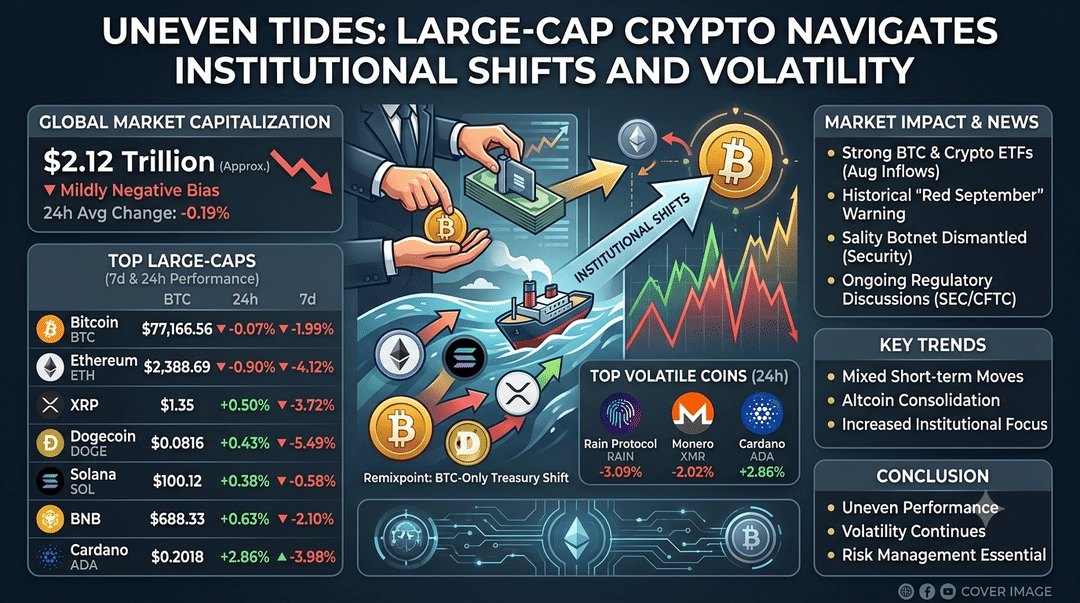
The broader cryptocurrency market currently reflects a landscape of mixed signals, with the global market capitalization standing at approximately $2.12 trillion. The average 24-hour price movement across the market indicates a mildly negative short-term bias, with an average change of -0.19%. While this suggests a period of consolidation or slight retraction, individual asset performance shows considerable divergence, particularly among the large-cap contenders.
Bitcoin (BTC), the market's leading asset, is trading at approximately $77,166.56. Over the last 24 hours, BTC registered a modest decline of -0.07%, while its seven-day performance shows a more pronounced dip of -1.99%. Despite these short-term movements, Bitcoin maintains its dominant market capitalization of over $1.54 trillion, underscoring its foundational role in the crypto ecosystem.
Ethereum (ETH), the second-largest cryptocurrency by market cap, mirrors some of Bitcoin's short-term softness. ETH is priced around $2,388.69, experiencing a -0.90% decrease over the past 24 hours and a -4.12% decline across the last seven days. Its market capitalization remains substantial at over $291 billion.
Among other significant large-cap assets, XRP demonstrated a positive 24-hour movement, gaining 0.50% to trade at approximately $1.35. However, its seven-day performance aligns with the broader downtrend, showing a -3.72% decrease. Dogecoin (DOGE) also posted a slight gain of 0.43% in the last 24 hours, reaching $0.0816, but like XRP, it recorded a more substantial -5.49% loss over the past week.
Solana (SOL) showed a marginal 24-hour increase of 0.38%, priced at $100.12, but was down -0.58% over seven days. BNB, ranked fourth by market cap, saw a 0.63% increase over 24 hours to $688.33, though it also experienced a -2.10% dip over the week. Uniswap (UNI), despite a -0.64% 24-hour change, stands out with an impressive 34.34% gain over the last seven days, indicating strong recent momentum amidst a generally flat market. Conversely, Monero (XMR) posted a -2.02% 24-hour decline, yet recorded a robust 12.89% increase over the past week. Cardano (ADA) registered a notable 2.86% gain in the last 24 hours, even as its weekly performance was down -3.98%. Rain Protocol (RAIN) saw a 24-hour decline of -3.09% and a 7-day drop of -4.31%.
Overall, the large-cap segment is characterized by a mix of minor daily fluctuations and more consistent negative trends over the seven-day period for most major assets, with a few notable exceptions like UNI and XMR showing strong weekly performance.
Top Volatile Coins
In the last 24 hours, several assets within the broader market have exhibited heightened volatility, drawing attention beyond the core large-cap movements. The strongest short-term moves are concentrated in Rain Protocol (RAIN), Cardano (ADA), and Monero (XMR), indicating specific catalysts or focused trading activity around these assets.
Rain Protocol (RAIN) registered the most significant decline among the top volatile assets, with a 24-hour price change of -3.09%. Trading at approximately $0.0167, RAIN also experienced a negative seven-day performance, down -4.31%. Despite its rank at 13 by market capitalization, its relatively lower trading volume compared to top-tier assets means that price movements can be more pronounced. Such a decline could be indicative of profit-taking or a reaction to specific project developments, though no immediate external cause is evident from the provided data.
On the positive side, Cardano (ADA) recorded a substantial 24-hour gain of 2.86%, pushing its price to around $0.2018. This upward movement stands in contrast to its seven-day performance, which shows a -3.98% decrease. ADA's volatility suggests a potential rebound or increased buying interest following its recent weekly dip, possibly driven by ecosystem news or technical factors specific to the Cardano network.
Monero (XMR), a privacy-focused cryptocurrency, also experienced notable volatility, with a 24-hour decrease of -2.02%, bringing its price to approximately $494.07. However, it is crucial to note that XMR has demonstrated strong performance over the past seven days, recording an impressive 12.89% increase. This suggests that the recent 24-hour dip might be a short-term correction after a period of significant upward momentum, rather than a reversal of its weekly trend. The sustained positive weekly performance for XMR could be linked to ongoing discussions around privacy coins or specific market dynamics influencing its niche.
These movements highlight that while the overall market sentiment might be mildly negative, individual assets can experience significant, sometimes counter-trending, price action. Such volatility can create opportunities but also carries elevated risk, particularly for assets outside the very top market capitalization ranks.
News and Market Impact
Recent headlines provide crucial context for the observed price actions and overall market sentiment, particularly concerning institutional involvement and regulatory discussions.
A significant development comes from Japan, where the company Remixpoint announced a strategic shift to a Bitcoin-only treasury. Remixpoint reportedly sold its holdings in Ethereum (ETH), Solana (SOL), XRP, and Dogecoin (DOGE), booking a profit and leaving approximately 1,506 BTC as its sole cryptocurrency asset. This move, highlighted by both Decrypt and Cointelegraph, is a strong signal of institutional preference for Bitcoin as a store of value and strategic asset, potentially at the expense of other large-cap altcoins. While the immediate market impact on the individual altcoins sold might be subtle, the narrative reinforces Bitcoin's position and could influence other corporate treasury strategies.
In a more broadly positive institutional trend, Bitcoin ETFs had their best month in 2026, with BTC gaining approximately 25% in August. US spot Bitcoin ETFs significantly reduced their year-to-date net outflows. Furthermore, Ether ETFs turned positive year-to-date with $732 million in inflows, and XRP ETFs reached $502 million. This data indicates growing institutional acceptance and investment into diversified crypto exposure through regulated products, which could provide underlying support for these assets despite short-term price fluctuations.
However, a cautionary narrative has emerged with discussions around "Red September," a historical pattern where Bitcoin has often lost ground in September. Decrypt noted that Bitcoin has declined in eight of the last 13 Septembers, a trend that mirrors similar seasonal weakness in traditional stock markets. While historical patterns are not guarantees, this narrative can contribute to a cautious sentiment among traders as the market enters the new month, potentially dampening upward momentum.
Security remains a perennial concern in the crypto space. The Sality Botnet, responsible for stealing Bitcoin and Ethereum over eight years, was reportedly dismantled by CrowdStrike and the DOJ. This operation, which isolated over 15,000 infected machines, is a positive development for ecosystem security, potentially reducing illicit activities that could undermine confidence in the digital asset space.
Regulatory discussions continue to shape the broader financial landscape. Ondo has urged the SEC and CFTC to consider bringing US stock perpetuals onshore, suggesting that existing US securities laws could accommodate such derivatives. While not directly impacting crypto assets, this reflects ongoing efforts to regulate and integrate novel financial products, which could eventually set precedents for crypto derivatives.
Finally, a different perspective on the two largest cryptocurrencies was offered by Arthur Hayes, who predicted Bitcoin would hit $1 million by 2030 but stated he is buying Ethereum instead due to its potential for a quicker "3x to 5x" increase. Such high-profile endorsements, even with differing asset preferences, can influence market narratives and investor allocations.
Conclusion and Risk Management
The current cryptocurrency market presents a complex picture, characterized by a blend of institutional shifts, varying asset performance, and impactful news cycles. The overall market capitalization reflects a state of mild contraction in the short term, with the average 24-hour move for the selected editorial asset basket showing a mildly negative bias. This suggests a period where broad upward momentum is limited, and investors are reacting to specific developments rather than a unified market surge.
Large-cap assets like Bitcoin and Ethereum have experienced slight short-term dips, though their foundational market positions remain unchallenged. The institutional move by Remixpoint to divest from altcoins in favor of a Bitcoin-only treasury highlights a growing, albeit selective, institutional conviction in BTC. Conversely, the success of Bitcoin, Ethereum, and XRP ETFs in August points to increasing mainstream acceptance and regulated investment pathways, which could provide long-term stability and growth.
The strongest 24-hour moves have been concentrated in assets such as Rain Protocol (RAIN), Cardano (ADA), and Monero (XMR). While ADA saw a notable daily gain, RAIN and XMR experienced declines, with XMR notably correcting after a strong weekly performance. These concentrated movements underscore the inherent volatility beyond the top two assets, where smaller market caps and specific project news can lead to more dramatic price swings.
Looking ahead, the "Red September" historical pattern serves as a reminder of potential seasonal headwinds, emphasizing the importance of a cautious approach. Developments in security, such as the dismantling of the Sality Botnet, are positive for the ecosystem's integrity, while ongoing regulatory discussions, though not always directly impacting crypto, shape the broader financial environment in which digital assets operate.
Given the mixed signals and uneven performance, effective risk management remains paramount. Investors should consider the inherent volatility of the crypto market, especially when evaluating altcoins that may be subject to more pronounced price swings. Diversification, careful position sizing, and staying informed about both macro trends and specific asset developments are crucial strategies. It is important to distinguish between observed facts and speculative interpretations, maintaining a balanced and evidence-based perspective without overstating certainty or fabricating causes. As always, this analysis does not constitute financial advice, and individuals should conduct their own research before making investment decisions.
Source Data Reference
Market Snapshot Input
| Asset | Symbol | Price (USD) | 24h Change | Market Cap (USD) |
|---|---|---|---|---|
| Bitcoin | BTC | 77,166.561729 | -0.07% | 1,549,417,052,637 |
| Ethereum | ETH | 2,388.690212 | -0.90% | 291,449,378,910 |
| XRP | XRP | 1.348874 | 0.50% | 84,634,423,659 |
| Dogecoin | DOGE | 0.081645 | 0.43% | 13,996,874,720 |
| Solana | SOL | 100.115584 | 0.38% | 58,595,176,880 |
| Uniswap | UNI | 5.837072 | -0.64% | 3,650,175,563 |
| Monero | XMR | 494.074985 | -2.02% | 9,288,402,700 |
| Cardano | ADA | 0.201849 | 2.86% | 7,842,490,072 |
| Rain Protocol | RAIN | 0.016739 | -3.09% | 11,871,343,940 |
| BNB | BNB | 688.329997 | 0.63% | 91,659,560,135 |
Trending Headlines Input
- Japan’s Remixpoint Dumps Ethereum, XRP in Shift to Bitcoin-Only Treasury
- Japan’s Remixpoint dumps altcoins, leaves 1,506 BTC as sole crypto bet
- Bitcoin ETFs notch best month of 2026 as BTC gains 25% in August
- What Is 'Red September'? Bitcoin's Curse, and Why Wall Street Has the Same One
- Sality Botnet Dismantled After Eight Years of Stealing Bitcoin and Ethereum
- Ondo urges SEC, CFTC to bring US stock perpetuals onshore
- Anthropic Admits Security Failures Behind Claude Hacking Incidents
- Is Bitcoin About to Flash Crash? What a 'Bart Simpson' Pattern Would Actually Take
- OpenAI's Astra Becomes Its First AI Model With 'Critical' Hacking Abilities
- BTC will hit $1M by 2030... but Arthur Hayes is buying ETH instead