Bitcoin Price Structure
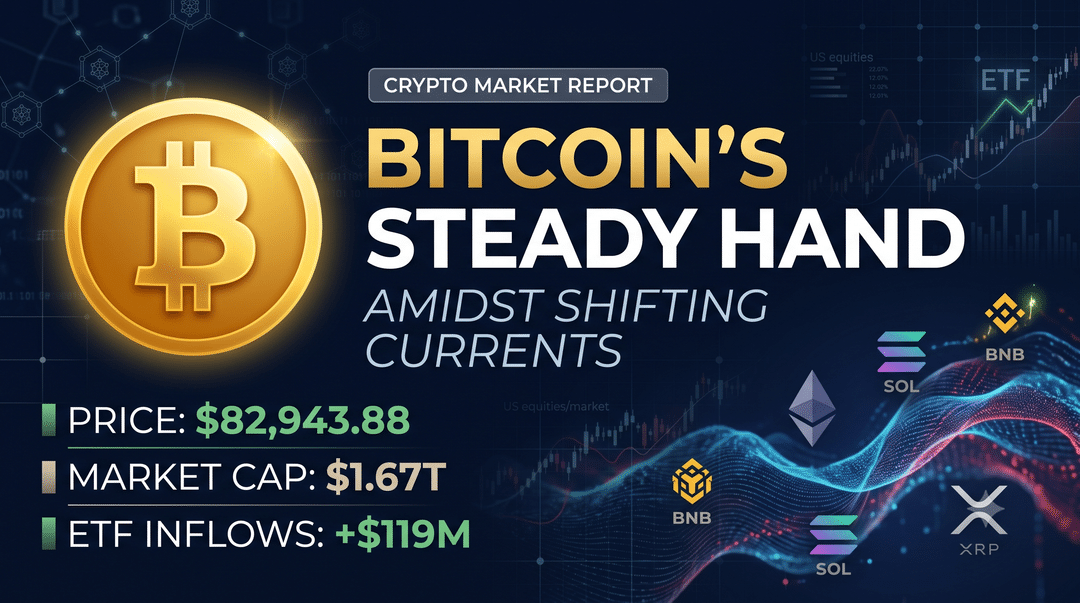
Bitcoin (BTC) is currently trading at approximately $80,882.28. In the last 24 hours, BTC has seen a modest positive change of 0.06%, demonstrating relative stability in the very short term. However, looking at the weekly performance, Bitcoin has experienced a slight decline of 1.14%. This suggests a period of consolidation or minor pullback following recent movements.
Bitcoin's market capitalization remains substantial at roughly $1.626 trillion, supported by a 24-hour trading volume of approximately $15.97 billion. This considerable market cap and robust trading volume highlight Bitcoin's liquidity and its status as the leading digital asset. Its performance often serves as a bellwether for the entire crypto ecosystem, with other assets frequently correlating with its movements. While the 24-hour change indicates a momentary pause, the weekly dip suggests that underlying factors are creating a more cautious environment for the primary cryptocurrency.
Why Bitcoin Is Driving The Tape
Bitcoin's market trajectory is currently being shaped by a confluence of institutional capital movements and broader macroeconomic forces. The dynamics of spot Bitcoin Exchange-Traded Funds (ETFs) have emerged as a significant short-term catalyst, illustrating the increasing integration of digital assets into traditional finance.
Recent data reveals a volatile pattern in ETF flows. On one hand, institutional interest saw spot Bitcoin ETFs attract approximately $1.07 billion over three sessions, effectively erasing earlier October losses and pushing monthly flows into a gain of roughly $460 million. This influx signals robust demand from institutional investors, underpinning Bitcoin's price support. Conversely, the market also observed a substantial outflow, with Bitcoin ETFs bleeding $635.6 million on a single Thursday, marking the largest daily outflow for the month and pushing October's net flows back into a loss of about $176 million. These dramatic swings in ETF flows underscore the sensitivity of Bitcoin's price to institutional sentiment and capital allocation decisions. The presence of a Singapore firm behind Europe's only spot Bitcoin ETF and Switzerland's deepening crypto ties with Vietnam further highlights the global expansion of institutional engagement with Bitcoin.
Beyond direct investment vehicles, macroeconomic conditions are increasingly influencing Bitcoin's performance. The price of Brent crude oil hitting its highest level since March, and oil climbing above $111, reflects broader inflationary pressures and geopolitical concerns. This macro environment, coupled with a slide in AI stocks dragging down the S&P 500 and global markets, suggests that Bitcoin is not immune to traditional market headwinds. Its quest for support above the $81,000 mark has been observed in conjunction with these wider market dips, indicating a growing correlation between crypto and traditional asset classes.
Furthermore, ongoing developments within the Bitcoin protocol itself contribute to its long-term stability and perceived value. The Bitcoin Core team's decision to rewrite its security policy to address AI-driven bug discovery, moving to immediate fixes for "easily discoverable" flaws, demonstrates a proactive approach to maintaining network integrity in an evolving technological landscape. Additionally, Bitcoin's hashrate has reached a seven-month high, indicating continued strength and security of the network despite the industry's partial shift towards AI in mining. These fundamental strengths provide a backdrop of resilience, even as price action reacts to external financial and economic pressures.
How The Rest Of The Market Is Responding
The broader cryptocurrency market is largely reacting to Bitcoin's lead, albeit with varying degrees of correlation and independent movement among different assets. While Bitcoin's stability or volatility tends to set the overall tone, specific altcoins exhibit distinct responses.
Ethereum (ETH), the second-largest cryptocurrency by market capitalization, has shown some sensitivity to the same institutional flows impacting Bitcoin. When Bitcoin ETFs experienced significant outflows, Ethereum funds also registered losses. ETH's price currently sits at approximately $2,364.16, reflecting a 24-hour decline of 0.63% and a 7-day drop of 2.36%. Its market capitalization is around $288.81 billion. Beyond these broader market sentiments, the Ethereum ecosystem has also contended with asset-specific security incidents, such as the Cysic exploit involving ETH and BNB, and the Initia blockchain halt due to an exploit, which saw assets transferred to Ethereum. These events, while not market-wide drivers, can impact investor confidence in specific network security.
Solana (SOL) has also been observed to follow the trend of institutional capital, being mentioned alongside Ethereum in the context of ETF outflows. Currently, SOL trades at approximately $102.37, with a 24-hour change of -0.17% and a 7-day change of -1.81%. Its market cap is around $60.38 billion.
BNB, on the other hand, has demonstrated relative resilience in the short term. Trading at about $744.90, BNB has recorded a 24-hour gain of 0.75% and a more notable 7-day increase of 3.29%. Its market capitalization is approximately $97.96 billion. This performance suggests some decoupling from the broader negative trend seen in BTC, ETH, and SOL over the past week, potentially due to ecosystem-specific developments or independent demand.
Among the top volatile assets, Monero (XMR) and Zcash (ZEC) have shown significant independent positive movements. XMR surged by 6.18% in 24 hours and 1.68% over seven days, trading around $614.84. ZEC also saw a 3.63% increase in 24 hours and a 5.74% gain over seven days, reaching approximately $1,213.08. These privacy-focused coins often exhibit volatility driven by factors distinct from mainstream institutional flows. Conversely, Near Protocol (NEAR) experienced a notable downturn, with a 24-hour decline of 3.60% and an 11.17% drop over seven days, pricing it around $4.46. The strongest 24-hour moves are indeed concentrated in these assets—XMR, ZEC, and NEAR—indicating that while Bitcoin anchors the market, a segment of altcoins continues to be influenced by project-specific news, technical developments, or lower liquidity, leading to more pronounced independent price action.
Conclusion and Risk Management
Bitcoin's position as the primary driver of the cryptocurrency market remains undisputed. Its price structure, heavily influenced by the ebb and flow of institutional capital through spot ETFs and broader macroeconomic shifts, sets the prevailing tone. The recent oscillation between significant ETF inflows and outflows underscores a market that is both highly engaged by traditional finance and acutely sensitive to its shifting sentiments. Furthermore, the increasing correlation between Bitcoin's performance and macro indicators like oil prices and traditional stock market movements suggests a maturing asset class that is more intertwined with global economic narratives than ever before.
While Bitcoin navigates these complex dynamics, the rest of the market responds in kind. Major altcoins like Ethereum and Solana often mirror Bitcoin's reactions to institutional capital movements, indicating a shared sensitivity to large-scale investment trends. However, some assets, such as BNB, show periods of relative strength, while others like Monero, Zcash, and Near Protocol demonstrate significant independent volatility, likely driven by project-specific factors or unique market niches. Despite some recent positive short-term movements across the broader market, the overarching sentiment remains highly sensitive to Bitcoin's trajectory.
For participants in this market, robust risk management is crucial. The observed volatility in ETF flows highlights the potential for rapid price changes, influenced by institutional decisions that can shift quickly. The growing impact of macroeconomic factors means that external economic indicators, beyond crypto-specific news, warrant close attention. Diversification, understanding individual asset fundamentals, and maintaining awareness of both Bitcoin's macro drivers and altcoin-specific catalysts are key. It is essential to acknowledge that past performance is not indicative of future results, and market conditions can change rapidly. This analysis provides an overview of current market dynamics and does not constitute financial advice.
Source Data Reference
Market Snapshot Input
| Asset | Symbol | Price (USD) | 24h Change | Market Cap (USD) |
|---|---|---|---|---|
| Bitcoin | BTC | 80,882.279842 | 0.06% | 1,625,987,876,056 |
| Ethereum | ETH | 2,364.164971 | -0.63% | 288,809,407,144 |
| Solana | SOL | 102.372534 | -0.17% | 60,375,668,159 |
| BNB | BNB | 744.900124 | 0.75% | 97,963,127,824 |
| Near Protocol | NEAR | 4.459273 | -3.60% | 5,841,082,339 |
| Monero | XMR | 614.838606 | 6.18% | 11,572,543,278 |
| Zcash | ZEC | 1,213.081198 | 3.63% | 19,807,516,123 |
| Cardano | ADA | 0.207795 | -1.82% | 8,093,851,353 |
| XRP | XRP | 1.309432 | 1.42% | 82,954,062,133 |
| Chainlink | LINK | 11.58971 | -2.06% | 8,887,568,717 |
Trending Headlines Input
- Bitcoin ETFs Bleed $636 Million as October Turns Red Again
- Bitcoin ETFs Erase October Losses With $1 Billion in Three Days
- Bitcoin Core Rewrites Its Security Policy for a World Where AI Finds Bugs in One Prompt
- New DeepSeek ban in US, Swiss-Asia crypto ties deepen: Asia Express
- Cysic dangles a 10% bounty, hacker pours loot into Tornado Cash
- Initia halts blockchain after exploit reportedly drains over $2.6M
- Bitcoin seeks support above $81K as Brent crude oil hits highest level since March
- Oil Climbs Above $111 as AI Stocks Slide, Dragging the S&P 500 and Global Markets With Them
- What Is a Bitcoin-Backed Loan? Borrowing Against BTC Explained
- Bitcoin hashrate hits seven-month high as AI shift fails to ease mining competition