Global Market Capitalization
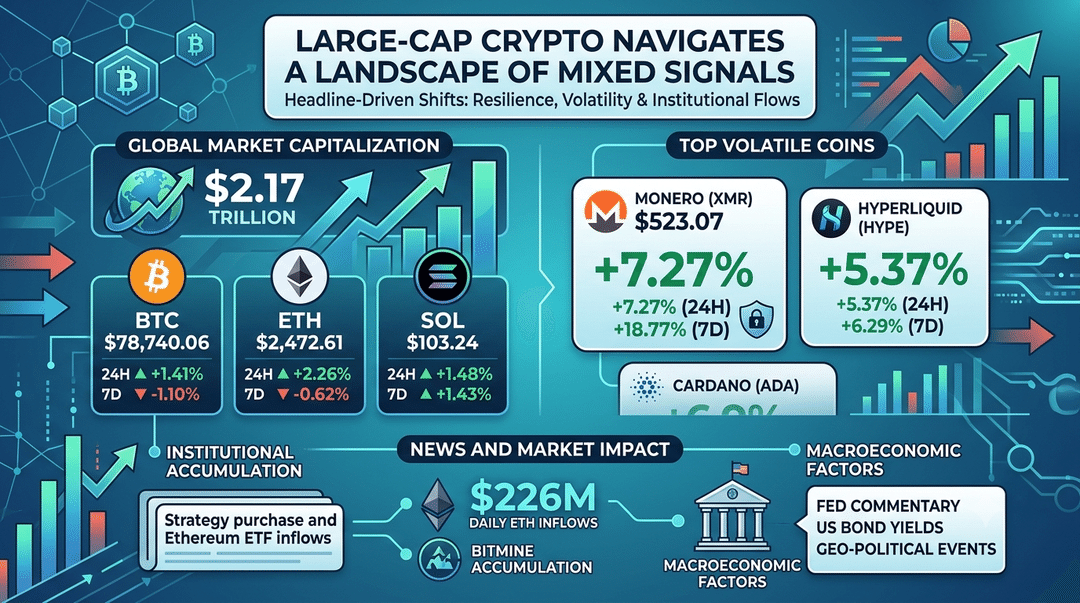
The aggregate cryptocurrency market capitalization stands at approximately $2.17 trillion, indicating a significant but nuanced landscape. Over the past 24 hours, the market has seen an average move of about 2.79%, suggesting a mildly positive short-term bias across the selected asset basket, though individual performances vary.
Bitcoin (BTC), the largest cryptocurrency by market capitalization, is trading at approximately $78,740.06. It recorded a 24-hour gain of 1.41%, yet it has seen a slight decline of 1.10% over the past seven days. This suggests a recent recovery after a period of minor downward pressure, maintaining its dominant position with a market cap of over $1.58 trillion.
Ethereum (ETH), the second-largest asset, shows a stronger short-term performance, trading around $2,472.61 with a 24-hour increase of 2.26%. Its seven-day performance, however, mirrors Bitcoin's trend with a modest 0.62% decrease. Ethereum's market capitalization remains substantial at approximately $298.40 billion.
Solana (SOL) has also posted positive movement, priced at approximately $103.24. It recorded a 24-hour gain of 1.48% and a 7-day increase of 1.43%, indicating sustained positive momentum over the past week. Solana's market cap is around $60.41 billion, positioning it as a significant player in the ecosystem.
Monero (XMR), a privacy-focused cryptocurrency, has demonstrated particularly strong performance. Trading at approximately $523.07, XMR surged by 7.27% in the last 24 hours and a notable 18.77% over the past seven days, reaching a market capitalization of about $9.83 billion. This significant upward trajectory distinguishes it from many other large-cap assets in the short term.
Other large-cap assets have also shown varied performance. BNB, ranked 4th, saw a 24-hour increase of 1.20% but a 7-day decrease of 2.36%. XRP, ranked 5th, gained 2.13% in 24 hours but is down 7.94% over seven days. Hyperliquid (HYPE), ranked 10th, recorded a 24-hour gain of 5.37% and a 7-day gain of 6.29%, indicating consistent growth. Cardano (ADA) experienced a 24-hour gain of 2.91% but a significant 7-day decline of 11.39%. Chainlink (LINK) gained 2.05% in 24 hours but fell 3.16% over the week, while Avalanche (AVAX) was up 1.82% in 24 hours but down 4.66% over seven days. These movements underscore a market characterized by selective strength rather than uniform bullishness.
Top Volatile Coins
While the overall market shows a mixed short-term bias, a few assets have exhibited particularly strong movements in the last 24 hours, driving narratives of focused interest or specific market reactions. The strongest 24-hour moves are concentrated in Monero (XMR), Hyperliquid (HYPE), and Cardano (ADA).
Monero (XMR) leads this group, showcasing a substantial 24-hour price increase of 7.27%. This follows an even more impressive 18.77% gain over the past seven days. Such sustained upward momentum for a privacy coin like Monero suggests a potential resurgence in demand for privacy-centric digital assets or a reaction to specific, though unstated, market catalysts. Its market cap is now approximately $9.83 billion.
Hyperliquid (HYPE) also stands out with a 24-hour increase of 5.37%, building on a 6.29% gain over the last week. This consistent positive performance points to growing interest or positive developments specific to the Hyperliquid ecosystem, leading to its current market cap of approximately $18.77 billion.
Cardano (ADA) recorded a 24-hour gain of 2.91%. However, it is important to note this comes after a significant 7-day decline of 11.39%. This suggests that while ADA experienced a short-term rebound, it is still navigating a period of broader downward pressure over the weekly timeframe. Its market cap is around $7.72 billion. The distinct performances of these volatile assets underscore the diverse factors influencing various segments of the crypto market.
News and Market Impact
Recent headlines have provided significant context for the market's movements, particularly concerning institutional activity and macroeconomic factors. A recurring theme has been the evolving role of institutional capital and traditional finance in the crypto space.
Bitcoin (BTC) has been a central figure in recent news. Strategy, a prominent corporate entity, reportedly purchased $370 million worth of Bitcoin, marking its first corporate acquisition since June. This move signals continued institutional accumulation and conviction in Bitcoin's long-term value, potentially contributing to its recent price stability and rebound from earlier dips. Despite this, spot Bitcoin ETFs experienced a $201.9 million outflow on August 28, interrupting a nine-day streak of inflows. This suggests a degree of uneven sentiment among institutional investors in the short term, with some profit-taking or reallocation occurring. Bitcoin also held steady above $78,000 even as broader US stocks reacted to geopolitical events, demonstrating a degree of decoupling from traditional markets in certain scenarios. However, Bitcoin's price action also saw sharp moves around its monthly close, influenced by discussions surrounding US bond yields and Federal Reserve commentary, which remained wary of inflation trends.
Ethereum (ETH) has demonstrated a contrasting trend in the ETF market. While Bitcoin ETFs saw outflows, Ethereum funds extended a 10-day inflow streak, attracting $226 million in a single day and a total of $1.4 billion over nine sessions. This robust inflow into Ethereum ETFs suggests increasing institutional confidence and demand for the asset. Furthermore, Bitmine, a significant player, has reportedly accumulated Ether for 65 consecutive weeks, now controlling 4.9% of the Ethereum supply, reinforcing the narrative of strong long-term institutional belief in ETH.
Solana (SOL) has also been in the spotlight, particularly regarding its on-chain growth. News highlighted that Solana validators agreed to curb rampant inflation by cancelling 18.9 million SOL, a development aimed at improving the network's economic model and potentially its long-term value proposition. This, combined with its inclusion in Charles Schwab's expanded crypto trading offerings alongside Avalanche (AVAX) and Chainlink (LINK), points to growing mainstream adoption and accessibility for these assets. Charles Schwab's move to expand crypto trading beyond just Bitcoin and Ethereum to include SOL, AVAX, and LINK is a notable indicator of increasing institutional validation for a broader range of digital assets.
These headlines collectively paint a picture of a market where institutional engagement is deepening and diversifying, yet remains sensitive to broader economic indicators and short-term sentiment shifts.
Conclusion and Risk Management
The cryptocurrency market continues to present a complex interplay of forces. The data indicates a mildly positive short-term bias across the editorial asset basket, with major assets like Bitcoin and Ethereum showing resilience and selective gains. However, this positive sentiment is not uniform, as evidenced by the varied performance across large-cap assets and the concentrated volatility in specific coins like Monero, Hyperliquid, and Cardano.
Recent news signals underscore the significant influence of institutional activity, from corporate Bitcoin acquisitions by Strategy to contrasting ETF flows for Bitcoin and Ethereum, and the expansion of traditional brokerage offerings to include assets like Solana, Avalanche, and Chainlink. Macroeconomic factors, such as US bond yields and Federal Reserve commentary, also continue to exert an influence, particularly on Bitcoin's short-term price movements.
The market environment is characterized by mixed signals, where strong institutional conviction in some areas coexists with short-term outflows and sensitivity to external economic pressures. As such, conviction should remain measured. Investors and participants are advised to exercise caution and implement robust risk management strategies. This includes diversifying portfolios, understanding the specific catalysts and risks associated with individual assets, and staying informed about both micro and macroeconomic developments. The current landscape necessitates a diligent approach to navigating both opportunities and potential downturns.
Source Data Reference
Market Snapshot Input
| Asset | Symbol | Price (USD) | 24h Change | Market Cap (USD) |
|---|---|---|---|---|
| Bitcoin | BTC | 78,740.060271 | 1.41% | 1,580,941,670,290 |
| Ethereum | ETH | 2,472.608061 | 2.26% | 298,397,174,460 |
| Solana | SOL | 103.235261 | 1.48% | 60,414,028,714 |
| Monero | XMR | 523.073268 | 7.27% | 9,833,112,090 |
| Chainlink | LINK | 11.349154 | 2.05% | 8,490,301,663 |
| Hyperliquid | HYPE | 84.371241 | 5.37% | 18,768,020,979 |
| Avalanche | AVAX | 7.246912 | 1.82% | 3,060,192,030 |
| Cardano | ADA | 0.198648 | 2.91% | 7,716,185,120 |
| XRP | XRP | 1.382538 | 2.13% | 86,746,636,986 |
| BNB | BNB | 692.760117 | 1.20% | 92,249,581,060 |
Trending Headlines Input
- Crypto Biz: Bitcoin pumps, Wall Street does the paperwork
- Strategy buys $370M Bitcoin in first corporate purchase since June
- Bitcoin ETFs Snap Nine-Day Inflow Streak as Ethereum Funds Extend Their Run
- Ethereum ETFs Take $226M in a Day, Almost Matching Bitcoin's Haul
- Bitcoin Holds Steady as US Strikes on Iran Rattle Stocks and Lift Oil
- Bitcoin’s new quantum defenses, 18.9M SOL cancelled: Hodler’s Digest
- Bitcoin begins volatile monthly close as US bond yields eye new 20-year high
- Bitmine now controls 4.9% of Ethereum supply after adding 53.5K ETH
- Bitcoin dips to $78.4K as Fed’s Warsh downplays softer inflation prints
- Charles Schwab Expands Crypto Trading Beyond Bitcoin and Ethereum