Bitcoin Price Structure
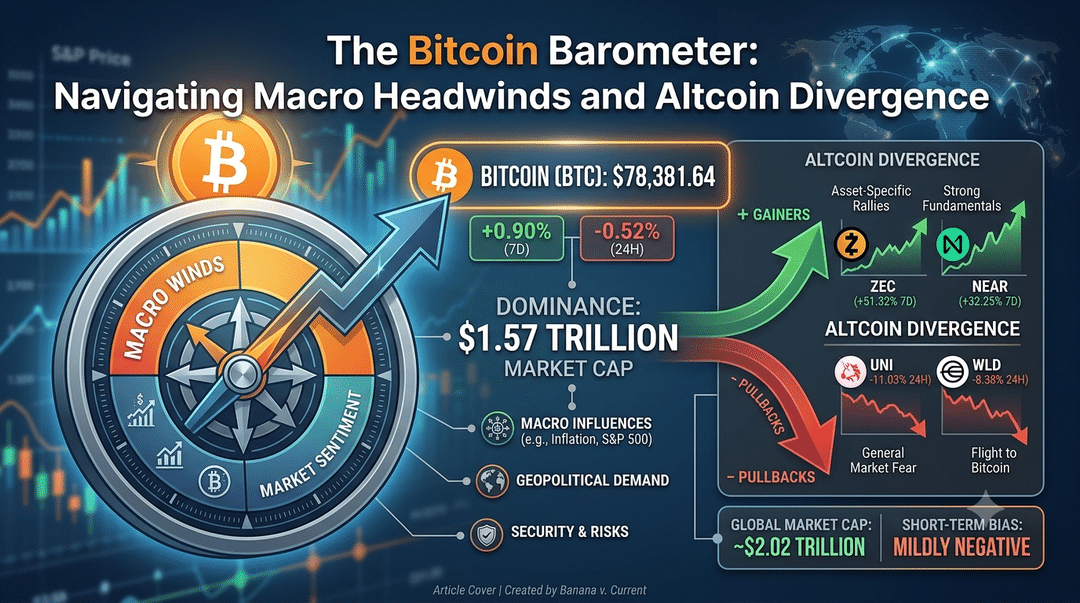
As of this report, Bitcoin (BTC) is trading at approximately $78,411, registering a 24-hour gain of 1%. Over the past seven days, however, BTC has experienced a slight retracement of -2.39%. Despite this short-term weekly dip, Bitcoin maintains a commanding market capitalization of over $1.57 trillion, anchoring the overall crypto market which stands at approximately $2.16 trillion. This substantial market share underscores Bitcoin's dominant position and its influence on the broader digital asset landscape.
Observed price action indicates that Bitcoin has managed to hold steady above the $78,000 mark. This stability comes despite a period characterized by a volatile monthly close, suggesting underlying strength or a consolidation phase. The 24-hour trading volume for BTC currently stands at around $26.6 billion, reflecting active participation and liquidity. While the 24-hour performance for BTC shows a modest positive move, its weekly performance suggests a period of slight consolidation or profit-taking after previous movements. The asset's ability to maintain its price level amidst external pressures is a notable characteristic of its current market structure.
Why Bitcoin Is Driving The Tape
Bitcoin's current market behavior is demonstrably influenced by a confluence of institutional developments and broader macroeconomic factors, reinforcing its position as the market's leading indicator.
A significant institutional catalyst emerged with Strategy's recent acquisition of $370 million in Bitcoin, marking its first corporate purchase in two months. This move highlights continued corporate confidence in Bitcoin as a treasury asset, adding to the long-term accumulation trend. Such large-scale corporate buying can provide a substantial demand floor for BTC, suggesting sustained institutional interest beyond short-term price fluctuations.
The landscape of Bitcoin Exchange-Traded Funds (ETFs) has also played a crucial role. While spot Bitcoin ETFs recently experienced a $201.9 million outflow on August 28, ending a nine-day streak of inflows, this event should be viewed in context. The preceding nine-day inflow streak itself demonstrated robust institutional appetite for BTC exposure through regulated products. The temporary outflow could be interpreted as a natural pause or profit-taking within a larger trend of institutional adoption, rather than a fundamental shift in sentiment. The "Crypto Biz" news also highlighted Bitcoin's rebound lifting crypto stocks, indicating a broader market correlation driven by BTC's performance and capital markets' engagement.
Macroeconomic conditions are another critical factor shaping Bitcoin's trajectory. Bitcoin has shown relative resilience, holding above $78,000 even as traditional markets faced headwinds. Reports indicate that BTC held steady despite US strikes on Iran, a hawkish Federal Reserve stance, and rising US bond yields. The Federal Reserve's stance, with officials like Kevin Warsh downplaying recent low inflation prints, suggests a cautious approach to monetary policy which typically creates uncertainty in risk-on assets. Similarly, US Treasury Secretary Scott Bessent's address on US bond yields underscores the sensitivity of financial markets to interest rate expectations. Bitcoin's ability to navigate these turbulent macro waters without a significant downturn suggests a maturing perception of the asset, potentially as a hedge against traditional market volatility or as a distinct asset class.
Furthermore, long-term protocol developments continue to underpin Bitcoin's value proposition. Discussions around "Bitcoin’s new quantum defenses" highlight ongoing efforts to future-proof the network, addressing potential technological challenges and reinforcing its security as a fundamental store of value. These ongoing enhancements contribute to Bitcoin's long-term investment appeal.
How The Rest Of The Market Is Responding
The broader cryptocurrency market is largely reacting to Bitcoin's lead, albeit with varying degrees of correlation and specific asset-driven narratives. The overall market context suggests a mildly positive short-term bias across the selected asset basket.
Ethereum (ETH), the second-largest cryptocurrency, has demonstrated notable relative strength. Priced at approximately $2,464, ETH recorded a 24-hour gain of 1.99%, outperforming BTC's 1% gain within the same period. Over the past seven days, ETH saw a -1.25% change, a smaller decline than Bitcoin's. This resilience is partly attributed to strong institutional interest in Ethereum ETFs, which extended a ten-day inflow streak, accumulating $226 million in a single day, nearly matching Bitcoin's recent institutional haul. Furthermore, large-scale accumulation by entities like Bitmine, which has consistently bought Ether for 65 consecutive weeks, underscores sustained demand for the asset.
Solana (SOL), trading at around $103, posted a 24-hour gain of 1.77% and a positive 7-day change of 2.13%. This positive weekly performance stands out compared to BTC and ETH's short-term dips, suggesting some independent momentum. News regarding Solana validators agreeing to curb rampant inflation and Charles Schwab expanding crypto trading to include SOL likely contributed to this strength, indicating both fundamental and institutional interest.
Chainlink (LINK) followed a similar 24-hour trajectory, rising by 1.85% to approximately $11.35. However, it experienced a more significant 7-day decline of -3.15%, lagging behind BTC and ETH. The announcement of Charles Schwab expanding trading to LINK may offer future support, but its immediate price action suggests it is more susceptible to broader market corrections.
Beyond these priority assets, volatility has been concentrated in specific altcoins. Hyperliquid (HYPE) recorded the strongest 24-hour move, up 4.45%. Monero (XMR) also saw a significant 24-hour increase of 3.52% and an impressive 7-day surge of 15.39%, making it a notable outlier with strong independent momentum. Cardano (ADA) also posted a strong 24-hour gain of 3.18%, but it experienced a substantial 7-day decline of -11.54%, indicating significant short-term volatility and a lack of sustained buying pressure over the week.
The observed trends suggest a market where Bitcoin sets the overarching tone, with major altcoins like Ethereum showing some decoupling potential due to their own institutional narratives. Other altcoins exhibit more varied responses, with some demonstrating strong individual momentum (XMR, SOL) and others showing pronounced weakness (ADA, LINK over 7d), often influenced by project-specific news or higher beta to market movements.
Conclusion and Risk Management
Bitcoin currently stands as the undeniable anchor of the cryptocurrency market. Its price structure, characterized by resilience above key levels despite macro pressures and fluctuating institutional ETF flows, dictates the broader market's direction. The continued corporate accumulation by entities like Strategy and the underlying long-term developments like quantum defenses reinforce Bitcoin's foundational role.
While Bitcoin has shown remarkable stability against a backdrop of geopolitical tensions, a hawkish Fed, and rising bond yields, these macroeconomic factors remain significant. Bitcoin's ability to hold above $78,000 during such periods suggests a degree of maturation and perceived safe-haven utility among some investors. However, this does not eliminate the potential for volatility, especially as the market navigates a "volatile monthly close" and ongoing macro uncertainties.
The rest of the market largely takes its cues from Bitcoin. Ethereum demonstrates notable strength, driven by its own institutional adoption narratives and consistent accumulation. Other altcoins like Solana show individual catalysts, while many, such as Chainlink and Cardano, exhibit more pronounced sensitivity to broader market sentiment and Bitcoin's movements. The concentration of the strongest 24-hour moves in assets like Hyperliquid, Monero, and Cardano highlights that while Bitcoin leads, specific altcoins can still experience high volatility based on their unique dynamics.
For participants in this market, a robust risk management approach is crucial. Given Bitcoin's central role, monitoring its price structure and the catalysts influencing it should be paramount. The mixed performance among altcoins underscores the importance of understanding individual asset fundamentals and their correlation to Bitcoin. While the overall short-term bias for the asset basket appears mildly positive, the prevailing macro environment suggests that sharp reversals or sustained periods of consolidation remain possibilities. Diversification and careful position sizing, particularly in more volatile altcoins, are prudent strategies to navigate the current, Bitcoin-led market.
Source Data Reference
Market Snapshot Input
| Asset | Symbol | Price (USD) | 24h Change | Market Cap (USD) |
|---|---|---|---|---|
| Bitcoin | BTC | 78,411.037377 | 1.00% | 1,574,339,788,072 |
| Ethereum | ETH | 2,464.192986 | 1.99% | 297,381,502,909 |
| Solana | SOL | 103.314185 | 1.77% | 60,460,204,474 |
| Chainlink | LINK | 11.346506 | 1.85% | 8,488,321,112 |
| Monero | XMR | 514.209531 | 3.52% | 9,666,509,283 |
| Avalanche | AVAX | 7.25092 | 1.46% | 3,061,884,219 |
| Cardano | ADA | 0.199946 | 3.18% | 7,766,587,930 |
| XRP | XRP | 1.374987 | 1.81% | 86,272,874,212 |
| Hyperliquid | HYPE | 83.768132 | 4.45% | 18,633,861,877 |
| BNB | BNB | 692.517243 | 1.15% | 92,217,235,254 |
Trending Headlines Input
- Crypto Biz: Bitcoin pumps, Wall Street does the paperwork
- Strategy buys $370M Bitcoin in first corporate purchase since June
- Bitcoin ETFs Snap Nine-Day Inflow Streak as Ethereum Funds Extend Their Run
- Ethereum ETFs Take $226M in a Day, Almost Matching Bitcoin's Haul
- Bitcoin Holds Steady as US Strikes on Iran Rattle Stocks and Lift Oil
- Bitcoin’s new quantum defenses, 18.9M SOL cancelled: Hodler’s Digest
- Bitcoin begins volatile monthly close as US bond yields eye new 20-year high
- Bitmine now controls 4.9% of Ethereum supply after adding 53.5K ETH
- Bitcoin dips to $78.4K as Fed’s Warsh downplays softer inflation prints
- Charles Schwab Expands Crypto Trading Beyond Bitcoin and Ethereum