Risk Tone Across The Market
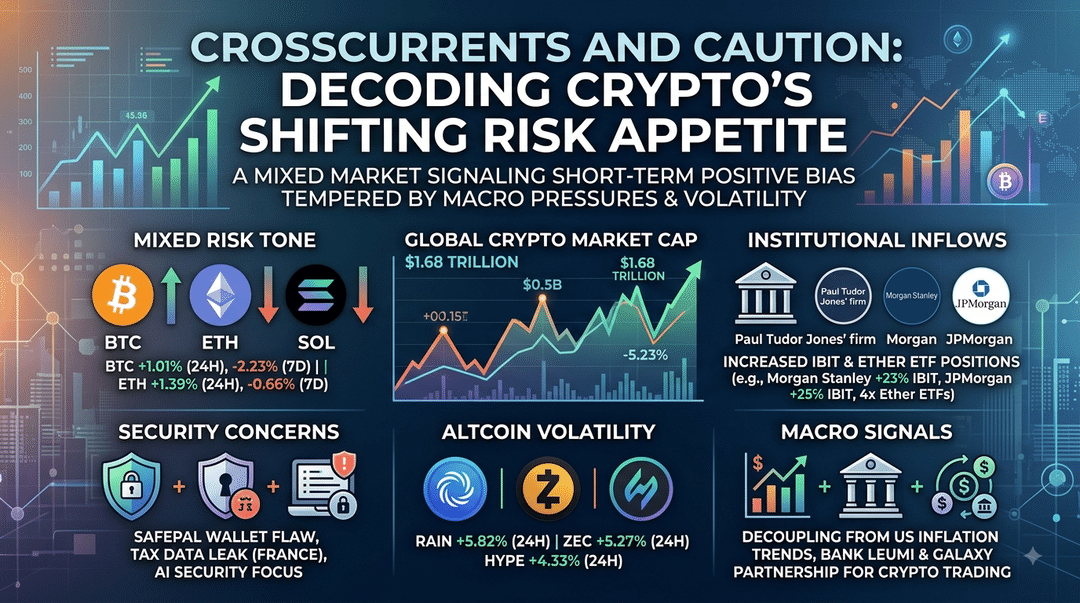
The prevailing risk tone across the cryptocurrency market is best described as mixed, characterized by a mild short-term positive bias tempered by broader macro pressures and localized volatility. The global crypto market capitalization currently stands at approximately $1.68 trillion, with an average 24-hour price movement of about 1.86%. While this suggests some underlying positive momentum in the short term, a deeper look reveals a more nuanced picture.
Bitcoin (BTC), the market leader, has seen a 24-hour gain of just over 1%, yet it remains down by 2.23% over the past seven days. Ethereum (ETH) mirrors this trend, with a 1.39% 24-hour increase but a 0.66% decline over the week. Solana (SOL) also reflects this pattern, up 0.65% in 24 hours but down 1.5% over seven days. These figures indicate that while there might be intraday buying interest, the broader weekly trend has been one of consolidation or slight retraction for major assets.
In contrast, several altcoins exhibit higher volatility and stronger positive momentum. Rain Protocol (RAIN) leads the pack with a 5.82% 24-hour surge, followed by Zcash (ZEC) at 5.27%, and Hyperliquid (HYPE) showing a robust 4.33% gain. These movements, particularly in the context of the larger market's more subdued weekly performance, suggest that capital is flowing into specific, higher-beta assets, potentially indicating a selective risk-on appetite rather than a broad-based surge. The overall sentiment, as observed, leans towards a mildly positive short-term bias, but this requires close monitoring given the mixed performance of market leaders and the influence of external factors.
Macro and Flow Signals
Market positioning is currently being shaped by a confluence of institutional activity, security concerns, and macro-economic undercurrents. Institutional engagement presents a complex picture. On one hand, several major financial institutions have increased their exposure to Bitcoin and Ethereum ETFs. Paul Tudor Jones' firm, for instance, raised its iShares Bitcoin Trust (IBIT) stake by 18.9% in Q2, shifting from leveraged bets to direct spot exposure. Similarly, Morgan Stanley's IBIT holdings rose 23% in Q2, alongside increased Ether ETF positions. JPMorgan also reported a 25% increase in its Bitcoin ETF position and more than quadrupled its Ether ETF position. These movements suggest a growing, albeit cautious, institutional adoption of crypto assets via regulated products.
However, this positive flow is not universal. Dartmouth's endowment, for example, saw its crypto exposure drop by $2 million, with holdings in Bitwise Solana staking ETF, Grayscale Ethereum staking ETF, and BlackRock’s iShares Bitcoin ETF decreasing in value. This divergence indicates that while some institutions are accumulating, others are experiencing value depreciation, contributing to the mixed sentiment.
Security remains a persistent concern, influencing risk appetite. Recent headlines highlight vulnerabilities, such as a flaw in SafePal's Bitcoin wallet exposing customer data and a significant tax data leak in France potentially affecting Bitcoin holders. These incidents underscore the ongoing security risks in the crypto ecosystem, which can dampen investor confidence and encourage a more risk-averse stance, particularly for retail participants. Furthermore, Bitcoin companies have reportedly sought assistance from AI labs to guard against hackers, indicating a proactive but also reactive response to these threats.
On the macro front, Bitcoin's recent price drop to $62.5K has occurred despite positive US inflation trends, a dynamic that typically might support risk assets. This observed decoupling suggests that crypto markets are not solely responding to conventional macro signals but are also influenced by internal dynamics and specific market catalysts. A positive development in institutional integration is Israel’s largest bank, Bank Leumi, partnering with Galaxy to offer Bitcoin, Ether, and Solana trading to its customers starting in early 2027, signaling longer-term mainstream adoption.
What Sentiment Is Doing To Major Coins
The current market sentiment, a blend of institutional interest and underlying caution, is manifesting differently across major cryptocurrencies.
Bitcoin (BTC), despite recent institutional inflows into its spot ETFs from major players like Paul Tudor Jones' firm, Morgan Stanley, and JPMorgan, has struggled to maintain upward momentum. Its 24-hour gain of 1.01% is modest, and the 7-day performance shows a 2.23% decline, indicating selling pressure or profit-taking outweighing new capital injections over the past week. The observation that Bitcoin's price dropped even as US inflation trends improved suggests a divergence from traditional macro correlations, implying that specific crypto-related news, such as security concerns (SafePal data breach, France tax data leak), might be exerting more immediate influence on short-term positioning and risk appetite. The market's reaction to these security headlines contributes to a cautious sentiment around BTC, despite the positive long-term signal from institutional adoption.
Ethereum (ETH) shows a similar pattern to Bitcoin, with a 1.39% 24-hour increase but a 0.66% dip over seven days. Like BTC, ETH has seen increased institutional interest via ETF positions from Morgan Stanley and JPMorgan. This institutional buy-in provides a foundational layer of support. Additionally, protocol-specific developments, such as Ethereum developers narrowing 66 proposals for the Hegotá upgrade aimed at enhancing native privacy, contribute to a positive long-term technical sentiment. However, these factors have not been sufficient to propel ETH into significant weekly gains, suggesting that broader market caution and macro pressures are still dominant forces.
Solana (SOL), while registering a modest 0.65% gain in 24 hours, has also experienced a 1.5% decline over the past week. Its inclusion in institutional products, such as the Bitwise Solana staking ETF held by Dartmouth's endowment (though Dartmouth's overall crypto exposure decreased), and the announcement of Bank Leumi offering Solana trading, points to growing institutional recognition. The mixed sentiment around Solana likely stems from its correlation with the broader market leaders and the general risk appetite, rather than specific negative news for the protocol itself.
Hyperliquid (HYPE) stands out with a significant 4.33% 24-hour gain and an impressive 9.49% rise over seven days. This strong performance indicates a localized bullish sentiment, likely driven by project-specific developments or speculative interest, rather than broader market or macro trends, given its relatively smaller market capitalization compared to BTC or ETH.
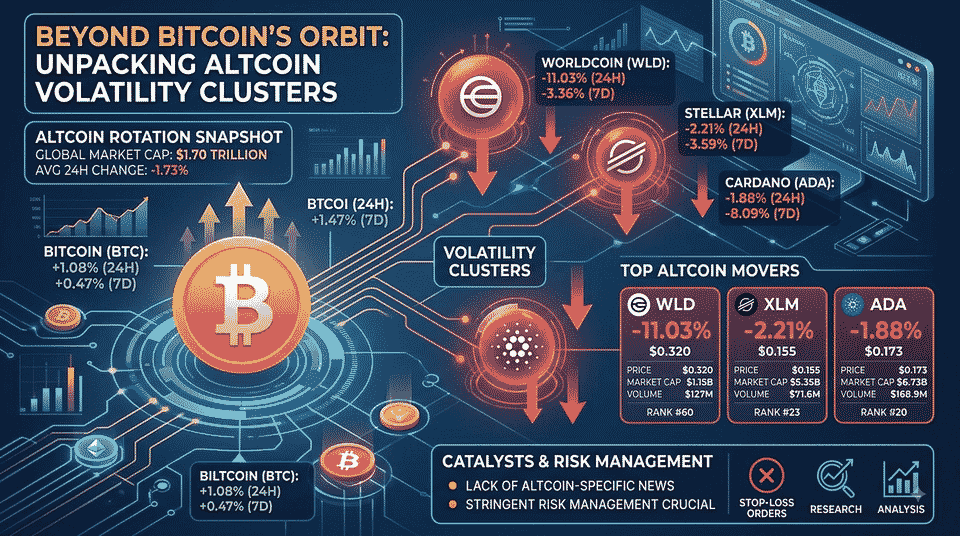
Among other notable assets, Rain Protocol (RAIN) and Zcash (ZEC) have shown the strongest 24-hour moves, with 5.82% and 5.27% gains respectively, highlighting areas of concentrated speculative interest. In contrast, Cardano (ADA) has underperformed, with a 1.51% drop in 24 hours and a notable 10.96% decline over seven days, suggesting a distinct lack of positive sentiment or a stronger bearish outlook for this asset compared to its peers.
Conclusion and Risk Management
The current crypto market sentiment is characterized by a delicate balance of competing forces. On one side, sustained institutional interest in Bitcoin and Ethereum ETFs from major financial players like Paul Tudor Jones' firm, Morgan Stanley, and JPMorgan signals a maturation of the asset class and a long-term bullish outlook from traditional finance. This institutional flow provides a crucial underpinning for market stability and future growth.
However, this positive institutional narrative is counterbalanced by several factors. The observed price declines for major assets like BTC, ETH, and SOL over the past week, despite positive institutional activity, indicate that immediate buying pressure is not overwhelming. Furthermore, security incidents, such as the SafePal wallet breach and broader data leaks, introduce elements of risk aversion and caution, particularly for retail participants. The decoupling of Bitcoin's price action from positive US inflation trends also suggests that the crypto market is responding to its own unique set of catalysts, rather than consistently mirroring traditional financial markets.
For market participants, it is crucial to separate sentiment signals from confirmed trend continuation. While institutional inflows are a positive long-term indicator, they do not guarantee immediate upward price action, especially in the face of ongoing macro pressures or specific security concerns. The localized rallies in assets like HYPE, RAIN, and ZEC demonstrate that capital is flowing into specific areas of perceived opportunity, even as the broader market leaders consolidate.
Looking ahead, the market's direction will likely be shaped by the continued interplay of these forces. A sustained period of positive institutional accumulation, coupled with improvements in security infrastructure and a clearer macro environment, could foster a more confident risk-on sentiment. Conversely, any escalation in security threats or a shift in institutional appetite could quickly lead to a more risk-off posture. Prudent risk management in this environment involves monitoring these cross-market catalysts, diversifying exposure, and acknowledging that short-term volatility can persist even amidst longer-term positive developments.
Source Data Reference
Market Snapshot Input
| Asset | Symbol | Price (USD) | 24h Change | Market Cap (USD) |
|---|---|---|---|---|
| Bitcoin | BTC | 63,555.032971 | 1.01% | 1,275,643,446,074 |
| Ethereum | ETH | 1,904.001165 | 1.39% | 229,291,845,947 |
| Solana | SOL | 75.687225 | 0.65% | 44,118,033,280 |
| Hyperliquid | HYPE | 59.797375 | 4.33% | 13,301,669,748 |
| Rain Protocol | RAIN | 0.013395 | 5.82% | 9,302,294,618 |
| Chainlink | LINK | 9.492729 | 0.76% | 7,101,510,054 |
| Zcash | ZEC | 510.64026 | 5.27% | 8,337,871,523 |
| Cardano | ADA | 0.174133 | -1.51% | 6,758,736,026 |
| Monero | XMR | 418.636293 | 1.24% | 7,867,193,223 |
| BNB | BNB | 604.448129 | -0.34% | 80,491,881,484 |
Trending Headlines Input
- Dartmouth endowment’s crypto exposure drops by $2M amid falling prices
- Paul Tudor Jones' Firm Buys Back Into BlackRock Bitcoin ETF After a Year of Selling
- Morgan Stanley’s BlackRock Bitcoin ETF holdings rise 23% in Q2
- JPMorgan boosts Bitcoin, Ether ETF positions in Q2 filing
- Bitcoin Companies Want Help From AI Labs to Guard Against Hackers
- SafePal Bitcoin Wallet Data Breach Stokes Fears of Physical Attacks
- France Tax Data Leak Could Fuel Scams, Attacks Targeting Bitcoin Holders
- Bitcoin price drops to $62.5K as trader warns weekly close may spark more losses
- Israel’s largest bank taps Galaxy to offer Bitcoin, Ether, Solana trading
- Ethereum devs to narrow 66 proposals tied to Hegotá upgrade