Global Market Capitalization
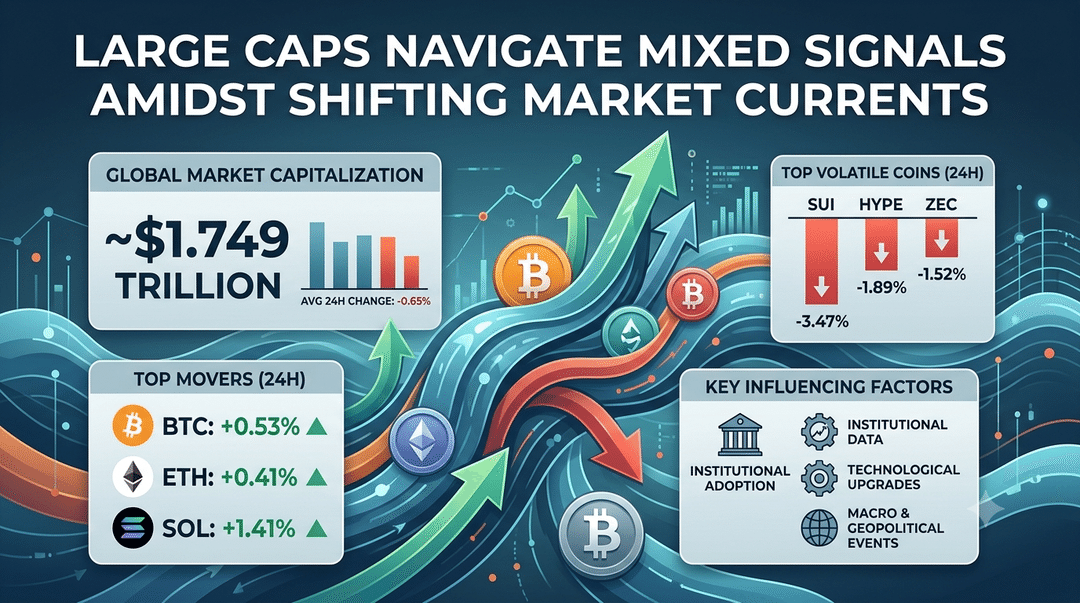
The broader cryptocurrency market has experienced a period of largely constrained movement, with the global market capitalization currently standing at approximately $1.749 trillion. The average 24-hour price change across the market reflects a mildly negative short-term bias, registering an average decline of 0.65%. This indicates a market grappling with uneven price action, where gains in some large-cap assets are offset by declines in others, leading to a largely sideways overall trend.
Bitcoin (BTC), the leading cryptocurrency by market capitalization, demonstrated a modest positive shift, trading around $64,584.75. BTC recorded a 24-hour increase of 0.53% and a 7-day gain of 1.40%, maintaining its market dominance with a capitalization of approximately $1.296 trillion. This performance suggests a degree of resilience in the flagship asset despite broader market hesitancy.
Ethereum (ETH), the second-largest cryptocurrency, mirrored Bitcoin's cautious optimism, with its price at approximately $1,913.43. ETH saw a 24-hour increase of 0.41% and a 7-day gain of 1.66%, holding a market capitalization of around $230.43 billion. Both Bitcoin and Ethereum's relatively stable, albeit slightly positive, short-term performance indicates a period of consolidation for the market's foundational assets.
Solana (SOL) presented a stronger positive impulse within the large-cap segment, with its price at approximately $76.93. SOL posted a 24-hour gain of 1.41%, though its 7-day performance was a more subdued 0.73% increase, contributing to its market capitalization of around $44.84 billion. This move stands out amidst the generally flat to negative landscape for many top assets.
In contrast, Sui (SUI), while not a top-tier large-cap, experienced a notable downturn. Trading at approximately $0.65, SUI recorded a 24-hour decline of 3.47% and a 7-day drop of 6.21%, with a market capitalization of around $2.65 billion. This significant negative movement positions SUI as one of the more volatile assets in the current market snapshot.
Beyond these priority assets, other major cryptocurrencies showed mixed performance. XRP, priced around $0.9997, saw a slight 24-hour decrease of 0.09% and a more pronounced 7-day decline of 2.27%, with a market cap of approximately $62.66 billion. BNB traded at approximately $602.85, experiencing a 24-hour dip of 0.25% and a 7-day drop of 2.58%, maintaining a market cap of around $80.28 billion. Avalanche (AVAX) was at approximately $6.32, down 1.18% in 24 hours but up 0.34% over seven days, with a market cap of around $2.67 billion. These figures collectively paint a picture of a market lacking strong directional conviction across many of its leading constituents, with individual asset performance often diverging from the slight overall negative drift.
Top Volatile Coins
In the last 24 hours, several assets have exhibited notable volatility, signaling potential areas of concentrated trading activity or reaction to specific catalysts. The strongest moves were observed in Sui (SUI), Hyperliquid (HYPE), and Zcash (ZEC), all of which experienced declines.
Sui (SUI) led the downside volatility among the selected assets, recording a 24-hour price decrease of 3.47%. This movement brought its price to approximately $0.65. This decline follows a more extended negative trend, with a 7-day decrease of 6.21%. For a relatively newer layer-1 blockchain project like Sui, such volatility can be influenced by a range of factors, including early-stage development news, shifts in investor sentiment towards newer ecosystems, or broader market liquidity dynamics.
Hyperliquid (HYPE), an asset with a market capitalization of approximately $12.97 billion, also saw significant downward pressure, declining by 1.89% over the past 24 hours to trade around $58.33. Despite this short-term dip, HYPE has shown stronger performance over the longer timeframe, with a 7-day increase of 7.13%. This contrast suggests that the recent 24-hour move might be a short-term correction within a larger upward trend or a reaction to immediate trading flows rather than a fundamental shift.
Zcash (ZEC), a privacy-focused cryptocurrency with a market cap of approximately $8.28 billion, also registered a 24-hour decrease of 1.52%, with its price around $506.85. Similar to HYPE, ZEC's 7-day performance indicates a positive trend, up 5.10%. The observed 24-hour volatility in these assets highlights that while the overall market shows a mild negative bias, specific assets can experience amplified movements, which may present both opportunities and heightened risks for traders. Understanding these short-term movements is crucial as they can sometimes precede broader market shifts or indicate emerging narratives within specific sectors.
News and Market Impact
Recent headlines suggest a market influenced by a blend of institutional developments, technological advancements, and macro considerations, contributing to the observed uneven price movements across large-cap assets.
Institutional engagement continues to be a significant narrative driver. FalconX and Interstice announced a partnership to connect Canton's institutional tokenized-asset markets with major public blockchains, including Ethereum (ETH) and Solana (SOL), as well as Robinhood Chain. This development aims to bridge traditional finance with decentralized ecosystems, potentially increasing liquidity and institutional participation for ETH and SOL. In a similar vein, asset manager Neuberger is collaborating with Securitize to launch a multi-chain tokenized fixed-income fund, leveraging Ethereum, Solana, Avalanche (AVAX), and Sui (SUI). These initiatives underscore a growing trend of traditional financial institutions exploring blockchain technology for tokenized assets, which could foster long-term demand for these platforms.
Bitcoin (BTC) has been the subject of several institutional-focused reports. Metaplanet, a Tokyo-based company, is expanding its Bitcoin treasury strategy into the US through a proposed deal with Nasdaq-listed Super League Enterprise, involving 2,100 BTC. This move signifies continued corporate adoption of Bitcoin as a treasury asset. Furthermore, Paul Tudor Jones' firm reportedly increased its stake in the BlackRock Bitcoin ETF by 18.9% in Q2, shifting from leveraged bets to direct spot exposure. This indicates a potential change in institutional investment strategy towards more direct holding of Bitcoin, which could be interpreted as a bullish signal for spot BTC. However, a security incident involving a data breach at SafePal, a Bitcoin wallet provider, exposed customer information, serving as a reminder of the inherent security risks in the crypto ecosystem.
Ethereum (ETH) also garnered attention from institutional players, with Bitmine reportedly nearing 5% of the total Ethereum supply. This entity continues to accumulate ETH despite significant unrealized losses, suggesting strong long-term conviction in the asset's future, particularly concerning its staking rewards. On the technical front, the Ethereum Foundation issued a warning that some tools might break with the upcoming Glamsterdam upgrade, urging developers to test on Plataberget. While necessary for protocol evolution, such warnings can introduce short-term uncertainty regarding ecosystem readiness.
Macroeconomic factors and geopolitical events continue to influence the broader market. Bitcoin's recent move past $64,000 was observed as gold also gained, amidst fluctuating US stocks and renewed US-Iran rhetoric. This suggests that some investors may view Bitcoin as a potential safe-haven asset in times of geopolitical uncertainty, similar to gold. For XRP, a report indicated that its price is clinging to a near two-year streak around the dollar mark, but daily and weekly charts are flashing warning signs. This highlights the importance of technical analysis and market sentiment in assets with ongoing regulatory considerations.
Beyond specific assets, a general security alert emerged regarding pirated copies of 'The Odyssey' hiding crypto-stealing malware. While not tied to a particular cryptocurrency, such threats underscore the importance of cybersecurity vigilance for all participants in the digital asset space.
Conclusion and Risk Management
The cryptocurrency market is currently navigating a period characterized by a blend of cautious optimism and underlying uncertainties. The global market capitalization reflects a mildly negative short-term bias, as indicated by the average 24-hour price movement. While foundational assets like Bitcoin and Ethereum have shown relative stability with slight gains, other large-cap assets have exhibited mixed performance, contributing to an uneven landscape.
The strongest 24-hour movements, particularly the declines in Sui, Hyperliquid, and Zcash, highlight areas of concentrated volatility that warrant close observation. These movements underscore that while the broader market trends are important, individual asset dynamics can diverge significantly due to project-specific developments or trading flows.
Recent headlines reinforce the narrative of increasing institutional integration, with major players exploring tokenized assets and direct spot exposure to Bitcoin. These developments, such as FalconX's cross-chain initiatives and Neuberger's tokenized fund, suggest a maturing ecosystem that continues to attract traditional finance. However, protocol-specific warnings, like those from the Ethereum Foundation regarding the Glamsterdam upgrade, and security concerns, such as the SafePal data breach, serve as reminders of inherent technological and operational risks. Macroeconomic influences, including geopolitical tensions, also continue to play a role in shaping market sentiment, positioning assets like Bitcoin as potential hedges for some investors.
Given the current market conditions, a measured approach to engagement is advisable. Investors and traders should acknowledge the observed mildly negative short-term bias while recognizing the long-term potential indicated by ongoing institutional adoption. Risk management remains paramount; this includes diversifying portfolios, understanding the specific risks associated with individual assets, and staying informed about both macro-level trends and project-specific news. The dynamic interplay between headline-driven catalysts and uneven short-term price action necessitates continuous monitoring and a flexible strategy to navigate the evolving crypto landscape.
Source Data Reference
Market Snapshot Input
| Asset | Symbol | Price (USD) | 24h Change | Market Cap (USD) |
|---|---|---|---|---|
| Bitcoin | BTC | 64,584.745048 | 0.53% | 1,296,358,500,822 |
| Ethereum | ETH | 1,913.426388 | 0.41% | 230,426,890,804 |
| Solana | SOL | 76.930511 | 1.41% | 44,842,184,750 |
| Sui | SUI | 0.650348 | -3.47% | 2,649,861,012 |
| XRP | XRP | 0.999719 | -0.09% | 62,659,339,866 |
| Avalanche | AVAX | 6.318881 | -1.18% | 2,668,307,088 |
| Hyperliquid | HYPE | 58.328709 | -1.89% | 12,974,971,371 |
| Monero | XMR | 412.004293 | -0.45% | 7,742,834,986 |
| Zcash | ZEC | 506.848084 | -1.52% | 8,275,951,857 |
| BNB | BNB | 602.852014 | -0.25% | 80,279,333,404 |
Trending Headlines Input
- FalconX, Interstice Connect Canton to Ethereum, Solana and Robinhood Chain
- Neuberger teams with Securitize on multi-chain tokenized fixed-income fund launch
- Metaplanet expands Bitcoin treasury strategy to US with 2,100-BTC Nasdaq play
- Paul Tudor Jones' Firm Buys Back Into BlackRock Bitcoin ETF After a Year of Selling
- Bitmine nears 5% of Ethereum supply despite $8.4B in unrealized losses
- SafePal Bitcoin Wallet Data Breach Stokes Fears of Physical Attacks
- XRP Price Holds to Near Two-Year Streak, But Charts Flash a Warning Sign
- Bitcoin hits $64K as gold gains while oil shakes off Trump Oman threat
- Pirated Copies of 'The Odyssey' Are Hiding Crypto-Stealing Malware
- Ethereum Foundation warns some tools may break with Glamsterdam upgrade