Bitcoin Price Structure
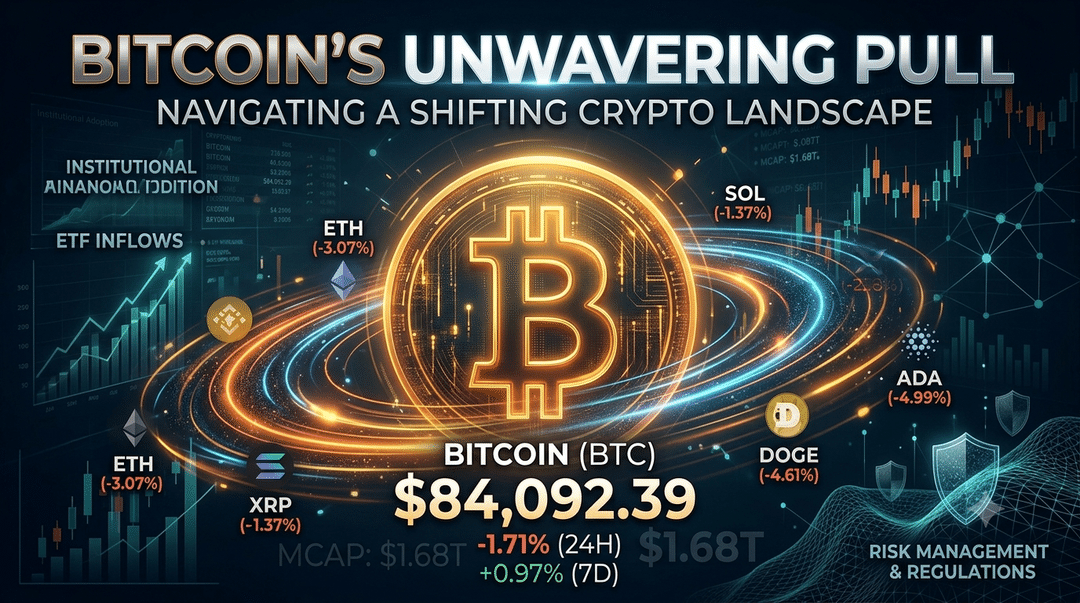
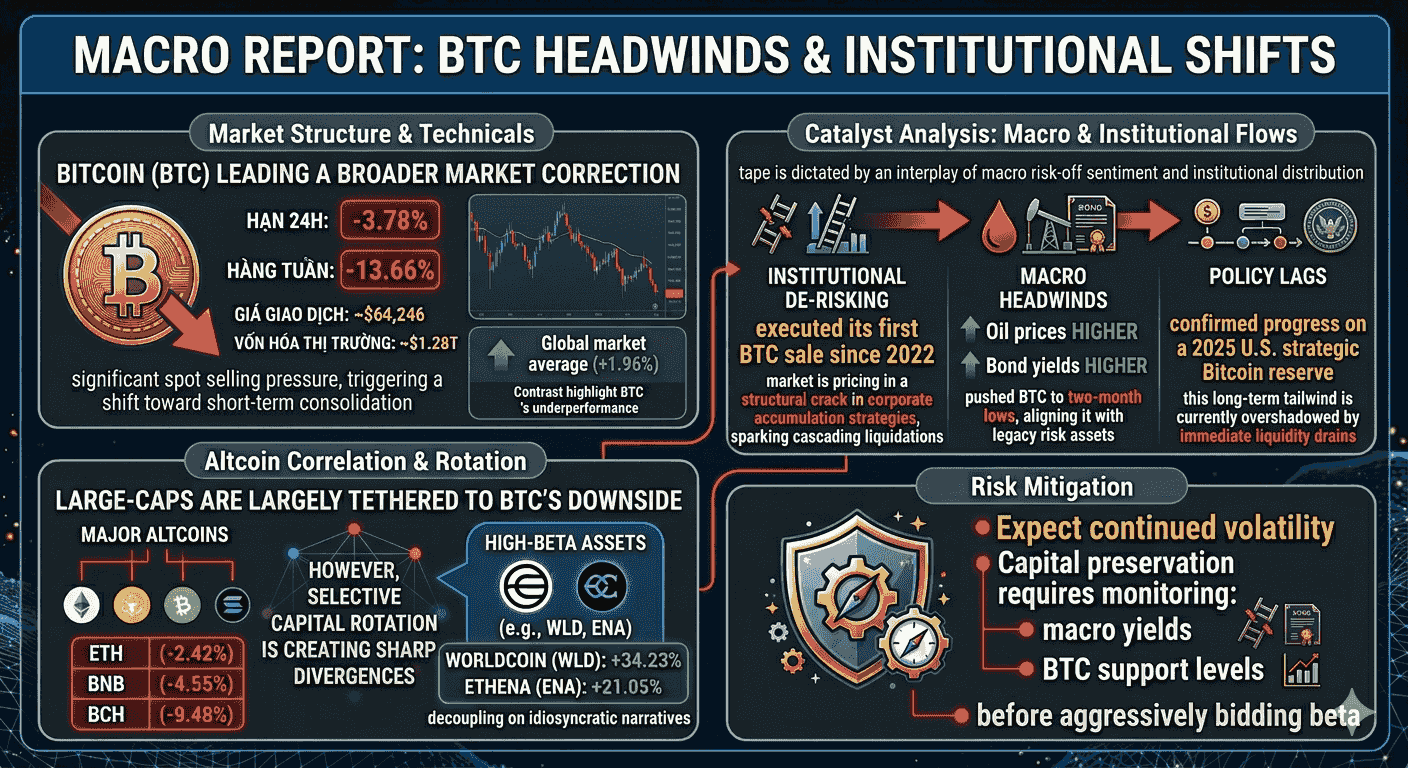
Bitcoin (BTC), the market's leading digital asset, has experienced a significant downturn over the past 24 hours, registering a decline of approximately 3.78%. This movement extends a more pronounced weekly trend, with BTC falling by about 13.66% over the last seven days. Priced around $64,246, Bitcoin maintains a dominant market capitalization exceeding $1.28 trillion, supported by a 24-hour trading volume of over $43.4 billion.
The observed price action places Bitcoin below the global market's average 24-hour move, which stands at a mildly positive 1.96%. This divergence suggests that while some segments of the market might be experiencing upward momentum, Bitcoin itself is under considerable selling pressure. Its current short-term positioning indicates a shift from recent highs, marking a period of consolidation or potential further correction.
Why Bitcoin Is Driving The Tape
Bitcoin's recent performance appears to be a direct consequence of a confluence of institutional actions and prevailing macroeconomic conditions. These factors are not only influencing BTC directly but are also setting the broader market sentiment.
One significant institutional development is the ongoing discussion around a potential U.S. strategic Bitcoin reserve. U.S. Treasury Secretary Scott Bessent has indicated that the Treasury Department is "proceeding with all deliberate speed" on a 2025 executive order to establish such a reserve and digital asset stockpile, as reported by Cointelegraph. This news, while potentially bullish in the long term by signaling increased institutional acceptance and demand, has not immediately translated into positive price action for Bitcoin. The long-term nature of such initiatives means their immediate impact on price can be overshadowed by more pressing short-term dynamics.
Conversely, a more immediate and tangible catalyst for Bitcoin's recent decline stems from institutional selling. Strategy, a prominent corporate holder of Bitcoin, executed its first BTC sale since 2022. This event has generated considerable discussion, with some experts questioning whether the sale has exposed a "structural crack" in Strategy’s Bitcoin accumulation strategy. Decrypt reported that with STRC trading under $100, the market is debating the implications of this move. Such a large-scale sale by a well-known institutional player can contribute to downward pressure and potentially trigger further selling from other market participants.
Adding to the complexity, the macroeconomic environment is exerting its influence. Bitcoin's price movement has been observed to correlate with broader financial markets, and recent global events have contributed to a risk-off sentiment. Decrypt noted that Bitcoin fell to a more than two-month low alongside U.S. stocks, following Middle East skirmishes that pushed bond yields and oil prices higher. This indicates that traditional macro indicators, such as geopolitical tensions and commodity price inflation, continue to play a role in shaping investor appetite for risk assets like Bitcoin. The narrative suggesting that "As Oil Moves Higher, Bitcoin Sinks to Lowest Price Since March" highlights Bitcoin's sensitivity to global economic stability and investor confidence.
Furthermore, Standard Chartered has put forth the view that "As Bitcoin Sinks, It's Time for Ethereum to Outperform." This interpretation, while not directly a cause for Bitcoin's decline, reflects a potential shift in institutional focus or a re-evaluation of relative value within the crypto ecosystem, particularly in light of Bitcoin's recent weakness.
In summary, Bitcoin's current price structure is demonstrably driven by a combination of institutional selling pressure from key players like Strategy, a cautious macroeconomic backdrop marked by rising oil prices and bond yields, and ongoing, albeit longer-term, regulatory discussions.
How The Rest Of The Market Is Responding
The broader cryptocurrency market is largely reacting to Bitcoin's lead, with varying degrees of correlation and occasional decoupling in specific assets. The overall global market capitalization stands at approximately $1.7 trillion, reflecting the significant scale of the digital asset economy.
Among the major cryptocurrencies, many have mirrored Bitcoin's downward trend, albeit with some nuances. Ethereum (ETH), the second-largest asset by market capitalization, has seen a 24-hour decline of about 2.42% and a 7-day drop of 10.37%. While also negative, its 24-hour performance shows slightly more resilience compared to Bitcoin’s sharper fall. Other large-cap assets like BNB (down 4.55% in 24h), XRP (down 1.70% in 24h), Bitcoin Cash (BCH, down 9.48% in 24h), and Stellar (XLM, down 7.24% in 24h) have also experienced declines, confirming a general market downtrend driven by Bitcoin's weakness.
However, the market is not uniformly bearish. The strongest 24-hour moves are observed to be concentrated in a few specific altcoins, indicating selective capital flows or project-specific catalysts. Worldcoin (WLD) stands out with a significant 24-hour gain of approximately 34.23%, alongside a 61.85% increase over seven days. Ethena (ENA) also demonstrated strong positive momentum, rising by about 21.05% in the last 24 hours. Hyperliquid (HYPE) posted an 8.28% gain within the same period. Humanity (H), despite a 24-hour decline of 14.74%, has seen a remarkable 160.14% surge over the past seven days, suggesting recent profit-taking after a strong run.
This dynamic illustrates that while Bitcoin's macro and institutional headwinds are influencing the general market sentiment and pulling down many correlated assets, certain altcoins are managing to defy the trend. This could be attributed to unique project developments, speculative interest, or a rotation of capital into assets perceived to have independent growth narratives. The observation of a "mildly positive short-term bias" for the selected editorial asset basket, as highlighted in derived insights, is largely due to the strong performance of these few volatile altcoins, masking the broader market's reaction to Bitcoin's decline.
Conclusion and Risk Management
Bitcoin's current price structure and its accompanying catalysts underscore its continued role as the primary barometer for the wider cryptocurrency market. The recent pullback is an observed fact, influenced significantly by institutional selling, particularly from entities like Strategy, and aggravated by a cautious macroeconomic environment characterized by rising oil prices and bond yields. While long-term institutional interest, such as discussions around a U.S. Bitcoin reserve, may offer future support, immediate market direction is being shaped by more tangible, short-term pressures.
The rest of the market, including major altcoins like Ethereum and BNB, largely reflects Bitcoin's downturn, indicating a high degree of correlation. However, it is also an observed fact that certain altcoins, such as Worldcoin and Ethena, have demonstrated notable independence, achieving significant positive gains against the prevailing market sentiment. This suggests a nuanced market where broad trends coexist with asset-specific narratives.
For market participants, effective risk management in this environment involves closely monitoring Bitcoin's price action and its key support levels. Understanding the interplay between institutional flows, macroeconomic indicators (like inflation, interest rates, and geopolitical stability), and their impact on Bitcoin is crucial. While some altcoins may offer opportunities for divergence, the overall market direction is likely to remain tethered to Bitcoin's performance. Investors should consider the potential for continued volatility driven by these macro and institutional forces, and evaluate positions with a clear understanding of both systemic and asset-specific risks. Diversification and a measured approach remain prudent in a market where the lead asset is navigating significant headwinds.
Source Data Reference
Market Snapshot Input
| Asset | Symbol | Price (USD) | 24h Change | Market Cap (USD) |
|---|---|---|---|---|
| Humanity | H | 0.57967 | -14.74% | 1,057,897,477 |
| Worldcoin | WLD | 0.535592 | 34.23% | 1,808,009,342 |
| Bitcoin | BTC | 64,246.600467 | -3.78% | 1,287,394,838,515 |
| Hyperliquid | HYPE | 75.080453 | 8.28% | 25,071,479,124 |
| Ethereum | ETH | 1,814.464954 | -2.42% | 218,509,329,924 |
| XRP | XRP | 1.204322 | -1.70% | 74,641,270,522 |
| Ethena | ENA | 0.110991 | 21.05% | 1,001,868,560 |
| Stellar | XLM | 0.209532 | -7.24% | 7,062,083,108 |
| Bitcoin Cash | BCH | 243.426608 | -9.48% | 4,835,861,139 |
| BNB | BNB | 621.961778 | -4.55% | 86,567,403,029 |
Trending Headlines Input
- US Treasury Secretary signals progress on Bitcoin reserve, CLARITY Act
- As Bitcoin Sinks, It's Time for Ethereum to Outperform: Standard Chartered
- Strategy Wanted to 'Inoculate' the Bitcoin Market—Has Its BTC Sale Backfired?
- Stripe Millionaire Loses Bid for Congress to Candidate Backed by Ripple Co-Founder
- As Oil Moves Higher, Bitcoin Sinks to Lowest Price Since March
- US Treasury issues sanctions on Iran, targets 4 crypto exchanges