Bitcoin Price Structure
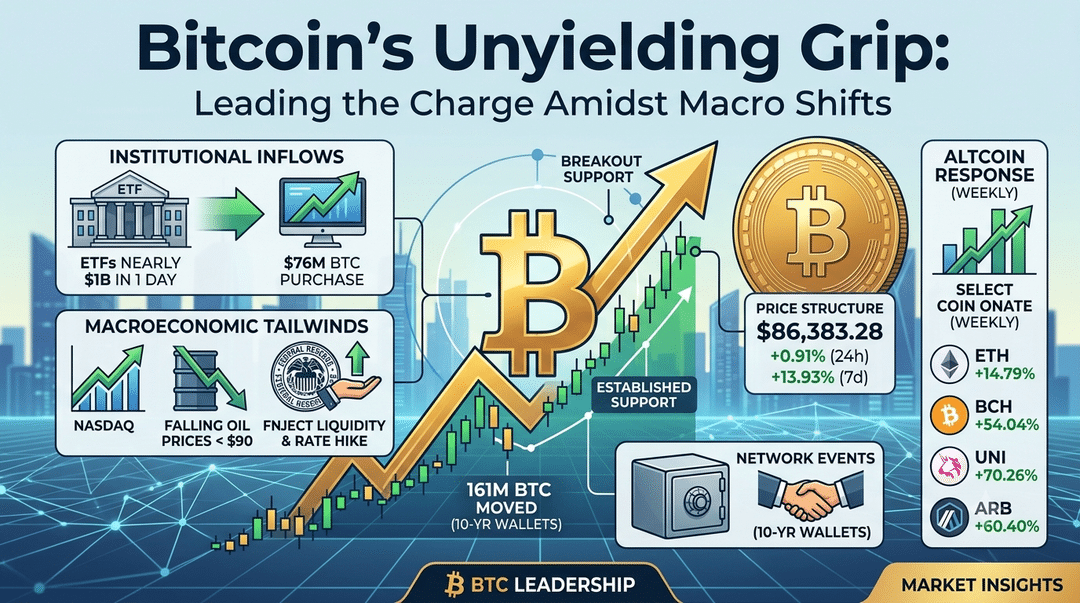
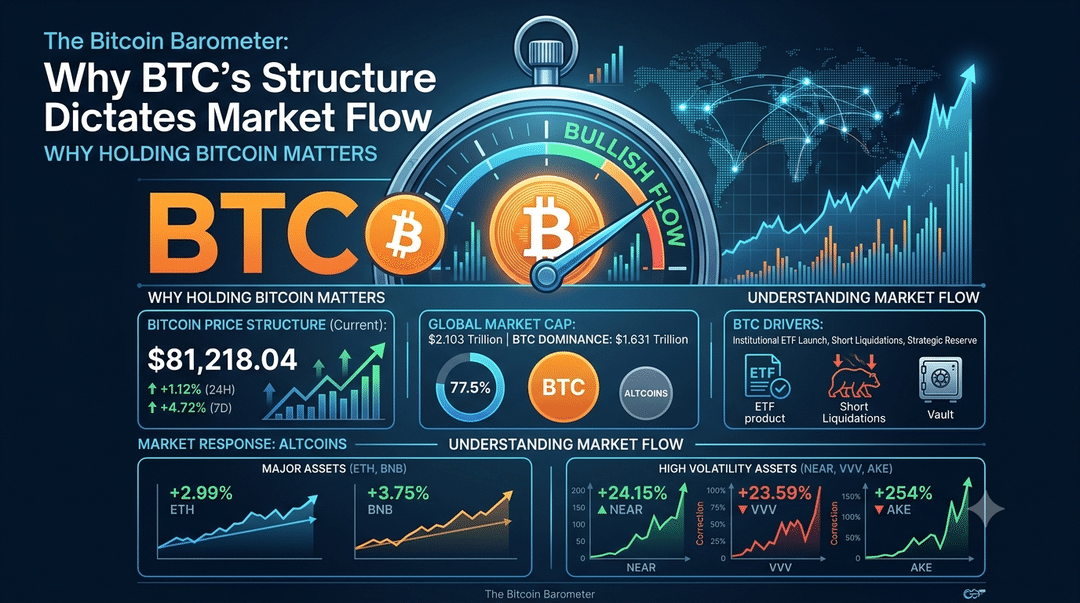
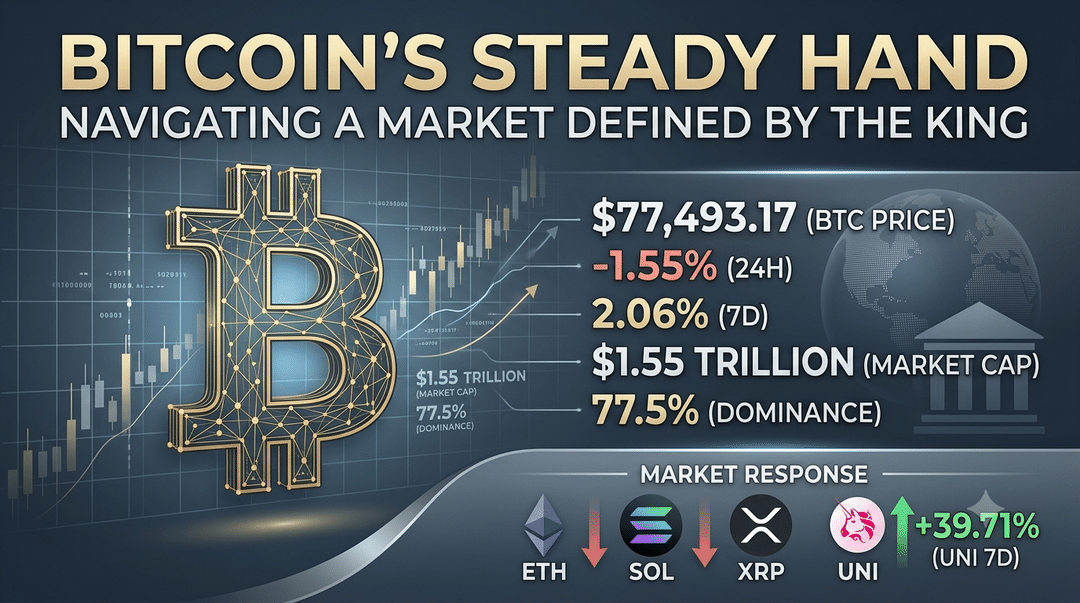
Bitcoin is currently trading at approximately $81,255.59, marking a 24-hour increase of 2.11%. This movement contributes to a 7-day gain of 1.81%, indicating a consistent, albeit measured, upward trajectory over the past week. Bitcoin's market capitalization stands at an impressive $1.63 trillion, anchoring the overall cryptocurrency market, which boasts a global market cap of $2.21 trillion. This positions Bitcoin as the dominant force, representing approximately 73.7% of the total market value.
While Bitcoin's 24-hour gain of 2.11% is positive, it is observed to be slightly below the average 24-hour move across the broader market, which is approximately 3.93%. This suggests that while Bitcoin is advancing, some altcoins have seen more pronounced percentage gains within the same period. Nevertheless, Bitcoin's sheer market capitalization means its movements exert a far greater influence on overall market sentiment and liquidity compared to individual altcoin rallies. The asset's short-term positioning appears to be consolidating recent gains, suggesting a market that is absorbing new information and institutional flows rather than experiencing rapid, speculative surges.
Why Bitcoin Is Driving The Tape
The current market environment sees Bitcoin's price action heavily influenced by a confluence of institutional adoption, new market infrastructure, and regulatory developments. These factors collectively reinforce Bitcoin's position as the leading indicator for the wider crypto market.
Recent disclosures highlight growing institutional comfort with Bitcoin exposure. JPMorgan, a significant player in traditional finance, notably increased its Bitcoin ETF holdings in Q1 2026, with a reported 174% rise in its BlackRock iShares Bitcoin ETF (IBIT) exposure. This move by a major financial institution signals a strengthening conviction in Bitcoin as a legitimate asset class for sophisticated investors. Further evidence of this trend comes from Dartmouth University's endowment, which has disclosed approximately $14 million in crypto exposure, including holdings in BlackRock's iShares Bitcoin ETF. These institutional endorsements provide a powerful narrative for Bitcoin, suggesting a structural shift in how traditional finance views and integrates digital assets.
Beyond direct investment, the market infrastructure supporting Bitcoin is also expanding. The announcement that CME and Nasdaq plan to launch crypto index futures, featuring Bitcoin alongside Ethereum, Solana, and XRP, is a significant development. These regulated products offer institutional investors more avenues for exposure and risk management, potentially increasing liquidity and broader market participation in Bitcoin. The inclusion of Bitcoin as a primary asset in these new offerings underscores its foundational role in the institutional crypto ecosystem.
Regulatory considerations also play a pivotal role. The upcoming CLARITY Act vote in the US Senate is being closely watched by analysts, as its outcome could introduce sudden swings in Bitcoin's price. The anticipation of regulatory clarity or potential shifts in policy can directly impact investor confidence and market sentiment around Bitcoin, given its status as the most scrutinized and regulated digital asset. This regulatory spotlight further solidifies Bitcoin's position as the asset around which major policy discussions and market reactions often revolve.
In terms of infrastructure, the news that crypto exchange Kraken is migrating its Wrapped Bitcoin (WBTC) technology to Chainlink, moving away from LayerZero following a security exploit, while specific to infrastructure, highlights the ongoing efforts to enhance the security and reliability of Bitcoin-linked products. This focus on robust infrastructure, even for wrapped versions of Bitcoin, speaks to the asset's importance and the need for secure, trustworthy solutions for its integration into the broader DeFi landscape.
These developments collectively illustrate that Bitcoin's current market trajectory is not merely a product of speculative retail interest but is increasingly shaped by fundamental shifts in institutional behavior, market structure, and regulatory frameworks.
How The Rest Of The Market Is Responding
The broader cryptocurrency market is currently exhibiting a mildly positive short-term bias, largely mirroring the sentiment established by Bitcoin. However, the performance across altcoins varies, with some confirming Bitcoin's lead while others show distinct, often more volatile, movements.
Among the priority assets, Ethereum (ETH) has registered a 24-hour gain of 0.95%, and Solana (SOL) a 1.15% increase. Both are positive but have lagged Bitcoin's 2.11% rise over the same period. Similarly, BNB saw a modest 0.67% increase. This indicates that while the positive momentum from Bitcoin extends to other major cryptocurrencies, they are not necessarily outperforming the market leader in percentage terms.
XRP, however, stands out among the larger-cap assets, posting a 24-hour gain of 3.89%, which is notably higher than Bitcoin's. Chainlink (LINK) also showed a stronger performance with a 2.54% increase. These assets demonstrate some independent strength or specific catalysts that allow them to exceed Bitcoin's short-term percentage gains.
Looking at the top volatile assets, the market shows pockets of significant activity. Hyperliquid (HYPE) recorded an impressive 14.33% surge in 24 hours, making it the highest mover. Canton Network (CC) also saw a substantial increase of 6.21%, and Zcash (ZEC) climbed by 6.19%. These strong moves, as identified in the derived insights, are concentrated in specific altcoins, suggesting sector-specific interest or project-specific news driving their performance. While these assets exhibit higher volatility and stronger percentage gains, their smaller market capitalizations mean their impact on the overall market direction is less pronounced compared to Bitcoin. TRON (TRX) also saw a modest 1.23% increase, aligning more with the general market's positive but subdued trend.
The overall picture is one where Bitcoin provides a foundational bullish sentiment, driven by its unique institutional and structural catalysts. Major altcoins like Ethereum and Solana generally follow this lead but with less intensity, while a select group of smaller-cap altcoins exhibit higher volatility, potentially driven by their own narratives or lower liquidity, without necessarily challenging Bitcoin's overarching market influence.
Conclusion and Risk Management
The current cryptocurrency market narrative is undeniably Bitcoin-centric, with institutional adoption and evolving market structures serving as key drivers. The consistent influx of capital from entities like JPMorgan and university endowments into Bitcoin ETFs, coupled with the expansion of regulated futures products by CME and Nasdaq, reinforces Bitcoin's role as a bellwether asset. This institutional engagement provides a robust foundation for the observed mildly positive short-term bias across the market.
While Bitcoin's steady ascent is a dominant theme, the market also reveals a nuanced landscape where altcoins exhibit varied responses. Major assets like Ethereum and Solana are generally confirming Bitcoin's positive sentiment, albeit with more modest gains. In contrast, certain altcoins like Hyperliquid, Canton Network, and Zcash are experiencing significantly higher volatility and percentage increases, suggesting that specific narratives or project developments are driving their individual performance. However, these movements do not detract from Bitcoin's overarching influence on market direction and sentiment.
For market participants, understanding these dynamics is crucial. The continued integration of Bitcoin into traditional finance frameworks is a significant long-term catalyst. Monitoring further institutional disclosures and the progress of regulatory initiatives, such as the CLARITY Act, will be paramount in anticipating potential market shifts for Bitcoin. Regulatory clarity could unlock further institutional capital, while adverse outcomes could introduce periods of volatility.
Regarding risk management, it is prudent to acknowledge the dual nature of the market. Bitcoin's movements, while generally more stable due to its size and institutional backing, still carry inherent volatility. For altcoins, particularly those exhibiting high percentage moves, the risk profile is elevated. Investors may consider that while Bitcoin's structural tailwinds offer a degree of stability, the potential for rapid price changes in smaller-cap assets necessitates careful due diligence and a clear understanding of their specific drivers and liquidity conditions. Diversification and a focus on assets with clear, fundamental catalysts, aligned with one's risk tolerance, remain key considerations in this evolving market.
Source Data Reference
Market Snapshot Input
| Asset | Symbol | Price (USD) | 24h Change | Market Cap (USD) |
|---|---|---|---|---|
| Bitcoin | BTC | 81,255.586865 | 2.11% | 1,627,506,745,728 |
| Ethereum | ETH | 2,287.017958 | 0.95% | 275,417,147,265 |
| Solana | SOL | 92.216155 | 1.15% | 53,301,009,481 |
| XRP | XRP | 1.488423 | 3.89% | 91,978,947,812 |
| Chainlink | LINK | 10.493168 | 2.54% | 6,577,641,814 |
| Hyperliquid | HYPE | 44.404636 | 14.33% | 14,827,959,291 |
| TRON | TRX | 0.353703 | 1.23% | 30,546,922,578 |
| Canton Network | CC | 0.166137 | 6.21% | 5,798,479,263 |
| Zcash | ZEC | 558.18426 | 6.19% | 9,114,182,748 |
| BNB | BNB | 679.852254 | 0.67% | 94,624,856,570 |
Trending Headlines Input
- Dartmouth endowment invests in Solana ETF, holds $14M in crypto exposure
- CME and Nasdaq to launch crypto index futures featuring BTC, ETH, SOL and XRP
- JPMorgan lifts Bitcoin ETF exposure in Q1, led by BlackRock’s IBIT
- Kraken to Migrate Wrapped Bitcoin Tech to Chainlink as LayerZero Exodus Expands
- Analysts are watching these Bitcoin price levels ahead of CLARITY Act vote
- Tether, Tron and TRM Financial Crime Unit Has Frozen $450 Million in Illicit Crypto Funds