Bitcoin Price Structure
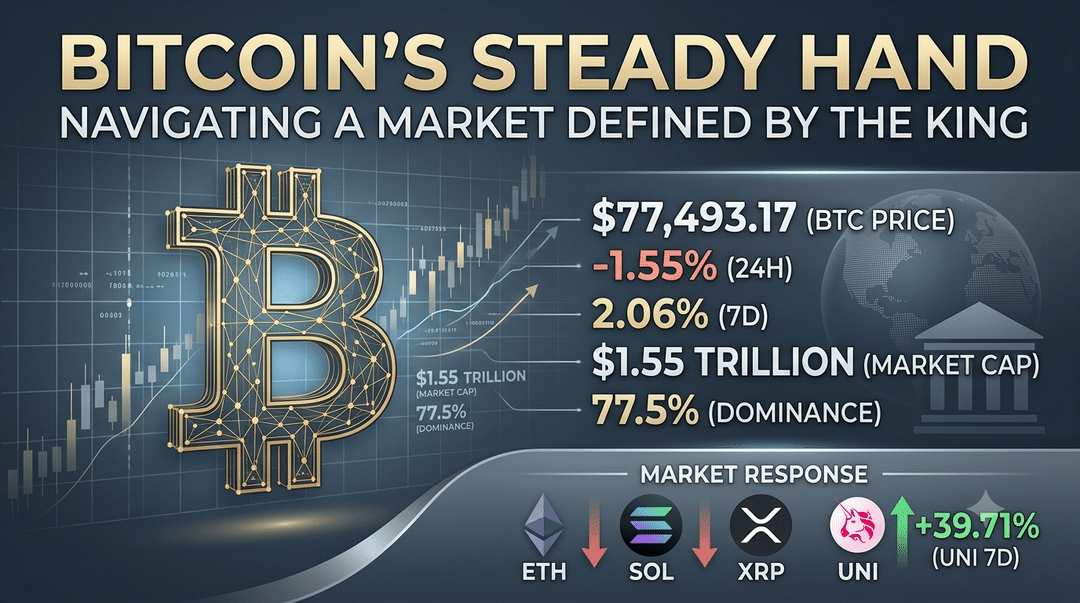
Bitcoin, the undisputed leader by market capitalization, currently trades at approximately $77,493.17. Over the last 24 hours, BTC has seen a decline of about 1.55%, extending its weekly loss to approximately 2.06%. Despite these short-term dips, Bitcoin maintains a commanding market capitalization of approximately $1.55 trillion, representing a substantial portion of the total global crypto market cap of $2.15 trillion. This dominant position underscores its influence on the overall market.
The observed slight negative movement in Bitcoin's price over the past 24 hours and the week indicates a period of consolidation or minor pullback following recent activity. However, its sheer scale and liquidity mean that even modest percentage changes in BTC can have significant ripple effects across the entire ecosystem. Its sustained rank as the number one asset positions it as the primary indicator for market health and direction. The short-term positioning suggests a cautious environment, with traders and investors closely watching for a definitive move that could signal renewed bullish momentum or further downside.
Why Bitcoin Is Driving The Tape
Bitcoin's influence on the market is not merely a function of its size but is deeply intertwined with several key catalysts, predominantly institutional and macro-economic factors. Recent news flows highlight a mixed but ultimately Bitcoin-centric narrative.
One significant driver is the continued institutional interest in Bitcoin Exchange-Traded Funds (ETFs). BlackRock's Bitcoin ETF notably saw a $217 million inflow, contributing to a rebound in BTC ETF performance. This rebound occurred after a period where spot Bitcoin ETFs experienced a $201.9 million outflow on a specific day, snapping a nine-day inflow streak. The ability of these institutional products to attract significant capital, even with intermittent outflows, underscores the sustained demand from traditional finance for Bitcoin exposure. Furthermore, a corporate entity, Strategy, made its first Bitcoin acquisition since June, adding $370 million to its BTC treasury. This action signals continued corporate belief in Bitcoin as a strategic asset, reinforcing its role as a store of value and an inflation hedge for institutional players.
Beyond direct investment vehicles, Bitcoin's response to broader macro-economic developments is a critical factor. Bitcoin demonstrated relative stability even as geopolitical tensions, such as US strikes on Iran, rattled traditional stock markets and lifted oil prices. This resilience, while not absolute, suggests that some market participants view Bitcoin as a distinct asset class, potentially uncorrelated with traditional risk assets under certain conditions. However, the market also grapples with macro headwinds, including rising US bond yields, which are eyeing new 20-year highs. Such developments can impact risk appetite across all asset classes, including cryptocurrencies, leading to volatile monthly closes for Bitcoin.
Additionally, historical patterns, such as the phenomenon of "Red September"—a month in which Bitcoin has historically lost ground in eight of the last thirteen instances, mirroring a similar trend in traditional stock markets since 1928—serve as a psychological and potentially fundamental factor. While not a predictive certainty, such historical observations can influence market participants' behavior and contribute to a more cautious outlook during specific periods.
Collectively, these factors—institutional inflows, corporate adoption, macro resilience, and historical patterns—position Bitcoin as the central figure around which the broader crypto market revolves. Its price movements and reactions to these catalysts provide the primary signals for market participants.
How The Rest Of The Market Is Responding
The broader cryptocurrency market is largely responsive to Bitcoin's trajectory, with most major altcoins exhibiting a similar, albeit sometimes amplified, short-term negative bias. The overall market, excluding Bitcoin, currently shows a mildly negative short-term bias, aligning with BTC's recent performance.
Ethereum (ETH), the second-largest cryptocurrency, has seen a 24-hour decline of approximately 2.26% and a 7-day decline of about 2.08%, closely mirroring Bitcoin's downward pressure. This correlation is a common observation, where ETH often follows BTC's lead, albeit with potentially higher volatility. Despite these price dips, news signals indicate that Ether ETFs have extended their inflow streak to 11 trading sessions, suggesting underlying institutional interest that could provide future support.
Other priority assets like XRP and Solana (SOL) have also experienced pullbacks. XRP is down approximately 2.40% in 24 hours and 6.21% over seven days. Solana, while down about 3.29% in the last 24 hours, has shown a 3.29% gain over the past seven days, indicating some short-term resilience or independent movement earlier in the week. XRP and Solana funds have also logged a 10th consecutive positive session for inflows, similar to Ethereum, suggesting that while spot prices may be declining, institutional products tied to these assets are still attracting capital. This divergence between spot price action and ETF inflows presents a mixed picture for these major altcoins.
Among the top volatile assets, Uniswap (UNI) stands out as a notable exception to the general market trend. UNI has surged by approximately 11.27% in the last 24 hours and an impressive 39.71% over the past seven days. This significant upward movement in UNI suggests a specific catalyst or strong independent momentum not directly tied to Bitcoin's immediate price action. Other volatile assets like TRON (TRX) have seen declines, with TRX down about 3.09% in 24 hours and 4.65% over seven days, aligning more closely with the broader market's negative sentiment.
In essence, while a few altcoins like UNI exhibit strong independent movements, the majority of the market, including significant majors like ETH, XRP, and SOL, tends to confirm or lag Bitcoin's short-term price direction. The general sentiment across the selected asset basket is one of mild short-term negativity, reflecting Bitcoin's current structure.
Conclusion and Risk Management
Bitcoin's current price structure, coupled with its pivotal role in institutional and macro narratives, firmly establishes it as the primary determinant of the broader crypto market's direction. While the market is experiencing a mildly negative short-term bias, driven largely by Bitcoin's recent dips, the underlying institutional interest in BTC ETFs and corporate acquisitions remains a significant counterbalancing force.
The observed resilience of Bitcoin in the face of certain macro pressures, contrasted with the historical "Red September" pattern and ongoing volatility from bond yields, highlights a complex environment. For market participants, this underscores the critical importance of closely monitoring Bitcoin's price action and the evolving landscape of institutional engagement.
In terms of risk management, the current market environment necessitates a cautious approach. The inherent volatility of the crypto market, amplified by macro-economic factors and geopolitical events, means that sudden price swings are always a possibility. While Bitcoin's dominance provides a central point of reference, the performance of individual altcoins can diverge significantly, as seen with UNI's recent surge. Investors should conduct thorough due diligence, understand the specific catalysts affecting their chosen assets, and consider the potential impact of Bitcoin's movements on their portfolios. Diversification and a clear understanding of risk tolerance remain paramount in navigating a market so heavily influenced by its leading asset.
Source Data Reference
Market Snapshot Input
| Asset | Symbol | Price (USD) | 24h Change | Market Cap (USD) |
|---|---|---|---|---|
| Bitcoin | BTC | 77,493.174504 | -1.55% | 1,555,945,464,397 |
| Ethereum | ETH | 2,417.034337 | -2.26% | 291,686,884,384 |
| XRP | XRP | 1.351798 | -2.40% | 84,817,869,991 |
| Solana | SOL | 100.291888 | -3.29% | 58,691,442,895 |
| Uniswap | UNI | 5.996975 | 11.27% | 3,750,169,755 |
| Monero | XMR | 513.491302 | -0.12% | 9,653,228,251 |
| TRON | TRX | 0.322011 | -3.09% | 30,568,773,960 |
| Zcash | ZEC | 836.429966 | -2.34% | 13,657,453,477 |
| Dogecoin | DOGE | 0.081394 | -2.24% | 13,953,765,779 |
| BNB | BNB | 688.053479 | -0.76% | 91,622,781,686 |
Trending Headlines Input
- BlackRock drives $217M Bitcoin ETF rebound as altcoin funds continue streaks
- What Is 'Red September'? Bitcoin's Curse, and Why Wall Street Has the Same One
- Asia sees digital asset custody infrastructure deals from Ripple, Coincheck
- Strategy buys $370M Bitcoin in first corporate purchase since June
- Bitcoin ETFs Snap Nine-Day Inflow Streak as Ethereum Funds Extend Their Run
- Bitcoin Holds Steady as US Strikes on Iran Rattle Stocks and Lift Oil
- Bitcoin begins volatile monthly close as US bond yields eye new 20-year high
- Bitmine now controls 4.9% of Ethereum supply after adding 53.5K ETH
- Mystery surrounds why an OG burned $1M in Bitcoin
- Robinhood Chain DEX Volume Jumps to $1.6 billion