Bitcoin Price Structure
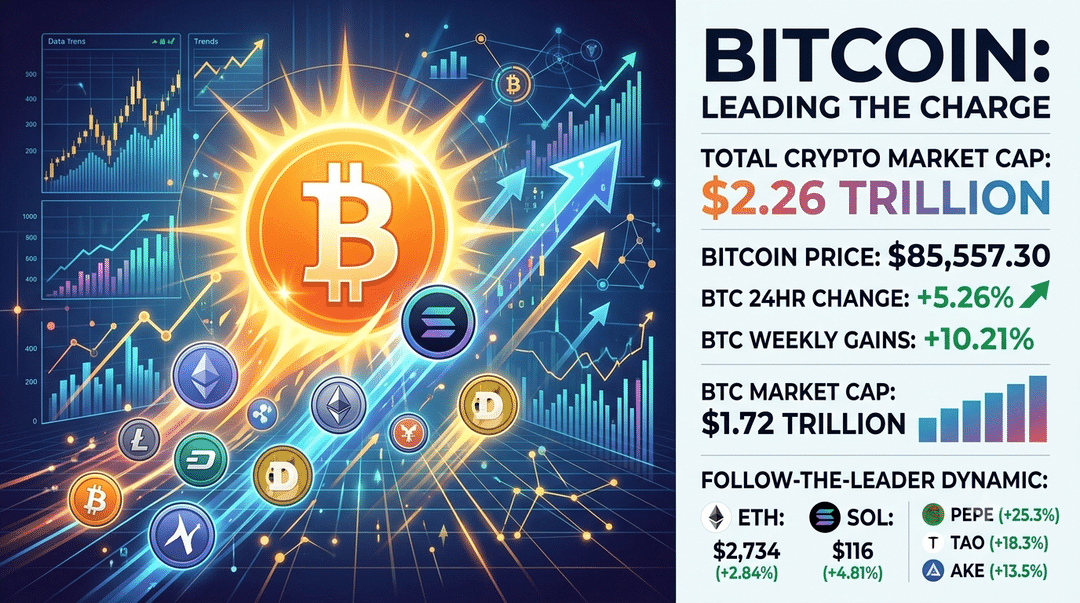
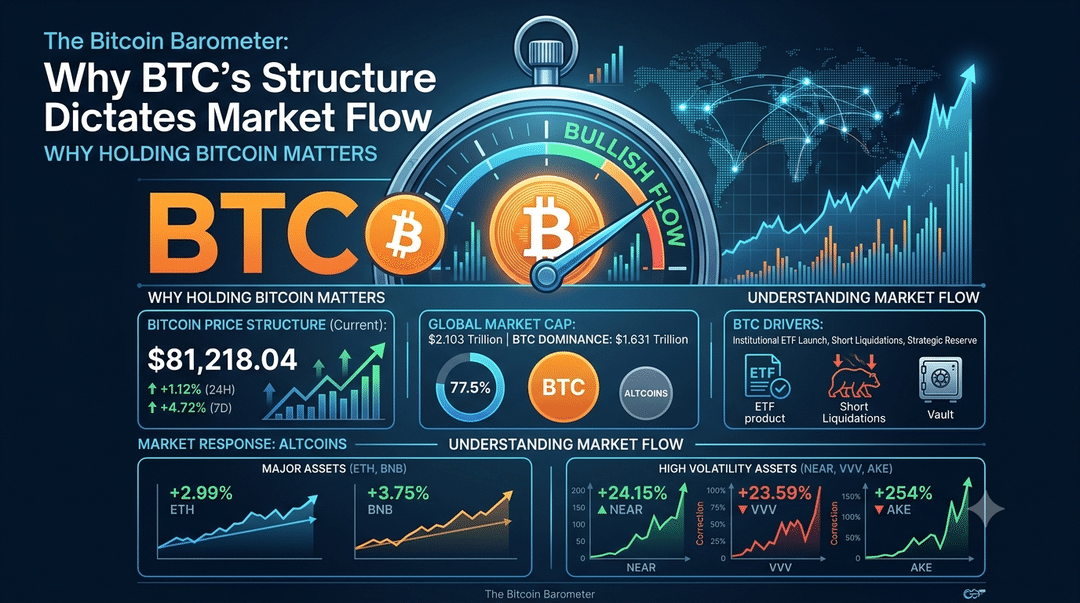
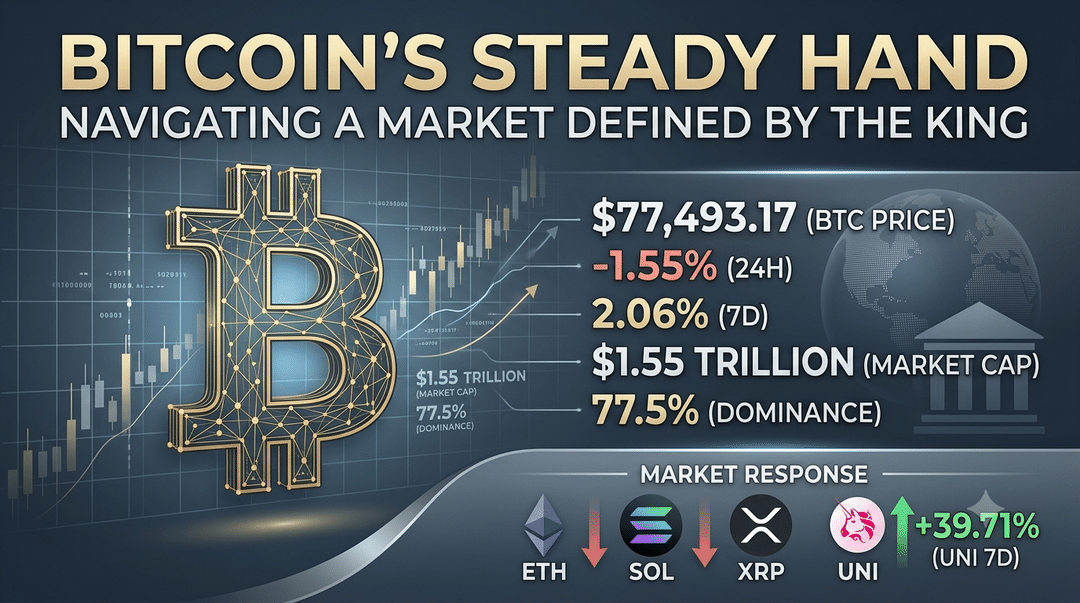
Bitcoin (BTC) is currently trading at approximately $80,150.71, reflecting a modest 24-hour increase of 0.46%. Over the past seven days, BTC has seen a gain of 2.29%. This relatively stable short-term performance contrasts with the broader market's average 24-hour move of 6.86%, indicating a period of consolidation or measured growth for the leading cryptocurrency.
With a market capitalization of approximately $1.605 trillion, Bitcoin continues to hold a dominant position within the global crypto market, which stands at around $2.032 trillion. This significant market share underscores Bitcoin's influence on overall market sentiment and capital flows. Ethereum (ETH), the second-largest cryptocurrency, has mirrored Bitcoin's subdued short-term movement, posting a 0.90% increase over the past 24 hours and a 0.27% gain over seven days, trading at approximately $2,305.37, with a market cap of $277.6 billion. This suggests a general lack of aggressive directional momentum among the top two assets in the very short term, with Bitcoin showing slightly stronger weekly resilience.
Why Bitcoin Is Driving The Tape
The primary catalysts underpinning Bitcoin's current market influence stem from a combination of sustained institutional interest and developments within its ecosystem. Observed data points to a clear trend of institutional capital flowing into Bitcoin, setting the pace for the wider crypto landscape.
A significant driver is the continued performance of spot Bitcoin Exchange-Traded Funds (ETFs). Recent reports indicate that Bitcoin ETFs have experienced a five-week buying streak, pushing their net assets to $108.76 billion. This sustained inflow is interpreted as a signal that institutional demand is returning and that hedging strategies against Bitcoin exposure are unwinding. The consistent accumulation by these institutional vehicles suggests a deepening integration of Bitcoin into traditional finance.
Furthermore, the sentiment from Wall Street indicates a broader appetite for crypto assets, though Bitcoin remains the primary entry point for much of this institutional capital. While there is a growing interest in other digital assets, the surging Bitcoin ETFs are the most visible manifestation of this institutional return. This suggests that while institutions may eventually diversify their crypto holdings, Bitcoin is currently serving as the anchor for their initial and ongoing engagement.
Beyond direct investment products, developments in the Bitcoin mining sector also highlight institutional confidence. For instance, Bitcoin miner IREN recently secured a $3.4 billion deal with Nvidia for AI infrastructure, including a $2.1 billion share option for Nvidia. While this deal is focused on AI compute capacity, it demonstrates significant institutional investment flowing into companies operating within the Bitcoin ecosystem, reflecting a long-term strategic view on the value generated by such infrastructure. This type of investment can indirectly bolster the perceived stability and future prospects of Bitcoin.
Additionally, the evolving infrastructure around tokenized Bitcoin further underscores its foundational role. Solv Protocol's decision to migrate its $700 million tokenized Bitcoin technology to Chainlink, following a security incident with LayerZero, illustrates the ongoing efforts to enhance the security and reliability of Bitcoin-linked financial products. This move, while driven by security concerns, ultimately reinforces the utility and demand for Bitcoin in various decentralized finance (DeFi) applications.
These factors — robust ETF inflows, broader institutional interest, strategic investments in the mining sector, and the development of secure tokenized Bitcoin solutions — collectively position Bitcoin as the central force influencing current market direction and investor sentiment.
How The Rest Of The Market Is Responding
The broader cryptocurrency market is largely responding to Bitcoin's lead, exhibiting a mildly positive short-term bias. While Bitcoin itself has shown relatively modest 24-hour gains, several altcoins have demonstrated significant independent momentum, suggesting selective capital rotation or project-specific catalysts at play.
Among the top volatile assets, Ondo (ONDO) has shown exceptional strength, surging by 30.49% over the past 24 hours and an impressive 69.30% over the last seven days, currently priced at $0.4548. Internet Computer (ICP) also recorded a substantial gain of 19.80% in 24 hours and 53.41% over seven days, trading at approximately $3.60. Near Protocol (NEAR) followed suit with an 8.21% increase in 24 hours and a 23.35% gain over the week, reaching $1.59. These pronounced movements in specific altcoins indicate that while Bitcoin provides a foundational stability, individual projects with strong narratives or technical developments can still attract significant capital.
Other notable movements among selected assets include Zcash (ZEC), which saw a 6.61% increase in 24 hours and a 59.25% rise over seven days, reaching $611.15. Chainlink (LINK) posted a 5.07% gain in 24 hours and 13.5% over the week, trading at $10.34, with its recent involvement in tokenized Bitcoin infrastructure likely contributing to its performance. Binance Coin (BNB) also saw a 1.90% increase in 24 hours and 5.41% over seven days, priced at $649.67.
Conversely, Toncoin (TON) experienced a 5.39% decline in the last 24 hours, despite a remarkable 92.95% surge over the past seven days, indicating a potential profit-taking phase after a strong rally. TRON (TRX) showed a modest 0.51% increase in 24 hours, with a 7.41% gain over the week, trading at $0.35.
Beyond price action, broader market developments include regulatory and security-related news. Tether's freezing of over $500 million in USDT across Ethereum and Tron addresses in 30 days highlights ongoing regulatory scrutiny and its impact on stablecoin operations. Additionally, Mantle tokenholders approving a 30K ETH Aave credit facility following an rsETH exploit points to continued efforts within the DeFi ecosystem to address security vulnerabilities and manage risk. These events, while not directly tied to Bitcoin's price movements, contribute to the overall market environment and investor caution.
In essence, the market appears to be in a state where Bitcoin's institutional narrative provides a stable backdrop, allowing specific altcoins to rally based on their unique value propositions or short-term momentum. The overall market capitalization growth is largely anchored by Bitcoin's performance, with altcoins either consolidating or experiencing project-specific surges.
Conclusion and Risk Management
The current crypto market landscape is demonstrably Bitcoin-centric, with the asset's price stability and robust institutional inflows acting as the primary drivers of sentiment and capital allocation. The consistent buying streak in spot Bitcoin ETFs and broader institutional engagement are observed facts that provide a strong narrative for Bitcoin's sustained relevance and potential as a foundational asset in traditional finance. This thesis suggests that Bitcoin's performance will likely continue to set the overarching tone for the cryptocurrency market in the near term.
Looking ahead, if Bitcoin maintains its current price structure and institutional demand continues to grow, it could provide a stable and potentially bullish foundation for the broader market. This scenario might encourage further capital rotation into select altcoins, particularly those with strong fundamentals or innovative developments, as seen with the recent surges in ONDO, ICP, and NEAR. Conversely, any significant shift in institutional sentiment, such as a slowdown in ETF inflows or a notable decline in Bitcoin's price, could trigger a broader market correction, impacting altcoins disproportionately due to their higher beta relative to BTC.
For market participants, effective risk management remains paramount. It is crucial to monitor Bitcoin's price action and the ongoing flows into BTC ETFs as key indicators of market health. While the strong performance of certain altcoins can be enticing, their movements are often more volatile and less correlated to the macro drivers currently affecting Bitcoin. Investors should exercise caution and conduct thorough due diligence before allocating capital to highly volatile assets, understanding that project-specific catalysts can be transient. Remaining vigilant to changes in institutional engagement, regulatory developments, and the underlying technical structure of Bitcoin will be essential for navigating the evolving market. Diversification, position sizing, and a clear understanding of individual asset risks are prudent strategies in this Bitcoin-led market environment.
Source Data Reference
Market Snapshot Input
| Asset | Symbol | Price (USD) | 24h Change | Market Cap (USD) |
|---|---|---|---|---|
| Ondo | ONDO | 0.454883 | 30.49% | 1,437,023,553 |
| Bitcoin | BTC | 80,150.708081 | 0.46% | 1,605,149,216,178 |
| Toncoin | TON | 2.527639 | -5.39% | 6,778,444,186 |
| Internet Computer | ICP | 3.600983 | 19.80% | 1,987,934,905 |
| Zcash | ZEC | 611.149471 | 6.61% | 9,979,012,964 |
| Ethereum | ETH | 2,305.372992 | 0.90% | 277,627,576,400 |
| Chainlink | LINK | 10.344376 | 5.07% | 6,484,371,802 |
| TRON | TRX | 0.350584 | 0.51% | 30,277,610,403 |
| Near Protocol | NEAR | 1.594283 | 8.21% | 1,889,489,634 |
| BNB | BNB | 649.665721 | 1.90% | 90,423,360,879 |
Trending Headlines Input
- Tether freezes over $500M of USDT in 30 days, BlockSec data shows
- Bitcoin ETFs Post 5-Week Buying Streak as Hedges Unwind, Institutional Appetite Returns
- Crypto Biz: Wall Street wants more than just Bitcoin
- Bitcoin Miner IREN Secures $3.4 Billion Nvidia AI Deal, With $2.1 Billion Share Option
- Solv Protocol Will Dump LayerZero, Migrate $700M Tokenized Bitcoin Tech to Chainlink
- Mantle tokenholders approve 30K ETH Aave credit facility after rsETH exploit