Bitcoin Price Structure
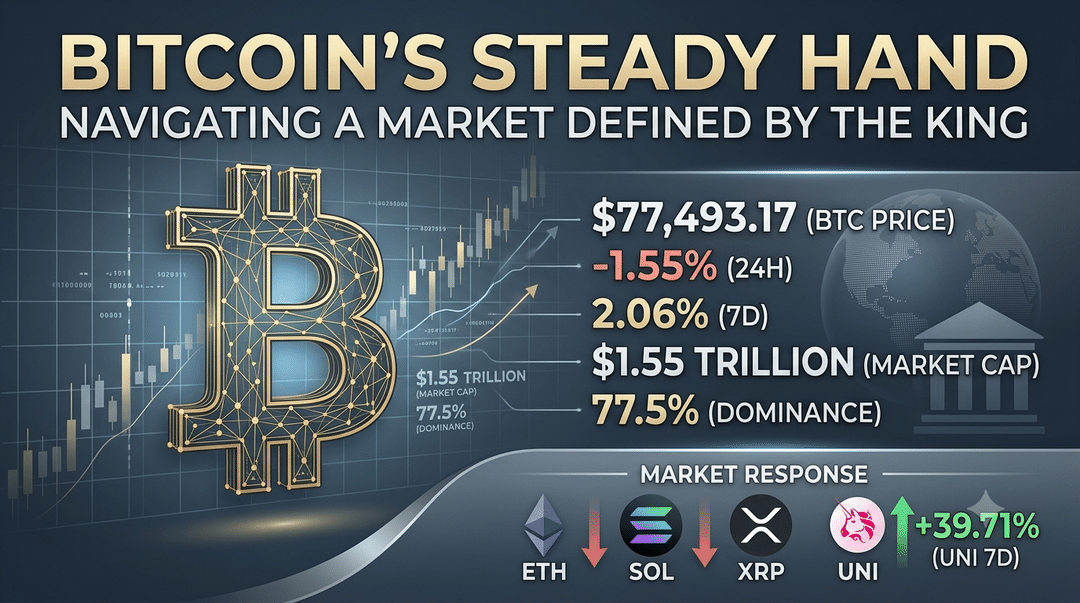
Bitcoin has demonstrated notable resilience and upward momentum, currently trading around $79,969.33. Over the past 24 hours, BTC has seen a gain of approximately 1.95%, building on a 7-day increase of 3.36%. This performance positions Bitcoin as a key driver, especially when compared to the broader market's average 24-hour move of 3.65%. While the average move is higher, Bitcoin's substantial market capitalization of $1.601 trillion means its movements carry significant weight for the entire crypto ecosystem.
The leading cryptocurrency's 24-hour trading volume reached approximately $44.72 billion, underscoring robust market activity. This price action has spurred market commentary, with some analysts describing the current rally as a "disbelief rally" and identifying an $84,000 price target in the short term, potentially to fill a futures gap. This observed price strength and the identification of potential upside targets suggest a positive short-term positioning for Bitcoin. Ethereum (ETH), the second-largest cryptocurrency by market cap, also recorded a 24-hour gain of 1.53%, trading around $2,351.63, with its market cap at $283.2 billion. While positive, ETH's percentage gain slightly lags BTC's over the same period, indicating Bitcoin's relative strength.
Why Bitcoin Is Driving The Tape
Bitcoin's market leadership is not merely a function of its size but is actively shaped by a confluence of institutional and macro-linked catalysts. Recent headlines underscore how developments directly impacting Bitcoin are reverberating through the entire crypto space.
A significant theme has been the institutional flow concerning crypto exchange-traded funds (ETFs). While Bitcoin has seen positive price action, there have been reports of substantial outflows from both Bitcoin and Ethereum ETFs. Specifically, Bitcoin funds reportedly shed $490 million, contributing to a 4-day negative streak for Ethereum ETFs, which saw $184 million in outflows. These figures, despite being negative, highlight the significant institutional engagement with Bitcoin and its derivatives, making ETF flows a critical barometer for market sentiment and capital allocation decisions. Even when negative, these large-scale movements in BTC-linked products are market movers.
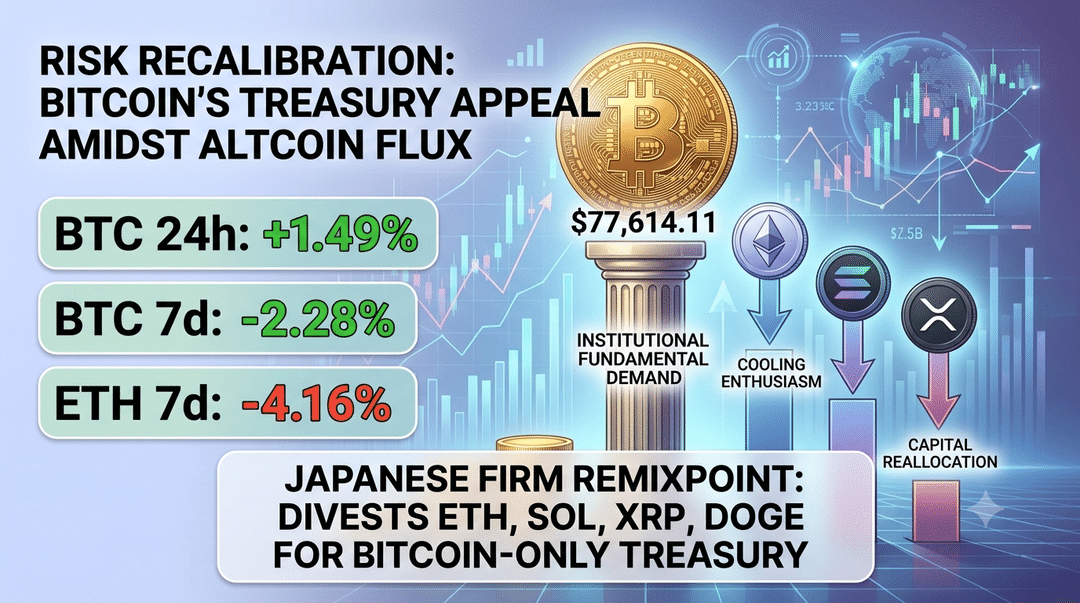
Furthermore, corporate strategic shifts are directly influencing the narrative around Bitcoin as an institutional asset. K Wave Media, a prominent firm, announced a pivot in its financing strategy, redirecting up to $485 million from a planned Bitcoin treasury strategy towards artificial intelligence (AI) infrastructure, alongside debt reduction and restructuring. This move, which reportedly led to a plunge in the K-Pop firm's stock, signals a re-evaluation of corporate Bitcoin adoption strategies in some sectors. While specific to one company, such decisions can influence broader perceptions of Bitcoin's role in corporate balance sheets and capital deployment. The decision points to a dynamic environment where corporate priorities can shift, impacting the institutional demand narrative for Bitcoin.
Adding to the complexity are developments on the regulatory and operational fronts concerning Bitcoin mining. A lawsuit has been filed by Texas residents against MARA Holdings over Bitcoin mining noise at its Granbury site. This event, while localized, underscores the ongoing challenges and scrutiny faced by Bitcoin mining operations, particularly regarding environmental and community impact. Such regulatory and operational hurdles, though not directly impacting price in the short term, contribute to the broader risk assessment for Bitcoin's infrastructure and long-term sustainability, making it a relevant catalyst for market participants.
The observed "disbelief rally" for Bitcoin, alongside analysts eyeing an $84,000 price target, suggests that despite some mixed institutional signals, there is underlying strength and conviction in Bitcoin's short-term trajectory. This market-structure-focused commentary further solidifies Bitcoin's position as the primary asset dictating market sentiment.
How The Rest Of The Market Is Responding
The broader cryptocurrency market is largely reacting to Bitcoin's lead, with some notable exceptions in volatility. The overall sentiment across the selected editorial asset basket is characterized by a mildly positive short-term bias, which appears to be influenced by Bitcoin's upward movement.
Ethereum (ETH), as a major asset, generally tracks Bitcoin but has shown some independent pressures. While ETH posted a 1.53% gain over the last 24 hours, slightly less than Bitcoin's 1.95%, it also contended with significant ETF outflows totaling $184 million over a four-day negative streak. This suggests that while Bitcoin's general positive trend provides some uplift, Ethereum faces its own specific institutional headwinds. Other core majors like BNB have shown more subdued performance, with BNB registering a 1.14% gain in 24 hours but a slight 0.46% decline over the past seven days, indicating a lack of strong independent momentum.
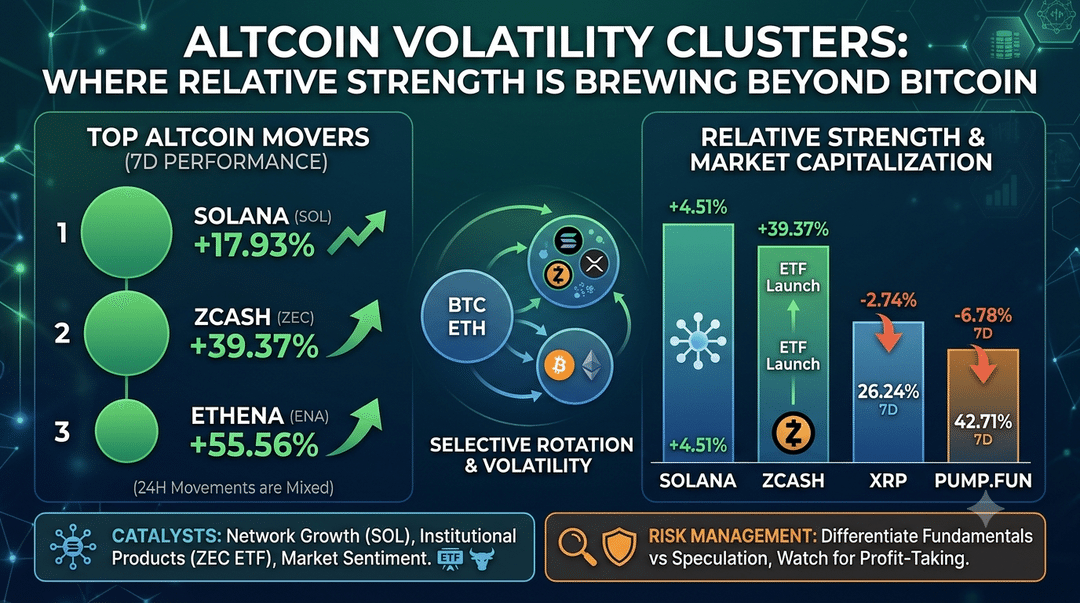
The strongest 24-hour moves, however, are concentrated in specific altcoins, rather than a broad-based rally. Toncoin (TON) stands out with an impressive 18.27% increase over the last 24 hours and a 23.43% gain over seven days, indicating a strong, asset-specific rally potentially driven by factors distinct from the broader Bitcoin narrative. Official World Liberty Financial (WLFI) also experienced a significant 6.06% rise in 24 hours, though its 7-day performance shows a 13.08% decline, suggesting short-term volatility within a longer-term downtrend. Monero (XMR) saw a 3.39% gain in 24 hours and a 6.52% increase over seven days, demonstrating moderate strength.
These strong individual altcoin performances, while notable, do not appear to be indicative of a widespread altcoin season driven by Bitcoin's momentum. Instead, they suggest that specific narratives or fundamental developments are driving these assets independently. The majority of other large-cap assets, such as Dogecoin (DOGE), Zcash (ZEC), and TRON (TRX), have shown more modest 24-hour gains, generally mirroring or slightly lagging Bitcoin's percentage move. This indicates that while the broader market benefits from a positive Bitcoin trend, capital is not flowing indiscriminately into altcoins in a way that suggests a decoupling from Bitcoin's primary influence.
Conclusion and Risk Management
Bitcoin continues to be the dominant force shaping the cryptocurrency market's direction. Its recent price structure, characterized by modest gains and resilience, sets a positive, albeit measured, tone for the broader digital asset space. While the overall market exhibits a mildly positive short-term bias, this is largely a reflection of Bitcoin's leadership rather than a widespread, independent altcoin surge.
The primary catalysts driving Bitcoin's influence stem from institutional activities and corporate strategy shifts. The ongoing dynamics of Bitcoin ETF flows, including recent outflows, highlight Bitcoin's central role in institutional investment narratives. Similarly, corporate decisions, such as K Wave Media's pivot away from a Bitcoin treasury, underscore the evolving landscape of corporate adoption and its potential impact on market sentiment for the leading cryptocurrency. Regulatory and operational discussions surrounding Bitcoin mining also remain relevant factors in its broader market context.
For market participants, it is crucial to recognize that the current environment suggests a Bitcoin-led market. While there are instances of significant, asset-specific volatility among certain altcoins like Toncoin, the overall market's trajectory appears tethered to Bitcoin's performance and the institutional narratives surrounding it.
Looking ahead, continued monitoring of Bitcoin's price structure, institutional inflows/outflows, and any further corporate or regulatory developments impacting BTC will be paramount. The market's "mildly positive short-term bias" should be viewed through the lens of Bitcoin's foundational role. Risks remain, particularly given the mixed signals from institutional flows and corporate strategies. A balanced approach that prioritizes Bitcoin's price action and its linked catalysts, while acknowledging the independent movements of select altcoins, is advisable in navigating the current market landscape.
Source Data Reference
Market Snapshot Input
| Asset | Symbol | Price (USD) | 24h Change | Market Cap (USD) |
|---|---|---|---|---|
| Bitcoin | BTC | 79,969.325927 | 1.95% | 1,601,371,037,333 |
| Ethereum | ETH | 2,351.632522 | 1.53% | 283,198,441,186 |
| Toncoin | TON | 1.615799 | 18.27% | 4,359,556,068 |
| Zcash | ZEC | 422.863637 | 0.62% | 6,904,631,207 |
| Dogecoin | DOGE | 0.110436 | 0.90% | 16,471,224,791 |
| Monero | XMR | 405.562855 | 3.39% | 7,481,314,160 |
| WhiteBIT Coin | WBT | 59.486288 | 1.66% | 8,573,075,655 |
| Official World Liberty Financial | WLFI | 0.06357 | 6.06% | 1,568,225,107 |
| TRON | TRX | 0.341291 | 0.98% | 29,475,016,263 |
| BNB | BNB | 624.325815 | 1.14% | 86,896,440,144 |
Trending Headlines Input
- K Wave Media abandons Bitcoin treasury push for AI infrastructure
- Ethereum ETFs Shed $184M Over 4-Day Negative Streak
- K-Pop Firm's Stock Plunges as It Dumps Bitcoin Treasury Plan for AI Pivot
- Texas Residents Sue MARA Holdings Over Bitcoin Mining Noise
- Bitcoin in ‘disbelief rally’ as traders spot $84K BTC price target
- US law firm attempts to block transfer of frozen ETH from Kelp exploit