Bitcoin Price Structure
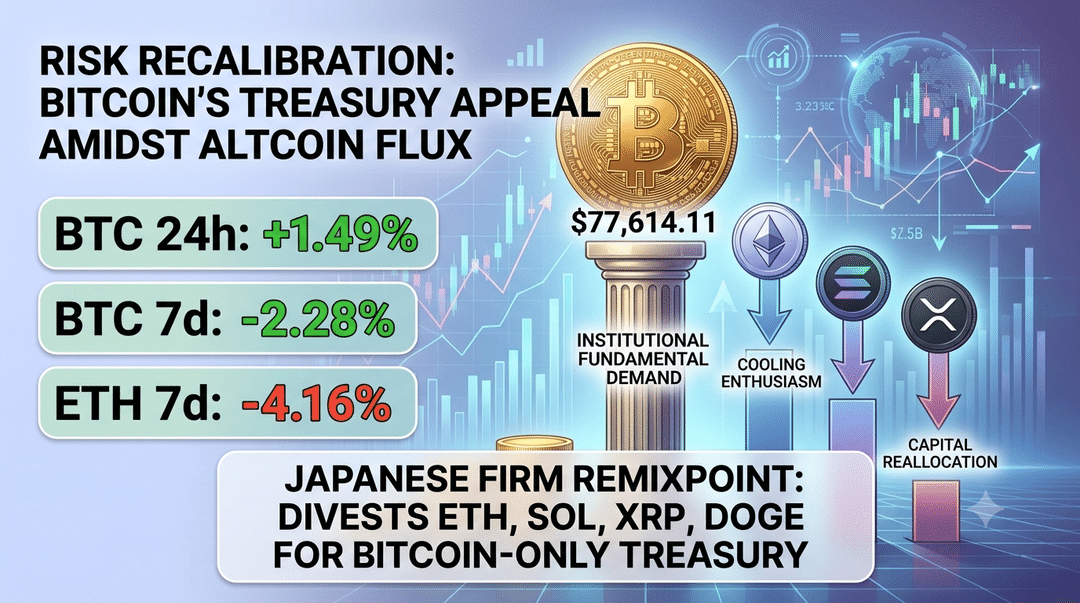
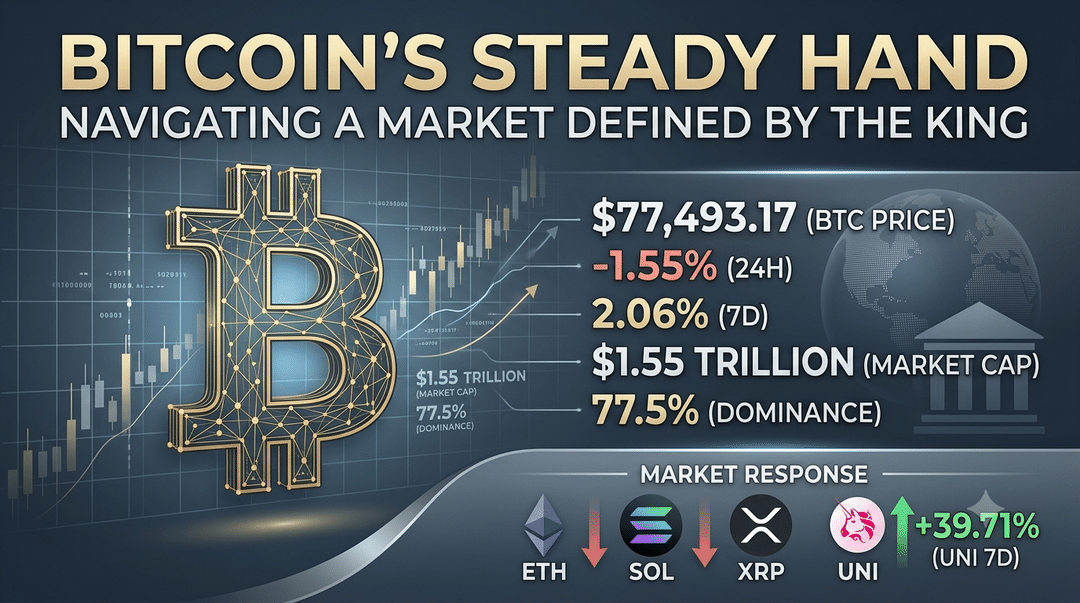
Bitcoin (BTC) has recently demonstrated a relatively stable price structure, trading at approximately $78,581.34. Over the past 24 hours, BTC has registered a modest gain of 0.28%. Looking at the weekly performance, Bitcoin has seen a 1.32% increase, indicating a slight upward trend over the medium term. With a market capitalization of approximately $1.57 trillion, Bitcoin continues to hold its dominant position as the largest cryptocurrency, representing a substantial portion of the total global market cap of $2.13 trillion. Its 24-hour trading volume stands at around $15.04 billion, underscoring its significant liquidity and market activity.
This performance suggests that while Bitcoin is not experiencing explosive growth in the immediate 24-hour window, it maintains a positive trajectory over a slightly longer period. The asset's immense market capitalization and consistent trading volume position it as the primary bellwether for the crypto market. Its movements, even if incremental, tend to have a ripple effect across other digital assets. The current price action indicates a period of consolidation with a mild bullish bias, as it holds onto weekly gains despite daily fluctuations being relatively subdued.
Why Bitcoin Is Driving The Tape
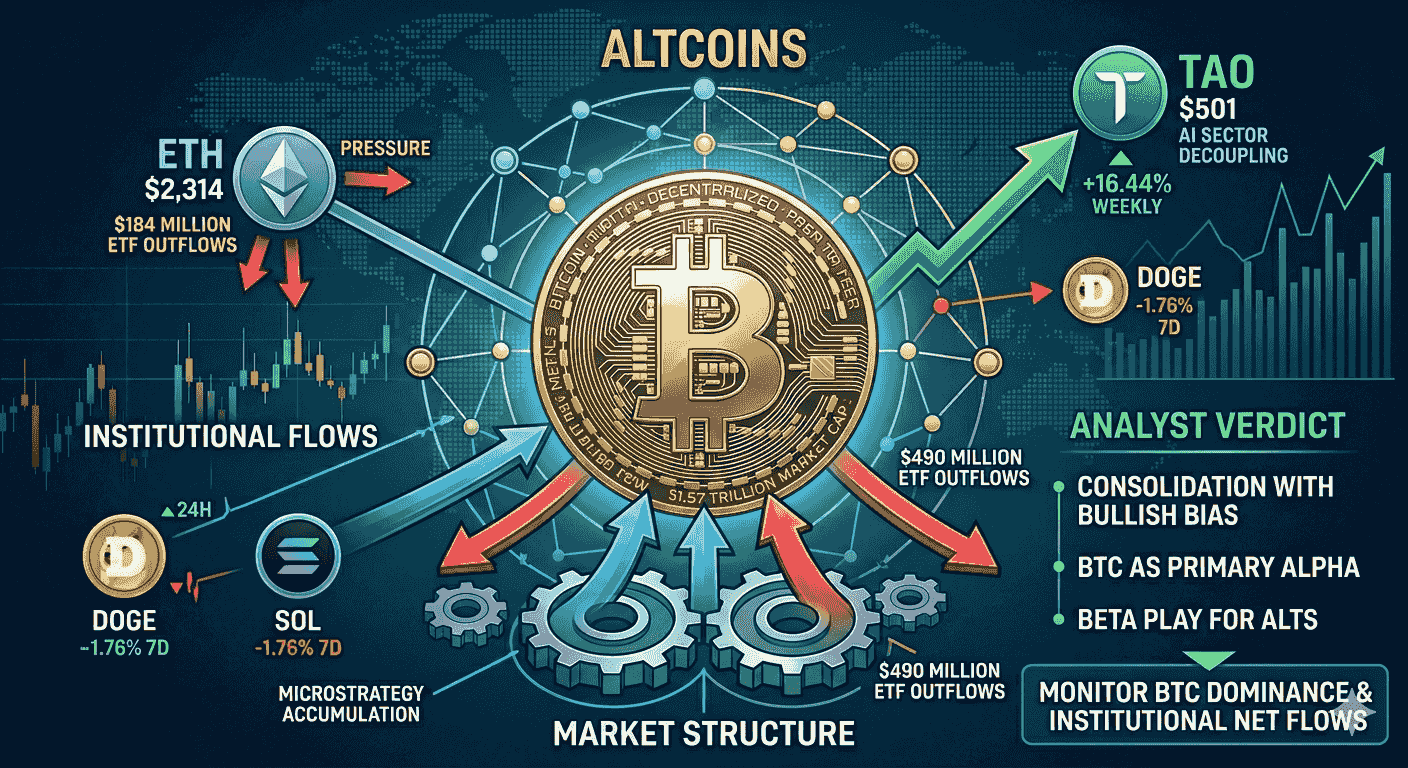
Bitcoin's influence over the current market tape is directly linked to recent institutional activity and evolving narratives. Despite a general market trend where Ethereum (ETH) ETFs have shed $184 million over a four-day negative streak, Bitcoin funds also experienced outflows, totaling $490 million during the same period. This suggests a broader cautious sentiment among institutional investors regarding spot crypto ETFs, even as the S&P 500 reached an all-time high. However, it's important to note that April saw Bitcoin rally 12%, with MicroStrategy (MSTR) reporting its first positive month since July, having added $4.1 billion in BTC. This indicates continued, albeit sometimes volatile, institutional accumulation.
Furthermore, market analysts are suggesting that Bitcoin may not require a fresh narrative to reclaim the $100,000 mark. This perspective implies that the existing drivers, such as institutional adoption and its status as a digital store of value, are deemed sufficient. Supporting this view, specific Bitcoin data points suggest a potential rally to $80,000 could be imminent. These observations include rising spot volumes and an increase in futures open interest, which are often interpreted as indicators that market sentiment has shifted back in favor of bullish positions. These on-chain and market structure signals, combined with the underlying institutional interest, reinforce Bitcoin's role as the primary catalyst for market direction, even amidst periods of ETF outflows.
How The Rest Of The Market Is Responding
The broader cryptocurrency market is largely reacting to Bitcoin's lead, with varying degrees of correlation and independent movement. Ethereum (ETH), the second-largest cryptocurrency, recorded a 24-hour gain of 0.70%, trading at approximately $2,314.51. However, its 7-day performance shows a slight decline of 0.09%, indicating a lack of strong upward momentum over the past week. This muted performance for Ethereum occurs alongside significant institutional headwinds, specifically the Ethereum Foundation's sale of 10,000 ETH (approximately $23 million) to BitMine for the second consecutive week, and the previously mentioned $184 million in Ethereum ETF outflows. These factors suggest that while ETH tracks BTC's general direction, it faces its own unique selling pressures that prevent it from mirroring Bitcoin's more resilient weekly gains.
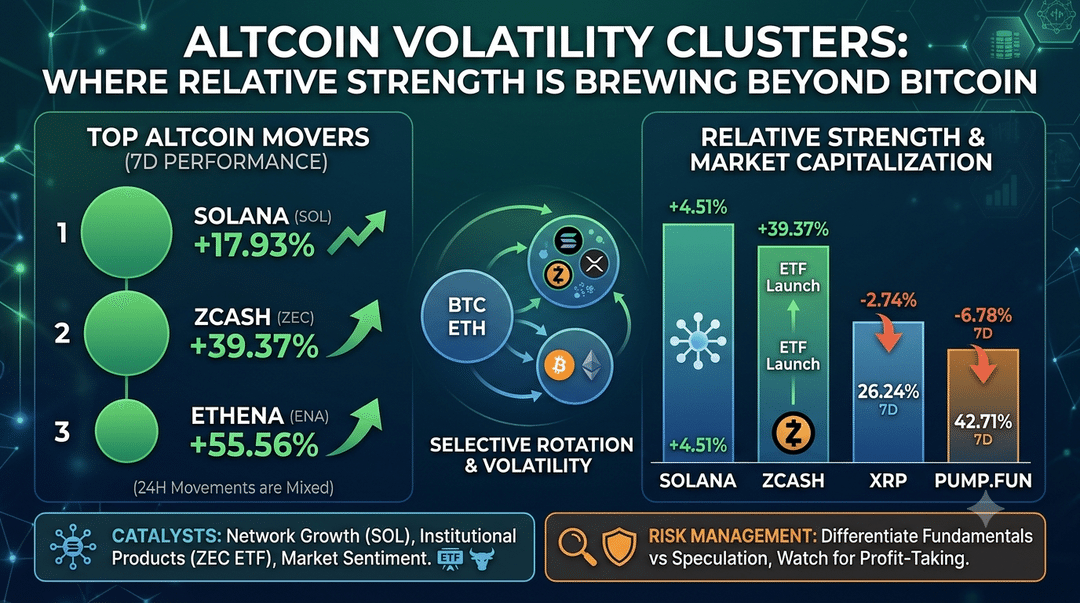
Among other major and volatile assets, the market presents a mixed picture. BitTensor (TAO) stands out with a significant 24-hour surge of 5.67% and a 7-day increase of 16.44%, making it the top volatile asset by a considerable margin. This strong performance indicates an asset with independent momentum, possibly driven by specific protocol developments or speculative interest, rather than direct correlation with Bitcoin's modest daily move. TRON (TRX) also showed a positive 24-hour change of 1.25%, with a 1.86% gain over seven days, suggesting some mild upward traction.
Conversely, other priority assets like Dogecoin (DOGE) experienced a 24-hour decline of 0.57%, despite a robust 10.45% gain over the past week. This suggests that while some altcoins have seen strong weekly rallies, their daily performance can diverge from Bitcoin's more stable trajectory. XRP, Solana (SOL), and BNB also registered minor 24-hour gains (0.37%, 0.17%, and 0.27% respectively), but all three experienced negative 7-day changes, ranging from -1.76% to -2.41%. This overall pattern confirms that while Bitcoin has maintained a mildly positive short-term bias, many large-cap altcoins are either lagging its weekly performance or experiencing their own distinct market dynamics, with only a few like TAO exhibiting significant independent strength.
Conclusion and Risk Management
The current cryptocurrency market environment is unequivocally Bitcoin-centric, with BTC's price structure and institutional catalysts serving as the primary drivers. While Bitcoin has shown a mildly positive short-term bias, evidenced by its weekly gains and analytical predictions of an $80,000 rally, this is occurring amidst a backdrop of mixed institutional flows, including significant ETF outflows for both BTC and ETH. The market's overall sentiment, as derived from asset performance, leans towards a cautious optimism, with Bitcoin's resilience being a key factor.
For market participants, understanding this Bitcoin-led dynamic is crucial. Bitcoin's ability to maintain its price structure and attract institutional capital, even with some outflows, underscores its foundational role. The rest of the market, particularly major altcoins, appears to be in a reactive state, with few demonstrating the consistent independent strength required to detach from Bitcoin's influence. Exceptions like BitTensor (TAO) highlight that specific narratives or developments can drive significant volatility in individual assets, but these remain isolated instances rather than a broader altcoin surge.
Looking ahead, the market's direction will likely continue to be heavily influenced by Bitcoin's ability to sustain its positive momentum and attract renewed institutional interest. Potential scenarios include a continued grind upward for BTC if spot volumes and futures open interest remain strong, potentially pulling other assets along. However, risks remain, particularly the ongoing institutional ETF outflows for both Bitcoin and Ethereum, which could exert downward pressure if they intensify. Investors should monitor Bitcoin's price action and institutional flow data closely, recognizing that sustained stability or growth in BTC is generally a prerequisite for broader market confidence. Given the concentrated volatility observed in a few altcoins, a diversified approach with careful risk management remains prudent.
Source Data Reference
Market Snapshot Input
| Asset | Symbol | Price (USD) | 24h Change | Market Cap (USD) |
|---|---|---|---|---|
| Bitcoin | BTC | 78,581.344343 | 0.28% | 1,573,502,544,960 |
| Ethereum | ETH | 2,314.505222 | 0.70% | 278,727,337,194 |
| BitTensor | TAO | 286.556329 | 5.67% | 2,750,221,786 |
| Dogecoin | DOGE | 0.108199 | -0.57% | 16,137,659,840 |
| Zcash | ZEC | 385.956687 | 0.53% | 6,302,004,601 |
| XRP | XRP | 1.39254 | 0.37% | 86,053,699,194 |
| TRON | TRX | 0.33046 | 1.25% | 28,539,656,232 |
| Solana | SOL | 84.033914 | 0.17% | 48,420,984,445 |
| BNB | BNB | 618.116428 | 0.27% | 86,032,190,116 |
| WhiteBIT Coin | WBT | 58.621688 | 0.31% | 8,448,470,748 |
Trending Headlines Input
- Ethereum ETFs Shed $184M Over 4-Day Negative Streak
- Bitcoin doesn’t need a fresh narrative to reclaim $100K: Analyst
- Bitcoin Closes April Up 12% as Strategy's MSTR Posts First Positive Month Since July
- Ethereum Foundation Sells $23 Million More in ETH to Tom Lee's BitMine
- Three Bitcoin data points suggest a rally to $80K is imminent
- North Korean Hackers Have Stolen $6 Billion in Crypto—Including 76% of 2026's Spoils: TRM