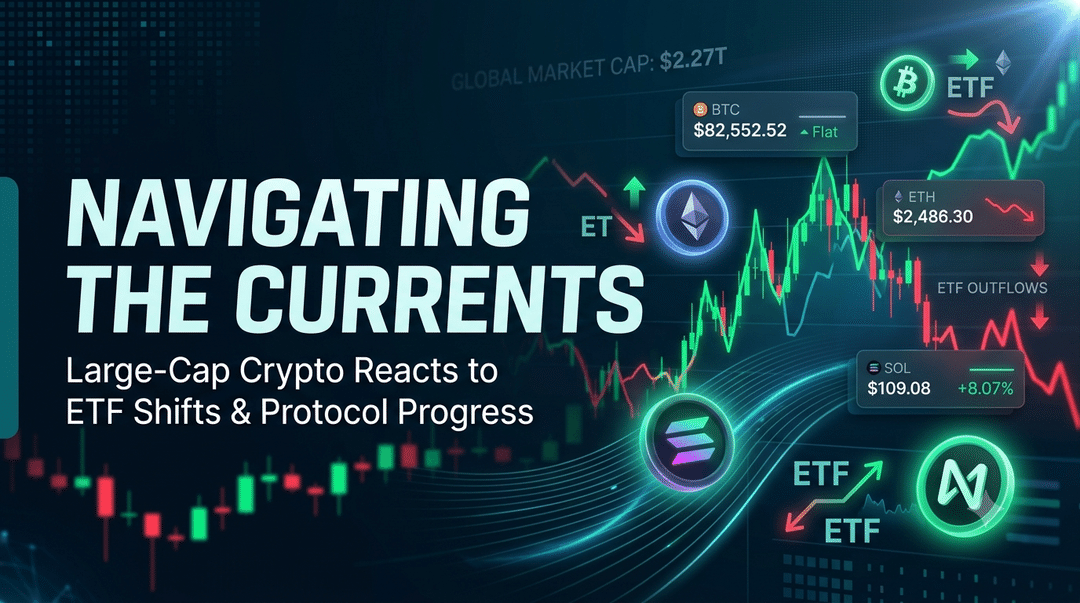
Global Market Capitalization
The total global cryptocurrency market capitalization stands at approximately $2.19 trillion, reflecting the significant scale of the digital asset economy. Across the top assets tracked, the average 24-hour price change registered around 2.03%, indicating a generally positive, albeit modest, short-term momentum for some components of the market. However, a closer look at individual large-cap assets reveals a more nuanced picture of performance.
Bitcoin (BTC), the leading cryptocurrency by market capitalization, is trading at approximately $81,225.05. It recorded a modest 24-hour gain of 0.85% but experienced a decline of 3.53% over the past seven days, suggesting a short-term rebound within a broader weekly correction. Bitcoin's market cap remains dominant at over $1.63 trillion.
Ethereum (ETH), the second-largest asset, followed a similar pattern, with a 24-hour increase of 0.71% to a price of $2,356.61. Like Bitcoin, Ethereum also saw a more significant weekly decline of 4.79%. Its market capitalization is approximately $287.91 billion.
Solana (SOL), a prominent layer-1 blockchain, showed a slightly stronger 24-hour performance compared to BTC and ETH, rising by 1.35% to $102.39. However, it also recorded a 7-day decline of 4.61%, indicating that recent gains have not fully offset earlier weekly losses. Solana's market cap is approximately $60.41 billion.
XRP, ranked among the top five, presented a different trend with a slight 24-hour decrease of 0.07%, trading at $1.32. Its 7-day performance also showed a decline of 2.98%. This suggests that XRP's price action has been less aligned with the modest positive momentum observed in BTC, ETH, and SOL over the last 24 hours. Its market capitalization stands at $83.87 billion.
In contrast to the broader weekly declines seen in many large-cap assets, BNB, Binance's native token, demonstrated notable strength. It posted a 24-hour increase of 2.36% and, uniquely among the top assets, also recorded a positive 7-day change of 1.5%. Trading at $759.64, BNB's performance indicates a degree of resilience or specific positive catalysts.
Other large-cap assets like Near Protocol (NEAR) and Chainlink (LINK) also posted positive 24-hour changes of 1.87% and 2.24% respectively, but both experienced significant 7-day declines (NEAR down 11.37%, LINK down 6.13%). Cardano (ADA) saw a minor 24-hour gain of 0.29% but a 7-day drop of 9.12%. Worldcoin (WLD) experienced a slight 24-hour dip of 0.27% and a substantial 7-day decrease of 25.53%, marking it as one of the weaker performers over the longer timeframe.
The observed data indicates that while the overall market retains a substantial valuation, the short-term movements within the large-cap segment are varied, with some assets showing signs of recovery over 24 hours while most contend with broader weekly corrections.
Top Volatile Coins
Within the broader market, certain assets have demonstrated particularly strong short-term volatility, standing out from the more measured movements of the largest cryptocurrencies. These assets often capture market attention and can sometimes signal shifts in sentiment or specific narratives.
Pepe (PEPE), a meme coin, was the most volatile asset among those tracked, posting a significant 24-hour gain of 10.98%. This surge also translated into a positive 7-day performance of 10.39%, indicating sustained upward momentum over the past week. PEPE's price action suggests a concentrated speculative interest that appears largely independent of the broader large-cap trends. Its market capitalization is approximately $2.15 billion.
BNB also featured among the top volatile assets, reinforcing its strong performance highlighted earlier. With a 24-hour increase of 2.36% and a 7-day gain of 1.5%, BNB's upward movement is noteworthy given the prevailing weekly declines across many other major assets. Its consistent positive trend over both timeframes suggests potential underlying strength or specific market catalysts.
Chainlink (LINK) registered a 24-hour increase of 2.24%, positioning it as another actively moving asset in the short term. However, LINK's 7-day performance showed a decline of 6.13%, suggesting that its recent 24-hour gains represent a rebound rather than a sustained upward trend over the week.
The concentration of strong 24-hour moves in assets like PEPE, BNB, and LINK indicates pockets of significant activity. PEPE's performance points to episodic, high-risk, high-reward trading, while BNB's consistent positive trend suggests a more fundamental or sustained buying interest. LINK's movement reflects short-term trading opportunities against a backdrop of weekly contraction.
News and Market Impact
Recent headlines provide crucial context for understanding current market dynamics, particularly concerning institutional involvement, security, and broader macroeconomic factors.
Institutional interest in the crypto space remains a significant theme. A Wall Street veteran, Jordi Visser, suggested that crypto could potentially outperform AI stocks, noting his expansion of holdings beyond Bitcoin, Ethereum, and Solana. This perspective indicates a growing recognition of digital assets within traditional finance, potentially attracting new capital. Further supporting this trend, Galaxy Research's findings on Bitcoin ETFs revealed a shift in institutional participation: while some "fast money" hedge funds and banks reduced their exposure, wealth platforms and sovereign funds notably increased their Bitcoin ETF holdings. This suggests a maturing institutional landscape for Bitcoin, with a potential transition from short-term speculative interest to more strategic, longer-term allocations.
Solana (SOL) specifically benefited from institutional news, with Mirae Asset Securities' Hong Kong unit issuing tokenized notes on the Solana blockchain. This move extends blockchain-based distribution to institutional investors, highlighting Solana's growing utility in regulated financial markets. Meanwhile, XRP also saw positive institutional engagement as Robinhood announced its integration of Ripple's RLUSD stablecoin, treasury software, and trading loans. This deepening collaboration could enhance XRP's utility and institutional adoption.
However, the market also grappled with security and operational concerns. Datavault AI, a Bitcoin treasury holder, reported being unable to access its Bitcoin from Biconomy since June, leading to a stock tank and restatement of financial reports. This incident underscores the operational risks associated with digital asset custody for institutional entities. Similarly, Bitcoin hardware wallet maker Keystone pulled devices after a factory key was stolen, affecting buyer records and raising security questions, though recovery phrases and private keys were reportedly not compromised. These events serve as reminders of the persistent security challenges and counterparty risks within the crypto ecosystem. Coinbase also addressed a security incident, denying a systems breach but confirming that a vendor, Amplitude, exposed some customer contact data, highlighting supply chain vulnerabilities.
Broader market and technological discussions also surfaced. The founder of Stacks, Muneeb Ali, suggested that "quantum fears" are already limiting Bitcoin's growth, potentially deterring institutional investors due to long-term security uncertainties. On a more abstract level, a new OpenAI paper declaring "ETH is false" sparked debate within the crypto community and among mathematicians, although the direct market impact of such a philosophical claim is not immediately clear. From a macro perspective, China's stock market has lost $2.4 trillion since May amid doubts about its AI boom and external pressures, which could indirectly influence global capital flows, including into crypto markets.
Conclusion and Risk Management
The current cryptocurrency market presents a complex picture of uneven performance and shifting dynamics. The overall global market capitalization remains substantial, yet individual large-cap assets are experiencing varied short-term movements, often within the context of broader weekly corrections. As observed, the selected editorial asset basket shows a mildly positive short-term bias, primarily driven by specific assets like PEPE, BNB, and LINK, which have posted the strongest 24-hour gains. There are 10 recent headlines available to contextualize these market moves.
Key takeaways from the recent activity and news flow include the ongoing, albeit nuanced, evolution of institutional engagement. While some traditional "fast money" may be exiting certain crypto positions, a more foundational interest from wealth platforms and sovereign funds appears to be taking hold, particularly in Bitcoin ETFs. Furthermore, specific blockchain platforms like Solana and Ripple are demonstrating increasing utility and integration within institutional finance, which can drive asset-specific positive momentum. However, the market is not without its challenges, with recent incidents highlighting persistent security vulnerabilities and operational risks associated with digital asset management. Discussions around long-term technological risks, such as quantum computing's potential impact on Bitcoin, also contribute to the complex risk landscape.
Given this backdrop, participants in the crypto market should maintain a measured and evidence-based approach. The inherent volatility of digital assets, coupled with the influence of both micro (asset-specific news) and macro (global economic and security concerns) factors, necessitates careful consideration. Understanding the distinction between observed price action and the potential, but not always direct, impact of news headlines is crucial. Market participants are advised to conduct thorough due diligence, assess their individual risk tolerance, and remain aware of the dynamic interplay between technological developments, institutional adoption, and regulatory landscapes.
Source Data Reference
Market Snapshot Input
| Asset | Symbol | Price (USD) | 24h Change | Market Cap (USD) |
|---|---|---|---|---|
| Bitcoin | BTC | 81,225.051642 | 0.85% | 1,633,033,237,170 |
| Solana | SOL | 102.393054 | 1.35% | 60,410,273,770 |
| Ethereum | ETH | 2,356.614554 | 0.71% | 287,907,991,302 |
| XRP | XRP | 1.323944 | -0.07% | 83,873,468,505 |
| Pepe | PEPE | 0.000005 | 10.98% | 2,146,017,622 |
| Near Protocol | NEAR | 4.718527 | 1.87% | 6,182,279,278 |
| BNB | BNB | 759.642566 | 2.36% | 99,901,741,641 |
| Chainlink | LINK | 11.82442 | 2.24% | 9,067,556,065 |
| Worldcoin | WLD | 0.437244 | -0.27% | 1,628,797,797 |
| Cardano | ADA | 0.205953 | 0.29% | 8,024,106,159 |
Trending Headlines Input
- Crypto could outperform AI stocks: Wall Street veteran Jordi Visser
- Wall Street’s Fast Money Fled Bitcoin ETFs, Sovereign Funds Stepped In
- Bitcoin Treasury Datavault AI Says It Can’t Access Its BTC, Stock Tanks
- Robinhood Taps Ripple's Stablecoin, Treasury Software and Trading Loans
- Bitcoin Wallet Maker Keystone Pulls Devices as Stolen Key Opens Door to Fakes
- Mirae Asset Securities issues tokenized notes on Solana
- Quantum fears already limiting Bitcoin’s growth, Stacks founder says
- Coinbase denies systems breach, says vendor exposed customer data
- China's Stock Market Has Lost $2.4 Trillion as Investors Doubt Its AI Boom Will Ever Pay Off
- OpenAI Proves ETH Is False, and Crypto Twitter Has Questions