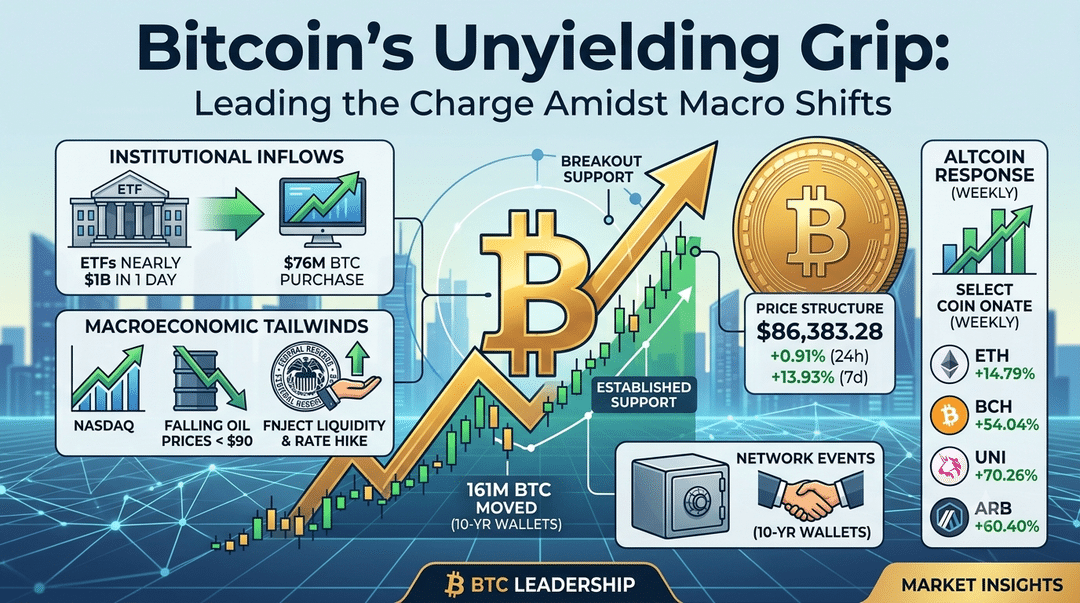
Bitcoin Price Structure
Bitcoin (BTC), ranked as the number one cryptocurrency by market capitalization, is currently trading at approximately $83,591.65. Its market capitalization stands at a substantial $1.68 trillion, anchoring the overall crypto market, which has a global market cap of approximately $2.28 trillion. This dominance underscores Bitcoin's role as the primary indicator for market health and direction.
Observing its recent performance, Bitcoin has registered a modest 24-hour gain of approximately 0.42%. This short-term positive movement follows a slight contraction over the past seven days, with BTC experiencing a -0.64% change. This structure suggests a period of consolidation or minor pullback, where Bitcoin has largely held its ground without significant volatility in either direction over the immediate term, especially when compared to the broader market's average 24-hour move of 3.43%. While the weekly performance indicates a slight cooling, the daily stability suggests a potential for equilibrium at current levels, or a pause before a more defined move. Its significant market cap and relatively muted short-term volatility, compared to some altcoins, position it as the steady anchor in the current environment.
Why Bitcoin Is Driving The Tape
Bitcoin's influence is not merely a function of its size; it is also heavily impacted by institutional developments, regulatory shifts, and macro-economic factors that primarily target or affect the flagship cryptocurrency. Several recent news signals highlight these BTC-linked catalysts.
Institutional engagement, particularly surrounding Bitcoin Exchange-Traded Funds (ETFs), remains a critical driver. Recent data indicates that Bitcoin ETFs have experienced $386.3 million in net outflows through the first seven trading days of October. This observed trend of outflows from institutional investment vehicles can exert downward pressure on Bitcoin's price, as it reflects a net selling interest from a significant segment of the market. This directly impacts Bitcoin's short-term price action and can set a cautious sentiment for the wider crypto space.
Adding to the institutional narrative, a recent incident involving an unauthorized Ledger hardware implant has reignited debates on the security of self-custody versus the perceived safety of Bitcoin ETFs. This discussion, while not directly a price driver, underscores the ongoing institutionalization of Bitcoin and the evolving landscape of how large sums of BTC are managed and secured. Such developments contribute to the long-term perception and adoption of Bitcoin by traditional finance.
On the regulatory front, there have been mixed signals. Positively, Russia’s largest bank, Sberbank, has secured authorization for crypto trading and is preparing to offer Bitcoin, Ethereum, and Tether USDt trading services. This move by a major financial institution in Russia signifies increasing mainstream acceptance and regulatory clarity in certain jurisdictions, potentially opening up new avenues for Bitcoin adoption and demand. Conversely, a UK High Court ruling moved the country closer to retaining a $5 billion Bitcoin haul seized from a fraud case, with claims to the funds now subject to Chinese law. While specific to a legal case, such large sums of Bitcoin involved in regulatory and legal proceedings highlight the asset's growing presence in global financial and legal systems.
Macroeconomic factors also play a role in Bitcoin's recent price movements. Bitcoin encountered resistance at the $84,000 level, coinciding with a deepening rout in South Korean tech and semiconductor stocks, which sent the KOSPI index down significantly. This correlation suggests that global equity market pressures, particularly in the tech sector, can spill over into Bitcoin, reinforcing its position as a macro-sensitive asset. The liquidity dynamics during such periods can impact Bitcoin's ability to break through key resistance levels.
Collectively, these factors — ETF flows, institutional custody debates, evolving regulatory landscapes in major economies, and macro-economic correlations — demonstrate how Bitcoin's narrative and price action are being shaped by forces distinct from the broader altcoin market, thereby enabling it to "drive the tape."
How The Rest Of The Market Is Responding
The broader cryptocurrency market is largely reacting to Bitcoin's lead, with varying degrees of correlation and independent volatility. The overall market, excluding stablecoins, shows a mildly positive short-term bias, as indicated by the average 24-hour move. However, this average masks significant divergence among individual assets.
Ethereum (ETH), the second-largest cryptocurrency, mirrors Bitcoin's subdued 24-hour performance with a negligible gain of approximately 0.11%. Its 7-day performance shows a more significant decline of -3.89%, suggesting that Ethereum has lagged Bitcoin's slight recovery over the past day and experienced a more pronounced weekly downturn. News regarding Ethereum includes ENS seeking DAO approval for an upgraded naming system, a protocol-specific development that is unlikely to be a primary market driver.
Other major altcoins also exhibit mixed responses. Solana (SOL) saw a marginal 24-hour dip of -0.02% and a notable 7-day loss of -8.99%. XRP recorded a modest 0.37% gain in 24 hours but a -6.27% drop over seven days. BNB showed a 0.31% gain in 24 hours, alongside a -2.90% weekly decline. These figures suggest that while Bitcoin has managed a slight daily uptick, many large-cap altcoins are still struggling with weekly losses, indicating that the positive momentum hasn't fully permeated beyond BTC, or that they are experiencing stronger selling pressure.
The market's strongest 24-hour moves are concentrated in a few specific assets, largely independent of Bitcoin's direct influence. Bitway (BTW) stands out with an exceptional 31.49% surge in 24 hours and a 90.79% increase over seven days, suggesting a highly localized catalyst or speculative interest. Zcash (ZEC) also posted a significant 4.47% gain in 24 hours, while Bitcoin Cash (BCH) rose by 2.47%. In contrast, Quant (QNT) experienced a notable 5.48% decline in 24 hours. These divergent movements among altcoins illustrate that while Bitcoin provides a general market backdrop, specific projects can still exhibit independent price action driven by their own narratives or smaller market dynamics.
Overall, the observed facts indicate that the rest of the market is primarily consolidating or showing weak performance in the wake of Bitcoin's recent stability and slight weekly downturn. While some altcoins exhibit strong independent volatility, the general trend among larger altcoins appears to be one of lagging or confirming Bitcoin's movements, rather than establishing a separate market direction.
Conclusion and Risk Management
Bitcoin's current market structure, characterized by its dominant market capitalization and relative short-term price stability following a slight weekly pullback, positions it as the unequivocal leader dictating the broader cryptocurrency market's direction. The confluence of institutional dynamics, regulatory developments, and macro-economic correlations directly impacting BTC reinforces its central role.
The primary scenario suggests that Bitcoin will continue to act as the bellwether. Sustained outflows from BTC ETFs could exert further downward pressure, potentially leading to a broader market correction. Conversely, positive regulatory advancements, such as the Sberbank approval, could bolster institutional confidence and provide a foundation for future upside, even if the immediate impact is not fully reflected in price. The observed resistance at $84,000, linked to external macro factors, highlights the importance of monitoring global economic indicators as potential catalysts or impediments for Bitcoin.
For market participants, effective risk management in this Bitcoin-led environment involves a keen awareness of BTC's price structure and the catalysts driving it. Diversification strategies should acknowledge Bitcoin's gravitational pull; significant moves in BTC are likely to influence all other assets. While some altcoins may show independent, high-volatility moves, their sustainability often depends on a stable or upward-trending Bitcoin. Therefore, monitoring institutional sentiment around Bitcoin, global regulatory shifts, and major macroeconomic headlines remains paramount. It is crucial to separate observed facts from speculative interpretations and understand that while Bitcoin sets the stage, individual altcoin performance can vary significantly, necessitating thorough due diligence for each asset.
Source Data Reference
Market Snapshot Input
| Asset | Symbol | Price (USD) | 24h Change | Market Cap (USD) |
|---|---|---|---|---|
| Bitway | BTW | 2.337911 | 31.49% | 5,143,404,699 |
| Bitcoin | BTC | 83,591.645803 | 0.42% | 1,680,019,965,436 |
| Ethereum | ETH | 2,510.798514 | 0.11% | 306,652,981,964 |
| Solana | SOL | 107.622974 | -0.02% | 63,413,541,770 |
| XRP | XRP | 1.371458 | 0.37% | 86,579,695,197 |
| BNB | BNB | 744.96519 | 0.31% | 99,198,520,964 |
| Chainlink | LINK | 12.959938 | 0.14% | 9,938,327,883 |
| Zcash | ZEC | 1,267.065979 | 4.47% | 20,688,994,151 |
| Bitcoin Cash | BCH | 278.531919 | 2.47% | 5,593,782,706 |
| Quant | QNT | 216.339927 | -5.48% | 2,611,815,254 |
Trending Headlines Input
- Bitcoin, Ethereum and Solana ETFs All in the Red for October
- Standard Chartered Will Hold Ripple's Stablecoin in Dubai—And Let Clients Trade With It Without Moving It
- Most tokenized stock trading on Solana, BNB Chain occurs outside US market hours
- Russia clears Sberbank for crypto trading ahead of December launch
- Ledger implant tests Bitcoin ETFs as safer custodial solutions than hardware wallets
- UK Moves Closer to Keeping $5B Bitcoin Haul After High Court Ruling
- Bitcoin hits $84K resistance as Korean tech rout deepens KOSPI losses
- ENS seeks DAO approval to activate upgraded Ethereum naming system
- Is Bitcoin kidding itself about the Lightning Network?
- Ripple-Backed Evernorth Hits Nasdaq Holding 473 Million XRP Worth Far Less Than It Paid