Global Market Capitalization
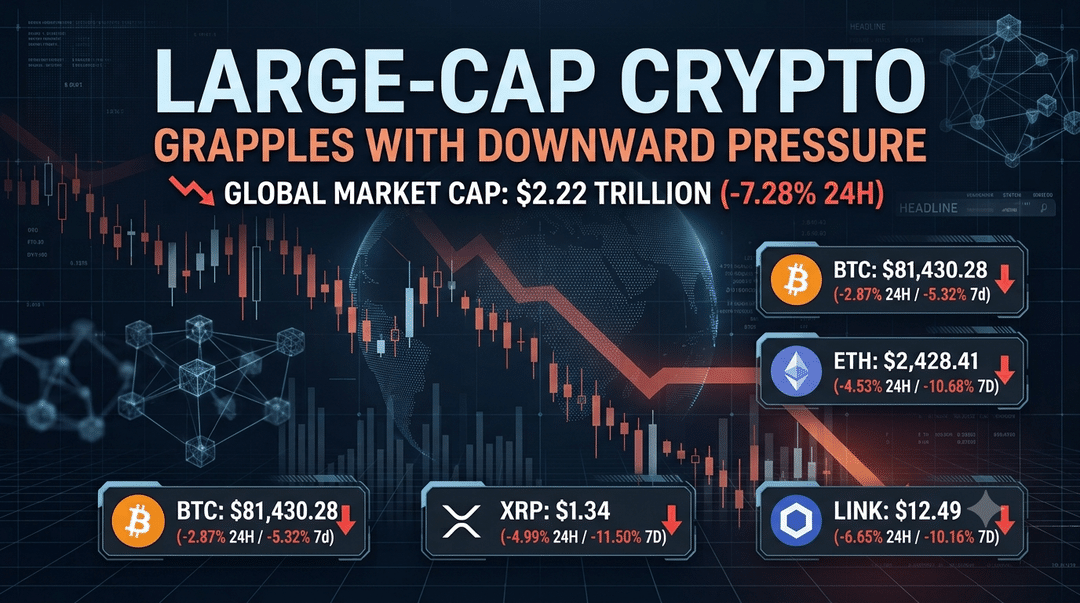
The total global cryptocurrency market capitalization stands at approximately $2.22 trillion. This figure reflects a significant downturn, with the average 24-hour price change across observed assets registering a decline of around -7.28%. This broad-based negative movement indicates a widespread selling pressure impacting the market.
Among the priority assets, Bitcoin (BTC), the largest cryptocurrency by market capitalization, is trading at approximately $81,430.28. It has experienced a 24-hour decrease of -2.87% and a 7-day decline of -5.32%. With a market cap of over $1.63 trillion, Bitcoin's performance often sets the tone for the rest of the market, and its current dip contributes substantially to the overall negative trend.
Ethereum (ETH), ranked second, is priced around $2,428.41. It has seen a 24-hour drop of -4.53% and a 7-day reduction of -10.68%. Its market capitalization is approximately $296.58 billion. Ethereum's more pronounced 7-day decline suggests a stronger bearish sentiment compared to Bitcoin over the past week.
XRP, holding the fifth rank, is trading at about $1.34. The asset recorded a 24-hour decrease of -4.99% and a 7-day decline of -11.50%, with a market cap of roughly $84.46 billion. XRP's performance mirrors the broader negative trend, with its 7-day decline exceeding that of both BTC and ETH.
Chainlink (LINK), ranked 16th, is priced at approximately $12.49. It has fallen by -6.65% over 24 hours and -10.16% over the past week. Its market cap is around $9.58 billion. LINK's movements align with the general market pullback, showing significant short-term depreciation.
Beyond the priority assets, other large-cap cryptocurrencies also experienced notable declines. BNB, ranked 4th, saw a 24-hour decrease of -3.25% to trade around $728.90, with a market cap of $97.06 billion. Its 7-day change was -7.24%. Solana (SOL), ranked 7th, is at $104.57, down -6.27% in 24 hours and -13.66% over seven days, holding a market cap of $61.61 billion. Zcash (ZEC), despite its lower rank at 10, is trading at $1165.55, with a 24-hour drop of -8.63% and a 7-day drop of -14.04%, and a market cap of $19.03 billion. Cardano (ADA), ranked 19th, is at $0.23, experiencing a 24-hour decline of -7.91% and a significant 7-day drop of -14.73%, with a market cap of $8.99 billion. These figures collectively illustrate a pervasive bearish sentiment across many top-tier digital assets.
Top Volatile Coins
In the midst of the broader market downturn, several assets exhibited particularly strong 24-hour movements, indicating concentrated volatility. These assets often become focal points for market attention due to their rapid price changes.
Ethena (ENA), ranked 44th, emerged as the most volatile asset among the observed group, experiencing a substantial 24-hour decline of -14.70%. Its price is approximately $0.20, with a market cap of $2.75 billion. The significant short-term depreciation for ENA suggests specific selling pressure or a reaction to internal project developments not immediately apparent from general market headlines. Over the past seven days, ENA has also seen an -18.14% drop, indicating a sustained negative trend.
Near Protocol (NEAR), ranked 23rd, also demonstrated considerable volatility, falling by -13.05% in the last 24 hours to a price of around $5.13. Its market capitalization stands at $6.71 billion. While its 7-day change was a more moderate -3.21%, the recent sharp decline suggests a fresh wave of selling pressure.
Zcash (ZEC), ranked 10th, also featured among the top volatile coins, with an 8.63% decrease over 24 hours, trading at approximately $1165.55. Its market cap is $19.03 billion. ZEC's 7-day change was -14.04%, indicating that its current volatility is part of a larger weekly downtrend.
The pronounced declines in these assets highlight areas of heightened activity and potential shifts in investor conviction, even as the overall market faces headwinds.
News and Market Impact
Recent headlines have provided context for the current market movements, particularly impacting institutional sentiment and perceptions of security.
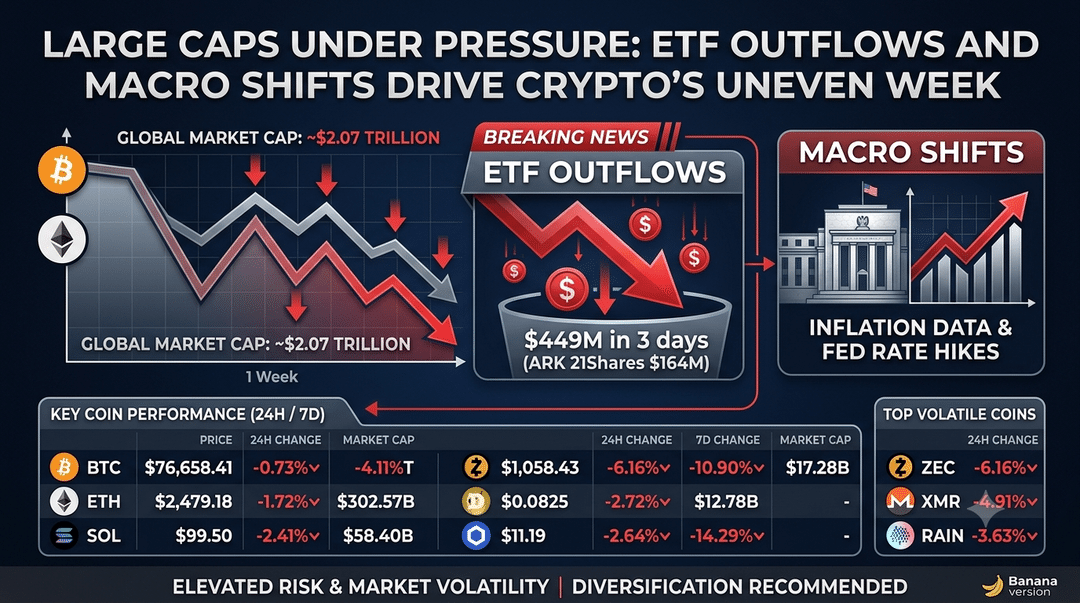
Institutional investment vehicles for major cryptocurrencies, specifically Bitcoin (BTC), Ethereum (ETH), and Solana (SOL), have seen negative performance. Bitcoin ETFs recorded $386.3 million in net outflows through the first seven trading days of October, while Ethereum funds have experienced nine consecutive days of losses. This trend suggests a cooling of institutional interest or a reallocation of capital away from these ETF products, potentially contributing to the downward price pressure observed in BTC, ETH, and SOL.
Further impacting the institutional narrative, a report emerged questioning whether Bitcoin ETFs are safer custodial solutions than hardware wallets, following the discovery of an unauthorized Ledger hardware implant. This discussion around the security of self-custody versus institutional custody could influence investor preferences and contribute to market uncertainty, especially for Bitcoin holders. Relatedly, Bitcoin miners are reportedly facing widening AI financing costs, needing approximately $50 billion for planned AI infrastructure, with major players like IREN, Riot Platforms, and HIVE Digital facing funding gaps. This financial strain on miners could indirectly affect market dynamics by influencing their holding or selling strategies.
XRP has been a subject of several significant news items. Standard Chartered's Dubai branch announced it would hold Ripple's RLUSD stablecoin and plans to allow institutional clients to use it as trading collateral without moving the coins. This development could be perceived as a positive step for institutional adoption and utility for XRP-related assets. However, other news around XRP has been mixed, including reports of an "18 trillion XRP" bug found by AI researchers, for which they received a $250K bounty. The XRP Ledger Foundation subsequently defended its emergency patch for this bug, pushing back against claims of forced implementation. These security-related headlines, despite the patch, may introduce a degree of caution among some investors. Additionally, Ripple-backed Evernorth began trading on Nasdaq, but 80% of SPAC investors cashed out, and its XRP holdings are now worth significantly less than at the time of signing, indicating potential challenges in its market debut.
In other security-related news, Coldcard announced an investigation into a phishing link appearing on its X (formerly Twitter) account, advising users against interaction. While not directly tied to a specific crypto asset's price action in the provided data, such incidents contribute to broader market security concerns.
For Ethereum (ETH), protocol developments indicate ongoing technical progress. The L2 Starknet is "actively considering" becoming its own blockchain, aiming to be the first fully quantum-resistant network by 2027. Separately, Ethereum's Sepolia test network activated Glamsterdam, raising its block gas limit to nearly 200 million, more than three times the mainnet's current capacity. These technical advancements, while positive for the ecosystem's long-term health and scalability, did not prevent ETH from experiencing short-term price depreciation, suggesting that macro or institutional factors might be exerting stronger immediate influence.
Conclusion and Risk Management
The current cryptocurrency market landscape is characterized by a mildly negative short-term bias, as evidenced by the widespread declines across large-cap assets and the average 24-hour move. The thesis that large-cap crypto markets are reacting to a mix of headline-driven catalysts and uneven short-term price movement is supported by the data.
Key takeaways from this market update include the continued importance of large-cap assets like Bitcoin, Ethereum, and XRP as indicators of overall market health, despite their recent downward price action. The strongest 24-hour moves, concentrated in assets like Ethena, Near Protocol, and Zcash, highlight specific areas of heightened volatility that may be driving narrative focus or reflecting asset-specific developments. Furthermore, the presence of 10 recent headlines underscores the influence of news on market sentiment, with institutional ETF outflows, security concerns surrounding hardware wallets and XRP bugs, and protocol developments all contributing to the current backdrop.
Investors should acknowledge the prevailing short-term bearish sentiment across major assets. While institutional adoption continues to be a long-term theme, the recent ETF outflows suggest a more nuanced picture of capital flows. Security incidents, whether related to hardware wallets or protocol bugs, serve as a reminder of inherent risks within the digital asset space.
Given the current market conditions, a measured approach to risk management remains prudent. This includes careful consideration of portfolio diversification, position sizing, and staying informed about both macro-economic factors and specific project developments. The interplay between headline news and price action suggests that market participants should remain vigilant, separating confirmed facts from speculative interpretations, and avoiding over-committing to positions based solely on short-term movements. The market's responsiveness to a diverse set of inputs underscores the importance of a comprehensive and cautious investment strategy.
Source Data Reference
Market Snapshot Input
| Asset | Symbol | Price (USD) | 24h Change | Market Cap (USD) |
|---|---|---|---|---|
| XRP | XRP | 1.337835 | -4.99% | 84,457,060,279 |
| Ethereum | ETH | 2,428.408086 | -4.53% | 296,576,042,314 |
| Bitcoin | BTC | 81,430.276739 | -2.87% | 1,636,534,075,095 |
| Chainlink | LINK | 12.487967 | -6.65% | 9,576,397,104 |
| Solana | SOL | 104.565061 | -6.27% | 61,605,891,747 |
| Ethena | ENA | 0.204919 | -14.70% | 2,747,197,175 |
| Zcash | ZEC | 1,165.546766 | -8.63% | 19,031,361,129 |
| Near Protocol | NEAR | 5.126206 | -13.05% | 6,709,227,897 |
| Cardano | ADA | 0.23082 | -7.91% | 8,986,220,870 |
| BNB | BNB | 728.90181 | -3.25% | 97,059,583,250 |
Trending Headlines Input
- Bitcoin, Ethereum and Solana ETFs All in the Red for October
- Standard Chartered Will Hold Ripple's Stablecoin in Dubai—And Let Clients Trade With It Without Moving It
- Ledger implant tests Bitcoin ETFs as safer custodial solutions than hardware wallets
- Ledger attack spreads to EU, AI finds ’18 trillion XRP’ bug: Hodler’s Digest
- Bitcoin miners face widening AI financing costs as lenders scrutinize deals
- XRP Ledger defends emergency patch for unlimited XRP bug
- Coldcard says it’s investigating how phishing link appeared on its X account
- Ethereum L2 Starknet Jumps 20% After Saying It Wants to Become an L1
- Ethereum Test Network Raises Block Limit to Over 3x Its Current Capacity
- Ripple-Backed Evernorth Hits Nasdaq Holding 473 Million XRP Worth Far Less Than It Paid