Risk Tone Across The Market
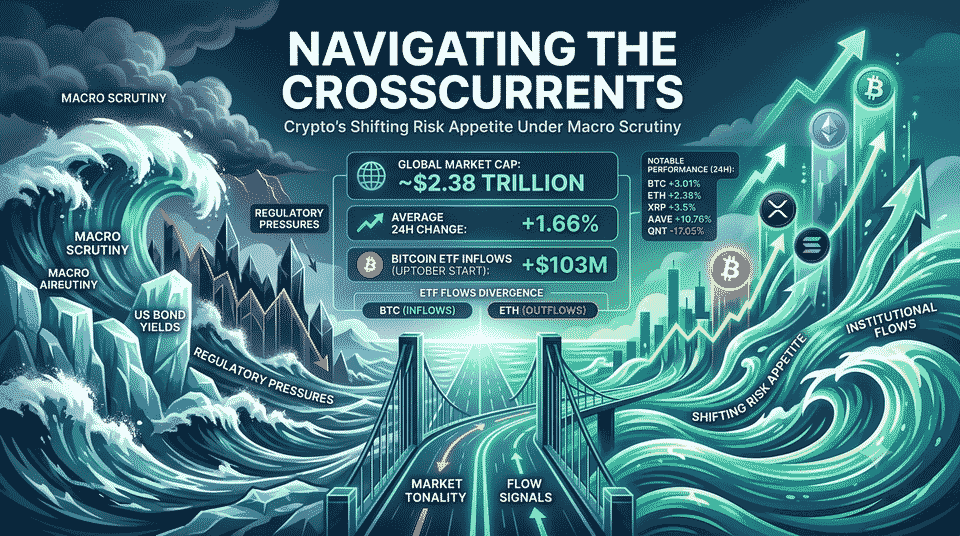
The cryptocurrency market is currently exhibiting a nuanced and somewhat selective risk appetite, rather than a uniform directional move. Observed facts indicate a mildly positive short-term bias across a curated basket of assets, as reflected by the overall market context. The global market capitalization stands at approximately $2.38 trillion, with the average 24-hour price change across top assets registering a modest 1.66%.
While Bitcoin (BTC) and Ethereum (ETH) have posted positive 24-hour gains of 3.01% and 2.38% respectively, suggesting a general uplift in major cryptocurrencies, the picture becomes more complex when examining other assets. XRP and Solana (SOL) also show positive momentum, with 24-hour increases of 3.5% and 3.73%. However, the market's strongest moves are concentrated in specific, often mid-cap, assets. Quant (QNT) notably experienced a significant -17.05% decline over the past 24 hours, even after a remarkable 139.59% surge over the last seven days. This suggests a period of profit-taking or a localized sentiment shift following a substantial rally. Conversely, Aave (AAVE) and Pump.fun (PUMP) demonstrated strong positive 24-hour performances, rising by 10.76% and 6.30%, respectively.
This divergence in performance—major assets showing modest gains, some mid-caps surging, and others undergoing sharp corrections—interprets as a market grappling with selective confidence. Investors appear to be allocating capital to specific narratives or momentum plays, while remaining sensitive to rapid reversals, particularly in assets that have seen outsized gains. The overall tone leans cautiously optimistic for certain segments, but a broad-based, aggressive risk-on environment is not yet definitively established.
Macro and Flow Signals
Current market positioning is significantly influenced by a blend of institutional flows, macroeconomic developments, and specific policy or security headlines. These factors contribute to a mixed sentiment, where optimism is tempered by underlying uncertainties.
A key institutional signal comes from Bitcoin ETFs, which initiated 'Uptober' with a notable $103 million inflow. This suggests continued institutional interest and demand for Bitcoin exposure through regulated products. In contrast, Ether funds have recorded a third consecutive day of net outflows. This divergence in ETF flows between the two largest cryptocurrencies indicates a selective institutional preference, potentially reflecting varying levels of confidence or strategic positioning between BTC and ETH.
For XRP, significant institutional news emerged with Evernorth clearing its shareholder vote ahead of a Nasdaq debut. This firm is set to go public with a substantial 473 million XRP treasury, valued at approximately $710 million. This development could be interpreted as a strong vote of confidence in XRP from a traditional financial market perspective, potentially driving positive sentiment for the asset.
Macroeconomic pressures continue to play a critical role in shaping crypto sentiment. Bitcoin's price action has been observed fighting for a local uptrend amidst fluctuations in US bond yields, which recently dropped from new 24-year highs. Initial optimism in Bitcoin followed cooler-than-expected PCE inflation data, a key Federal Reserve gauge. However, this positive sentiment was subsequently challenged as analysts cautioned that methodology changes complicated the lower-than-expected inflation reading, leading to Bitcoin retracing some of its gains and remaining trapped below the $86,000 mark. This illustrates the market's high sensitivity to nuanced interpretations of macro data.
On the regulatory and security front, the crypto ecosystem faces ongoing scrutiny. Illinois has delayed its controversial 0.2% Digital Asset Tax amid an industry lawsuit, pushing its implementation to July 1, 2027. While specific to one state, this highlights the broader regulatory challenges and industry efforts to shape policy. Separately, MetaMask exited Lido validators following an infrastructure 'security incident,' though no immediate threat to user wallets was found. This incident, alongside a report from PeckShield indicating crypto hacks totaled $768 million in September (the worst month of 2026, including major exploits like Bitget and Liquid Network), underscores persistent security risks that can weigh on overall market confidence. A Bitcoin Policy Institute paper also questioned MSCI's proposed "non-operating company" rule, which could impact firms like Strategy and Metaplanet from its indexes, signaling ongoing debates about how traditional finance categorizes and integrates crypto-holding entities.
What Sentiment Is Doing To Major Coins
The prevailing market sentiment, influenced by a blend of institutional flows, macro indicators, and headline news, is manifesting in varied price actions across major cryptocurrencies and high-volatility assets.
Bitcoin (BTC), the market leader, has demonstrated resilience, posting a 3.01% gain over the past 24 hours and a 2.07% increase over seven days, trading around $86,141.02. This upward movement is primarily supported by institutional interest, evidenced by the $103 million inflow into Bitcoin ETFs. However, its immediate trajectory remains sensitive to macroeconomic interpretations; initial gains on cooler PCE inflation data were partially erased as analysts highlighted complexities from methodology changes. This suggests that while there's a foundational bullish sentiment from institutional adoption, it's easily swayed by macro uncertainties.
Ethereum (ETH), currently priced at approximately $2,750.29, has also recorded positive 24-hour (2.38%) and 7-day (1.97%) changes. Despite this spot price strength, institutional flows tell a different story, with Ether funds experiencing net outflows for a third consecutive day. This divergence suggests that while retail or speculative interest might be holding up ETH's price, institutional conviction might be waning or shifting. Furthermore, the MetaMask exit from Lido validators due to a "security incident" introduces a layer of caution specific to the ETH ecosystem, particularly concerning staking and decentralized finance infrastructure.
XRP has shown a strong 3.5% gain over the last 24 hours, though its 7-day performance remains slightly negative (-0.87%). The primary driver for its current positive sentiment appears to be the news surrounding Evernorth's impending Nasdaq debut with a substantial 473 million XRP treasury. This institutional endorsement and upcoming public listing likely overshadow broader market sentiment for XRP, providing a specific bullish catalyst.
Among the top volatile assets, Quant (QNT) stands out with a significant -17.05% drop over the past 24 hours, trading at $236.81. This sharp correction follows an extraordinary 139.59% surge over the last seven days. This behavior is indicative of intense profit-taking after an extended rally, rather than a reflection of a broad market downturn. Its extreme volatility highlights that sentiment for QNT is highly localized and prone to rapid shifts.
Aave (AAVE), on the other hand, has seen a robust 10.76% increase in 24 hours, reaching $181.74, building on a 24.74% gain over seven days. Similarly, Pump.fun (PUMP) recorded a 6.30% 24-hour rise to $0.00587, and a 46.45% increase over seven days. These performances suggest strong, asset-specific momentum or positive sentiment, likely driven by project-specific catalysts or speculative interest within their respective niches, detached from broader macro concerns.
Solana (SOL) is trading at $121.80, with a 3.73% 24-hour gain and a 3.14% 7-day gain, indicating consistent positive sentiment aligned with a selective appetite for growth-oriented altcoins. Other major assets like Zcash (ZEC) and Bitcoin Cash (BCH) show more subdued or negative sentiment, with ZEC down -0.07% in 24 hours and -12.43% in 7 days, and BCH up 2.93% in 24 hours but down -6.98% in 7 days. BNB maintains a relatively stable posture, with a modest 1.14% 24-hour gain and a flat 0.17% 7-day change, suggesting a more neutral sentiment.
Conclusion and Risk Management
The cryptocurrency market is currently navigating a period characterized by a mildly positive, yet highly selective, short-term bias. This sentiment is largely shaped by a delicate interplay of institutional capital flows, evolving macroeconomic indicators, and distinct asset-specific developments. While the overall market capitalization shows stability and major assets like Bitcoin and Ethereum demonstrate modest 24-hour gains, the underlying dynamics reveal a nuanced risk appetite.
Observed facts indicate that Bitcoin ETFs are attracting inflows, signaling sustained institutional confidence in BTC. Conversely, Ether funds are experiencing outflows, suggesting a cautious stance or re-evaluation from institutional players regarding ETH. Macroeconomic factors, particularly US bond yields and the interpretation of inflation data, continue to exert significant influence, demonstrating the market's sensitivity to traditional financial indicators. Asset-specific news, such as Evernorth's Nasdaq debut with an XRP treasury, can generate strong localized positive sentiment, as seen with XRP's recent performance. However, this is balanced by high-volatility events like QNT's sharp correction following a substantial rally, and broader concerns stemming from significant crypto hacks in September.
Looking ahead, several scenarios could unfold. A continuation of easing macro pressures, coupled with consistent institutional adoption and clear regulatory frameworks, could foster a more robust, albeit still selective, risk-on environment. This might see assets with strong fundamentals or unique catalysts, like XRP's institutional backing, continue to outperform. Conversely, any reversal in bond yield trends, ambiguous inflation data, or a resurgence of large-scale security breaches could quickly shift sentiment towards increased caution or a broader risk-off stance. The divergent ETF flows for BTC and ETH underscore that institutional capital is not monolithic and can rapidly reallocate based on perceived risk and opportunity.
For market participants, effective risk management in this environment necessitates a multi-faceted approach. It is crucial to differentiate between broad market trends and idiosyncratic asset-specific drivers. Given the selective nature of recent gains and the pronounced volatility in certain assets, diversification across different asset classes and careful position sizing are paramount. Monitoring both macro indicators, such as central bank policies and economic data, and specific project-related news will be key. The market's sensitivity to nuanced macro interpretations and institutional policy discussions means that sentiment can pivot rapidly. Therefore, maintaining agility and adapting strategies to evolving market narratives will be essential for navigating these crosscurrents.
Source Data Reference
Market Snapshot Input
| Asset | Symbol | Price (USD) | 24h Change | Market Cap (USD) |
|---|---|---|---|---|
| Quant | QNT | 236.809529 | -17.05% | 2,858,939,402 |
| Bitcoin | BTC | 86,141.019135 | 3.01% | 1,730,778,434,612 |
| XRP | XRP | 1.534939 | 3.50% | 96,843,887,334 |
| Ethereum | ETH | 2,750.294493 | 2.38% | 335,807,354,752 |
| Pump.fun | PUMP | 0.005875 | 6.30% | 2,731,389,928 |
| Aave | AAVE | 181.739656 | 10.76% | 2,801,775,412 |
| Solana | SOL | 121.802181 | 3.73% | 71,628,865,192 |
| Zcash | ZEC | 1,382.670338 | -0.07% | 22,576,613,212 |
| Bitcoin Cash | BCH | 315.054259 | 2.93% | 6,327,264,295 |
| BNB | BNB | 776.227898 | 1.14% | 103,361,978,230 |
Trending Headlines Input
- Evernorth clears shareholder vote ahead of Nasdaq debut with 473M XRP treasury
- The 'Largest Pure-Play' XRP Treasury Is About to Go Public
- Bitcoin ETFs kick off ‘Uptober’ with $103M inflow
- Bitcoin think tank questions MSCI’s ‘invisible committee’ over Strategy, Metaplanet rule
- Bitcoin fights for local uptrend as US bond yields drop from new 24-year highs
- MetaMask Exits Lido Validators Amid Infrastructure ‘Security Incident’
- Illinois Delays Controversial Crypto Tax Amid Industry Lawsuit
- Bitcoin Jumps on Cool PCE Inflation Data as Bond Yields Hit 20-Year Highs
- Bitcoin trapped below $86K as PCE changes cloud inflation reading
- Crypto hacks top $768M in September, worst month of 2026