Risk Tone Across The Market
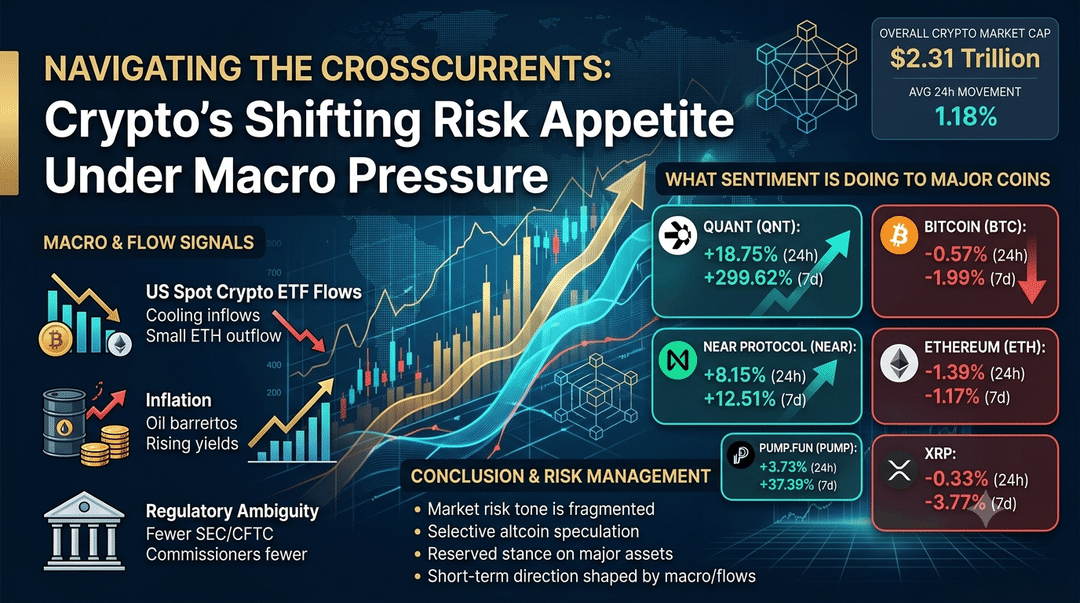
The overall crypto market capitalization stands at approximately $2.31 trillion, with an average 24-hour price movement of around 1.18%. This aggregate figure, however, masks a nuanced risk tone. Derived insights suggest a mildly positive short-term bias across the selected editorial asset basket, yet this positivity is not uniformly distributed.
Observed market behavior indicates a mixed sentiment. Bitcoin (BTC) and Ethereum (ETH), the two largest cryptocurrencies by market capitalization, have registered slight negative movements over the past 24 hours (-0.57% and -1.39% respectively) and over seven days (-1.99% and -1.17% respectively). XRP also shows similar patterns, with a -0.33% change in 24 hours and -3.77% over seven days. These trends suggest a cautious, if not slightly de-risking, posture among participants in the major assets.
In stark contrast, specific altcoins are demonstrating significant upward momentum, indicating pockets of strong risk-on behavior or asset-specific catalysts. Quant (QNT) has surged by an impressive 18.75% in 24 hours and a remarkable 299.62% over seven days. Near Protocol (NEAR) also shows robust gains of 8.15% in 24 hours and 12.51% over seven days. Pump.fun (PUMP), a newer entrant, has seen a 3.73% 24-hour increase and a 37.39% 7-day rally. This divergence highlights a market where capital is rotating into higher-beta or narrative-driven assets, even as the foundational layer of the market exhibits restraint. Conversely, Hedera Hashgraph (HBAR) experienced a notable 10.30% drop in 24 hours, despite a positive 7-day performance, underscoring the high volatility inherent in this segment.
Overall, the market's risk tone is fragmented. There's a clear appetite for specific, high-growth altcoins, suggesting targeted speculation. However, this is counterbalanced by a more reserved stance on the established majors, likely influenced by broader external factors.
Macro and Flow Signals
Current market sentiment is heavily shaped by a confluence of institutional flow dynamics, regulatory developments, and broader macroeconomic pressures.
A significant theme influencing positioning is the status of US crypto Exchange Traded Funds (ETFs). Recent reports indicate a cooling of US spot crypto ETF inflows, with a notable 80% drop from the previous week. While Bitcoin ETFs managed to extend their inflow streak to nine days, attracting a substantial $2.95 billion over 30 days, Ether funds saw a $3 million outflow on one specific day after seven days of inflows. This mixed picture for ETF flows signals a potential moderation in the intense institutional buying pressure observed previously, leading to a more tempered bullish outlook for major assets. The reduced pace of inflows, even if still positive for Bitcoin, suggests that a key demand driver might be losing some of its immediate potency.
Regulatory developments also contribute to the prevailing sentiment of uncertainty. The news that crypto regulation at the SEC and CFTC will effectively come down to fewer commissioners following a key resignation introduces ambiguity. While fewer commissioners might, in theory, lead to less aggressive enforcement for some, it could also mean a slower pace of clarity or a more unpredictable regulatory environment, which typically fosters caution among institutional players. In a related development, Chainlink (LINK) has introduced CCIP 2.0, allowing institutions to implement their own bridge checks, a move that enhances security and addresses concerns following significant cross-chain hacks. This proactive step by Chainlink could be interpreted as a positive signal for institutional adoption within the DeFi space, offering a layer of reassurance amidst security risks.
Broader macroeconomic factors are also exerting influence, particularly on Bitcoin. Reports directly link Bitcoin's recent pullback to geopolitical events, specifically a "Trump's Iran Snub" that sent oil prices above $100 and yields higher. Such correlations underscore Bitcoin's evolving role as a macro-sensitive asset, reacting to global economic and political shifts alongside traditional markets. The anticipation of key economic reports, such as the PCE, further adds to the cautious sentiment as investors await signals on inflation and monetary policy.
Finally, security incidents, such as the Bitget CEO expressing low optimism about recovering funds from a $388 million breach, serve as a reminder of operational risks within the crypto ecosystem. While not directly tied to price action for major assets, such events can contribute to an underlying layer of apprehension, particularly for retail investors and those concerned about platform security.
What Sentiment Is Doing To Major Coins
The prevailing sentiment, a blend of cautious institutional flows, macro pressures, and selective altcoin speculation, is manifesting in distinct ways across major cryptocurrencies.
Bitcoin (BTC), despite its foundational role and long-term bullish predictions from figures like Peter Brandt (who foresees $300,000-$600,000 by 2029), is currently experiencing a period of modest retraction. The 24-hour decline of -0.57% and a 7-day dip of -1.99% are observed facts. This price action is largely interpreted as a response to the cooling of US crypto ETF inflows and the broader macroeconomic pressures, specifically rising oil prices and bond yields. Bitcoin's sensitivity to these macro signals suggests that investor sentiment towards the asset is currently risk-averse, prioritizing capital preservation in the face of external uncertainties over aggressive accumulation.
Ethereum (ETH) mirrors Bitcoin's cautious posture, registering a 24-hour decline of -1.39% and a 7-day drop of -1.17%. The observed outflow from Ether ETFs on a specific day, following a period of inflows, indicates a similar institutional sentiment to Bitcoin. This suggests that the narrative around Ethereum, while strong on fundamentals, is currently overshadowed by the same macro and flow-related anxieties that are impacting BTC.
XRP, with its 24-hour change of -0.33% and 7-day change of -3.77%, also aligns with the general cautious sentiment surrounding major assets. The commentary from analyst Peter Brandt, labeling XRP a "fool coin" while being bullish on Bitcoin, could contribute to specific negative sentiment for the asset, even if it's a single opinion. Its price action reflects a lack of strong positive catalysts to counter the broader market's conservative mood.
In stark contrast, Quant (QNT) stands out as a beacon of strong positive sentiment, surging by 18.75% in 24 hours and an astounding 299.62% over seven days. This explosive growth suggests a concentrated speculative interest or significant project-specific developments that are driving capital into QNT, largely decoupled from the subdued performance of BTC and ETH. This indicates that while the macro environment influences majors, specific altcoins can still command intense bullish sentiment based on their unique value proposition or narrative.
Near Protocol (NEAR) is another example of positive sentiment, with an 8.15% gain in 24 hours and 12.51% over seven days. This reflects an appetite for growth in the mid-cap altcoin space, where investors might be seeking higher returns than currently offered by the more stable, but subdued, majors.
Chainlink (LINK) has seen a 24-hour decline of -6.37%, despite a 7-day gain of 12.90%. The recent news about its CCIP 2.0 offering institutional-grade security features for cross-chain transfers is a strong fundamental development. The 24-hour dip, following a week of gains, might be an instance of profit-taking or general market pressure temporarily overriding positive project news.
Solana (SOL) shows a slight 24-hour dip of -0.31% but a modest 7-day gain of 2.35%. Its performance is relatively stable compared to the extremes, suggesting a resilient but not aggressively bullish sentiment.
BNB (Binance Coin) recorded a slight 24-hour gain of 0.45% but a 7-day dip of -1.63%. Its relative stability might be attributed to its strong ecosystem and utility, which can partially buffer it from broader market sentiment swings.
Finally, Pump.fun (PUMP), with a 3.73% 24-hour gain and 37.39% 7-day gain, exemplifies the continued speculative interest in newer, higher-risk assets, indicating that a segment of the market remains highly risk-on, even as majors consolidate.
Conclusion and Risk Management
The current cryptocurrency market sentiment is a tapestry woven with contrasting threads. While
derivedInsightsThis divergence underscores the thesis that short-term crypto direction is being shaped less by the isolated performance of a single coin and more by broader risk sentiment and cross-market catalysts. The observed facts point to a market where participants are selective in their risk exposure, seeking high-growth opportunities in specific altcoins while adopting a more reserved stance on the larger, more macro-sensitive assets.
Looking ahead, several scenarios could influence market sentiment shifts. A sustained increase in global inflation or further tightening of monetary policy could intensify macro pressures, potentially leading to continued headwinds for major cryptocurrencies. Conversely, a renewed surge in institutional ETF inflows, perhaps driven by fresh regulatory clarity or a more stable macro outlook, could quickly reignite bullish sentiment for BTC and ETH. The continued strong performance of individual altcoins like QNT also highlights that targeted project developments or unique narratives can still drive significant rallies, potentially creating further decoupling from the broader market tone.
For market participants, navigating this environment requires a nuanced approach. It is crucial to separate observed price action from speculative interpretation. The current market structure suggests that while overall bullishness might be tempered, opportunities for significant gains exist within specific, high-conviction altcoins. However, these opportunities often come with elevated risk. Diversification remains a key consideration, as does closely monitoring both on-chain metrics and broader macroeconomic indicators. Understanding that sentiment is fluid and that reversals are always possible, especially given the current mixed signals, is paramount for prudent risk management. Focusing on the specific drivers for each asset, rather than a monolithic market view, will be essential in the weeks ahead.
Source Data Reference
Market Snapshot Input
| Asset | Symbol | Price (USD) | 24h Change | Market Cap (USD) |
|---|---|---|---|---|
| Quant | QNT | 295.815192 | 18.75% | 3,571,299,314 |
| Bitcoin | BTC | 83,897.570153 | -0.57% | 1,685,631,470,537 |
| XRP | XRP | 1.512827 | -0.33% | 95,448,767,641 |
| Ethereum | ETH | 2,694.645438 | -1.39% | 328,997,186,495 |
| Chainlink | LINK | 14.403408 | -6.37% | 10,775,189,007 |
| Solana | SOL | 119.797702 | -0.31% | 70,441,761,301 |
| Near Protocol | NEAR | 5.298716 | 8.15% | 6,929,064,357 |
| Pump.fun | PUMP | 0.005771 | 3.73% | 2,685,440,751 |
| Hedera Hashgraph | HBAR | 0.106577 | -10.30% | 4,671,471,802 |
| BNB | BNB | 769.80431 | 0.45% | 102,506,750,024 |
Trending Headlines Input
- US crypto ETF inflows cool after $3.3B week but streaks hold
- Bitcoin ETFs stretch $3.1B inflow streak as Ether funds turn red
- Bitcoin's Quantum Problem: Three Ways Researchers Are Trying to Fix It
- Crypto regulation at SEC, CFTC to come down to 3 commissioners following key resignation
- Crypto ETFs Surge as Bitcoin Funds Add $2.95 Billion in 30 Days
- Months After the $292M Kelp Hack, Chainlink Lets Institutions Add Their Own Bridge Checks
- Bitget CEO ‘not very optimistic’ on recovering funds from $388M breach
- Nvidia Built a Kill Switch for AI Agents Because They Keep Getting Out
- Bitcoin Falls Lower as Trump's Iran Snub Sends Oil, Yields Higher
- Peter Brandt says Bitcoin may hit $600K by 2029, calls XRP a ‘fool coin’