The Core Narrative
The cryptocurrency market is currently most profoundly shaped by a concentrated narrative centered on institutional engagement and capital flows. This theme, encompassing both inflows and outflows through structured investment vehicles and corporate treasury strategies, serves as a primary lens through which recent market movements can be understood. Rather than broad retail sentiment or isolated technological developments, the actions and strategies of institutional players are signaling key shifts in market dynamics.
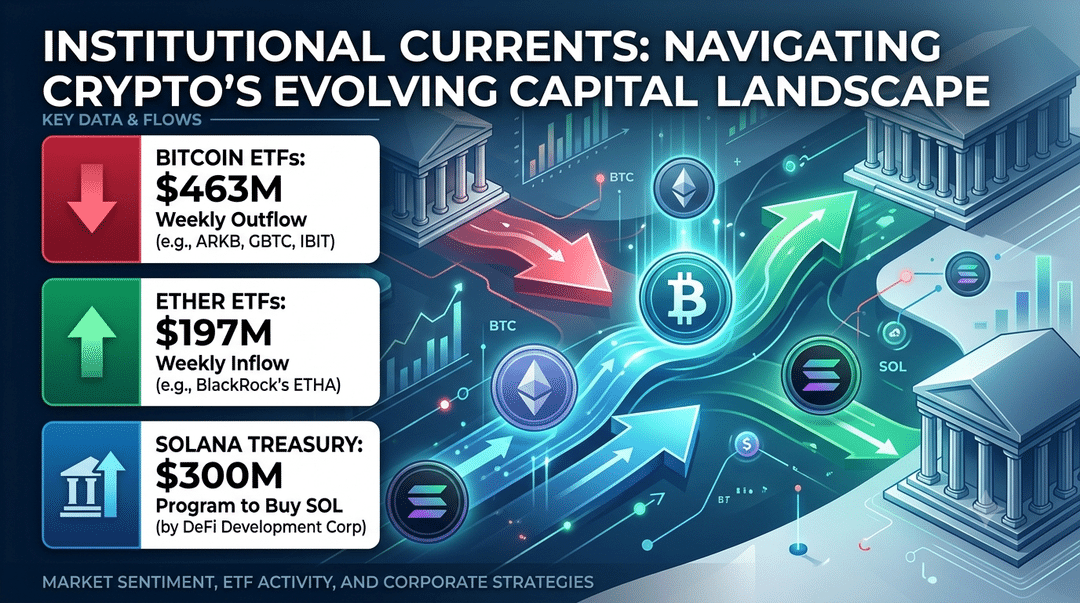
A prominent illustration of this trend is the recent activity in spot Bitcoin and Ether Exchange-Traded Funds (ETFs). Observed facts indicate a notable divergence in performance: Bitcoin ETFs collectively experienced a significant weekly reversal, shedding approximately $463 million. This outflow was primarily led by funds such as ARKB, GBTC, and IBIT, suggesting a period of profit-taking or reallocation by institutional investors. In stark contrast, Ether ETFs recorded weekly inflows totaling $197 million, largely propelled by BlackRock’s ETHA product. This distinct pattern highlights a nuanced institutional appetite, potentially signaling a rotation of capital or a growing conviction in Ethereum's ecosystem post-upgrade developments.
Beyond ETFs, corporate treasury management continues to underscore the institutional narrative. Strive, a notable corporate Bitcoin holder, recently added 469 Bitcoin to its treasury, bringing its total holdings to an impressive 25,000 BTC. This acquisition was reportedly funded through its SATA preferred stock program, indicating a strategic, capital markets-driven approach to increasing its Bitcoin exposure. Conversely, another significant Bitcoin treasury firm, Strategy, bought back $139 million of its STRC preferred stock. While this buyback occurred, the firm's substantial 845,050 BTC stack remained untouched for a second consecutive week, suggesting a focus on managing its equity structure rather than actively adjusting its Bitcoin holdings.
Further demonstrating the breadth of institutional interest, the Solana ecosystem also saw significant capital activity. DeFi Development Corp, a Solana treasury firm, announced the rollout of a $300 million CHAD at-the-market program for its preferred stock, explicitly stating its intention to buy more SOL. This strategy has already resulted in the addition of 55,491 SOL, extending a rapid three-week period of capital markets activity. These actions collectively paint a picture of sophisticated, deliberate institutional participation, influencing not just the largest cryptocurrencies but also prominent altcoins with established ecosystems.
Which Coins Or Segments Are Most Exposed
Given the dominant institutional narrative, specific assets and market segments exhibit heightened exposure to these capital shifts. Bitcoin (BTC) and Ethereum (ETH) are at the forefront due to their direct involvement with the institutional ETF market. Solana (SOL) also demonstrates significant exposure through corporate treasury initiatives. Other assets, while not directly tied to the institutional headlines in the provided data, show notable volatility that may be indirectly influenced or represent localized market dynamics.
Bitcoin (BTC), as the pioneer cryptocurrency, remains highly exposed. The observed weekly outflow of $463 million from Bitcoin ETFs directly impacts its market sentiment and liquidity. While corporate entities like Strive are actively accumulating, the net effect of ETF movements suggests a re-evaluation of positions by some institutional players. The scale of these movements indicates that institutional flows can exert considerable pressure on Bitcoin's price trajectory.
Ethereum (ETH)'s exposure is currently characterized by positive institutional sentiment, as evidenced by the $197 million in weekly inflows into Ether ETFs. This suggests a growing institutional acceptance and demand for ETH, potentially driven by its foundational role in the decentralized finance (DeFi) ecosystem and upcoming network enhancements. The sustained interest from major asset managers like BlackRock through their ETHA product underscores this exposure.
Solana (SOL) is directly exposed through the strategic actions of firms like DeFi Development Corp. The commitment of $300 million to acquire more SOL via a preferred stock program indicates strong institutional conviction in Solana's long-term potential and its utility within the DeFi landscape. Such large-scale, programmatic buying can provide a significant demand floor and influence price stability, even amidst broader market fluctuations.
Among the broader market, several assets exhibit notable volatility, though their direct link to the institutional narrative in the provided data is not explicitly established. Rain Protocol (RAIN) stands out with a significant 24-hour decline of -11.92% and a 7-day drop of -21.19%. This pronounced volatility suggests concentrated selling pressure, which could stem from various factors including profit-taking, project-specific news not captured here, or broader market sentiment shifts affecting smaller-cap assets more acutely. While its specific institutional exposure is not detailed, its market capitalization places it within a range where institutional interest could emerge or recede.
Uniswap (UNI) recorded a strong 24-hour gain of +7.58%, making it another top volatile asset. This positive movement contrasts with the generally mildly negative short-term bias of the broader market. Without specific institutional news, this could be attributed to a localized bullish catalyst, technical factors, or a speculative rebound.
XRP (XRP) also showed a positive 24-hour change of +1.19%, despite a nearly flat 7-day performance. As a top volatile asset, its movements often reflect ongoing regulatory developments or specific trading dynamics rather than broad institutional capital flow into spot products.
Other assets like Chainlink (LINK), Dogecoin (DOGE), Cardano (ADA), and BNB (BNB) exhibit more moderate movements, suggesting they are less directly impacted by the immediate institutional capital flow narrative presented, or their price action is influenced by a different set of factors.
How The Market Is Pricing It
The market's pricing mechanisms are reflecting the institutional narrative with a nuanced, and at times, divergent response across different assets. Overall, the selected editorial asset basket shows a mildly negative short-term bias, with the average 24-hour move across the broader market being approximately -0.50%. This general sentiment provides a backdrop against which the more specific institutional flows are playing out.
Bitcoin's price action appears to align with the observed institutional outflows. With a 24-hour decline of -0.78% and a 7-day drop of -2.06%, the market is seemingly pricing in the $463 million weekly reversal from Bitcoin ETFs. This suggests that the selling pressure or reduced buying interest from institutional funds, particularly those exiting positions in ARKB, GBTC, and IBIT, is translating into a bearish short-term outlook for BTC. The market is interpreting these outflows as a signal of waning institutional demand, at least for the immediate period.
Conversely, Ethereum’s performance offers a more complex picture. Despite the observed $197 million in weekly inflows into Ether ETFs, ETH recorded a marginal 24-hour decline of -0.53%. However, its 7-day performance shows a slight positive gain of +0.15%. This suggests that while the positive institutional inflows might be providing a floor or contributing to a more stable longer-term outlook, broader market pressures or profit-taking might be offsetting some of the immediate bullish impact. The market is likely balancing the positive signal from BlackRock's ETHA inflows with other macro or crypto-specific factors.
Solana’s pricing appears to be benefiting from its specific institutional support. With a 24-hour change of +0.13%, SOL shows relative resilience compared to BTC and ETH's 24-hour dips. This stability, despite a -2.15% 7-day change, could be attributed to the ongoing programmatic buying by DeFi Development Corp, which has committed $300 million to acquire SOL. The market is likely pricing in this sustained corporate demand, providing a degree of insulation from the broader negative sentiment.
Among the top volatile assets, Rain Protocol (RAIN) stands out with a significant 24-hour depreciation of -11.92%. This sharp decline, alongside a -21.19% 7-day change, indicates a strong bearish sentiment for RAIN. While no direct institutional news links are available in the provided data, such a concentrated move suggests a specific catalyst or significant re-evaluation by market participants, potentially reflecting project-specific concerns or a broader risk-off move in certain altcoin segments.
Uniswap (UNI) is experiencing a strong positive price movement, up +7.58% in 24 hours. This counter-trend rally, in an otherwise mildly negative market, suggests localized strength. While not explicitly tied to the institutional narrative in the provided data, such a move could indicate renewed interest in decentralized exchange (DEX) protocols or a response to specific protocol developments. Similarly, XRP saw a 24-hour increase of +1.19%, which, while modest, stands out against the general market downtrend.
It is important to note that while correlations between institutional capital flows and price action are observed, causality should not be overstated. Market movements are multifaceted, influenced by a confluence of factors including macroeconomics, regulatory news, and technical analysis. However, the current data strongly suggests that institutional capital shifts are a significant, if not primary, driver in the immediate pricing of key assets.
Conclusion and Risk Management
The dominant narrative in the crypto market is unequivocally the ebb and flow of institutional capital. The distinct patterns of ETF inflows and outflows for Bitcoin and Ethereum, coupled with strategic corporate treasury movements in BTC and SOL, are not merely signals but active forces shaping market sentiment and price discovery. The market's current disposition, characterized by a mildly negative short-term bias, reflects a cautious stance as participants digest these institutional shifts.
Confirmation of this narrative's continued dominance would manifest through several key indicators. Ongoing monitoring of ETF flow data, particularly weekly and daily reports, will be crucial. A sustained trend of Ether ETF inflows, potentially expanding to other altcoin ETFs if approved, would reinforce the narrative of institutional diversification. Similarly, further announcements of corporate treasury adjustments—whether accumulation or strategic divestment—would underscore the programmatic nature of institutional engagement. Regulatory developments, such as the progression of the CLARITY Act, could also significantly impact institutional participation by providing clearer operational frameworks.
Conversely, the weakening of this narrative would be signaled by a noticeable decoupling of market movements from institutional capital flows. If major assets begin to exhibit strong, sustained price action that is not correlated with ETF data or corporate treasury news, it would suggest that other factors, such as retail speculation, technological breakthroughs, or broader macroeconomic forces, are taking precedence. A prolonged period of flat institutional activity, or a shift in news focus away from institutional adoption and into other market aspects, would also dilute the current narrative's influence.
For risk management, market participants should prioritize tracking institutional reports, particularly those detailing ETF net flows and corporate balance sheet allocations. Understanding where institutional capital is being deployed or withdrawn offers a critical layer of insight into market momentum. Given the observed volatility in certain assets like RAIN and the nuanced responses of BTC and ETH to their respective institutional flows, a diversified approach with careful position sizing remains prudent. Monitoring for confirmation or weakening signals of this institutional narrative will be key to navigating the evolving crypto landscape effectively.
Source Data Reference
Market Snapshot Input
| Asset | Symbol | Price (USD) | 24h Change | Market Cap (USD) |
|---|---|---|---|---|
| Bitcoin | BTC | 76,868.614799 | -0.78% | 1,543,886,680,487 |
| Rain Protocol | RAIN | 0.013203 | -11.92% | 9,363,878,371 |
| Solana | SOL | 100.849049 | 0.13% | 59,201,220,854 |
| Ethereum | ETH | 2,477.608521 | -0.53% | 302,392,518,895 |
| Chainlink | LINK | 11.383213 | 1.11% | 8,515,781,140 |
| Dogecoin | DOGE | 0.082533 | -0.78% | 14,149,159,861 |
| Uniswap | UNI | 6.693584 | 7.58% | 4,171,524,963 |
| Cardano | ADA | 0.204651 | -1.18% | 7,955,428,796 |
| BNB | BNB | 718.469346 | 0.14% | 95,671,932,730 |
| XRP | XRP | 1.400414 | 1.19% | 88,056,950,474 |
Trending Headlines Input
- Bitcoin ETFs shed $463M in weekly reversal as Ether ETFs gain $197M
- Solana Treasury Firm DeFi Dev Corp Rolls Out $300M CHAD to Buy More SOL
- Strive adds 469 Bitcoin to reach 25,000 BTC treasury
- Strategy Buys Back $139 Million of STRC, Bitcoin Stack Frozen for Second Week
- Blockstream Refuses Ransom for Return of $47M in Bitcoin from Liquid Hack: 'It Is Theft'
- CLARITY Act vote meets Fed rate hike: Five things to know in Bitcoin this week
- Symbiosis says recovered 15 BTC from bridge hack, offers 20% bounty
- Bitcoin tops $79K, oil falls as Trump says Iran war could end
- Bitcoin Rises as Markets Digest Inflation Data Ahead of Fed Rate Decision
- Balancer eyes wind-down after restructuring fails to revive revenue