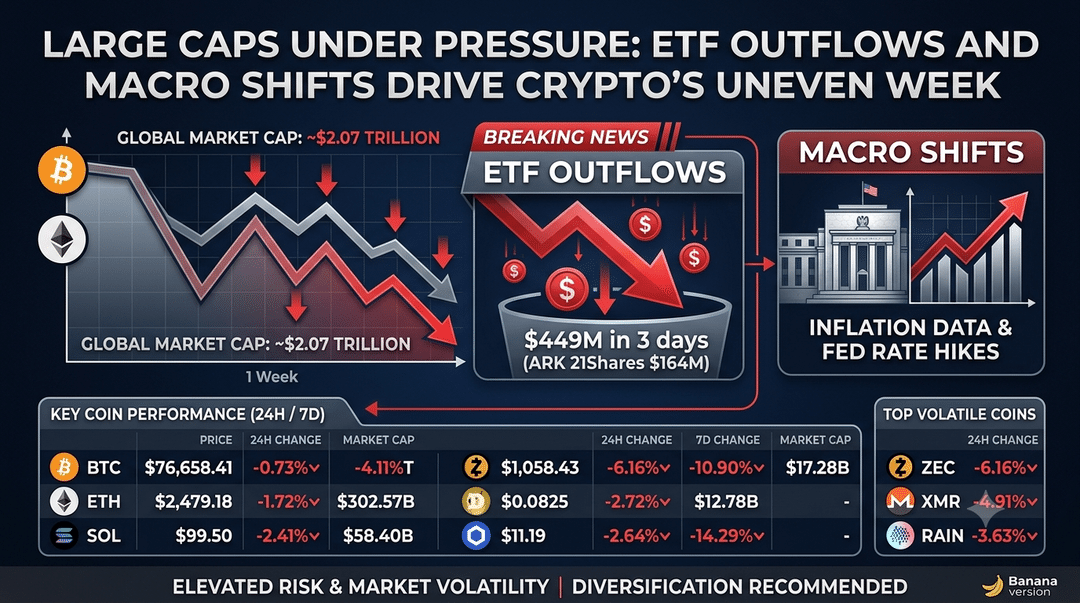
Global Market Capitalization
The broader cryptocurrency market is currently navigating a period of uneven performance, marked by a slight contraction in overall valuation. The global crypto market capitalization stands at approximately $2.07 trillion. Over the past 24 hours, the market has seen an average decline of 2.87% across sampled assets, indicating a general downward bias in short-term price action.
Bitcoin (BTC), the leading cryptocurrency by market capitalization, is trading around $76,658.41, reflecting a modest 24-hour decrease of 0.73%. Its 7-day performance shows a more pronounced decline of 4.11%, suggesting a sustained selling pressure over the past week. Bitcoin's market capitalization remains substantial at $1.54 trillion, with a 24-hour trading volume of approximately $12.78 billion.
Ethereum (ETH), the second-largest asset, has also experienced a downturn, with its price at $2,479.18, down 1.72% in the last 24 hours and 1.03% over seven days. Ethereum's market capitalization is approximately $302.57 billion, supported by a 24-hour trading volume of $7.79 billion.
Among other large-cap assets, Solana (SOL) is priced at $99.50, recording a 24-hour drop of 2.41% and a 7-day decline of 5.71%. Its market cap is $58.40 billion, with a 24-hour volume of $1.33 billion. BNB, ranked fourth, is trading at $717.00, down 1.60% in 24 hours and 4.04% over seven days, with a market cap of $95.48 billion.
Zcash (ZEC), an asset prioritized for its market relevance, shows a more significant 24-hour decline of 6.16%, with its price at $1,058.43. Its 7-day performance indicates a substantial drop of 10.90%. Zcash holds a market capitalization of $17.28 billion.
Other notable assets also reflect this negative trend. Chainlink (LINK) is down 2.64% in 24 hours and 14.29% over seven days, trading at $11.19. Monero (XMR) shows a 4.91% decrease in 24 hours to $513.77. Dogecoin (DOGE) is down 2.72% in 24 hours, trading at $0.0825. Hyperliquid (HYPE) and Rain Protocol (RAIN) also registered 24-hour declines of 2.16% and 3.63% respectively. These figures collectively indicate a broad, albeit uneven, bearish sentiment dominating short-term trading across a significant portion of the crypto market.
Top Volatile Coins
In the current market environment, several assets have displayed heightened volatility, registering the strongest negative price movements over the past 24 hours. These movements often draw attention, as they can sometimes precede broader market shifts or reflect specific asset-related developments.
Zcash (ZEC) stands out as the most volatile among the priority assets, experiencing a significant 24-hour decline of 6.16%, with its price settling around $1,058.43. This sharp drop contributed to a 7-day decrease of 10.90%, making it one of the weaker performers over the past week. Zcash's market capitalization is approximately $17.28 billion, with a 24-hour trading volume exceeding $1.01 billion. While the specific catalyst for this pronounced short-term volatility is not immediately apparent from the provided news signals, its performance suggests a notable shift in investor sentiment for this privacy-focused cryptocurrency.
Monero (XMR), another privacy coin, also exhibited considerable volatility, recording a 4.91% decrease in its price over the last 24 hours, trading at $513.77. Over the past seven days, Monero's price has fallen by 4.20%. With a market capitalization of $9.66 billion and a 24-hour trading volume of $145.78 million, Monero's decline aligns with a general risk-off sentiment observed in privacy-centric assets.
Rain Protocol (RAIN) also registered a notable 24-hour price drop of 3.63%, with its price at $0.0151. Its 7-day performance shows a 9.19% decline. Rain Protocol has a market capitalization of $10.75 billion and a 24-hour trading volume of $11.05 million. The observed volatility in these assets underscores the dynamic nature of the crypto market, where specific segments or individual tokens can experience rapid price adjustments independent of, or in conjunction with, broader market trends.
The concentration of stronger negative moves in ZEC, XMR, and RAIN suggests that while the overall market is down, these assets are facing particularly strong selling pressure, making them important to monitor for potential shifts in market dynamics or emerging narratives.
News and Market Impact
Recent headlines have provided several catalysts and contextual factors influencing the crypto market, particularly for large-cap assets like Bitcoin and Ethereum. A key theme emerging is the significant outflow from Bitcoin Exchange Traded Funds (ETFs), which has exerted downward pressure on BTC.
Reports indicate that Bitcoin ETF outflows have accelerated, with investors pulling $449 million in just three days. ARK 21Shares alone accounted for $164 million of Thursday’s Bitcoin ETF withdrawals. This trend also impacted other large-cap assets, as Ether and Solana funds reportedly recorded net outflows. These institutional capital movements are a direct signal of shifting sentiment among a segment of professional investors, contributing to the observed short-term price declines for BTC, ETH, and SOL. The mixed sentiment around these outflows suggests an ongoing re-evaluation of positions by institutional players.
Beyond ETF flows, Bitcoin has been subject to a mix of macro and security-related news. On the macro front, Bitcoin's price movements have been observed to react to inflation data and expectations surrounding the Federal Reserve's rate decisions. While Bitcoin initially rose as markets digested inflation data, a "golden cross" technical indicator reportedly flickered off as rate-hike bets firmed up, suggesting that the macroeconomic outlook, particularly interest rate policy, continues to play a significant role in Bitcoin's near-term price trajectory. The overall sentiment from these macro signals appears mixed, with market participants weighing inflation figures against potential rate hikes.
Security concerns have also featured prominently. Blockstream, a major Bitcoin infrastructure company, publicly refused a ransom demand for the return of $47 million in Bitcoin stolen in the Liquid hack, stating it would pursue legal avenues and work with law enforcement. This incident, alongside news of hackers breaching Bitcoin wallet maker Trezor's email provider, leading to phishing attempts targeting 347,000 subscribers, highlights persistent security vulnerabilities within the ecosystem. Furthermore, Revolut reportedly leaked passports and Bitcoin transaction histories due to a fraudulent government information request. While these events don't directly impact Bitcoin's underlying protocol, they can erode investor confidence in the security of associated services and platforms, contributing to a cautious market sentiment.
In the Ethereum ecosystem, Vitalik Buterin has reportedly pushed a plan (EIP-8288) aimed at slashing quantum-safe privacy costs for the network. This development, while forward-looking and positive for the protocol's long-term resilience and efficiency, is more aligned with technical progress and may not have an immediate, direct impact on short-term price action, especially in a market dominated by broader macro and institutional flow narratives.
Finally, Metaplanet, a Bitcoin treasury company, faced shareholder backlash over equity allocations for insiders, indicating governance challenges within companies heavily invested in Bitcoin. This news, while specific to a single entity, underscores the scrutiny faced by institutional players in the crypto space.
In summary, the market is grappling with significant Bitcoin ETF outflows, ongoing macro uncertainty related to inflation and interest rates, and a series of security incidents affecting prominent service providers. These factors combine to create a backdrop of mixed sentiment and caution, particularly for Bitcoin and other large-cap assets.
Conclusion and Risk Management
The cryptocurrency market is currently characterized by a mildly negative short-term bias, as evidenced by the overall decline in global market capitalization and the average 24-hour price movements across a selection of key assets. Large-cap assets like Bitcoin, Ethereum, and Solana have all registered declines, reflecting a period of consolidation or correction. The strongest negative 24-hour moves are concentrated in Zcash, Monero, and Rain Protocol, indicating specific areas of pronounced selling pressure.
The market backdrop is heavily influenced by a confluence of recent headlines. Significant Bitcoin ETF outflows, coupled with similar trends in Ether and Solana funds, suggest a cautious stance from institutional investors. Macroeconomic factors, particularly inflation data and the anticipation of Federal Reserve interest rate decisions, continue to play a role in shaping Bitcoin's price action. Furthermore, a series of security incidents, including the Blockstream Liquid hack, the Trezor email breach, and the Revolut data leak, serve as reminders of operational risks within the broader crypto ecosystem, which can impact investor confidence. While developments like Vitalik Buterin's proposal for Ethereum's quantum-safe privacy costs are positive for long-term protocol development, their immediate market impact is likely overshadowed by more pressing institutional and macroeconomic concerns.
Given the current environment, market participants should acknowledge the prevailing uncertainty. The confluence of institutional outflows, macroeconomic crosscurrents, and security-related news signals an elevated risk profile for short-term trading. As always, market movements are complex and subject to multiple interacting variables.
For effective risk management in such conditions, it is prudent to recognize that past performance is not indicative of future results. Volatility remains a defining characteristic of the crypto market, and rapid price changes can occur. Investors are encouraged to conduct thorough due diligence, understand their personal risk tolerance, and consider the potential for continued price fluctuations. Diversification, careful position sizing, and a clear understanding of investment objectives are critical components of a robust risk management strategy, particularly when the market is responding to a mix of headline-driven catalysts and uneven short-term price movement.
Source Data Reference
Market Snapshot Input
| Asset | Symbol | Price (USD) | 24h Change | Market Cap (USD) |
|---|---|---|---|---|
| Bitcoin | BTC | 76,658.410388 | -0.73% | 1,539,609,660,666 |
| Ethereum | ETH | 2,479.176148 | -1.72% | 302,569,322,563 |
| Solana | SOL | 99.504379 | -2.41% | 58,398,441,184 |
| Zcash | ZEC | 1,058.434782 | -6.16% | 17,282,407,847 |
| Chainlink | LINK | 11.192886 | -2.64% | 8,373,397,658 |
| Hyperliquid | HYPE | 77.574068 | -2.16% | 17,256,018,965 |
| Monero | XMR | 513.774536 | -4.91% | 9,661,183,358 |
| Dogecoin | DOGE | 0.082543 | -2.72% | 14,150,791,262 |
| Rain Protocol | RAIN | 0.015156 | -3.63% | 10,748,748,419 |
| BNB | BNB | 717.000164 | -1.60% | 95,476,426,599 |
Trending Headlines Input
- Bitcoin ETF outflows accelerate as investors pull $449M in three days
- Metaplanet equity backlash, SE Asia crypto funding doubles: Asia Express
- Blockstream Refuses Ransom for Return of $47M in Bitcoin from Liquid Hack: 'It Is Theft'
- Blockstream rejects ransom as Liquid hackers hold nearly 600 BTC
- Bitcoin Rises as Markets Digest Inflation Data Ahead of Fed Rate Decision
- Bitcoin Wallet Maker Trezor Says Hackers Breached Its Email Provider
- Bitcoin Golden Cross Flickers Off as Rate-Hike Bets Firm Up
- Brevo login flaw enabled phishing email targeting 347K Trezor subscribers
- Revolut Leaks Passports, Bitcoin Transaction Histories to Fake Government Request
- Vitalik Buterin Pushes Ethereum Plan to Slash Quantum-Safe Privacy Costs


