Bitcoin Price Structure
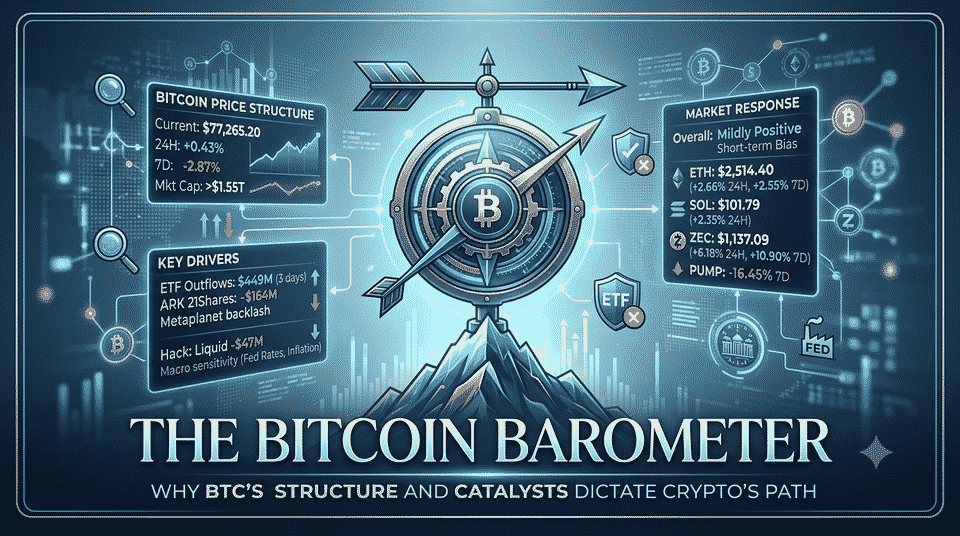
Bitcoin, the leading digital asset by market capitalization, is currently trading at approximately $77,265.20. Over the past 24 hours, BTC has registered a modest increase of 0.43%, indicating a period of short-term consolidation. However, a look at the weekly performance reveals a decline of 2.87%, suggesting underlying selling pressure or profit-taking after previous movements. With a commanding market capitalization of over $1.55 trillion and a 24-hour trading volume exceeding $25.76 billion, Bitcoin's sheer scale ensures its movements exert significant influence across the entire crypto market.
Observed facts indicate that despite its recent modest daily gain, Bitcoin's weekly trend shows a slight retreat. This short-term positioning suggests that while immediate downward momentum may have paused, the asset has not yet fully recovered from recent dips. Its dominance as the largest asset means that its price action often sets the tone, whether other assets follow in lockstep or exhibit divergent behavior.
Why Bitcoin Is Driving The Tape
Bitcoin's influence on the broader market is currently being shaped by a confluence of institutional, regulatory, and macro-economic factors. These BTC-linked catalysts are creating distinct signals that market participants are closely watching.
A significant development is the accelerated outflow from Bitcoin Exchange-Traded Funds (ETFs). Recent data shows investors have pulled $449 million from these funds over three days, with ARK 21Shares alone accounting for $164 million of Thursday’s withdrawals. This sustained institutional divestment is a direct reflection of shifting sentiment among a key segment of the market, indicating a potential cooling of demand from traditional finance players who previously fueled significant rallies. While the exact reasons for these outflows are subject to interpretation, they represent a tangible reduction in capital flowing into BTC via these regulated vehicles.
Further institutional scrutiny is evidenced by the Metaplanet equity backlash, where shareholders of the Bitcoin treasury company are expressing discontent over equity allocations for insiders. This highlights a growing demand for transparency and accountability within corporate structures integrating Bitcoin, suggesting that the institutional embrace of BTC is not without its internal challenges.
Regulatory and security concerns also continue to cast a shadow. Blockstream's refusal to pay a ransom for the return of $47 million in Bitcoin from the Liquid hack underscores the ongoing challenges of digital asset security and the firm stance some entities are taking against illicit activities. Similarly, the news of a Mexican musician and family allegedly killed over a Bitcoin cold wallet believed to hold millions, while a tragic isolated incident, serves as a stark reminder of the real-world risks associated with large crypto holdings and the importance of robust security practices. The breach of Trezor's email provider, leading to phishing attempts targeting subscribers, further emphasizes the persistent security vulnerabilities that can affect even reputable hardware wallet manufacturers.
On the macro front, Bitcoin's price has shown sensitivity to prevailing economic indicators. The asset recently saw a rise as markets processed inflation data ahead of the Federal Reserve's rate decision. However, this positive reaction was tempered by a "Bitcoin Golden Cross" flickering off as rate-hike bets firmed up, suggesting that the prospect of higher interest rates continues to weigh on market sentiment. This illustrates Bitcoin's increasing integration into traditional financial narratives, where monetary policy expectations directly impact its perceived value and risk appetite. The mixed signals from macro data — inflation holding steady but core inflation cooling, alongside persistent rate-hike probabilities — create an environment of uncertainty that Bitcoin, as a risk asset, is particularly susceptible to.
In summary, the narrative around Bitcoin is currently dominated by institutional capital flows, security incidents, and macro-economic uncertainty. These factors, rather than internal network developments, are acting as the primary drivers influencing BTC's price and, by extension, the broader crypto market.
How The Rest Of The Market Is Responding
The broader cryptocurrency market is largely reacting to Bitcoin's lead, albeit with some notable divergences among specific assets. Overall, the selected editorial asset basket currently shows a mildly positive short-term bias, as per derived insights. However, this general sentiment masks varied performances beneath the surface.
Ethereum (ETH), the second-largest cryptocurrency, has demonstrated relative resilience. Trading at approximately $2,514.40, ETH has seen a 24-hour increase of 2.66% and a 7-day gain of 2.55%. This performance contrasts with Bitcoin's weekly decline, suggesting a degree of independent strength or a potential shift in capital allocation within the market. Ethereum's positive momentum may be linked to ongoing developments within its ecosystem, such as the recent news of Consensys splitting into two, with MetaMask becoming its own entity, and a new Consensys focusing on Ethereum protocols and institutional blockchain infrastructure. While not a direct price driver, such organizational shifts can signal maturity and strategic focus, potentially bolstering investor confidence.
Solana (SOL), another prominent altcoin, exhibits a mixed picture. With a 24-hour gain of 2.35% to $101.79, it mirrors some of the short-term positive sentiment. However, its 7-day performance is nearly flat, with a marginal decline of 0.02%. This indicates that while SOL can capture short-term upward movements, it hasn't entirely decoupled from the broader market's cautious weekly trend, which has seen Bitcoin decline.
Among the top volatile assets, Zcash (ZEC) stands out with significant gains, up 6.18% in 24 hours and an impressive 10.90% over seven days, trading at $1,137.09. This strong performance suggests asset-specific catalysts or renewed interest in privacy-focused coins, allowing ZEC to largely move independently of Bitcoin's recent weekly dip. Monero (XMR) also saw a 4.31% increase in 24 hours, though its 7-day performance was a slight decrease of 1.73%. Conversely, Pump.fun (PUMP) experienced a notable decline, down 4.01% in 24 hours and 16.45% over seven days, highlighting the inherent volatility and risk in smaller, less established assets, especially during periods of market uncertainty.
In essence, while Bitcoin sets the overarching market tone, the responses from other assets are not monolithic. Majors like Ethereum show capacity for independent positive movement, while some altcoins like Zcash demonstrate significant isolated strength. However, the general market remains sensitive to Bitcoin's structural shifts and the macro-economic environment it navigates.
Conclusion and Risk Management
Bitcoin continues to serve as the undeniable bellwether for the broader cryptocurrency market. Its price structure, characterized by a recent weekly decline despite short-term consolidation, reflects the ongoing tussle between underlying demand and prevailing headwinds. The key drivers for this observed behavior are predominantly external: significant outflows from Bitcoin ETFs signal a cooling in institutional enthusiasm, while persistent macro-economic uncertainties, particularly around inflation data and the Federal Reserve's rate decisions, anchor BTC firmly to traditional financial market dynamics. Security incidents and regulatory scrutiny further contribute to a complex risk profile.
The market's response is varied but generally confirms Bitcoin's lead. While the overall short-term bias is mildly positive, as indicated by derived insights, this positivity is not uniformly distributed. Ethereum has shown relative strength, potentially benefiting from its own ecosystem developments and perhaps a slight rotation of capital. Other altcoins like Zcash have demonstrated impressive independent gains, suggesting localized catalysts. However, the majority of the market remains highly susceptible to shifts in Bitcoin's momentum and the external factors influencing it.
For market participants, effective risk management in this Bitcoin-led environment necessitates a keen focus on these primary drivers. Monitoring Bitcoin ETF flows, understanding the implications of macro-economic data on global liquidity, and staying abreast of security and regulatory developments are paramount. While individual altcoins may present opportunities for outperformance due to specific narratives, the overarching market direction will likely continue to be dictated by Bitcoin's ability to navigate these institutional and macro pressures. Any significant sustained recovery or further decline in Bitcoin's price is expected to exert a strong influence across the entire digital asset space.
Source Data Reference
Market Snapshot Input
| Asset | Symbol | Price (USD) | 24h Change | Market Cap (USD) |
|---|---|---|---|---|
| Bitcoin | BTC | 77,265.200746 | 0.43% | 1,551,727,380,114 |
| Ethereum | ETH | 2,514.396891 | 2.66% | 306,860,448,885 |
| Solana | SOL | 101.794932 | 2.35% | 59,716,288,449 |
| Zcash | ZEC | 1,137.09172 | 6.18% | 18,566,739,489 |
| BNB | BNB | 734.788857 | 3.09% | 97,845,272,647 |
| Monero | XMR | 524.299008 | 4.31% | 9,858,662,689 |
| XRP | XRP | 1.364262 | 1.45% | 85,783,730,755 |
| WhiteBIT Coin | WBT | 80.190398 | 0.75% | 9,453,005,831 |
| WETH | WETH | 2,514.91812 | 2.69% | 5,108,585,872 |
| Pump.fun | PUMP | 0.003552 | -4.01% | 1,471,815,160 |
Trending Headlines Input
- Bitcoin ETF outflows accelerate as investors pull $449M in three days
- Metaplanet equity backlash, SE Asia crypto funding doubles: Asia Express
- Mexican Musician and Family Killed Over Bitcoin Cold Wallet Believed to Hold Millions
- Consensys Is Splitting in Two as MetaMask Goes Its Own Way
- Blockstream Refuses Ransom for Return of $47M in Bitcoin from Liquid Hack: 'It Is Theft'
- Bitcoin Wallet Maker Trezor Says Hackers Breached Its Email Provider
- Bitcoin Rises as Markets Digest Inflation Data Ahead of Fed Rate Decision
- Bitcoin Golden Cross Flickers Off as Rate-Hike Bets Firm Up
- Brevo login flaw enabled phishing email targeting 347K Trezor subscribers
- Trading stocks against BONER is the latest trend for DeFi degens


