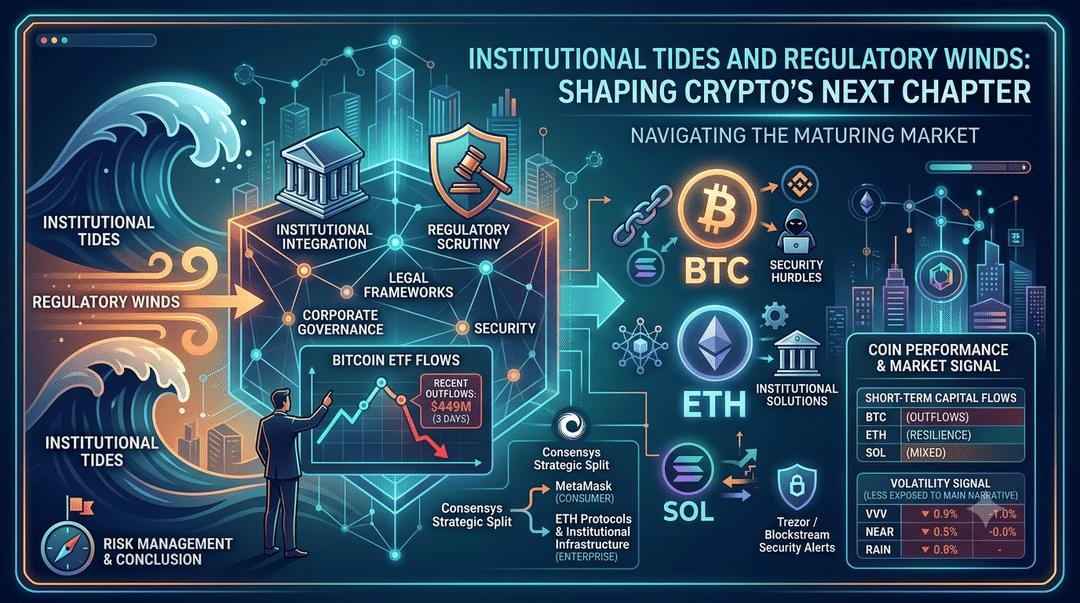
The Core Narrative
The crypto market is currently navigating a period defined by the ongoing, complex interplay of institutional integration and heightened regulatory and security scrutiny. This narrative cluster, encompassing institutional capital flows, corporate governance, and the legal and security frameworks surrounding digital assets, stands out as the most concentrated storyline in the current headline set. It underscores a maturing industry grappling with the realities of mainstream adoption and the challenges that come with it.
A significant observed fact is the acceleration of Bitcoin ETF outflows, with reports indicating $449 million pulled in three days, including a substantial $164 million from ARK 21Shares on a single day. This trend extends beyond Bitcoin, as Ether and Solana funds also recorded net outflows. This suggests a notable shift in institutional investor sentiment, potentially indicating profit-taking or a re-evaluation of risk in the short term. The Metaplanet equity backlash, where shareholders of the Bitcoin treasury company are reportedly upset over equity allocations for insiders, further highlights the governance challenges arising as traditional corporate structures intersect with the crypto world.
On the development front, the strategic move by Consensys to split into two distinct entities—one focusing on MetaMask and another on Ethereum protocols and institutional blockchain infrastructure—is a clear signal of the industry's deepening commitment to institutional-grade solutions for Ethereum. This structural change indicates a strategic pivot towards catering more explicitly to enterprise and institutional clients, recognizing the distinct needs and opportunities within that segment.
Simultaneously, the narrative is punctuated by incidents that underscore the critical importance of security and regulation. The alleged targeting of a Mexican musician and his family over a Bitcoin cold wallet believed to hold millions, as well as Blockstream's firm stance against a ransom demand for $47 million in Bitcoin stolen from the Liquid hack, refusing to negotiate and opting for law enforcement, illustrate the tangible, real-world implications of crypto's value and the legal challenges associated with its theft. Furthermore, the breach of Trezor's email provider, leading to phishing attempts targeting subscribers, highlights persistent vulnerabilities even among established hardware wallet providers. These events collectively paint a picture of an industry striving for institutional legitimacy while continuously confronting the inherent security and regulatory hurdles that accompany its growth.
Which Coins Or Segments Are Most Exposed
The assets most directly exposed to this dominant narrative are those with significant institutional touchpoints or those repeatedly featured in the news signals concerning these themes.
Bitcoin (BTC) is at the epicenter of this narrative. As the primary asset for institutional investment vehicles like ETFs and corporate treasuries, its price action is highly susceptible to shifts in institutional sentiment and capital flows. The reported ETF outflows directly impact BTC's perceived institutional demand. Furthermore, the governance issues at Metaplanet, a Bitcoin treasury company, and the security incidents involving Blockstream's Liquid hack and Trezor's email breach, all directly involve Bitcoin. These events underscore the asset's dual role as both a leading institutional investment and a target for security exploits, placing it firmly within the institutional and regulatory spotlight.
Ethereum (ETH) also demonstrates significant exposure. Its inclusion in recent ETF outflows, alongside Bitcoin and Solana, confirms its growing presence in institutional portfolios. More critically, the strategic restructuring of Consensys, with a dedicated focus on "Ethereum protocols and institutional blockchain infrastructure business," positions ETH and its ecosystem as central to the development of enterprise-grade blockchain solutions. This development suggests a long-term institutional commitment to Ethereum as a foundational layer for various applications, making ETH highly sensitive to the success and adoption of these new institutional offerings.
Solana (SOL), while a smaller component of the institutional narrative compared to BTC and ETH, is explicitly mentioned in the context of recent ETF outflows. This indicates its emerging, albeit more nascent, role in institutional investment products. Its inclusion in these reports suggests that institutional investors are diversifying beyond the top two, but also that SOL is subject to the same capital flow dynamics affecting its larger counterparts.
Other assets, such as Venice Token (VVV), Near Protocol (NEAR), and Rain Protocol (RAIN), have exhibited significant 24-hour volatility, with VVV dropping by 9.53%, NEAR by 8.59%, and RAIN by 4.23%. While these are notable price movements, the provided news signals do not explicitly link their volatility to the dominant institutional or regulatory narrative. Their price action is more likely driven by asset-specific developments, broader market sentiment, or other factors not directly related to the concentrated storyline of institutional adoption and regulatory scrutiny.
How The Market Is Pricing It
The market's reaction to the dominant institutional and regulatory narrative presents a mixed picture, reflecting both caution and strategic positioning.
Bitcoin (BTC), the flagship cryptocurrency, has observed a 24-hour price change of -0.36% and a 7-day change of -2.98%. This mild short-term negative bias in BTC's performance can be interpreted as the market pricing in the direct impact of the accelerated Bitcoin ETF outflows. The withdrawal of significant capital from these institutional vehicles, coupled with the negative sentiment from corporate governance issues (Metaplanet) and ongoing security concerns (Blockstream, Trezor), appears to be exerting downward pressure. The market is evidently sensitive to the perception of institutional demand and the integrity of the ecosystem serving institutional clients.
In contrast, Ethereum (ETH) has shown resilience, recording a 24-hour price change of +1.48% and a 7-day change of +3.06%. While ETH funds also experienced outflows, its positive price action could be interpreted as the market reacting favorably to the news of Consensys splitting to focus on institutional blockchain infrastructure. This strategic move might be viewed by investors as a long-term bullish signal for Ethereum's role in enterprise and institutional applications, potentially offsetting the negative impact of short-term ETF outflows. The market may be differentiating between immediate capital movements and fundamental developments that strengthen ETH's institutional utility.
Solana (SOL) has experienced a 24-hour price change of +1.00% but a 7-day change of -0.94%. This mixed performance suggests that while it also saw ETF outflows, its price action might be influenced by a combination of broader market dynamics and its own ecosystem developments, rather than being solely dictated by the institutional capital narrative. Its relatively smaller institutional footprint compared to BTC and ETH means that while sensitive, it may not be as singularly exposed to these specific institutional flow shifts.
Regarding the top volatile assets – Venice Token (VVV), Near Protocol (NEAR), and Rain Protocol (RAIN) – their price movements are notable but not directly attributable to the core institutional and regulatory narrative from the provided information. VVV experienced a significant 24-hour drop of -9.53% but a robust 7-day gain of +31.47%. NEAR saw a -8.59% drop over 24 hours but a +6.28% gain over 7 days. RAIN recorded a -4.23% decrease in 24 hours and a -7.87% decrease over 7 days. These fluctuations, while significant, are not explicitly linked to the institutional capital flows, corporate governance, or regulatory developments highlighted as the dominant narrative. Their volatility likely reflects asset-specific news, technical factors, or broader speculative market activity that falls outside the concentrated storyline. The overall market, as indicated by the average 24-hour move of -1.52%, suggests a mildly negative short-term bias across the selected asset basket.
Conclusion and Risk Management
The prevailing market narrative is undeniably anchored to the ongoing institutionalization of crypto and the attendant regulatory and security challenges. This storyline is not merely a background hum but a direct driver of sentiment and capital flows for major assets like Bitcoin and Ethereum. The observed facts, such as accelerated Bitcoin ETF outflows and significant security incidents, clearly demonstrate that the market is actively processing the implications of crypto's integration into traditional finance and legal frameworks.
To confirm the continued dominance of this narrative, market participants should monitor several key indicators. Sustained or increasing institutional capital inflows into various crypto products, particularly ETFs, would signal renewed confidence. Further developments in regulatory clarity, especially concerning stablecoins, institutional custody, and DeFi protocols, would also reinforce the narrative of a maturing, regulated market. Additionally, the successful launch and adoption of new institutional-grade infrastructure and products, such as those being developed by Consensys for Ethereum, would serve as strong affirmations.
Conversely, the narrative would weaken if we were to observe a prolonged period of significant institutional capital flight without clear explanatory factors, suggesting a fundamental loss of confidence. A wave of stringent, uncoordinated, or overly restrictive regulatory actions that stifle innovation and institutional participation could also diminish this narrative's influence. Furthermore, major, systemic security breaches that undermine trust in institutional custody solutions or core protocols would severely test the market's conviction in crypto's institutional future.
For effective risk management, it is crucial to remain vigilant regarding these institutional and regulatory signals. Investors should consider the implications of ETF flow trends, monitor regulatory announcements from key jurisdictions, and assess the security postures of platforms and protocols handling institutional capital. Understanding that market movements, particularly for core assets, are increasingly tied to these macro-institutional developments rather than solely retail sentiment, is paramount. Diversification and a clear understanding of the regulatory landscape relevant to one's holdings can help mitigate exposure to the inherent uncertainties of this evolving market phase.
Source Data Reference
Market Snapshot Input
| Asset | Symbol | Price (USD) | 24h Change | Market Cap (USD) |
|---|---|---|---|---|
| Bitcoin | BTC | 77,335.974698 | -0.36% | 1,553,165,215,435 |
| Ethereum | ETH | 2,535.152718 | 1.48% | 309,393,518,410 |
| Solana | SOL | 102.239359 | 1.00% | 59,976,975,375 |
| Venice Token | VVV | 23.191293 | -9.53% | 1,118,024,188 |
| Zcash | ZEC | 1,150.830054 | 0.22% | 18,791,062,693 |
| Rain Protocol | RAIN | 0.015144 | -4.23% | 10,740,186,191 |
| BNB | BNB | 736.741352 | 2.39% | 98,105,242,413 |
| Near Protocol | NEAR | 2.369692 | -8.59% | 3,095,070,071 |
| Monero | XMR | 532.559286 | 4.13% | 10,014,074,933 |
| Hyperliquid | HYPE | 80.262849 | -1.76% | 17,854,126,828 |
Trending Headlines Input
- Bitcoin ETF outflows accelerate as investors pull $449M in three days
- Metaplanet equity backlash, SE Asia crypto funding doubles: Asia Express
- Mexican Musician and Family Killed Over Bitcoin Cold Wallet Believed to Hold Millions
- Consensys Is Splitting in Two as MetaMask Goes Its Own Way
- Blockstream Refuses Ransom for Return of $47M in Bitcoin from Liquid Hack: 'It Is Theft'
- Bitcoin Wallet Maker Trezor Says Hackers Breached Its Email Provider
- Bitcoin Rises as Markets Digest Inflation Data Ahead of Fed Rate Decision
- Bitcoin Golden Cross Flickers Off as Rate-Hike Bets Firm Up
- Brevo login flaw enabled phishing email targeting 347K Trezor subscribers
- Trading stocks against BONER is the latest trend for DeFi degens


