Bitcoin Price Structure
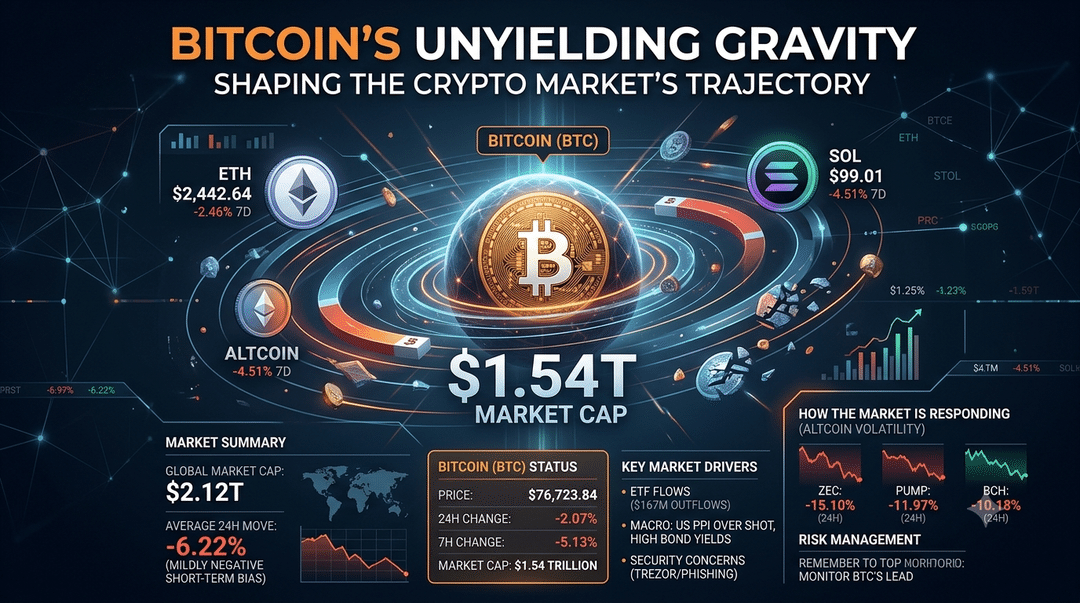
Bitcoin, the leading cryptocurrency by market capitalization, is currently trading at approximately $76,723.84. Over the past 24 hours, BTC has seen a decline of -2.07%, while its seven-day performance shows a more significant drop of -5.13%. Despite these recent pullbacks, Bitcoin maintains a commanding market capitalization of $1.54 trillion, representing a substantial portion of the total crypto market. This dominance underscores its pivotal position, where its movements often set the precedent for the entire ecosystem.
Compared to the broader market's average 24-hour decline of over 6%, Bitcoin's more contained -2.07% dip suggests a degree of relative short-term resilience. Its robust market cap and significant trading volume, recorded at $21.91 billion over 24 hours, indicate sustained institutional and retail interest, even amidst minor corrections. The current price action indicates that while not immune to downward pressure, Bitcoin is exhibiting less immediate volatility than many other digital assets, acting as a less volatile anchor in a generally declining environment. This observed stability, however, is short-term, as its weekly performance shows a more significant retreat.
Why Bitcoin Is Driving The Tape
Bitcoin's current market trajectory is heavily influenced by a confluence of institutional flows, macro-economic factors, and security-related news. These catalysts collectively shape investor sentiment and direct capital movements, reinforcing Bitcoin's role as the market's primary driver.
One significant development observed is the recent shift in Bitcoin Exchange-Traded Funds (ETFs). After experiencing their strongest three-week inflow run of the year, Bitcoin ETFs collectively shed $167 million, with ARKB leading the outflows. This reversal in institutional appetite for spot Bitcoin products indicates a potential cooling of demand or profit-taking, which can exert downward pressure on BTC's price. Relatedly, the news surrounding Metaplanet, a Bitcoin treasury company, facing an equity backlash over insider allocations, further highlights the complexities and scrutiny within the institutional adoption space, potentially introducing a layer of caution for institutional investors.
From a macroeconomic perspective, Bitcoin's price action has been intertwined with traditional financial markets. BTC experienced a fall as US Producer Price Index (PPI) figures overshot expectations, coinciding with a 30-year bond yield hitting a new 19-year high. These macro indicators, suggesting persistent inflation and rising interest rate expectations, often lead to a risk-off sentiment that can impact cryptocurrencies, especially Bitcoin, which is increasingly viewed through a macro lens. Reports indicate that Bitcoin is defending its "golden zone support" while Wall Street stalls, awaiting inflation reports and Federal Reserve rate decisions, underscoring its sensitivity to global economic shifts.
Security concerns have also cast a shadow, albeit with less direct price impact than institutional flows or macro events. Warnings from hardware wallet providers Trezor and BitBox about phishing emails and a breach at Trezor's email service have raised awareness about digital asset security. While not directly impacting Bitcoin's protocol, such incidents can lead to increased caution among holders. Furthermore, the unfortunate incident in Mexico involving a musician and his family allegedly killed over a Bitcoin cold wallet, and the ongoing saga of the Liquid hack with $47 million still missing, serve as stark reminders of the security risks associated with holding significant amounts of Bitcoin, potentially influencing individual investor behavior and regulatory discussions. These events, while isolated, contribute to the broader narrative around Bitcoin's ecosystem.
How The Rest Of The Market Is Responding
The broader cryptocurrency market is largely reacting to Bitcoin's lead, with altcoins generally reflecting the prevailing cautious sentiment. The overall market is experiencing a mildly negative short-term bias, and this is evident across various asset classes.
Ethereum (ETH), the second-largest cryptocurrency, is trading at approximately $2,442.64, with a 24-hour decline of -1.35% and a 7-day decline of -2.46%. While its 24-hour performance appears slightly more resilient than Bitcoin's, its weekly performance is comparatively stronger than BTC's -5.13% decline. This suggests that while ETH is not entirely decoupled from BTC's movements, it may be exhibiting a degree of relative strength on a weekly timeframe, potentially influenced by its own ecosystem developments. News of Vitalik Buterin pushing an Ethereum plan to slash quantum-safe privacy costs indicates ongoing protocol development, which might offer some intrinsic support.
Solana (SOL), another prominent altcoin, is priced at around $99.01, experiencing a -2.91% drop over 24 hours and a -4.51% decline over seven days. Solana's movements closely mirror Bitcoin's short-term bearish trend, indicating that assets with strong institutional interest often move in tandem with BTC, especially during periods of market uncertainty.
Beyond the major altcoins, the market exhibits higher volatility in certain assets. As per derived insights, the strongest 24-hour moves are concentrated in Zcash (ZEC), Pump.fun (PUMP), and Bitcoin Cash (BCH). Zcash (ZEC) has seen a significant 24-hour drop of -15.10%, despite a positive 11.52% gain over seven days, indicating sharp intraday swings. Pump.fun (PUMP) is down -11.97% in 24 hours and -16.34% over seven days, while Bitcoin Cash (BCH) has declined -10.18% in 24 hours and -11.67% over seven days. These pronounced movements in smaller-cap assets underscore a flight to perceived safety or a rotation out of higher-risk assets during Bitcoin-led downturns, or simply higher sensitivity to market shifts. The general trend observed is that while Bitcoin experiences a measured decline, many altcoins tend to amplify these movements, either with sharper losses or, in some cases, more dramatic recoveries if specific narratives emerge.
Conclusion and Risk Management
The current cryptocurrency market landscape is characterized by Bitcoin's pronounced leadership, with its price structure and associated catalysts setting the overall tone. While Bitcoin itself has experienced recent declines, particularly over the past week, its 24-hour performance shows relative stability compared to the broader market average. Institutional flows, macroeconomic indicators, and security concerns continue to be pivotal in shaping Bitcoin's trajectory, and by extension, the entire crypto market.
The derived insights indicate a "mildly negative short-term bias" across the market, with altcoins generally following Bitcoin's lead, often with increased volatility. Major altcoins like Ethereum and Solana reflect this sentiment, albeit with some nuances in their weekly performance relative to BTC. Smaller-cap assets, as evidenced by the significant swings in Zcash, Pump.fun, and Bitcoin Cash, tend to exhibit more exaggerated reactions to market movements.
Looking ahead, Bitcoin's ability to hold key support levels in the face of ongoing macroeconomic uncertainty and shifting institutional sentiment will be crucial. Potential scenarios include continued consolidation around current price levels if institutional demand stabilizes and macro headwinds subside, or further downward pressure should ETF outflows persist and inflation concerns escalate.
For market participants, effective risk management in this Bitcoin-led environment involves closely monitoring BTC's price action and the fundamental catalysts driving it. Given the observed volatility in altcoins, a diversified approach and careful position sizing may be prudent. Understanding that Bitcoin often acts as a leading indicator, any significant shift in its price structure or the news signals impacting it could foreshadow broader market movements. It is essential to conduct thorough independent research and consider individual risk tolerance when navigating these dynamic market conditions. This article provides market observations and interpretations, not financial advice.
Source Data Reference
Market Snapshot Input
| Asset | Symbol | Price (USD) | 24h Change | Market Cap (USD) |
|---|---|---|---|---|
| Bitcoin | BTC | 76,723.835147 | -2.07% | 1,540,815,319,311 |
| Ethereum | ETH | 2,442.63877 | -1.35% | 298,095,912,903 |
| Solana | SOL | 99.013423 | -2.91% | 58,075,115,514 |
| Zcash | ZEC | 1,058.185101 | -15.10% | 17,278,330,983 |
| Pump.fun | PUMP | 0.003609 | -11.97% | 1,496,102,033 |
| Hyperliquid | HYPE | 78.34143 | -7.01% | 17,426,715,419 |
| Bitcoin Cash | BCH | 225.813859 | -10.18% | 4,535,040,964 |
| Near Protocol | NEAR | 2.388976 | -6.10% | 3,119,994,119 |
| XRP | XRP | 1.338813 | -3.76% | 84,183,502,428 |
| BNB | BNB | 710.38626 | -1.78% | 94,595,869,058 |
Trending Headlines Input
- Bitcoin ETFs shed $167M after strongest three-week inflow run of 2026
- Metaplanet equity backlash, SE Asia crypto funding doubles: Asia Express
- Trezor, BitBox warn users about fake hardware wallet security alerts
- Mexican Musician and Family Killed Over Bitcoin Cold Wallet Believed to Hold Millions
- $47M Still Missing After Liquid Hack as Blockstream Bargains With 'White Hats'
- Bitcoin Holds, Wall Street Stalls as Oil Shock Revives Fed Hike Bets
- Bitcoin Wallet Maker Trezor Says Hackers Breached Its Email Provider
- Bitcoin falls on US PPI overshoot as 30-year bond yield hits new 19-year high
- Vitalik Buterin Pushes Ethereum Plan to Slash Quantum-Safe Privacy Costs
- 10 of the greatest unsolved crypto mysteries


