The Core Narrative
The crypto market is currently navigating a concentrated narrative cluster, prominently defined by the interplay of burgeoning institutional integration and persistent, high-profile security challenges. This duality, largely centered around Bitcoin, paints a picture of an asset class simultaneously gaining mainstream legitimacy and grappling with inherent vulnerabilities. The storyline is critical because it highlights the ongoing tension between adoption and infrastructure robustness, shaping investor confidence and market dynamics.
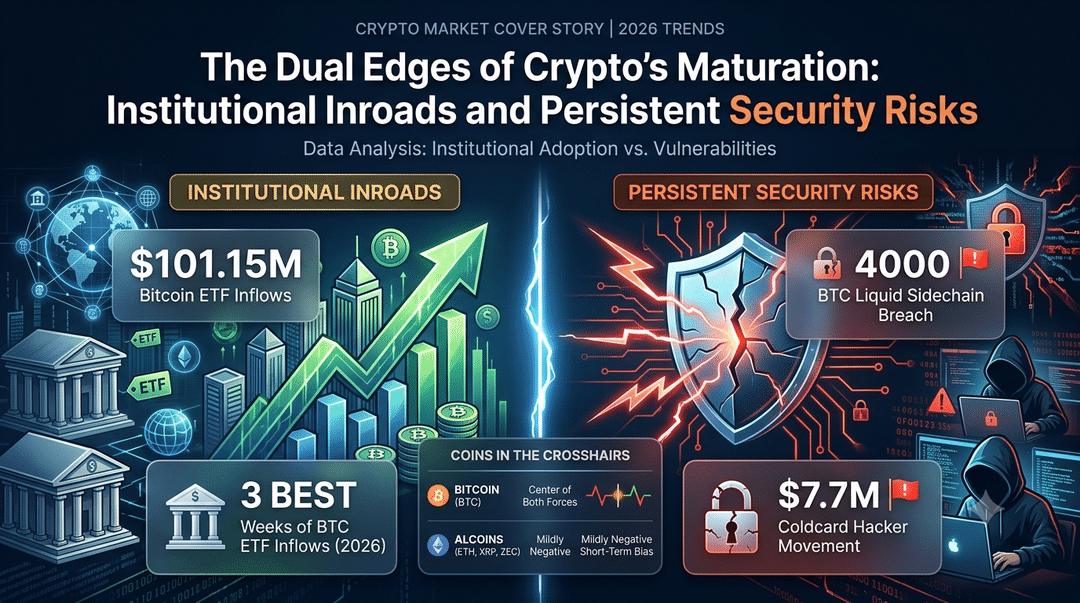
On the institutional front, Bitcoin has demonstrated significant traction. Recent data indicates a notable rebound in Bitcoin Exchange-Traded Funds (ETFs), with one day seeing $101.15 million in inflows, marking a recovery after a period of outflows. This resurgence contributes to what has been identified as the best three weeks of inflows for Bitcoin ETFs in 2026. Further underscoring this institutional pivot, the International Monetary Fund (IMF) has revised its stance, now acknowledging that donations played a role in funding El Salvador's Bitcoin growth, a shift from previous claims of mere internal shuffling. These developments suggest a growing, albeit sometimes complex, acceptance of Bitcoin within traditional financial structures and sovereign states. Additionally, broader macro signals, such as the Federal Reserve signaling a potential rate pause, contributed to a Bitcoin pump, indicating its increasing sensitivity to traditional economic indicators.
However, this institutional ascent is occurring against a backdrop of significant security incidents. The market has been reminded of these risks with reports of "white hat" hackers reportedly taking 4000 Bitcoin from the Liquid sidechain in a major security breach. Concurrently, a Coldcard hacker has been observed moving $7.7 million, representing nearly half of a third-wave Bitcoin haul, by emptying numerous vaults of stolen Bitcoin. These events serve as stark reminders that as the value and institutional interest in crypto grow, so too does the incentive for malicious actors, underscoring the critical need for robust security measures and vigilance within the ecosystem.
Which Coins Or Segments Are Most Exposed
Given the dominant narrative, Bitcoin (BTC) is unequivocally the most exposed asset. Its price movements are directly influenced by both the positive institutional news, such as ETF inflows and macro signals, and the negative implications of security breaches. The broader institutional narrative extends to other major assets, with Ethereum (ETH) and XRP (XRP) having seen their respective ETF winning streaks come to an end, suggesting that the institutional sentiment isn't uniformly positive across all major crypto assets.
Beyond the majors, other segments exhibit varying degrees of exposure or independent volatility within this market context. Zcash (ZEC), a privacy coin, experienced significant price action, hitting its highest price in nearly a decade. This surge was initially tied to a Fed-driven crypto rally, demonstrating how broader market optimism, even if short-lived, can significantly impact specific altcoins. However, the subsequent reversal, when a stronger-than-expected jobs report sent Bitcoin back under $80,000, illustrates the sensitivity of such assets to overarching macro and Bitcoin-centric market shifts.
Among the top volatile assets, Arbitrum (ARB), Chainlink (LINK), and Worldcoin (WLD) are currently exhibiting notable price swings. Arbitrum, a prominent Layer-2 scaling solution for Ethereum, recorded a significant 24-hour decline of -13.51%. While not directly linked to the specific Bitcoin institutional or security news, such a sharp correction often follows periods of strong gains (ARB was up over 91% in 7 days) or reflects broader risk-off sentiment that can be amplified by prevailing market uncertainty, including security concerns. Chainlink (LINK), an oracle network, and Worldcoin (WLD), an identity-focused project, both posted strong 24-hour gains of approximately +6.97% and +6.96% respectively. These movements suggest that certain segments or projects can demonstrate independent strength or react to specific project-related catalysts even when the dominant market narrative is a mix of institutional progress and security challenges.
How The Market Is Pricing It
The market's pricing reflects a nuanced response to these conflicting signals. Bitcoin, despite the positive institutional news, experienced a slight 24-hour decline of -0.58%, although it maintains a positive 7-day change of +1.81%. This modest 24-hour dip can be interpreted as the market digesting the combined impact of recent security incidents and potentially reacting to broader economic data that tempered earlier optimism, such as the jobs report that sent BTC under $80,000. The sustained 7-day positive movement, however, likely reflects the underlying strength from consistent ETF inflows and the broader narrative of institutional adoption.
Ethereum and XRP, which had enjoyed extended winning streaks for their respective ETFs, saw these runs conclude, with ETH registering a -0.35% 24-hour change and XRP a -1.13% change. This suggests that while institutional interest in Bitcoin is strong, the enthusiasm for other assets within the ETF space may be moderating, or investors are taking profits.
Zcash (ZEC) stands out with a 24-hour gain of +1.11% and a substantial 7-day increase of +44.57%. This performance is an observed fact, and the news indicates it was driven by a Fed-driven crypto rally. However, the same report noted a reversal when macroeconomic data shifted, demonstrating how quickly such gains can be influenced by broader market sentiment, even if the asset initially reacted strongly to positive signals.
The derived insights indicate that the selected editorial asset basket shows a mildly negative short-term bias, which aligns with the slight corrections seen in BTC, ETH, and XRP over the past 24 hours. However, this is not uniform across the board, as evidenced by the significant volatility in other assets. The strongest 24-hour moves are concentrated in Arbitrum, Chainlink, and Worldcoin. Arbitrum's -13.51% 24-hour change, despite a strong 7-day performance, suggests profit-taking or a reaction to specific ecosystem developments, potentially exacerbated by a generally cautious market sentiment. Conversely, Chainlink and Worldcoin's positive 24-hour movements (+6.97% and +6.96% respectively) indicate targeted buying or strength in specific use cases that are less directly tied to the immediate Bitcoin-centric institutional and security headlines.
Conclusion and Risk Management
The current market narrative is a compelling illustration of the crypto industry's ongoing evolution: a simultaneous embrace by traditional finance and a continuous battle against security vulnerabilities. Bitcoin, as the market's bellwether, is at the epicenter of this dynamic, with its price action reflecting the push and pull of these forces. The institutional narrative, bolstered by ETF inflows and growing acceptance, provides a bullish undercurrent. However, the persistent threat of security breaches, as seen with the Liquid sidechain and Coldcard hacker incidents, serves as a critical counterpoint, reminding participants of the inherent risks.
Looking ahead, confirmation of this narrative would involve sustained institutional capital inflows into Bitcoin and other crypto ETFs, coupled with continued regulatory clarity and perhaps even more traditional financial products emerging. Conversely, a weakening of this narrative could manifest through a prolonged period of ETF outflows, a significant regulatory rollback affecting institutional participation, or a substantial, confidence-eroding security exploit that goes unaddressed.
For market participants, effective risk management in this environment necessitates a dual focus. Firstly, monitoring institutional adoption metrics and regulatory developments remains crucial for understanding long-term market direction. Secondly, maintaining a high level of awareness regarding security best practices and staying informed about potential vulnerabilities within the ecosystem is paramount. The market is pricing in both the promise of mainstream integration and the reality of an evolving threat landscape. Investors are advised to conduct their own research and understand the risks associated with digital asset investments.
Source Data Reference
Market Snapshot Input
| Asset | Symbol | Price (USD) | 24h Change | Market Cap (USD) |
|---|---|---|---|---|
| Bitcoin | BTC | 79,455.173594 | -0.58% | 1,595,539,340,947 |
| Arbitrum | ARB | 0.164174 | -13.51% | 1,096,366,122 |
| Zcash | ZEC | 1,192.871929 | 1.11% | 19,477,533,738 |
| XRP | XRP | 1.403155 | -1.13% | 88,040,261,728 |
| Ethereum | ETH | 2,489.687388 | -0.35% | 303,808,540,136 |
| Chainlink | LINK | 13.201341 | 6.97% | 9,875,922,505 |
| Solana | SOL | 105.044337 | -1.58% | 61,573,433,013 |
| Worldcoin | WLD | 0.448908 | 6.96% | 1,632,454,155 |
| Uniswap | UNI | 7.042324 | 0.26% | 4,388,863,696 |
| BNB | BNB | 745.402301 | -1.15% | 99,259,077,783 |
Trending Headlines Input
- Bitcoin ETFs Rebound as Ethereum and XRP ETFs End Winning Streaks
- ‘White hats’ take 4000 BTC from Liquid, ETFs see best inflows of 2026: Hodler’s Digest
- Coldcard Hacker Moves $7.7M, Nearly Half of Third-Wave Bitcoin Haul
- IMF Now Says Donations Funded El Salvador's Bitcoin Growth
- Bitcoin Pumps as Fed Signals Rate Pause, $415 Million in Shorts Get Rekt
- Zcash Hits Highest Price in Nearly a Decade, Crushing Short Bets
- CFTC Asks Judge to Dismiss CME Lawsuit Over Crypto Perpetual Futures
- US law enforcement group moves to ‘neutral’ position on CLARITY Act
- Satoshi-era Bitcoin wakes after 16 years of dormancy as 600 BTC moves
- Fomo overtakes Pump.fun in daily revenue on Solana


