Risk Tone Across The Market
The broader cryptocurrency market is currently exhibiting a mildly negative short-term bias, characterized by an overall cautious risk tone. The global market capitalization stands at approximately $2.14 trillion, with the average 24-hour price movement across major assets registering a decline of -0.66%. This observed downturn in the aggregate suggests a prevailing sentiment of risk aversion in the immediate term.
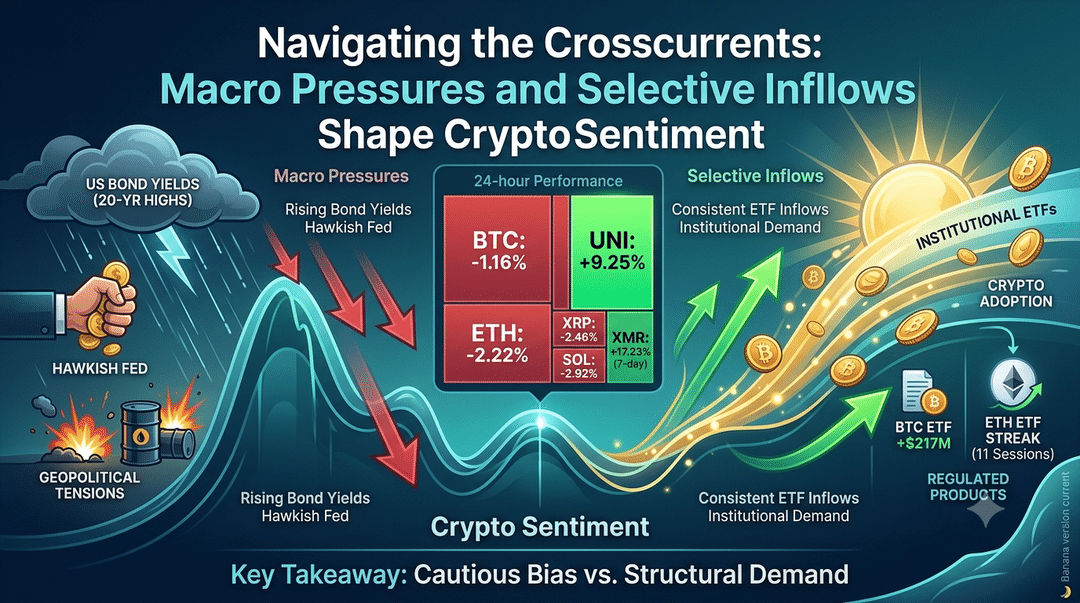
A closer look at the market's leading assets reinforces this cautious stance. Bitcoin (BTC), the largest cryptocurrency by market capitalization, has seen a 24-hour decrease of -1.16%, extending its 7-day decline to -1.77%. Ethereum (ETH) mirrors this trend, down -2.22% over 24 hours and -1.98% over the past week. Other significant assets like XRP and Solana (SOL) have also experienced notable 24-hour dips of -2.46% and -2.92% respectively, with XRP also showing a -5.01% drop over seven days.
Despite this general pullback, the market is not uniformly risk-off. Certain assets demonstrate resilience or even independent momentum, indicating a nuanced risk appetite. Uniswap (UNI) stands out with a significant 9.25% gain over the last 24 hours and an impressive 46.9% increase over seven days, pointing to localized positive sentiment or specific drivers not broadly reflective of the market. Similarly, Monero (XMR) and Zcash (ZEC) have posted strong 7-day gains of 17.23% and 5.11% respectively, even as their 24-hour performance tracks the broader negative trend. This divergence suggests that while the overall market may be treading cautiously, pockets of capital are still flowing into specific assets, possibly driven by idiosyncratic factors. The strongest 24-hour moves are observed to be concentrated in UNI, SOL, and XRP, highlighting specific areas of volatility.
Macro and Flow Signals
Current market sentiment is heavily influenced by a confluence of institutional flows and broader macroeconomic pressures, creating a complex backdrop for digital assets. Recent headlines reveal a mixed picture, with strong institutional interest in exchange-traded funds (ETFs) providing a counterweight to macro uncertainties.
On the institutional front, Bitcoin ETFs have shown a significant rebound, with BlackRock notably driving a $217 million inflow. This follows a period where US spot Bitcoin ETFs experienced a $201.9 million outflow on August 28th, breaking a nine-day inflow streak. Despite this brief interruption, August proved to be a strong month for Bitcoin ETFs, reducing their year-to-date net outflows by 66% as BTC gained approximately 25%. This suggests a continued, albeit sometimes volatile, institutional appetite for Bitcoin exposure via regulated products.
The positive ETF trend extends beyond Bitcoin. Ether ETFs have demonstrated remarkable consistency, extending their inflow streak to 11 consecutive trading sessions and turning positive year-to-date at $732 million. XRP and Solana funds have also logged their 10th consecutive positive session, with XRP ETFs reaching $502 million in inflows. This sustained interest across multiple asset-specific ETFs indicates a growing institutional comfort and diversification within the crypto space, acting as a significant positive flow signal. Furthermore, Ripple has been actively involved in strategic partnerships to build digital asset custody and tokenized asset management solutions in Asia, potentially bolstering institutional adoption for XRP.
However, these positive flow signals are juxtaposed against a backdrop of macroeconomic concerns. Headlines point to US bond yields eyeing new 20-year highs and discussions around a "hawkish Fed." Such developments in traditional finance typically signal tighter monetary conditions, which can increase the cost of capital and reduce investor appetite for riskier assets like cryptocurrencies. Geopolitical events, such as US strikes on Iran, have been observed to rattle stock markets and lift oil prices, yet Bitcoin has shown some resilience, holding steady above $78,000 during these events. This suggests a potential, albeit not definitive, narrative of Bitcoin acting as a non-correlated asset in times of broader market instability, though the overall macro environment remains a source of caution.
Adding to the macro considerations is the historical pattern of "Red September," a phenomenon where Bitcoin has historically lost ground in eight of the last 13 Septembers, mirroring a similar trend in traditional stock markets since 1928. While historical performance is not indicative of future results, this narrative can contribute to a cautious sentiment among some market participants as the calendar turns.
In summary, the market is experiencing a push-pull between robust institutional inflows into various crypto ETFs, signaling increasing adoption and demand, and broader macroeconomic headwinds concerning interest rates, bond yields, and geopolitical tensions that typically dampen risk appetite.
What Sentiment Is Doing To Major Coins
The prevailing market sentiment, a blend of cautious risk appetite and selective institutional engagement, is eliciting varied responses across major cryptocurrencies.
Bitcoin (BTC), despite a recent 24-hour decline of -1.16%, has demonstrated a degree of resilience in the face of broader macro pressures. Its performance in August, which saw a 25% gain, was significantly bolstered by institutional inflows into spot Bitcoin ETFs. While a recent $201.9 million outflow temporarily interrupted a nine-day streak, the overall trend of BlackRock driving a $217 million rebound suggests that institutional capital remains a crucial driver for BTC. The narrative of Bitcoin holding steady amidst geopolitical events that rattled traditional markets also indicates a potential, though not yet fully confirmed, flight-to-safety characteristic or at least a decoupling from immediate equity market shocks. However, the historical "Red September" pattern and concerns over rising US bond yields introduce an element of caution for its short-term trajectory.
Ethereum (ETH) is similarly navigating a complex sentiment landscape. While its price has dipped by -2.22% over the last 24 hours, institutional interest in Ether ETFs remains robust. These funds have extended an impressive 11-session inflow streak, turning positive year-to-date with $732 million in net inflows. This sustained institutional accumulation, alongside reports of entities like Bitmine accumulating Ether for 65 consecutive weeks, suggests underlying fundamental demand that could act as a buffer against broader market downturns. The increase in Robinhood Chain DEX volume and DeFi deposits also points to ongoing activity within the Ethereum ecosystem, which could support sentiment.
XRP has experienced a -2.46% decline in the last 24 hours and a -5.01% drop over seven days. Despite this price action, XRP funds have recorded their 10th consecutive positive session, accumulating $502 million. This divergence between price and fund flows suggests that while retail or speculative sentiment might be lagging, institutional conviction or strategic positioning for XRP remains in play, potentially linked to Ripple's ongoing efforts in building digital asset custody solutions in Asia.
Solana (SOL), like many other majors, is down -2.92% over 24 hours. However, its 7-day performance shows a positive 3.23% gain, and Solana funds have also seen their 10th consecutive positive session. This indicates that despite short-term fluctuations, there is sustained interest and capital allocation towards SOL, possibly driven by its ecosystem developments or perceived growth potential that is somewhat insulated from the immediate daily market sentiment.
Among the top volatile assets, Uniswap (UNI) stands out as an anomaly. With a 9.25% surge in 24 hours and a remarkable 46.90% increase over seven days, UNI is demonstrating strong independent momentum that appears disconnected from the general market's cautious tone. While specific news catalysts for this surge are not immediately apparent in the provided data, its performance suggests focused buying interest or technical breakouts that defy the broader sentiment.
Other assets like TRON (TRX) and Dogecoin (DOGE) are largely tracking the negative sentiment, with 24-hour declines of -1.95% and -1.65% respectively, and negative 7-day performance. BNB, while down a modest -0.14% in 24 hours, also shows a -1.41% drop over seven days, indicating it is not entirely immune to the prevailing cautious mood.
Conclusion and Risk Management
The current cryptocurrency market operates under a complex interplay of forces, where short-term direction is shaped less by isolated asset performance and more by broader risk sentiment and cross-market catalysts. The observed sentiment is characterized by a mildly negative short-term bias across the aggregate market, driven by macroeconomic headwinds such as rising US bond yields and the specter of a hawkish Federal Reserve. Historical patterns like "Red September" also contribute to a cautious outlook for Bitcoin.
However, this cautious environment is significantly offset by robust and consistent institutional inflows into key crypto ETFs. Bitcoin ETFs have shown a notable rebound, and Ether, XRP, and Solana funds have demonstrated sustained positive streaks. This indicates a growing structural demand from institutional players, which provides a foundational layer of support and suggests that underlying conviction in digital assets remains strong despite daily price volatility. The ability of Bitcoin to hold steady amidst geopolitical tensions further complicates the sentiment, hinting at potential safe-haven characteristics for some investors.
Market participants should recognize this dichotomy: a macro environment that fosters caution, contrasted with specific, strong institutional flow signals. The market is not uniformly risk-off, as evidenced by the significant independent gains in assets like Uniswap, highlighting that capital can still flow into specific narratives or technical setups.
Given these mixed signals, a balanced approach to risk management is prudent. Investors may consider monitoring macroeconomic indicators closely, as shifts in interest rate expectations or global stability could quickly alter the broader risk appetite. Simultaneously, tracking institutional ETF flows can offer insights into areas of sustained demand. While the short-term bias is negative, the consistent institutional interest suggests that significant downturns might be met with buying pressure from these larger entities. As always, diversification and position sizing remain critical, especially in an environment where sentiment shifts can be rapid and headline-driven.
Source Data Reference
Market Snapshot Input
| Asset | Symbol | Price (USD) | 24h Change | Market Cap (USD) |
|---|---|---|---|---|
| Bitcoin | BTC | 76,974.331892 | -1.16% | 1,545,534,895,971 |
| Ethereum | ETH | 2,397.548982 | -2.22% | 292,530,578,322 |
| XRP | XRP | 1.334255 | -2.46% | 83,717,170,603 |
| Solana | SOL | 99.155235 | -2.92% | 58,026,246,398 |
| Uniswap | UNI | 6.21432 | 9.25% | 3,886,085,086 |
| Monero | XMR | 520.310181 | -1.30% | 9,781,474,992 |
| Zcash | ZEC | 825.614398 | -2.06% | 13,480,853,984 |
| TRON | TRX | 0.323031 | -1.95% | 30,665,763,654 |
| Dogecoin | DOGE | 0.081144 | -1.65% | 13,910,921,631 |
| BNB | BNB | 685.217975 | -0.14% | 91,245,188,504 |
Trending Headlines Input
- BlackRock drives $217M Bitcoin ETF rebound as altcoin funds continue streaks
- Bitcoin ETFs notch best month of 2026 as BTC gains 25% in August
- Asia sees digital asset custody infrastructure deals from Ripple, Coincheck
- What Is 'Red September'? Bitcoin's Curse, and Why Wall Street Has the Same One
- Bitcoin ETFs Snap Nine-Day Inflow Streak as Ethereum Funds Extend Their Run
- Bitcoin Holds Steady as US Strikes on Iran Rattle Stocks and Lift Oil
- Bitcoin begins volatile monthly close as US bond yields eye new 20-year high
- Bitmine now controls 4.9% of Ethereum supply after adding 53.5K ETH
- Mystery surrounds why an OG burned $1M in Bitcoin
- Robinhood Chain DEX Volume Jumps to $1.6 billion