Global Market Capitalization
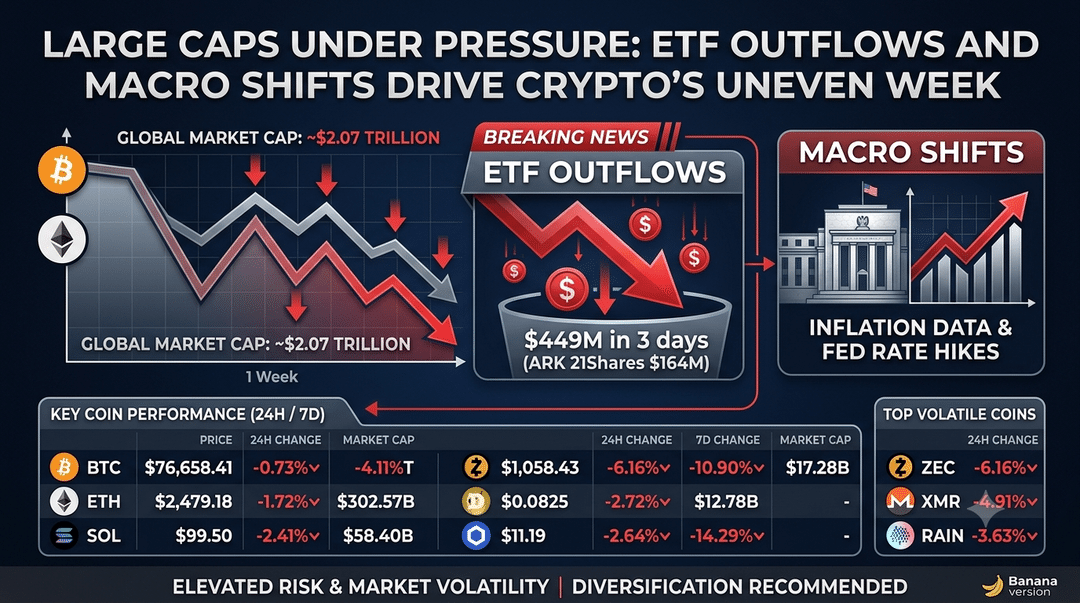
The total global cryptocurrency market capitalization stands at approximately $2.128 trillion. Over the past 24 hours, the average movement across a snapshot of top assets registered a mildly negative bias, with an average change of -1.07%. This indicates a slight downturn across many major cryptocurrencies, suggesting a period of consolidation or minor profit-taking following recent market activity.
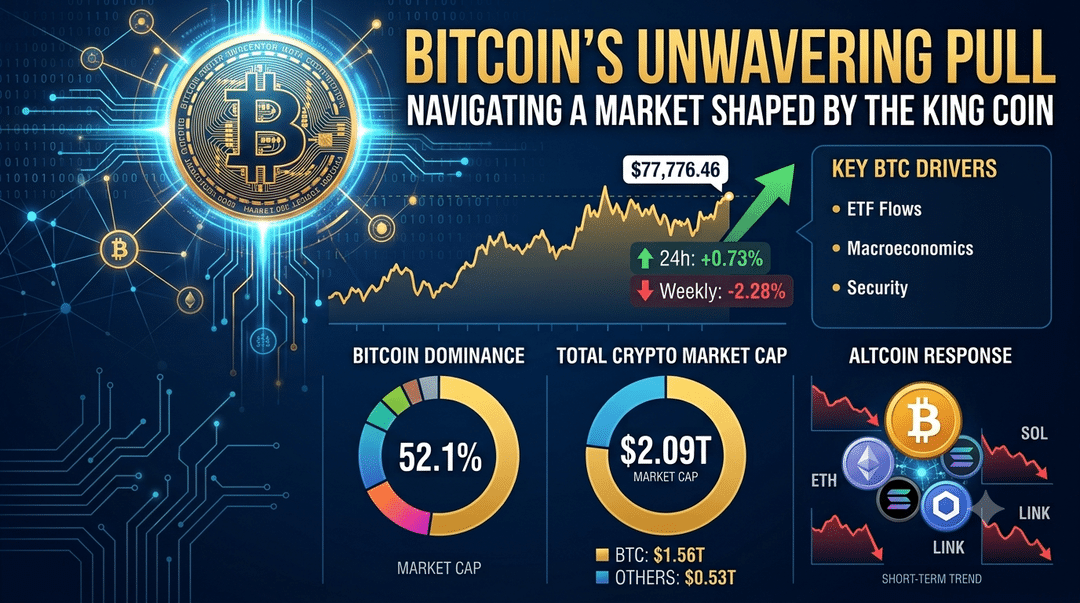
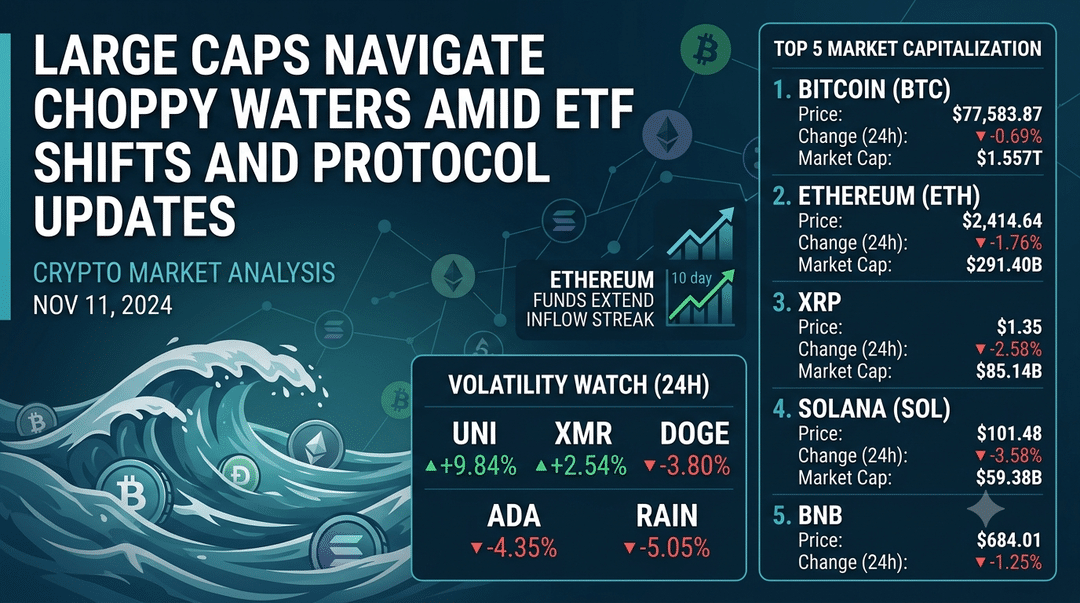
Bitcoin (BTC), the market's leading asset, is currently priced around $77,583.87. Over the last 24 hours, BTC saw a modest decline of -0.69%, though its performance over the past seven days remains marginally positive at +0.17%. Its market capitalization holds firm at approximately $1.557 trillion, underscoring its dominant position.
Ethereum (ETH), the second-largest cryptocurrency, trades at approximately $2,414.64. ETH has experienced a 24-hour decrease of -1.76% and a 7-day decline of -1.65%. Its market cap is around $291.40 billion.
Solana (SOL), a prominent layer-1 blockchain, is priced at about $101.48. SOL recorded a more pronounced 24-hour drop of -3.58%, despite maintaining a strong 7-day gain of +6.90%. Its market capitalization is approximately $59.38 billion.
XRP, another significant large-cap asset, is trading at roughly $1.35. It registered a 24-hour decline of -2.58% and a notable 7-day decrease of -8.82%. XRP's market cap is approximately $85.14 billion.
Among other top assets, BNB, ranked fourth by market capitalization, is at $684.01, showing a 24-hour decrease of -1.25% and a 7-day decline of -2.61%. Dogecoin (DOGE) also experienced a 24-hour dip of -3.80% and a 7-day drop of -10.97%. Monero (XMR) bucked the trend with a 24-hour gain of +2.54% and a significant 7-day increase of +16.20%.
Top Volatile Coins
While the broader market showed a slight negative tilt, some assets experienced more pronounced movements, indicating specific catalysts or shifts in short-term trading interest. The strongest 24-hour moves were observed in Uniswap (UNI), Rain Protocol (RAIN), and Cardano (ADA).
Uniswap (UNI) emerged as a notable gainer, posting a substantial 24-hour increase of +9.84%, with its price reaching approximately $5.12. This positive momentum extends to its 7-day performance, which shows a gain of +14.79%. UNI's significant short-term appreciation suggests increased interest in the decentralized exchange sector or specific developments related to the protocol, though no direct news correlation is immediately apparent in the provided data.
On the downside, Rain Protocol (RAIN) registered a 24-hour decline of -5.05%, with its price around $0.0166. Despite this daily dip, RAIN has shown considerable strength over the past week, with a 7-day gain of +18.94%. This pattern could indicate recent profit-taking following earlier strong performance.
Cardano (ADA) also experienced notable volatility, with a 24-hour decrease of -4.35%, bringing its price to approximately $0.192. Furthermore, ADA has seen a significant 7-day decline of -13.77%. This sustained negative performance suggests a period of downward pressure or perhaps a broader re-evaluation of its market position among traders.
These significant movements in UNI, RAIN, and ADA highlight areas of concentrated short-term trading activity that may be driving specific narratives or attracting focused attention from market participants, even as the larger market experiences more subdued shifts.
News and Market Impact
Recent headlines have provided a mix of institutional developments, protocol updates, and macroeconomic considerations, influencing market dynamics, particularly for large-cap assets.
For Bitcoin (BTC), the institutional landscape remains a primary driver. Bitcoin ETFs recently ended a nine-day inflow streak, shedding $201.9 million, which may have contributed to its modest 24-hour dip. This contrasts with earlier optimism surrounding a Bitcoin rally that saw prices near $80,000, lifting crypto stocks and benefiting firms like Strategy, whose Bitcoin holdings reportedly generated $2.8 billion in profit, fueling speculation about potential renewed buying by the company. Macroeconomic factors also played a role, with Bitcoin dipping to $78.4K as the Fed’s Kevin Warsh downplayed recent low inflation prints, indicating continued sensitivity to broader economic outlooks. On the technical front, discussions around "Bitcoin’s new quantum defenses" highlight ongoing efforts to future-proof the protocol.
Ethereum (ETH) has seen positive momentum from the institutional investment side, particularly concerning its spot ETFs. Ethereum funds extended a 10-day inflow streak, taking in $226 million in a single day, almost matching Bitcoin's haul and marking their strongest day in 10 months. These inflows totaled $1.4 billion over nine straight sessions. This sustained institutional interest in Ethereum ETFs appears to be a significant positive catalyst for ETH, even as its price saw a slight 24-hour decline. Separately, a security concern regarding an outdated Ethereum app on Ledger devices was addressed, with the company confirming the vulnerability was patched before any exploit, mitigating potential negative sentiment around security.
Solana (SOL) has been in the spotlight due to significant protocol governance decisions. Solana validators approved a proposal to accelerate SOL disinflation, effectively doubling the annual disinflation rate from 15% to 30%. This decision aims to reduce future SOL issuance, potentially impacting its long-term supply dynamics, despite a razor-thin margin of approval. This development, along with mentions of Solana's on-chain growth in broader crypto business reports, suggests ongoing foundational development and adoption, even as its price experienced a 24-hour decline.
XRP also saw a notable headline regarding regulatory progress. An XRP treasury company, Evernorth, gained SEC clearance, moving one step closer to a Nasdaq listing. This development, while not directly impacting XRP's price in the short term, signals potential for increased institutional integration and regulatory clarity, which could be a long-term positive for the ecosystem.
These diverse news items illustrate how the crypto market is influenced by a combination of institutional capital flows, macroeconomic signals, and specific protocol-level developments, all contributing to the complex price action observed across major assets.
Conclusion and Risk Management
The cryptocurrency market is currently navigating a period of mixed signals, as evidenced by the performance of large-cap assets and the surrounding news. While the global market capitalization remains substantial, the average 24-hour movement points to a mildly negative short-term bias across the editorial asset basket. Bitcoin experienced a slight dip following the end of its ETF inflow streak, even as speculation around corporate buying interest persists. Ethereum, conversely, saw robust inflows into its ETFs, indicating strong institutional conviction despite a minor price retraction. Solana's protocol-level changes aimed at disinflation highlight ongoing development, while XRP benefits from regulatory progress.
The strongest 24-hour moves were concentrated in assets like Uniswap, Rain Protocol, and Cardano, indicating that specific narratives or project-centric developments can drive significant short-term volatility outside the immediate influence of broader market trends or major headlines.
Investors and market participants should recognize that the market remains dynamic, with both institutional capital flows and underlying protocol developments acting as significant catalysts. The presence of numerous recent headlines underscores the ongoing evolution of the crypto space, but also its sensitivity to a wide range of factors.
From a risk management perspective, the current environment calls for a measured approach. While large-cap assets provide a core lens for assessing market structure, uneven price movements suggest that broad market trends may mask divergent performance at the individual asset level. The influence of institutional investment via ETFs for Bitcoin and Ethereum, alongside protocol-specific governance for Solana, exemplifies the varied drivers impacting different segments of the market. Remaining informed on both macro trends and project-specific updates, while maintaining a diversified portfolio and understanding individual asset risk profiles, is essential in such an environment.
Source Data Reference
Market Snapshot Input
| Asset | Symbol | Price (USD) | 24h Change | Market Cap (USD) |
|---|---|---|---|---|
| Bitcoin | BTC | 77,583.868179 | -0.69% | 1,557,691,587,453 |
| Solana | SOL | 101.47951 | -3.58% | 59,377,850,478 |
| Ethereum | ETH | 2,414.638819 | -1.76% | 291,401,416,020 |
| XRP | XRP | 1.356929 | -2.58% | 85,139,817,178 |
| Rain Protocol | RAIN | 0.016651 | -5.05% | 11,808,766,649 |
| Uniswap | UNI | 5.118705 | 9.84% | 3,200,949,030 |
| Cardano | ADA | 0.192208 | -4.35% | 7,466,037,393 |
| Monero | XMR | 484.847858 | 2.54% | 9,114,309,188 |
| Dogecoin | DOGE | 0.081891 | -3.80% | 12,213,827,599 |
| BNB | BNB | 684.007773 | -1.25% | 91,084,148,882 |
Trending Headlines Input
- Crypto Biz: Bitcoin pumps, Wall Street does the paperwork
- Bitcoin ETFs Snap Nine-Day Inflow Streak as Ethereum Funds Extend Their Run
- Ethereum ETFs Take $226M in a Day, Almost Matching Bitcoin's Haul
- Strategy’s Bitcoin Is $2.8 Billion in Profit—Is Saylor Teeing Up a Buy?
- Bitcoin’s new quantum defenses, 18.9M SOL cancelled: Hodler’s Digest
- Bitcoin dips to $78.4K as Fed’s Warsh downplays softer inflation prints
- No, Ledger Wasn’t Hacked: Vulnerable Ethereum App Was Patched Before Exploit, Company Says
- XRP Treasury Company Gets One Step Closer to Listing on Nasdaq
- Solana Will Now Print Less SOL as Disinflation Vote Passes in Dramatic Fashion
- Solana validators approve proposal to accelerate SOL disinflation