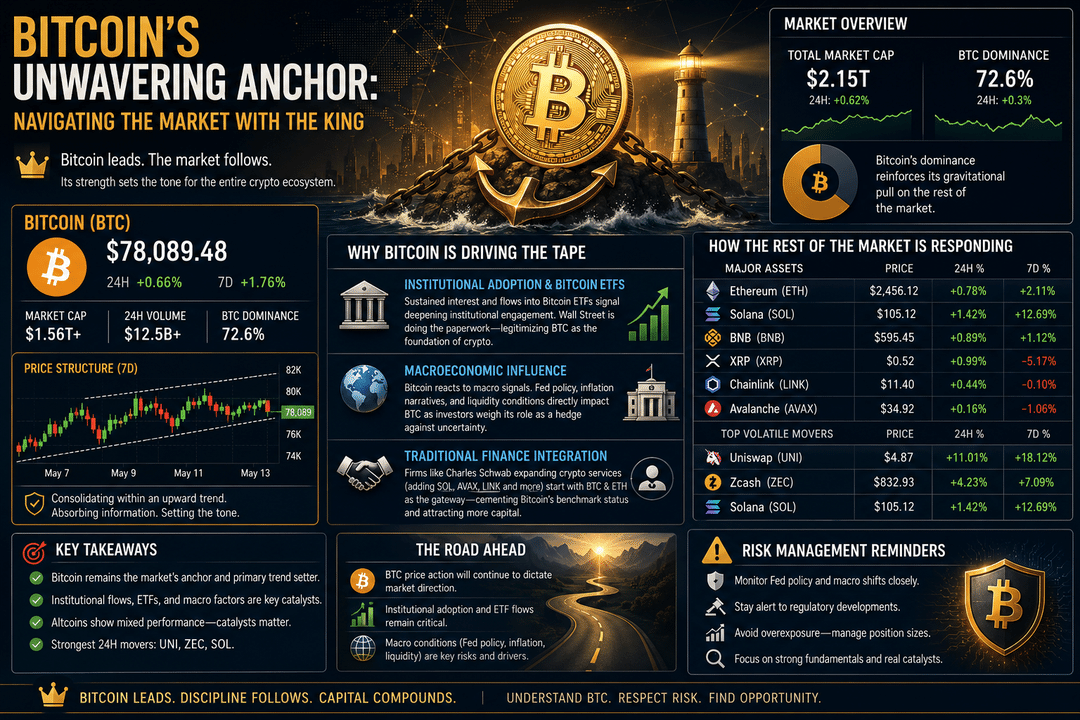
Bitcoin Price Structure
Bitcoin (BTC) is currently trading at approximately $78,089.48, reflecting a 24-hour gain of 0.66% and a 7-day increase of 1.76%. This price action places Bitcoin firmly in a consolidating yet upward-biased trend, maintaining its position as the undisputed market leader with a market capitalization exceeding $1.56 trillion. Its 24-hour trading volume stands at over $12.5 billion, indicating sustained investor interest and liquidity.
Observed facts indicate that Bitcoin's recent movements, while not characterized by explosive surges, have been instrumental in establishing a positive, albeit cautious, sentiment across the wider crypto ecosystem. Its sheer scale and market dominance mean that even minor shifts in BTC's valuation can have ripple effects throughout the altcoin landscape. The current price structure suggests a period where Bitcoin is absorbing market-moving information and setting the foundational tone, rather than experiencing extreme volatility. This relative stability in Bitcoin's price, following earlier rallies, positions it as a key indicator for overall market health and direction.
Why Bitcoin Is Driving The Tape
Bitcoin's influence on the market is not solely a function of its size but is deeply intertwined with significant institutional and macroeconomic developments. Recent news flow highlights several key catalysts that are reinforcing Bitcoin's role as the market's north star.
One primary driver is the ongoing institutional adoption and regulatory landscape surrounding Bitcoin Exchange-Traded Funds (ETFs). While the headlines also touch upon Ethereum ETFs, which recently saw significant inflows, the foundational approval and sustained interest in Bitcoin ETFs continue to shape institutional engagement with the crypto space. Reports like "Crypto Biz: Bitcoin pumps, Wall Street does the paperwork" suggest that traditional finance is increasingly integrating Bitcoin, with the necessary compliance and infrastructure being developed. This "paperwork" signifies a deepening legitimization that primarily benefits Bitcoin as the most established crypto asset.
Furthermore, macroeconomic factors continue to play a crucial role. Bitcoin's price movements are sensitive to global economic indicators and central bank policies. A recent dip in Bitcoin to $78.4K was observed as Federal Reserve official Kevin Warsh downplayed softer inflation prints. This illustrates how macro narratives, particularly those concerning inflation and monetary policy, directly impact Bitcoin's valuation, as investors weigh its potential as a hedge against traditional financial uncertainties. The Fed's stance on inflation, therefore, remains a critical external factor influencing Bitcoin's short-term trajectory.
Lastly, the expansion of crypto trading services by traditional financial giants like Charles Schwab, which is reportedly expanding beyond Bitcoin and Ethereum to include other assets, still positions Bitcoin as the entry point and benchmark. The very act of expanding beyond BTC and ETH implicitly acknowledges their foundational status and the initial demand they generated within these platforms. These developments collectively underscore that Bitcoin is not just moving on its own accord but is actively shaping the narrative and attracting capital that, in turn, influences the entire digital asset market.
How The Rest Of The Market Is Responding
The broader cryptocurrency market is demonstrating a mixed but generally responsive posture to Bitcoin's lead. While Bitcoin's 24-hour and 7-day gains have been modest, several altcoins are exhibiting more pronounced movements, either confirming the positive bias or, in some cases, showing independent strength driven by specific catalysts. The overall market overview indicates a mildly positive short-term bias across the selected asset basket.
Ethereum (ETH), the second-largest cryptocurrency, largely mirrors Bitcoin's trajectory with a 24-hour increase of 0.78% and a 7-day gain of 2.11%, trading around $2,456.12. This alignment is expected, given ETH's deep correlation with BTC. News of Ethereum ETFs almost matching Bitcoin's haul in daily inflows suggests a strong institutional interest that, while beneficial for ETH, also highlights the benchmark set by Bitcoin's ETF performance.
Among the priority assets, Solana (SOL) stands out with a 24-hour gain of 1.42% and a significant 7-day increase of 12.69%, reaching $105.12. This robust performance appears to be fueled by specific protocol developments. Solana validators recently approved a "Double Disinflation" proposal to accelerate SOL disinflation, doubling the annual rate from 15% to 30%. This supply-side adjustment is a strong bullish catalyst for SOL. Additionally, Charles Schwab's plan to add Solana, Avalanche, and Chainlink to its crypto platform provides further institutional validation and potential for increased liquidity.
Chainlink (LINK) is showing more subdued activity, with a 24-hour change of 0.44% and a slight 7-day decline of -0.10%, priced at $11.40. Despite being named in the Charles Schwab expansion news, its price action has not yet reflected a significant uplift, suggesting that broader market sentiment or specific project-related news is having a greater immediate impact on other assets.
Looking at the top volatile assets, Uniswap (UNI) is a notable outperformer, surging 11.01% in 24 hours and 18.12% over seven days, trading at $4.87. Zcash (ZEC) also saw a strong 24-hour move of 4.23% and a 7-day gain of 7.09%, reaching $832.93. These movements, while significant, appear to be more asset-specific rather than direct reflections of Bitcoin's more measured pace, indicating pockets of independent momentum within the altcoin space.
Other major assets like BNB saw a modest 0.89% 24-hour increase and 1.12% 7-day gain, while XRP experienced a 0.99% 24-hour rise but a -5.17% decline over seven days, despite news of an XRP treasury company moving closer to a Nasdaq listing. Avalanche (AVAX) showed minimal movement, up 0.16% in 24 hours and down -1.06% over seven days.
In summary, while Bitcoin provides a foundational stability and direction, the altcoin market's response is varied. Some assets, particularly those with strong fundamental catalysts or significant news, are showing independent strength, while others are either tracking Bitcoin's modest gains or lagging due to their own dynamics. The derived insights confirm that the strongest 24-hour moves are concentrated in UNI, ZEC, and SOL, underscoring that while BTC leads, selected altcoins can carve out their own narratives.
Conclusion and Risk Management
Bitcoin's current position as the market's leading indicator remains firmly established. Its price structure, characterized by consolidation within an upward trend, combined with significant institutional interest and sensitivity to macroeconomic factors, dictates the overall sentiment. While the market exhibits a mildly positive short-term bias, this optimism is largely anchored by Bitcoin's performance and the continued development of its ecosystem, particularly in the realm of traditional finance integration through ETFs.
The broader market's response is a testament to Bitcoin's influence. Ethereum largely follows suit, while certain altcoins like Solana and Uniswap demonstrate independent strength, often propelled by project-specific news or fundamental developments. However, these altcoin rallies often occur within the overarching market context set by Bitcoin, meaning sustained altcoin performance frequently relies on a stable or appreciating BTC.
For market participants, understanding Bitcoin's central role is paramount. Future market direction will likely continue to be heavily influenced by Bitcoin's ability to maintain its price structure, absorb institutional capital, and navigate the evolving macroeconomic landscape. Key risks to consider include potential shifts in Federal Reserve policy that could impact liquidity, any unexpected regulatory hurdles for digital assets, or a significant unwinding of institutional positions.
Given the observed facts, a balanced approach to risk management is advisable. While the market shows a positive bias, the presence of specific altcoin rallies suggests a need for selective engagement rather than broad-based speculation. Monitoring Bitcoin's price action and the catalysts driving it will provide the clearest signals for overall market health, while carefully evaluating individual altcoin fundamentals and news will be crucial for identifying opportunities and managing exposure in a Bitcoin-led market.
Source Data Reference
Market Snapshot Input
| Asset | Symbol | Price (USD) | 24h Change | Market Cap (USD) |
|---|---|---|---|---|
| Solana | SOL | 105.124731 | 1.42% | 61,501,753,956 |
| Bitcoin | BTC | 78,089.475169 | 0.66% | 1,567,808,249,674 |
| Ethereum | ETH | 2,456.1234 | 0.78% | 296,407,823,427 |
| Chainlink | LINK | 11.403729 | 0.44% | 8,531,129,574 |
| Avalanche | AVAX | 7.28814 | 0.16% | 3,077,601,393 |
| XRP | XRP | 1.393928 | 0.99% | 87,461,317,985 |
| Uniswap | UNI | 4.874912 | 11.01% | 3,048,494,684 |
| Rain Protocol | RAIN | 0.017541 | -0.61% | 12,440,117,751 |
| Zcash | ZEC | 832.933591 | 4.23% | 13,600,363,738 |
| BNB | BNB | 694.990927 | 0.89% | 92,546,732,031 |
Trending Headlines Input
- Crypto Biz: Bitcoin pumps, Wall Street does the paperwork
- Ethereum ETFs Take $226M in a Day, Almost Matching Bitcoin's Haul
- Solana Will Now Print Less SOL as Disinflation Vote Passes in Dramatic Fashion
- No, Ledger Wasn’t Hacked: Vulnerable Ethereum App Was Patched Before Exploit, Company Says
- Charles Schwab Expands Crypto Trading Beyond Bitcoin and Ethereum
- Bitcoin dips to $78.4K as Fed’s Warsh downplays softer inflation prints
- Solana validators approve proposal to accelerate SOL disinflation
- Charles Schwab adda Solana, Avalanche and Chainlink to nascent crypto platform
- XRP Treasury Company Gets One Step Closer to Listing on Nasdaq
- Solana Is Having Its Best Month Since 2024—With a Historic Governance Vote on Deck


