Bitcoin Price Structure
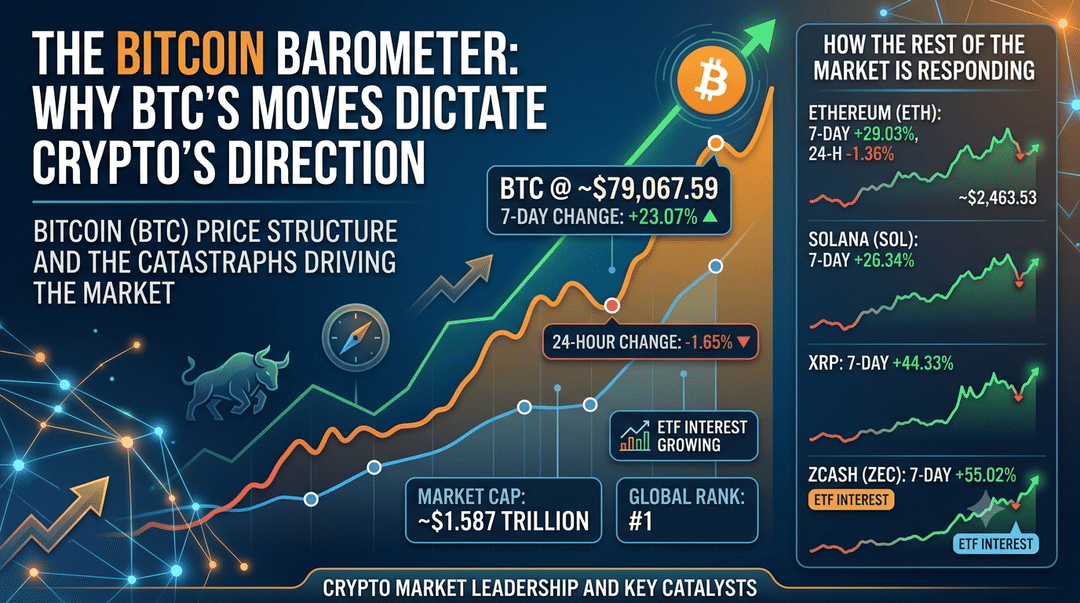
As of the latest market snapshot, Bitcoin (BTC) is trading at approximately $79,067.59. This price point reflects a 24-hour decrease of -1.65%, aligning with a mildly negative short-term bias observed across the broader market. However, a more expansive view reveals a significant rally over the past seven days, with BTC recording an impressive 23.07% increase. This strong weekly performance indicates underlying bullish momentum despite recent intraday fluctuations.
Bitcoin's market capitalization stands at approximately $1.587 trillion, cementing its position as the undisputed leader by a substantial margin. This valuation represents a significant portion of the total global crypto market cap of $2.154 trillion, illustrating Bitcoin's profound influence on the overall health and direction of the digital asset space. The asset's rank as number one globally remains unchallenged, reinforcing its role as the benchmark for the crypto economy. Recent price action saw Bitcoin briefly test the $80,000 mark, a level not seen since May, before experiencing a minor pullback. This attempt at a new psychological resistance level highlights both the upward pressure and the inherent volatility characteristic of the asset.
Why Bitcoin Is Driving The Tape
Bitcoin's current market leadership is not merely a function of its size but is deeply intertwined with several key catalysts that are shaping institutional adoption, regulatory landscapes, and macro-economic correlations.
A significant driver has been the continued institutional interest in Bitcoin exchange-traded funds (ETFs). While a recent report indicated that Bitcoin and Ethereum ETFs collectively grew by $23 billion last week, it was noted that only $2.6 billion of this constituted new money, with the majority stemming from existing assets appreciating in value. This observation suggests that while direct fresh capital inflows are present, a substantial portion of the AUM growth is a reflection of Bitcoin's price performance itself, creating a positive feedback loop.
Further bolstering the institutional narrative, Strive, a Bitcoin treasury company, announced a significant acquisition of 1,110 BTC for $81.5 million. This purchase pushed its total holdings above 21,000 BTC, demonstrating sustained corporate accumulation and confidence in Bitcoin as a strategic asset. Such large-scale institutional buying can exert considerable upward pressure on price and signals a long-term commitment from corporate entities.
The regulatory environment also continues to evolve in ways that could expand Bitcoin's reach. Thailand's Securities and Exchange Commission (SEC) has moved closer to establishing draft rules for local Bitcoin and Ether ETFs. This development, if finalized, would open new avenues for investment in Bitcoin for a broader range of investors in the region, mirroring the trend seen in other jurisdictions. While Grayscale also launched a Zcash ETF, signaling broader institutional interest in assets beyond just Bitcoin and Ethereum, the general institutionalization of crypto assets, of which Bitcoin is the primary beneficiary, remains a central theme.
On a macro level, Bitcoin has shown a notable correlation with traditional safe-haven assets. Gold, for instance, recently hit a three-month high as Bitcoin tested $80,000. This parallel movement suggests that Bitcoin is increasingly being viewed by some market participants as a digital alternative or complement to gold, particularly in an environment of a weaker dollar and falling yields. This macro alignment can attract a different class of investors, further solidifying Bitcoin's position.
Finally, Bitcoin's price surge to $80,000 was accompanied by significant market structure events, including over $220 million in crypto short liquidations within a 24-hour period. This suggests that a portion of the upward movement was fueled by a short squeeze, where bearish positions were forced to close, adding momentum to the rally. While this indicates strong buying pressure, it also introduces a degree of volatility driven by leveraged positions.
How The Rest Of The Market Is Responding
The broader cryptocurrency market is largely responsive to Bitcoin's trajectory, often mirroring its trends but with varying degrees of volatility and performance. The overall market sentiment, as indicated by the selected editorial asset basket, currently shows a mildly negative short-term bias, reflecting the recent 24-hour dip observed in Bitcoin.
Ethereum (ETH), the second-largest cryptocurrency, is trading at approximately $2,463.53. It experienced a 24-hour decline of -1.36%, a slightly less pronounced dip compared to Bitcoin. However, over the past seven days, Ethereum has outperformed Bitcoin, registering a 29.03% gain, indicating strong underlying demand and potentially independent catalysts, such as ongoing developments in its ecosystem or anticipation of future upgrades.
Among the top volatile assets, Rain Protocol (RAIN) stands out with a remarkable 24-hour increase of 21.84%, contrasting sharply with the general market downturn. Its 7-day performance is also robust at 36.96%. This suggests specific, perhaps project-centric, drivers for RAIN that defy the broader market's short-term movements. Zcash (ZEC) also exhibited significant volatility, dropping -7.99% in 24 hours but boasting an impressive 55.02% gain over seven days. The news of Grayscale launching a Zcash ETF likely contributed to its substantial weekly rally, even as it experiences short-term profit-taking or market adjustments.
Other major altcoins like Solana (SOL) and XRP also registered 24-hour declines of -4.01% and -4.61% respectively, aligning with Bitcoin's short-term pullback. However, similar to ETH and ZEC, both SOL (26.34%) and XRP (44.33%) have seen substantial gains over the past seven days, demonstrating that while they react to Bitcoin's immediate price swings, they have also participated strongly in the broader weekly rally led by BTC. Meme coins like Pepe (PEPE) and Pump.fun (PUMP) also saw 24-hour declines of -8.08% and -3.51% respectively, but maintained strong 7-day gains, indicating their susceptibility to short-term market corrections while riding the overall bullish wave.
The observation that the strongest 24-hour moves are concentrated in assets like RAIN, PEPE, and ZEC highlights that while Bitcoin sets the overall market tone, certain altcoins can experience significant independent volatility, often driven by specific news or speculative interest. However, the general trend remains: when Bitcoin corrects, many altcoins tend to follow, even if their percentage moves differ.
Conclusion and Risk Management
Bitcoin's current market position as the leading indicator is undeniable. Its price structure, characterized by strong weekly gains despite recent short-term pullbacks, dictates the rhythm for the broader cryptocurrency market. Key catalysts, including sustained institutional ETF interest, significant corporate acquisitions, and positive regulatory advancements, continue to solidify Bitcoin's foundational role. Furthermore, its increasing correlation with traditional assets like gold suggests a maturing market perception.
While the overall market shows a mildly negative short-term bias, this appears to be a reaction to Bitcoin's minor consolidation after a strong rally. Altcoins, while exhibiting varying degrees of volatility and sometimes outperforming BTC on longer timeframes, generally track Bitcoin's direction. The expansion of institutional products to assets like Zcash underscores a growing confidence in the wider crypto ecosystem, but this trend often emanates from the precedent set by Bitcoin.
For market participants, understanding Bitcoin's price structure and the catalysts driving it is paramount. The current environment suggests continued institutional engagement and potential for further price discovery, particularly if Bitcoin can sustain levels above recent psychological thresholds. However, it is crucial to manage expectations and risks. The market remains inherently volatile, and short-term corrections, as evidenced by the recent 24-hour performance, are a natural part of any rally. Factors such as shifts in macro-economic sentiment, regulatory changes, or unexpected security incidents could introduce significant volatility. Investors should remain vigilant, conduct thorough research, and consider the dynamic nature of the crypto market when making decisions.
Source Data Reference
Market Snapshot Input
| Asset | Symbol | Price (USD) | 24h Change | Market Cap (USD) |
|---|---|---|---|---|
| Bitcoin | BTC | 79,067.585146 | -1.65% | 1,587,302,487,512 |
| Ethereum | ETH | 2,463.530731 | -1.36% | 296,673,930,320 |
| Rain Protocol | RAIN | 0.017902 | 21.84% | 12,432,753,085 |
| Zcash | ZEC | 781.978073 | -7.99% | 12,768,348,319 |
| Ethena | ENA | 0.143943 | -6.80% | 1,414,685,874 |
| Solana | SOL | 97.202335 | -4.01% | 56,705,456,296 |
| XRP | XRP | 1.442116 | -4.61% | 90,484,874,019 |
| Pepe | PEPE | 0.000004 | -8.08% | 1,622,002,042 |
| Pump.fun | PUMP | 0.004691 | -3.51% | 1,826,882,304 |
| BNB | BNB | 697.320777 | -2.50% | 92,859,351,646 |
Trending Headlines Input
- Grayscale Launches Zcash ETF Following Critical Privacy Flaw That Rocked the Cryptocurrency
- Thailand moves closer to Bitcoin, Ether ETFs with draft rules
- Bitcoin, Ethereum ETFs Grew $23 Billion Last Week—Only $2.6 Billion Was New Money
- Strive buys 1,110 Bitcoin for $81.5M, holdings top 21K BTC; ASST shares surge 11%
- Coldcard Adds New Security Measures After $130 Million Bitcoin Exploit
- Galaxy puts Coldcard hack losses at 1,789 BTC, with 87% unmoved
- Solana transactions hit record 4.2B as SOL rallies 40%
- Gold Hits Three-Month High as Bitcoin Tests $80,000
- Hugging Face Explores $13 Billion Sale a Month After a Rogue OpenAI Agent Hacked It
- Bitcoin price hits $80K as 24-hour crypto short liquidations pass $220M