Risk Tone Across The Market
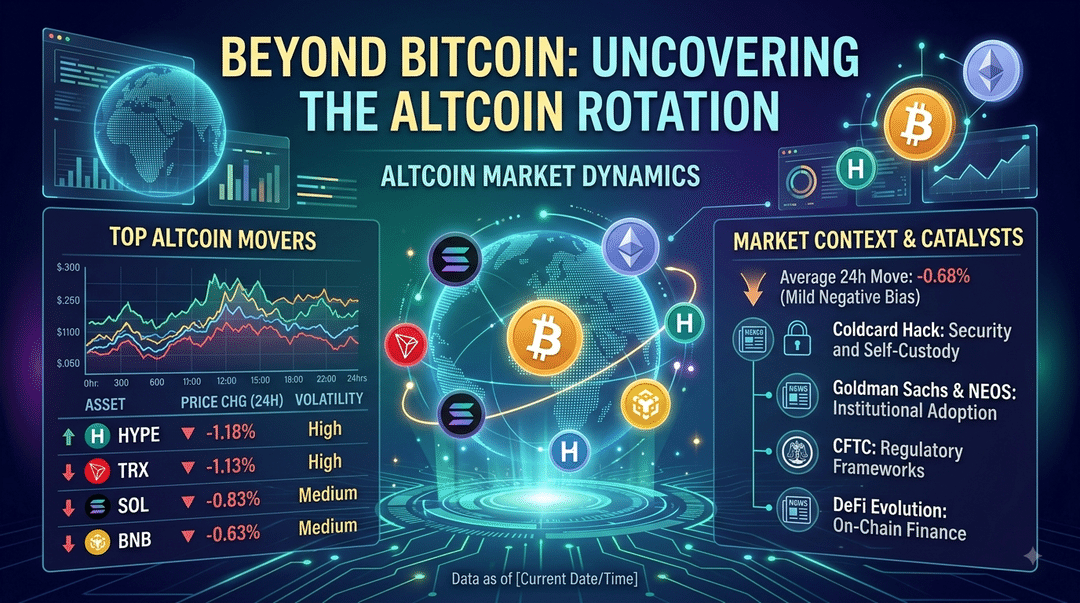
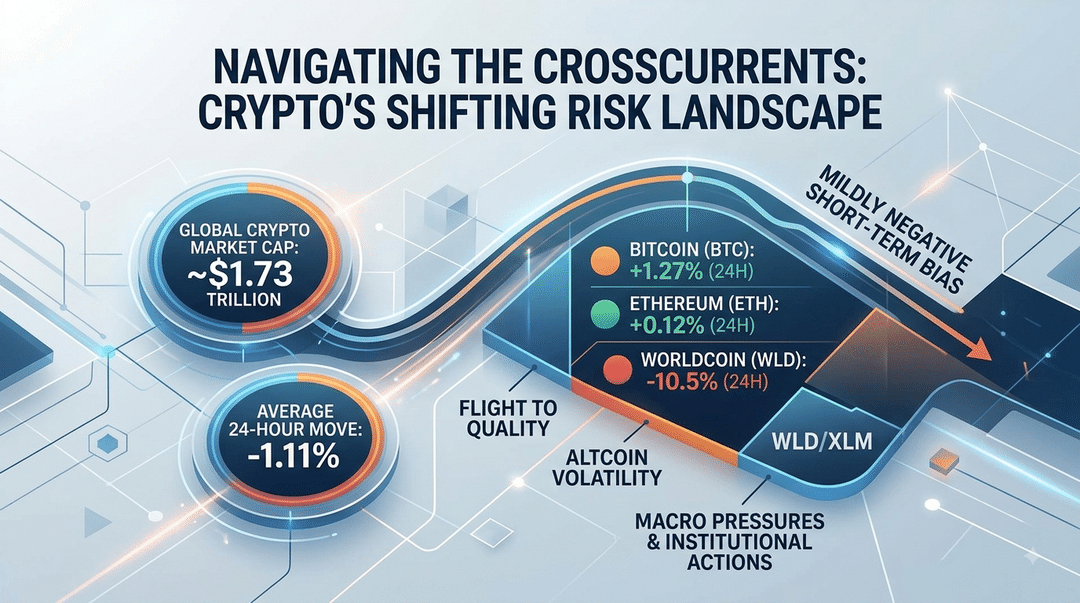
The overall risk tone across the crypto market can be best described as mixed, leaning towards cautious. Our editorial asset basket analysis confirms a mildly negative short-term bias, reflecting a market that is not uniformly risk-on or risk-off, but rather selective in its movements. Bitcoin (BTC) has demonstrated a degree of resilience, posting a 24-hour gain of 1.27% and remaining relatively stable over the 7-day period with a slight dip of -0.16%. This suggests a potential flight to quality within the crypto ecosystem, where the largest asset may be viewed as a more stable store of value amidst uncertainty.
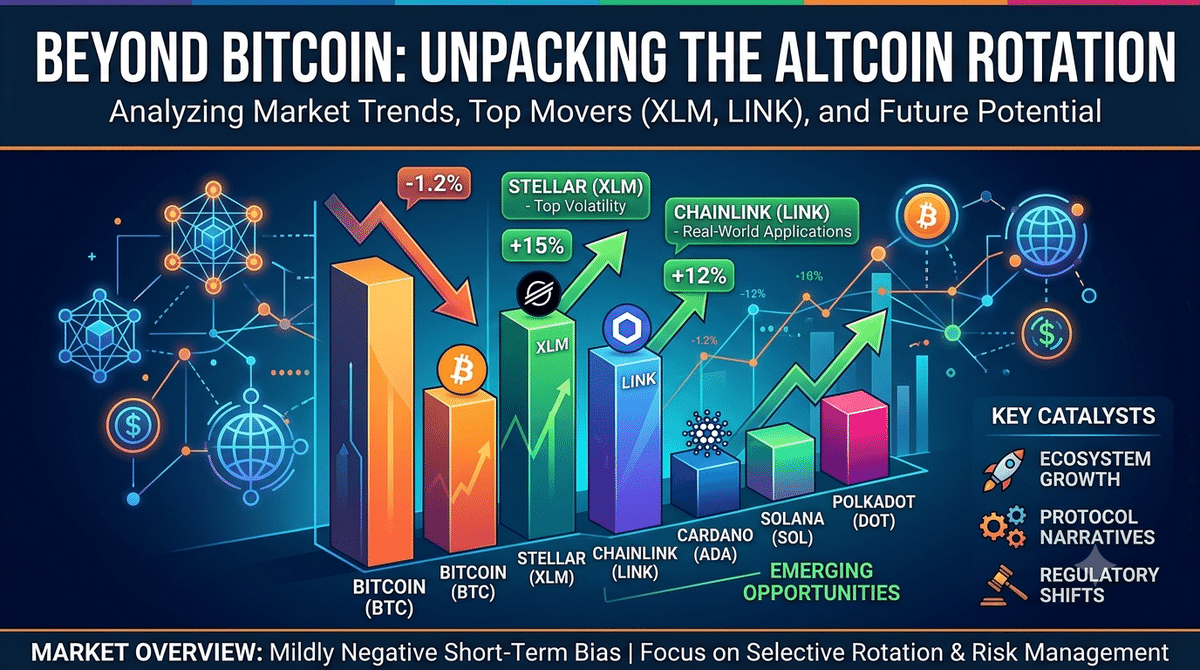
In contrast, several altcoins have experienced more pronounced downward movements. Worldcoin (WLD), for instance, saw a significant 24-hour decline of -10.5%, making it one of the most volatile assets alongside Stellar (XLM) which dropped by -2.48%. Other major altcoins like XRP and Cardano (ADA) also registered minor 24-hour losses of -0.22% and -0.25% respectively, with ADA notably down -8.12% over seven days. Ethereum (ETH) has maintained relative stability, with a modest 0.12% gain in 24 hours and a 0.56% increase over seven days. This divergence highlights a market where capital appears to be consolidating towards perceived safer assets, while more speculative or smaller-cap tokens bear the brunt of reduced risk appetite.
Macro and Flow Signals
Current market sentiment is significantly shaped by a series of macro, institutional, and policy-related headlines, offering a complex picture for investor positioning.
On the institutional front, a notable development involves Paul Tudor Jones' firm, which has reportedly increased its stake in BlackRock's iShares Bitcoin Trust (IBIT) by 18.9% in Q2, shifting from leveraged call options towards direct spot exposure. This move suggests a more conviction-based, long-term institutional interest in Bitcoin. Conversely, Strategy (MSTR), a prominent Bitcoin treasury firm, raised $334 million through stock sales but opted not to purchase additional Bitcoin, instead allocating funds to dividends, a stock buyback, and increasing its US dollar reserve. This decision by a historically aggressive Bitcoin accumulator could be interpreted as a pause in aggressive accumulation, potentially signaling a more cautious approach to capital deployment in the current environment.
Macroeconomic factors continue to exert influence, as evidenced by Bitcoin's ability to cross the $64,000 mark concurrently with gains in gold, even as US stocks showed volatility amidst fresh geopolitical rhetoric concerning US-Iran relations. This linkage underscores how broader global financial and political developments can directly impact crypto valuations, particularly for Bitcoin, which is increasingly viewed through a macro lens.
Regulatory and institutional adoption signals remain mixed but generally constructive. Bitmine, an Ethereum treasury company, continues to accumulate ETH, nearing 5% of the total supply despite significant unrealized losses, with a substantial portion staked for annual rewards. This indicates strong institutional conviction in Ethereum's long-term utility and staking economics. Furthermore, Israel's largest bank, Bank Leumi, is reportedly preparing to re-enter Bitcoin trading in early 2027, citing a softer regulatory environment, pointing to a gradual, albeit slow, integration of crypto into traditional finance.
However, security concerns have also surfaced, potentially dampening retail sentiment. A data breach affecting SafePal Bitcoin wallet users, exposing personal information of nearly 40,000 customers, and a reported tax data leak in France impacting Bitcoin holders, serve as reminders of ongoing security risks in the digital asset space. While these events haven't caused a widespread market panic, they add a layer of caution for investors regarding the security of their holdings and personal data.
Lastly, technical developments within the Ethereum ecosystem, such as the Ethereum Foundation warning about potential tool compatibility issues with the upcoming Glamsterdam upgrade, represent minor headwinds. While important for developers, such protocol-level concerns typically have a limited impact on broader market sentiment unless they signal fundamental instability.
What Sentiment Is Doing To Major Coins
The current market sentiment, characterized by cautiousness and a sensitivity to macro headlines, is manifesting differently across major cryptocurrencies.
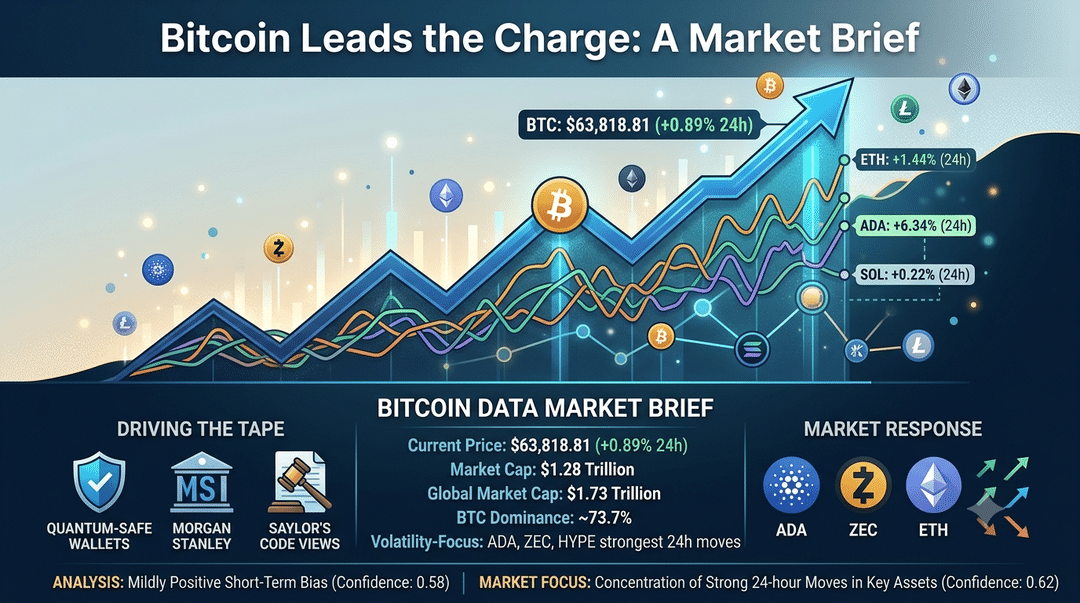
Bitcoin (BTC), currently trading around $64,083, has shown relative strength with a 1.27% gain over 24 hours. Its ability to maintain this level and even achieve gains while some altcoins fall suggests that investors are treating it as a primary store of value within the crypto space. The mixed institutional signals—Paul Tudor Jones' firm increasing direct exposure versus Strategy pausing Bitcoin purchases—indicate a tug-of-war between long-term conviction and short-term strategic adjustments. Despite security-related headlines, Bitcoin's price action appears to be more influenced by its macro correlation and institutional accumulation trends.
Ethereum (ETH), priced near $1,893, has demonstrated stability, with a slight 0.12% increase in 24 hours. This resilience is likely bolstered by strong institutional backing, as evidenced by Bitmine's continued accumulation and staking of a significant portion of ETH supply. The long-term conviction from such large holders appears to be offsetting any minor concerns arising from protocol upgrade warnings. Ethereum's ecosystem strength and staking yield narrative continue to attract dedicated institutional capital.
XRP, trading at approximately $0.99, has seen a minor 24-hour decline of -0.22% and a -0.86% drop over seven days. Reports indicate that XRP is "clinging to the dollar price line" it has defended, but technical charts are "flashing a warning sign." This suggests that while it holds a critical psychological level, underlying sentiment is weakening, and it remains vulnerable to broader risk-off movements. Its performance underscores how assets without strong, recent positive catalysts can struggle under a cautious market tone.
Worldcoin (WLD), priced around $0.32, has experienced a significant 24-hour drop of -10.5%. As one of the most volatile assets, its sharp decline is a clear indicator of reduced risk appetite impacting more speculative tokens. Without specific positive news to counter the broader cautious sentiment, WLD and similar assets are more susceptible to profit-taking and deleveraging.
Other assets like Stellar (XLM), down -2.48% in 24 hours, and Cardano (ADA), down -8.12% over seven days, further illustrate the altcoin sector's vulnerability to the current market mood. Conversely, Chainlink (LINK) and Hyperliquid (HYPE) have posted notable 7-day gains of 9.35% and 7.70% respectively, suggesting that some altcoins may be experiencing isolated positive momentum or delayed reactions to specific developments not immediately apparent in the broader market narrative.
Conclusion and Risk Management
The current cryptocurrency market environment is defined by a delicate balance of forces, where broader risk sentiment and macro-level signals are exerting a stronger influence on price action than individual asset-specific news. The observed mildly negative short-term bias across the editorial asset basket reflects this cautious positioning.
We are seeing a clear bifurcation in sentiment: Bitcoin continues to demonstrate relative resilience, potentially acting as a safe haven within the crypto space, supported by some institutional accumulation. Ethereum also shows stability, underpinned by strong long-term institutional conviction in its ecosystem. However, many altcoins, particularly those with higher beta or lacking strong independent catalysts, are struggling under the weight of reduced risk appetite, as exemplified by the significant corrections in assets like Worldcoin and Stellar.
Investors should acknowledge that short-term crypto direction is being shaped less by one isolated coin and more by broader risk sentiment and cross-market catalysts, including institutional flow, macroeconomic indicators, and geopolitical developments. Separating sentiment signals from confirmed trend continuation is crucial. While institutional interest remains a long-term positive, the nuanced actions of major players like Strategy highlight the importance of careful risk assessment.
In this environment, risk management strategies could include a focus on asset quality, closely monitoring macro indicators, and being aware of the heightened sensitivity of altcoins to periods of market caution. Sentiment, while a powerful short-term driver, can shift rapidly, underscoring the need for adaptable strategies and a balanced perspective on market movements.
Source Data Reference
Market Snapshot Input
| Asset | Symbol | Price (USD) | 24h Change | Market Cap (USD) |
|---|---|---|---|---|
| Bitcoin | BTC | 64,083.899363 | 1.27% | 1,286,287,029,473 |
| Ethereum | ETH | 1,893.920871 | 0.12% | 228,077,913,278 |
| XRP | XRP | 0.993934 | -0.22% | 62,296,739,135 |
| Worldcoin | WLD | 0.321208 | -10.50% | 1,157,079,341 |
| Chainlink | LINK | 9.448303 | 0.21% | 7,068,275,512 |
| Stellar | XLM | 0.153457 | -2.48% | 5,300,791,786 |
| Hyperliquid | HYPE | 59.420224 | 0.29% | 13,217,774,221 |
| Cardano | ADA | 0.172576 | -0.25% | 6,699,993,138 |
| Solana | SOL | 75.841087 | 0.77% | 44,207,432,083 |
| BNB | BNB | 601.575327 | -0.35% | 80,109,322,190 |
Trending Headlines Input
- Paul Tudor Jones' Firm Buys Back Into BlackRock Bitcoin ETF After a Year of Selling
- Strategy Leaves Bitcoin Untouched, Raises $334M Selling MSTR Stock
- Strategy raises $334M through stock sales but buys no Bitcoin
- Bitmine nears 5% of Ethereum supply despite $8.4B in unrealized losses
- Bitcoin hits $64K as gold gains while oil shakes off Trump Oman threat
- SafePal Bitcoin Wallet Data Breach Stokes Fears of Physical Attacks
- Israel’s Largest Bank Will Give Bitcoin Trading Another Try
- France Tax Data Leak Could Fuel Scams, Attacks Targeting Bitcoin Holders
- XRP Price Holds to Near Two-Year Streak, But Charts Flash a Warning Sign
- Ethereum Foundation warns some tools may break with Glamsterdam upgrade