The Core Narrative
The prevailing narrative in the crypto market today is unequivocally centered on the accelerating institutional adoption of digital assets, particularly through regulated investment vehicles like exchange-traded funds (ETFs). This storyline is not merely about volume or price action, but a fundamental shift in how traditional finance (TradFi) views and integrates cryptocurrencies into broader portfolios. A concentrated cluster of recent headlines underscores this trend, painting a picture of a market maturing under the influence of major financial players.
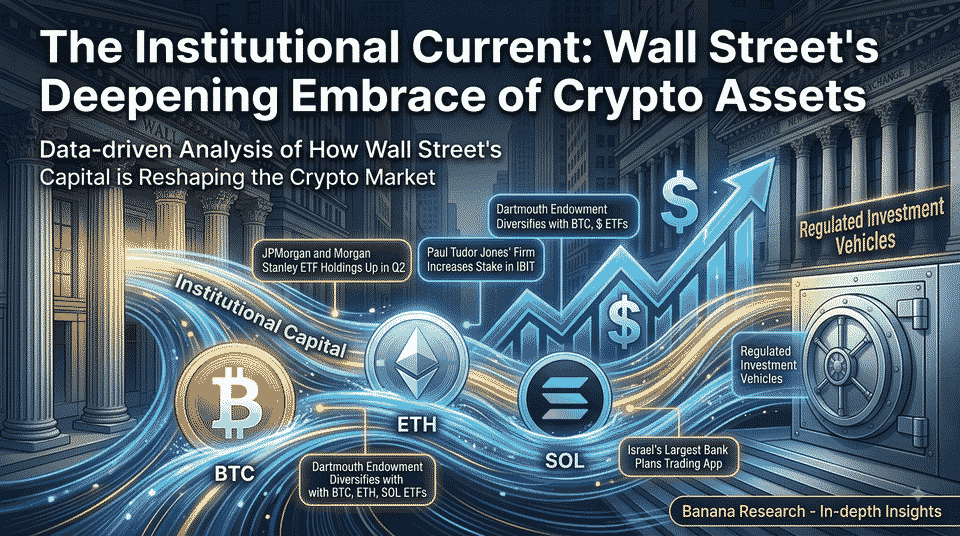
Observed facts indicate a significant uptick in institutional engagement. Paul Tudor Jones' firm, a prominent macro fund, has reportedly bought back into the BlackRock Bitcoin ETF (IBIT) after a year of selling, increasing its stake by 18.9% to 688,529 shares worth $22.9 million in Q2. This move is notable for its shift from leveraged bets to direct spot exposure, suggesting a more conservative, long-term conviction. Similarly, Morgan Stanley’s reported IBIT holdings rose by 23% in Q2, alongside increased positions in Ether ETFs and several crypto-linked stocks. JPMorgan also reported a 25% increase in its Bitcoin ETF position and more than quadrupled its Ether ETF holdings in the second quarter.
Beyond direct ETF investments, the narrative extends to broader integration. Dartmouth endowment's crypto exposure, while seeing a $2 million drop in value amid falling prices, still maintains holdings in the Bitwise Solana staking ETF, Grayscale Ethereum staking ETF, and BlackRock’s iShares Bitcoin ETF, totaling approximately $12 million. This demonstrates continued, diversified institutional interest across key assets. Furthermore, Israel’s largest bank tapping Galaxy to offer Bitcoin, Ether, and Solana trading directly through its investment app by early 2027 signals a move towards mainstream accessibility and legitimacy.
These developments collectively suggest a deepening institutional footprint, moving beyond speculative interest to strategic allocation and product integration. While some analysts interpret these moves as risk management rather than purely bullish bets, the consistent pattern of major financial entities increasing their exposure to Bitcoin and Ethereum, and increasingly Solana, via regulated products, highlights a structural shift. This institutional current is arguably the most concentrated storyline, suggesting that market movements are increasingly influenced by the long-term positioning of large-scale capital.
Which Coins Or Segments Are Most Exposed
Given the dominant narrative of institutional adoption, Bitcoin (BTC), Ethereum (ETH), and Solana (SOL) emerge as the assets most directly exposed and, by extension, potentially benefiting from this trend. Their consistent mention across multiple institutional news signals underscores their pivotal role in the institutionalization of crypto.
Bitcoin (BTC) stands at the forefront. Its status as the primary asset for institutional ETF products, as evidenced by holdings in BlackRock's iShares Bitcoin ETF by firms like Paul Tudor Jones, Morgan Stanley, and JPMorgan, positions it as the flagship for institutional entry. The continued accumulation, even amidst market fluctuations, suggests a foundational belief in Bitcoin as a store of value and a legitimate asset class.
Ethereum (ETH) closely follows BTC, with institutions increasingly diversifying their crypto exposure. Morgan Stanley and JPMorgan both boosted their Ether ETF positions in Q2, indicating growing confidence in Ethereum's ecosystem and its potential beyond just a speculative asset. The mention of the Grayscale Ethereum staking ETF in Dartmouth's endowment further solidifies ETH's position as a key institutional asset.
Solana (SOL) is also gaining traction within institutional circles. Dartmouth's endowment includes the Bitwise Solana staking ETF, and Israel's largest bank plans to offer Solana trading alongside Bitcoin and Ethereum. This indicates that institutions are looking beyond the top two to high-performance blockchain ecosystems, recognizing their potential for growth and utility.
While the research packet also includes Chainlink (LINK) as a priority asset, and it shows a notable 7-day price increase of 14.84%, there are no direct news signals linking LINK to the specific institutional adoption narrative dominating headlines. Its strong performance might be attributed to other factors, such as protocol-specific developments or broader DeFi momentum, rather than direct institutional ETF inflows. Other assets like Hyperliquid (HYPE), Rain Protocol (RAIN), and Zcash (ZEC) exhibit higher 24-hour volatility but are not directly tied to the institutional narrative in the provided context. Cardano (ADA) shows a negative 7-day change of -11.26%, but again, no direct links to the primary institutional narrative are evident.
Therefore, the segment most exposed to this institutional current is clearly the large-cap, established cryptocurrencies that have secured regulated investment pathways, with BTC, ETH, and SOL leading the charge.
How The Market Is Pricing It
The market's reaction to this deepening institutional involvement appears to be one of measured absorption rather than explosive immediate price surges. While the overarching narrative is positive for the long-term legitimacy and capital inflow into crypto, the short-term price action reflects a more complex interplay of factors.
Looking at the priority assets, Bitcoin (BTC) is currently priced at $63,565.63, showing a modest 0.90% increase over the last 24 hours, but a 1.92% decrease over the past seven days. Ethereum (ETH) stands at $1,902.22, with a 1.25% gain in 24 hours and a slight 0.26% decrease over seven days. Solana (SOL) is at $75.52, experiencing a 0.36% increase in 24 hours and a 1.50% drop over the week.
The observed facts indicate that despite consistent news of institutional accumulation, the immediate price movements for these major assets are relatively subdued. This suggests that the market may be interpreting these institutional moves as a slow, steady accumulation phase rather than a catalyst for rapid appreciation. The "mixed" sentiment assigned to many of the institutional news signals further supports this, indicating that while the news is significant, it's being digested with nuance.
In contrast, some of the top volatile assets, not directly linked to the institutional ETF narrative, are showing stronger short-term gains. Rain Protocol (RAIN) leads with a 5.51% 24-hour increase, followed by Zcash (ZEC) at 5.12%, and Hyperliquid (HYPE) at 3.91%. These movements, identified as the strongest 24-hour moves in the market, suggest that specific protocol developments or niche market dynamics might be driving localized volatility, independent of the broader institutional narrative affecting BTC, ETH, and SOL.
The derived insights indicate that the selected editorial asset basket shows a "mildly positive short-term bias." This aligns with the generally positive, albeit not explosive, 24-hour performance of many assets, including the institutional favorites. However, the slightly negative 7-day performance for BTC, ETH, and SOL suggests that the institutional news, while foundational, is not currently overcoming broader market pressures or profit-taking cycles. The market appears to be pricing in the long-term implications of institutional adoption, leading to a more stable floor rather than immediate parabolic growth, while other segments may experience higher, more speculative volatility.
Conclusion and Risk Management
The current crypto market narrative is firmly anchored to the theme of institutional adoption, with major financial players steadily increasing their exposure to Bitcoin, Ethereum, and Solana through regulated investment vehicles. This trend, evidenced by the Q2 filings of firms like Paul Tudor Jones, Morgan Stanley, and JPMorgan, and the integration efforts by institutions such as Israel's largest bank, suggests a fundamental re-rating of digital assets within traditional finance. This is a long-term structural shift, implying a gradual maturation of the market rather than immediate, dramatic price action.
For market participants, understanding this narrative's implications is key to risk management. The observed facts indicate that while institutional interest is robust, it does not necessarily translate into instant price pumps for the underlying assets. Bitcoin, Ethereum, and Solana are experiencing relatively subdued short-term price movements despite the positive institutional news, indicating a period of quiet accumulation and integration.
Confirmation of this narrative's strengthening would come from continued, verifiable increases in institutional holdings, expansion of regulated crypto products (e.g., more spot ETFs for other assets, institutional custody solutions), and clearer regulatory frameworks that provide certainty for large-scale investors. Further integration by mainstream financial services, such as direct trading offerings from major banks, would also reinforce this trend.
Conversely, the narrative could weaken if institutions begin to divest significantly from these positions, if regulatory bodies introduce highly restrictive measures that deter investment, or if major security breaches undermine institutional confidence in the underlying assets or their custodial solutions. While recent headlines have highlighted security concerns for Bitcoin holders (e.g., SafePal data breach, France tax data leak), these have not yet demonstrably deterred the broader institutional trend.
In summary, the market is pricing in a future where crypto assets, particularly BTC, ETH, and SOL, are increasingly legitimate components of institutional portfolios. Risk management in this environment involves recognizing the long-term implications of this trend while acknowledging that short-term price action may not always directly reflect the underlying institutional momentum. Instead, it reflects a nuanced process of integration and market digestion.
Source Data Reference
Market Snapshot Input
| Asset | Symbol | Price (USD) | 24h Change | Market Cap (USD) |
|---|---|---|---|---|
| Bitcoin | BTC | 63,565.629415 | 0.90% | 1,275,857,912,197 |
| Ethereum | ETH | 1,902.221832 | 1.25% | 229,077,567,437 |
| Solana | SOL | 75.524435 | 0.36% | 44,023,140,182 |
| Chainlink | LINK | 9.526464 | 1.96% | 7,126,747,229 |
| Hyperliquid | HYPE | 59.454735 | 3.91% | 13,225,451,002 |
| Rain Protocol | RAIN | 0.013354 | 5.51% | 9,274,267,464 |
| Zcash | ZEC | 509.995452 | 5.12% | 8,327,342,930 |
| Cardano | ADA | 0.174254 | -1.11% | 6,763,433,654 |
| Monero | XMR | 415.841401 | 1.36% | 7,814,681,655 |
| BNB | BNB | 604.24589 | -0.58% | 80,464,950,188 |
Trending Headlines Input
- Dartmouth endowment’s crypto exposure drops by $2M amid falling prices
- Paul Tudor Jones' Firm Buys Back Into BlackRock Bitcoin ETF After a Year of Selling
- Morgan Stanley’s BlackRock Bitcoin ETF holdings rise 23% in Q2
- JPMorgan boosts Bitcoin, Ether ETF positions in Q2 filing
- Bitcoin Companies Want Help From AI Labs to Guard Against Hackers
- SafePal Bitcoin Wallet Data Breach Stokes Fears of Physical Attacks
- France Tax Data Leak Could Fuel Scams, Attacks Targeting Bitcoin Holders
- Bitcoin price drops to $62.5K as trader warns weekly close may spark more losses
- Israel’s largest bank taps Galaxy to offer Bitcoin, Ether, Solana trading
- Ethereum devs to narrow 66 proposals tied to Hegotá upgrade