Bitcoin Price Structure
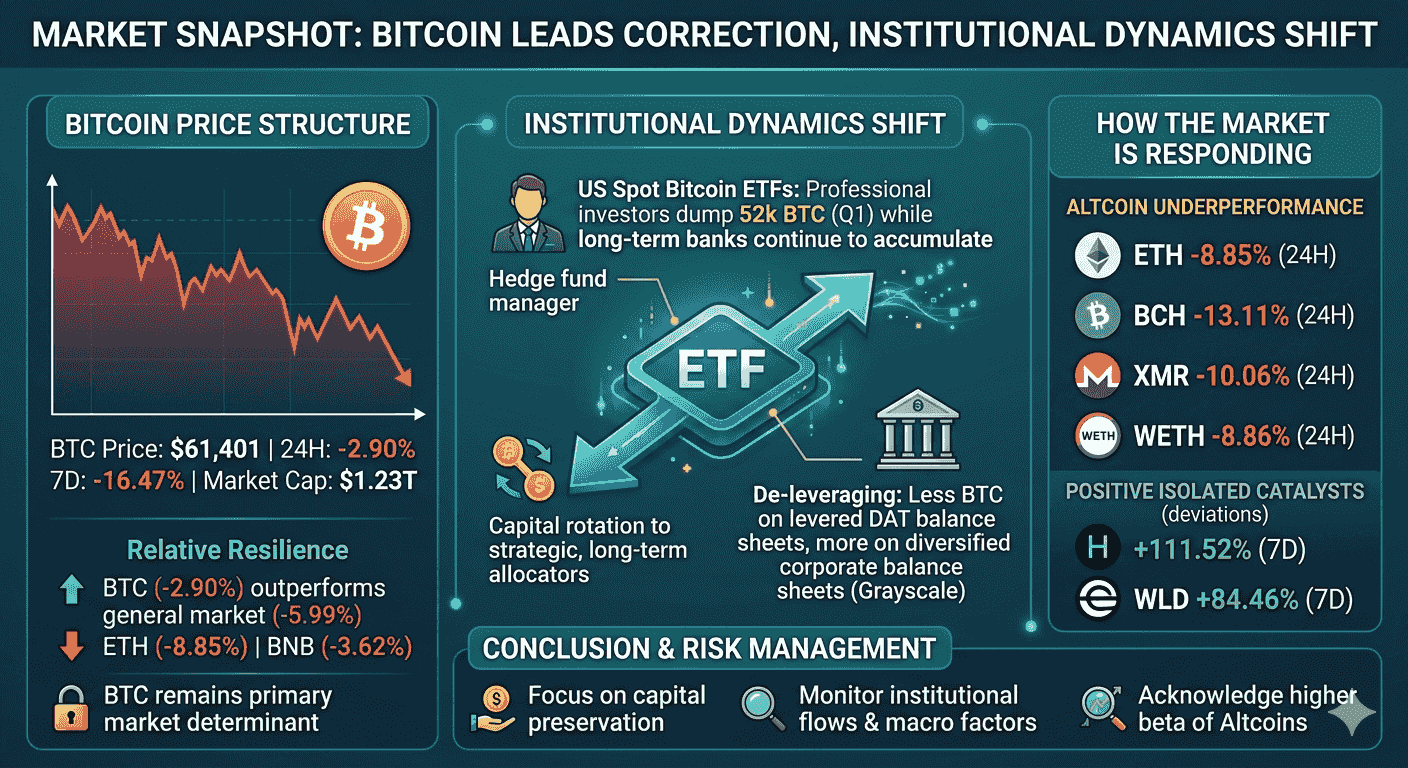
Bitcoin currently trades at approximately $61,401, reflecting a 24-hour decline of around 2.90%. Over the past seven days, the leading cryptocurrency has experienced a more significant correction, falling by approximately 16.47%. Despite these movements, Bitcoin maintains its position as the largest digital asset by market capitalization, standing at roughly $1.23 trillion, within a global market capitalization of $1.53 trillion.
When viewed against the broader market, Bitcoin's 24-hour performance indicates a degree of relative resilience. The average 24-hour move across the top assets in the market snapshot stands at a decline of approximately 5.99%. Bitcoin's more contained drop of 2.90% suggests it is outperforming the general market during this corrective phase.
In contrast, Ethereum (ETH), the second-largest cryptocurrency, has seen a more pronounced decline, trading around $1,597 after an 8.85% drop over the last 24 hours and a 20.73% fall over seven days. Other significant assets like BNB also registered a 3.62% 24-hour decrease. This divergence in performance, with Bitcoin showing less severe losses than many of its peers, highlights its current role as a relative anchor in a volatile environment. Notably, some priority assets like Humanity (H) and Worldcoin (WLD) have demonstrated strong weekly gains of 111.52% and 84.46% respectively, though their 24-hour movements are mixed, with H up 4.58% and WLD down 1.74%, suggesting more localized catalysts for their individual strength rather than broad market momentum.
Why Bitcoin Is Driving The Tape
The current narrative surrounding Bitcoin is heavily influenced by evolving institutional dynamics and a recalibration of market demand. Recent headlines underscore a significant shift in ownership within Bitcoin ETFs and a re-evaluation of leveraged models, all of which contribute to Bitcoin's current price action and market leadership.
One key development is the reported shift in US spot Bitcoin ETF ownership during the recent market downturn. Filings indicate that professional investors collectively dumped approximately 52,000 BTC worth of ETFs in Q1. This observed outflow from certain segments, specifically hedge funds, has been a contributing factor to short-term selling pressure. However, this divestment was met with continued accumulation from other long-term allocators, including banks, which continued to build exposure to Bitcoin. This suggests a rotation of capital and a maturing institutional landscape, where short-term speculative interest may be giving way to more strategic, long-term allocations.
Further contextualizing this institutional re-evaluation, Grayscale's head of research, Zach Pandl, commented on the "stress test" faced by Strategy's leveraged Bitcoin model. The observation that "less Bitcoin on levered DAT balance sheets and more on diversified corporate balance sheets will be a positive" points to a broader market desire for more sustainable, less speculative forms of institutional engagement with Bitcoin. This shift away from highly leveraged positions towards more stable corporate holdings could be interpreted as a healthy maturation of the institutional market.
Adding to the long-term vision, prominent Bitcoin advocate Michael Saylor has called for "disciplined expansion" of Bitcoin, envisioning its integration through banks, credit, securities, and higher layers, while emphasizing the preservation of its base layer. Such commentary, alongside ongoing discussions in Congress regarding new crypto tax bills, indicates that Bitcoin's future growth path is increasingly intertwined with traditional financial infrastructure and regulatory frameworks. These macro and institutional factors are not merely influencing Bitcoin's price but are actively shaping the broader market's perception and valuation of digital assets.
How The Rest Of The Market Is Responding
The broader cryptocurrency market is largely confirming Bitcoin's lead, with many altcoins experiencing more pronounced declines than BTC. The overall short-term bias across the selected asset basket is mildly negative, as indicated by recent market insights.
Ethereum, as previously noted, has seen an 8.85% decline over 24 hours, significantly underperforming Bitcoin's 2.90% drop. This wider percentage loss in ETH suggests that capital may be flowing out of higher-beta assets or seeking relative safety in Bitcoin during this corrective phase.
The observation that the strongest 24-hour moves are concentrated in Bitcoin Cash (BCH), Monero (XMR), and WETH further illustrates this dynamic. BCH has plummeted by 13.11% in 24 hours and 30.25% over seven days. Monero (XMR) recorded a 10.06% 24-hour drop and a 23.13% weekly decline. WETH, a wrapped version of Ethereum, closely mirrored ETH's performance with an 8.86% 24-hour decrease and a 20.75% fall over the week. These substantial losses in prominent altcoins, which are significantly higher than Bitcoin's, underscore a broader market sentiment of risk aversion where speculative capital is being withdrawn from more volatile assets.
While some assets like Humanity (H) and Worldcoin (WLD) have shown impressive weekly gains, their relatively smaller market capitalizations and specific, potentially isolated, positive catalysts mean they do not represent a broad altcoin rally. Instead, their performance appears to be a deviation from the general trend of altcoin underperformance relative to Bitcoin during this period of market consolidation. The overall pattern observed is one where Bitcoin’s relative stability is mirrored by more pronounced weakness across much of the altcoin market.
Conclusion and Risk Management
The current market environment is characterized by Bitcoin's leadership in a corrective phase. While the overall short-term bias remains mildly negative, Bitcoin has demonstrated relative strength, with its 24-hour decline being less severe than the broader market average. This relative resilience is occurring against a backdrop of significant institutional shifts, where a rotation of ownership within Bitcoin ETFs from hedge funds to long-term allocators suggests a maturing market structure for the leading digital asset.
Looking ahead, Bitcoin's price action will likely continue to dictate the direction for the wider crypto market. Continued institutional interest, particularly from traditional financial entities, could provide a more stable foundation for Bitcoin. However, the market remains sensitive to macro factors and further shifts in institutional sentiment.
For market participants, risk management is paramount. The observed volatility in altcoins, with assets like Bitcoin Cash, Monero, and WETH experiencing double-digit percentage declines over 24 hours, highlights the heightened risk associated with these assets during periods of market weakness. While Bitcoin has shown relative stability, it is still subject to significant price swings, as evidenced by its 16.47% weekly decline. Investors should continue to monitor Bitcoin's price structure, institutional inflows and outflows, and broader economic indicators. A cautious approach, prioritizing capital preservation and understanding the higher beta nature of altcoins, is advisable in the current environment.
Source Data Reference
Market Snapshot Input
| Asset | Symbol | Price (USD) | 24h Change | Market Cap (USD) |
|---|---|---|---|---|
| Bitcoin | BTC | 61,401.35406 | -2.90% | 1,230,434,014,286 |
| Humanity | H | 0.590026 | 4.58% | 1,076,798,039 |
| Ethereum | ETH | 1,597.993495 | -8.85% | 192,440,469,556 |
| Worldcoin | WLD | 0.530821 | -1.74% | 1,794,308,775 |
| Cardano | ADA | 0.158596 | -8.12% | 6,133,216,993 |
| Bitcoin Cash | BCH | 211.521175 | -13.11% | 4,202,034,601 |
| Monero | XMR | 311.399695 | -10.06% | 5,744,310,460 |
| Zcash | ZEC | 397.287278 | -7.23% | 6,487,013,545 |
| WETH | WETH | 1,597.439347 | -8.86% | 6,015,790,446 |
| BNB | BNB | 577.12159 | -3.62% | 80,326,346,425 |
Trending Headlines Input
- Tom Lee's Ethereum Treasury BitMine Prices Preferred Shares With 9.5% Dividend
- Professional investors dumped 52K BTC worth of ETFs in Q1, filings show
- Strategy’s leveraged Bitcoin model has faced its first stress test: Grayscale
- Saylor says Bitcoin needs ‘disciplined expansion’ as analysts weigh demand reset
- Anthropic Is Helping the NSA Hack China. It Also Wants Everyone to Pause AI
- Congress Gets 7 New Crypto Tax Bills: Here's What's In Them