Bitcoin Price Structure
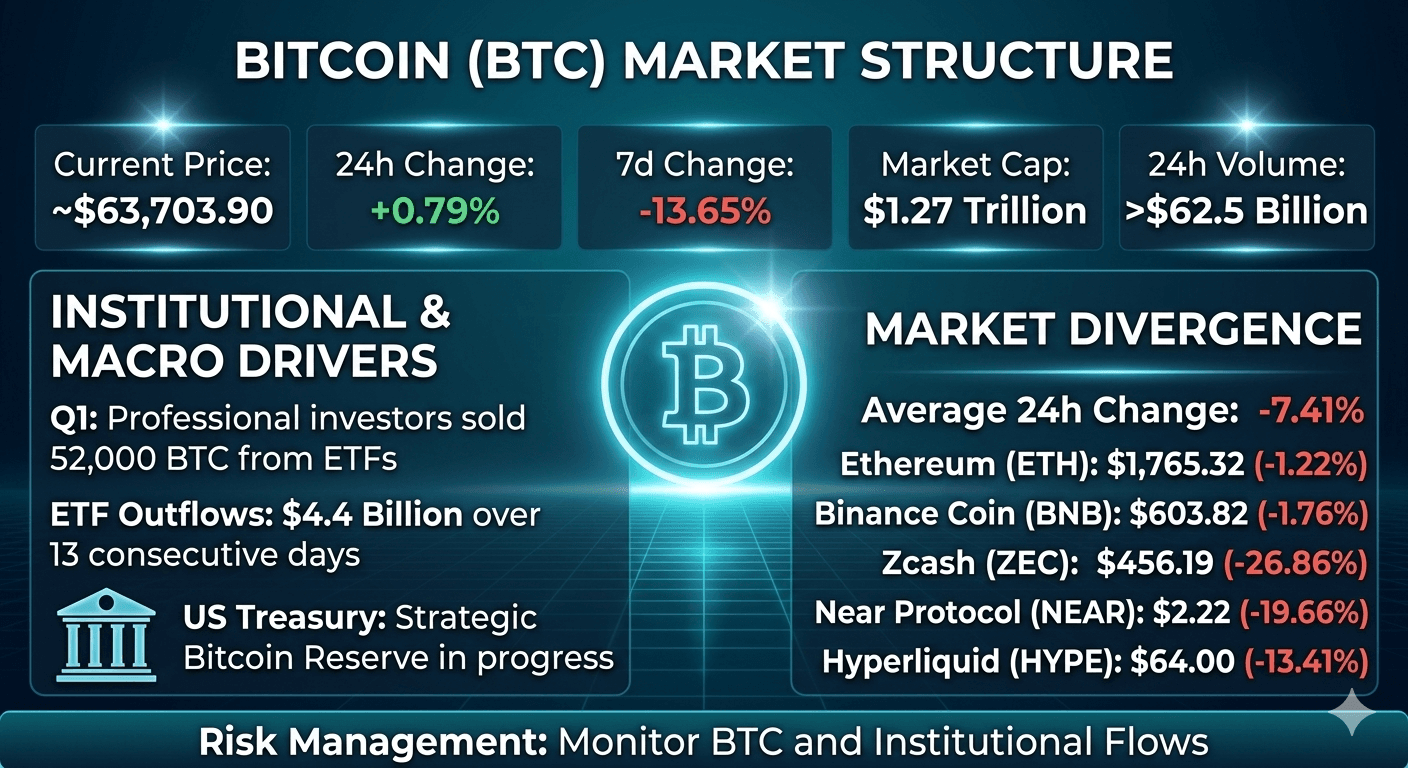
In the past 24 hours, Bitcoin (BTC) has shown a modest gain of 0.79%, trading at approximately $63,703.90. This short-term resilience stands in contrast to a more significant decline over the past seven days, where BTC has fallen by 13.65%. With a market capitalization of $1.27 trillion and a 24-hour trading volume exceeding $62.5 billion, Bitcoin remains the undisputed leader in the crypto ecosystem.
When viewed against the backdrop of the wider market, Bitcoin's recent performance appears to be a point of relative strength. The average 24-hour price movement across a selection of key digital assets currently sits at a notably negative -7.41%. This divergence highlights Bitcoin's capacity to absorb market pressures more effectively than many other assets, suggesting a potential flight to quality or a consolidation around the largest and most liquid cryptocurrency. Despite its own weekly drawdown, Bitcoin's ability to avoid the steeper daily losses seen elsewhere positions it as the anchor for the overall market's sentiment and direction.
Why Bitcoin Is Driving The Tape
Bitcoin's current market behavior is significantly influenced by a confluence of institutional developments and broader macroeconomic factors. The performance of US spot Bitcoin Exchange-Traded Funds (ETFs) has emerged as a critical barometer for institutional engagement, and recent data indicates a dynamic shift in ownership.
Over the first quarter of the year, professional investors reportedly divested approximately 52,000 BTC worth of ETFs. This pattern included hedge funds exiting their positions, contributing to a substantial $4.4 billion in outflows from US-listed spot Bitcoin ETFs over a 13-day consecutive streak. This sustained outflow period coincided with Bitcoin's price falling approximately 21% since mid-May.
However, the narrative surrounding institutional involvement is not entirely bearish. While hedge funds showed a tendency to sell, reports also indicate that banks and long-term allocators continued to build exposure, suggesting a rebalancing of institutional portfolios rather than a complete retreat. This nuanced picture indicates that different segments of the institutional market are approaching Bitcoin with varying strategies and time horizons.
Adding to the institutional discourse, the US Treasury secretary has signaled ongoing progress regarding the establishment of a strategic Bitcoin reserve and a broader digital asset stockpile. This initiative, stemming from a 2025 executive order, suggests a long-term strategic interest in Bitcoin at a national level, which could serve as a significant positive catalyst for its perceived value and stability. Such developments, while not immediately impacting price, contribute to a foundational shift in how Bitcoin is viewed by sovereign entities.
Macroeconomic developments are also playing a role in Bitcoin's price movements. Recent Middle East skirmishes have pushed bond yields and oil prices higher, contributing to a broader risk-off sentiment in traditional markets. This has been observed to correlate with Bitcoin's recent dip to its lowest price since March, mirroring a broader decline in US stocks. The interconnectedness between global geopolitical events, traditional financial markets, and Bitcoin's price action reinforces its increasing integration into the global financial system.
How The Rest Of The Market Is Responding
The broader crypto market is largely reacting to Bitcoin's lead, with many assets experiencing more pronounced downturns than BTC itself. The overall market capitalization stands at approximately $1.68 trillion, with an average 24-hour price change of -7.41%, indicating a widespread negative trend.
Ethereum (ETH), the second-largest cryptocurrency by market cap, recorded a 24-hour decline of 1.22%, trading around $1,765.32. Similarly, Binance Coin (BNB) saw a 1.76% decrease, resting at approximately $603.82. These movements, while negative, are less severe than the market average, suggesting that larger-cap altcoins are somewhat more resilient than smaller counterparts, though still trailing Bitcoin's short-term positive momentum. XRP also experienced a 1.90% decline in the last 24 hours, trading at $1.16.
The most significant volatility has been observed in other segments of the altcoin market. Zcash (ZEC) registered a substantial 24-hour drop of 26.86%, with its price falling to approximately $456.19. Near Protocol (NEAR) followed suit with a 19.66% decrease, trading at around $2.22. Hyperliquid (HYPE) also saw a notable decline of 13.41%, priced at about $64.00. These sharp corrections in mid-to-large cap altcoins suggest that capital may be rotating out of riskier assets, or that these specific protocols are facing unique selling pressure not directly tied to Bitcoin's immediate price action, but exacerbated by the broader market's negative sentiment.
Among other priority assets, Humanity (H) saw a minor dip of 0.86%, while Worldcoin (WLD) registered a slight gain of 0.84%. Cardano (ADA) experienced a significant 10.01% decline. This varied performance underscores that while Bitcoin sets the overall tone, individual altcoins can still exhibit distinct price behaviors influenced by their specific fundamentals or market positioning. However, the prevailing trend among most altcoins remains one of underperformance relative to Bitcoin's recent stability.
Conclusion and Risk Management
Bitcoin is unequivocally setting the direction for the current crypto market. Its relative stability in the last 24 hours, contrasted with a broader market average showing significant declines, highlights its role as a potential safe haven within the digital asset space, even amidst its own weekly drawdown. The market's response is largely dictated by institutional flows, particularly within the spot Bitcoin ETF ecosystem, and the broader macroeconomic environment. While short-term ETF outflows indicate profit-taking or repositioning by certain institutional players like hedge funds, the continued accumulation by banks and the strategic interest signaled by the US Treasury point towards a maturing asset class with long-term institutional appeal.
The derived insights suggest a mildly negative short-term bias for the overall market, with the strongest 24-hour moves concentrated in specific altcoins like ZEC, NEAR, and HYPE. This indicates that while Bitcoin is holding its ground, the broader altcoin market is experiencing more pronounced selling pressure.
For market participants, effective risk management in this environment involves closely monitoring Bitcoin's price action and the underlying institutional flows. The dual narrative of ETF outflows versus long-term institutional adoption requires a balanced perspective. Continued observation of global macroeconomic indicators, such as oil prices and bond yields, will also be crucial, as these factors demonstrate an increasing correlation with Bitcoin's performance. Diversification and careful position sizing remain paramount, especially given the heightened volatility observed across many altcoins. The current landscape suggests that Bitcoin's stability, or lack thereof, will continue to be the primary determinant for the direction of the wider digital asset market.
Source Data Reference
Market Snapshot Input
| Asset | Symbol | Price (USD) | 24h Change | Market Cap (USD) |
|---|---|---|---|---|
| Bitcoin | BTC | 63,703.901116 | 0.79% | 1,276,548,332,197 |
| Humanity | H | 0.565736 | -0.86% | 1,032,468,718 |
| Zcash | ZEC | 456.185855 | -26.86% | 7,448,725,361 |
| Worldcoin | WLD | 0.529725 | 0.84% | 1,789,434,818 |
| XRP | XRP | 1.166342 | -1.90% | 72,287,337,340 |
| Cardano | ADA | 0.177632 | -10.01% | 6,869,372,456 |
| Near Protocol | NEAR | 2.223154 | -19.66% | 2,634,805,561 |
| Hyperliquid | HYPE | 63.997489 | -13.41% | 21,370,565,137 |
| BNB | BNB | 603.815275 | -1.76% | 84,041,692,072 |
| Ethereum | ETH | 1,765.316085 | -1.22% | 212,590,512,701 |
Trending Headlines Input
- Professional investors dumped 52K BTC worth of ETFs in Q1, filings show
- US Treasury secretary signals progress on Bitcoin reserve, CLARITY Act
- Bitcoin ETFs bleed $4.4B as outflow run extends to 13 trading days
- Stripe Millionaire Loses Bid for Congress to Candidate Backed by Ripple Co-Founder
- US House Democrats call for FTC probe into prediction markets
- As Oil Moves Higher, Bitcoin Sinks to Lowest Price Since March