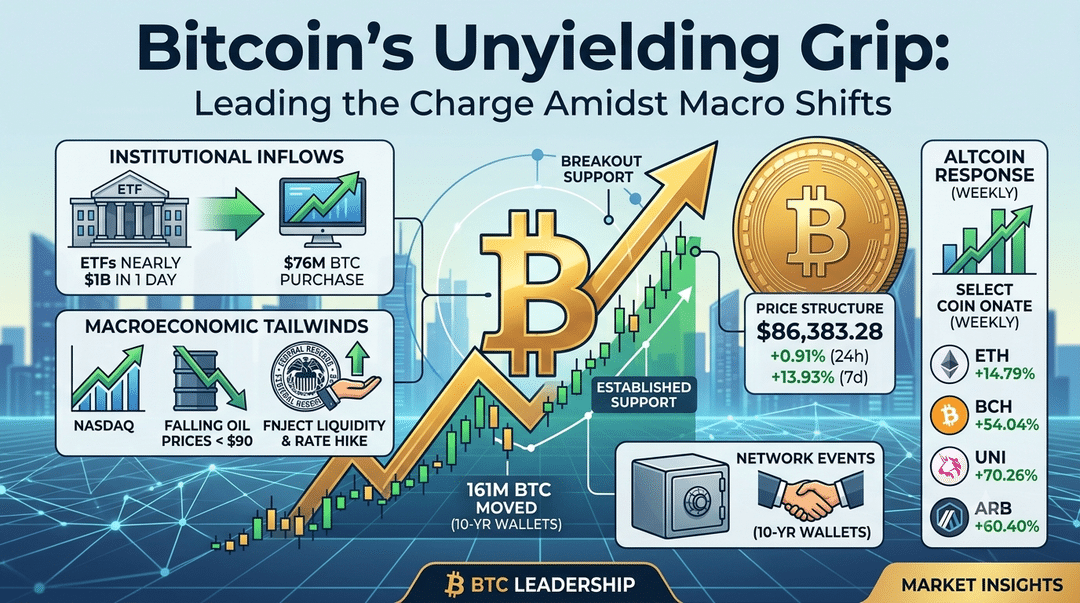
Bitcoin Price Structure
Bitcoin (BTC), the market's dominant asset, is observed trading at approximately $73,672.63. Over the last 24 hours, BTC has registered a slight decrease of 0.53%, extending its weekly decline to 4.34%. Despite this short-term downward pressure, Bitcoin maintains a commanding market capitalization of approximately $1.48 trillion, underscoring its pivotal role in the overall crypto economy, which stands at around $1.95 trillion.
This performance contrasts with the average 24-hour move across the broader market, which is a positive 2.27%. However, other major assets largely mirror Bitcoin's recent subdued performance. Ethereum (ETH), for instance, the second-largest cryptocurrency by market cap, is trading at approximately $2,007.14, experiencing a 24-hour decline of 0.96% and a 7-day drop of 4.55%. This close correlation in percentage changes between BTC and ETH suggests that the current market sentiment influencing Bitcoin is also broadly impacting other large-cap cryptocurrencies. BNB, another core major, also saw a 2.15% decline over 24 hours. The observed price action indicates a period of consolidation or slight retraction for the market's leading assets, with Bitcoin's movement setting the primary direction.
Why Bitcoin Is Driving The Tape
Bitcoin's influence on the market is not solely a function of its size but is deeply intertwined with ongoing institutional and regulatory developments. Several key headlines underscore why Bitcoin remains the primary driver of market sentiment and capital flows.
A notable development has been the record 10-day outflow streak from spot Bitcoin ETFs, amounting to nearly $3 billion. This sustained withdrawal of capital from these investment vehicles could be interpreted as a bearish signal, reflecting reduced institutional demand or profit-taking. However, one analyst has characterized this streak as a "contrarian indicator," suggesting that such extended outflows might precede a reversal, hinting at potential undervaluation or an impending rebound. This interpretation introduces nuance to what might otherwise appear as a straightforward negative trend.
In a move that could significantly expand institutional access to Bitcoin, Kraken is reportedly planning to offer regulated perpetual futures contracts tied to the spot price of Bitcoin to its U.S. institutional clients within the next month. This follows approval from the CFTC for such products and positions Kraken to compete with other platforms already offering similar services. The introduction of regulated perp contracts could enhance liquidity and provide sophisticated hedging tools, potentially attracting more institutional capital and solidifying Bitcoin's status as a mature financial asset.
Further reinforcing institutional interest, Michael Saylor of Strategy, a prominent Bitcoin corporate holder, has hinted at a potential resumption of Bitcoin purchases. Saylor's tweet, referencing "working better," suggests that Strategy, which had paused its Bitcoin acquisitions in recent weeks, may be poised to re-enter the market. Strategy's buying activity has historically been a significant bullish catalyst for Bitcoin, and any confirmation of renewed purchases could provide a substantial boost to market sentiment.
On a macro level, discussions surrounding the potential merger of Tesla and SpaceX raise the prospect of Elon Musk's combined entity holding billions of dollars worth of Bitcoin. While speculative, such a scenario highlights Bitcoin's increasing integration into the balance sheets of major corporations and the potential for significant corporate-level accumulation, further cementing its institutional relevance.
These intertwined regulatory advancements, institutional investment trends, and high-profile corporate interests collectively illustrate why Bitcoin remains at the forefront of the crypto market's direction. Even amidst short-term price fluctuations and ETF outflows, the underlying structural developments continue to build a case for Bitcoin's long-term significance and its role as the market's primary bellwether.
How The Rest Of The Market Is Responding
While Bitcoin sets the overall market tone, the response from altcoins and other assets varies, demonstrating a mix of correlation and independent movement. The overall market shows a mildly positive short-term bias on average, contrasting with BTC's slight dip, indicating that some assets are indeed finding their own momentum.
Ethereum (ETH), as previously noted, largely tracks Bitcoin's movements, exhibiting similar percentage declines over both 24 hours and 7 days. This suggests that the foundational market forces impacting Bitcoin's price structure are also influencing Ethereum, reinforcing the idea of a BTC-led market where other majors often follow suit. BNB also shows a similar trend, reinforcing this observation.
However, a closer look at
topVolatileAssetsThese strong moves in select altcoins like XLM, ZEC, and HYPE underscore that while Bitcoin generally leads, individual projects can experience significant price action driven by their unique developments, community sentiment, or technical factors. These instances, however, appear as exceptions rather than a broad-based altcoin rally that might challenge Bitcoin's market dominance. The market remains characterized by Bitcoin's overarching influence, with other assets either largely confirming its trend or experiencing localized volatility. The
derivedInsightsConclusion and Risk Management
Bitcoin continues to be the dominant force shaping the cryptocurrency market. Its price structure, currently characterized by a slight pullback over the past 24 hours and week, is nonetheless underpinned by significant institutional and regulatory developments. The record outflows from spot Bitcoin ETFs, while a factual observation of capital movement, are viewed by some analysts as a potential contrarian indicator, suggesting an impending shift. Simultaneously, the prospect of regulated Bitcoin perpetual contracts from Kraken and Michael Saylor's hints at renewed buying from Strategy signal ongoing institutional maturation and demand. These factors collectively indicate that Bitcoin's trajectory will remain the primary determinant of broader market direction.
For market participants, this Bitcoin-led environment necessitates a focus on BTC's price action and the catalysts influencing it. While the overall market sentiment shows a mildly positive short-term bias, this is largely driven by specific altcoin rallies rather than a universal upward trend. The performance of major altcoins like Ethereum largely confirms Bitcoin's lead, moving in tandem with its fluctuations.
Risk Management: Investors should remain vigilant regarding Bitcoin's key support and resistance levels. The mixed signals from ETF outflows versus sustained institutional interest introduce a degree of uncertainty, suggesting that volatility could persist. Monitoring the flow of institutional capital into new regulated products and the buying patterns of major corporate holders will be crucial. For altcoins, while some may offer significant independent gains, their performance should be assessed in the context of Bitcoin's overall trend. Diversification and careful position sizing, particularly in more volatile altcoins, remain prudent strategies. The market's direction is primarily contingent on Bitcoin's ability to absorb current selling pressure and capitalize on the growing institutional infrastructure being built around it.
Source Data Reference
Market Snapshot Input
| Asset | Symbol | Price (USD) | 24h Change | Market Cap (USD) |
|---|---|---|---|---|
| Bitcoin | BTC | 73,672.627159 | -0.53% | 1,476,195,448,762 |
| Stellar | XLM | 0.258561 | 14.48% | 8,697,314,475 |
| Ethereum | ETH | 2,007.138188 | -0.96% | 241,712,257,697 |
| Zcash | ZEC | 573.994899 | 7.60% | 9,372,343,119 |
| Hyperliquid | HYPE | 72.17217 | 4.35% | 24,100,321,458 |
| BNB | BNB | 708.746929 | -2.15% | 98,646,545,798 |
| Bitcoin Cash | BCH | 303.263628 | -0.14% | 6,024,570,639 |
| OKB | OKB | 92.87226 | -0.79% | 5,572,335,618 |
| TRON | TRX | 0.351366 | 1.33% | 30,345,161,366 |
| Solana | SOL | 82.477091 | -0.53% | 47,718,801,486 |
Trending Headlines Input
- Spot Bitcoin ETFs see record 10-day outflow streak, analyst calls it ‘contrarian indicator’
- Kraken ‘plans’ regulated perp contracts as rivals are quick off the blocks
- Strategy's Michael Saylor teases BTC buy with 'working better' tweet
- Bitcoin retail sentiment still matters, says Swan Bitcoin CEO
- What Is an AI Prompt Injection Attack? The Hidden Threat Hijacking Your Chatbots
- Here's How Much Bitcoin Elon Musk Would Control If SpaceX and Tesla Merge