Bitcoin Price Structure
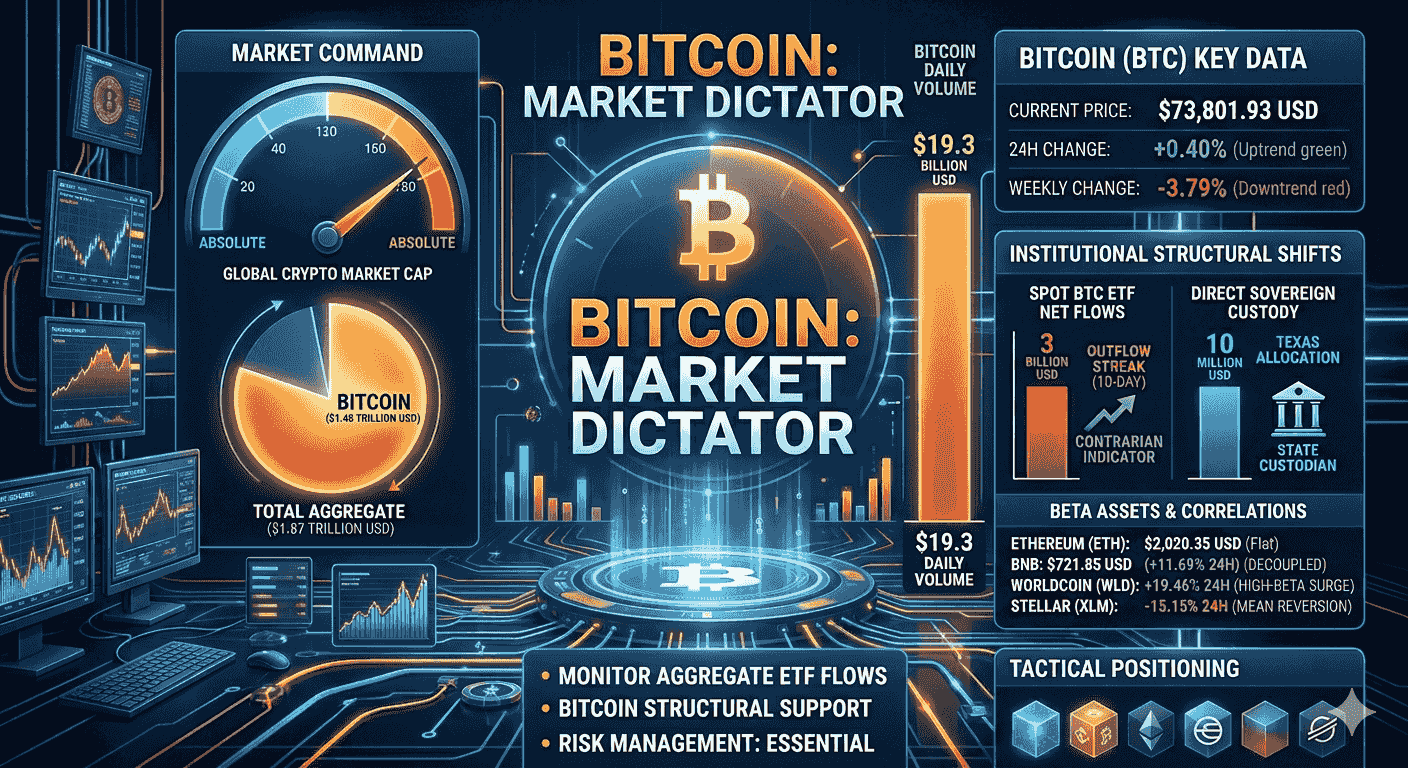
Bitcoin (BTC) is presently trading around $73,801.93, reflecting a modest 24-hour increase of approximately 0.40%. This short-term gain comes after a more significant pullback over the past seven days, during which BTC experienced a decline of about 3.79%. Despite this weekly dip, Bitcoin's market capitalization stands robustly at approximately $1.48 trillion, representing a substantial portion of the total global crypto market cap of $1.87 trillion. This dominance underscores Bitcoin's foundational role in the digital asset ecosystem.
In comparison to the average 24-hour move across the top assets, which sits at about 1.84%, Bitcoin's recent 0.40% upward movement suggests a period of consolidation or relative equilibrium. Its significant market capitalization and trading volume of over $19.3 billion in the last 24 hours indicate continued institutional and retail interest, even as it navigates short-term price fluctuations. The short-term positioning of Bitcoin appears to be one of cautious stability, with price action largely dictated by reactions to ongoing macro and institutional developments rather than internal market volatility.
Why Bitcoin Is Driving The Tape
The primary catalysts currently influencing Bitcoin's market direction are predominantly linked to institutional adoption, regulatory developments, and broader macro narratives. These factors collectively explain why Bitcoin is largely driving the tape, even as its short-term price movements appear subdued.
A notable development is the plan by Texas to shift its $10 million Strategic Bitcoin Reserve from BlackRock’s IBIT ETF into directly held coins. This initiative involves hiring a crypto custodian to build state-level Bitcoin infrastructure. This move, while representing a relatively small amount in the grand scheme, signals a deepening institutional comfort with direct Bitcoin custody, potentially setting a precedent for other state-level entities. This shift from an ETF product to direct holding indicates a maturation of institutional engagement beyond mere investment vehicles, suggesting a long-term commitment to Bitcoin as a reserve asset.
Conversely, the spot Bitcoin ETF market has recently experienced a record 10-day outflow streak, totaling nearly $3 billion. This sustained outflow has been mirrored by Ether ETFs, which have seen 14 consecutive sessions of outflows. While this might appear bearish on the surface, some analysts interpret such prolonged outflows as a "contrarian indicator," suggesting that a market reversal could be on the horizon as weaker hands exit. This data highlights the ongoing tug-of-war between new institutional inflows and profit-taking or reallocation by existing ETF investors. The net effect of these flows remains a critical determinant for Bitcoin's immediate price trajectory, reflecting a period of institutional re-evaluation or position adjustment.
Further underscoring the institutional and regulatory narrative, a Republican candidate in Florida has reportedly liquidated $800,000 in Bitcoin to fund a congressional bid. While this is a localized event, it illustrates the increasing intersection of cryptocurrency holdings with traditional finance and political spheres, potentially bringing Bitcoin further into the mainstream regulatory discussion.
Finally, the speculative possibility of a merger between Tesla and SpaceX, which could consolidate billions of dollars' worth of Bitcoin under a single Elon Musk-led entity, continues to fuel macro discussions. Such a development, if it materializes, would significantly increase the corporate exposure to Bitcoin, reinforcing its status as a corporate treasury asset. This ongoing narrative, though speculative, contributes to Bitcoin's macro relevance and its perceived value as a hedge or strategic asset for large corporations.
These BTC-linked catalysts, ranging from direct state custody plans to ETF flow dynamics and corporate treasury considerations, collectively underscore Bitcoin’s central role in shaping market sentiment and direction. The news flow largely revolves around Bitcoin's integration into traditional financial and governmental structures, reinforcing its position as the market's leading indicator.
How The Rest of The Market Is Responding
The broader cryptocurrency market is largely reacting to Bitcoin's lead, with varying degrees of correlation and independent movement among altcoins. The overall market, as indicated by derived insights, shows a mildly positive short-term bias across the selected asset basket, suggesting a general, albeit cautious, upward trend.
Ethereum (ETH), the second-largest cryptocurrency by market cap, mirrors some of Bitcoin’s recent performance. ETH is currently priced around $2,020.35, with a marginal 24-hour gain of approximately 0.22%. However, similar to Bitcoin, it has seen a 4.63% decline over the last seven days. This parallel movement suggests that the institutional and macro headwinds affecting Bitcoin also influence Ethereum, particularly given the shared trend of outflows from their respective spot ETFs.
BNB, ranked fourth by market capitalization, has shown more independent strength, posting a significant 11.69% increase over the past 24 hours to trade around $721.85. Its 7-day performance is also positive, up 9.95%. This robust performance for BNB indicates specific ecosystem developments or platform-related catalysts that are allowing it to decouple from Bitcoin's more subdued short-term movements, at least on a 24-hour basis.
Looking at the top volatile assets, Worldcoin (WLD), Stellar (XLM), and Hedera Hashgraph (HBAR) have experienced the strongest 24-hour moves. Worldcoin (WLD) surged by 19.46%, indicating significant speculative interest or project-specific news, though no direct news signals were provided for WLD. Conversely, Stellar (XLM) saw a sharp decline of 15.15% in 24 hours, despite being up over 52% in the last seven days. This suggests a significant profit-taking event after a strong weekly rally. Hedera Hashgraph (HBAR) also experienced a notable drop of 12.91% in 24 hours. These movements among altcoins highlight that while Bitcoin sets the overall market tone, individual assets can exhibit high volatility driven by their unique narratives, technical factors, or localized trading dynamics.
The varied performance among these altcoins, particularly the strong moves in WLD, XLM, and HBAR, suggests a market where capital is actively rotating, but often within the overarching framework established by Bitcoin's stability or directional bias. While some altcoins demonstrate strong independent rallies or corrections, their longer-term trends often remain tethered to Bitcoin’s broader market cycles.
Conclusion and Risk Management
Bitcoin's current market structure, characterized by relatively stable short-term price action and significant institutional attention, firmly establishes it as the primary driver of market sentiment and direction. The ongoing narratives around direct state custody, ETF flows, and corporate integration underscore its growing importance within traditional finance and governance. While Bitcoin's 24-hour performance has been modest, its pivotal role in absorbing and reacting to these macro and institutional developments dictates the broader market's rhythm.
The rest of the market, including major altcoins like Ethereum, largely follows Bitcoin's lead, albeit with some assets like BNB showing independent strength based on specific catalysts. Highly volatile altcoins such as Worldcoin, Stellar, and Hedera Hashgraph demonstrate that significant price movements can occur independently, often driven by project-specific factors or short-term trading dynamics. However, these movements typically occur within the risk parameters set by Bitcoin’s overarching market posture.
Looking ahead, Bitcoin's price action will likely continue to be influenced by the ongoing institutional adoption cycle and any shifts in ETF flows. A sustained period of outflows from spot Bitcoin ETFs could signal a broader market correction, while renewed inflows or further direct institutional custody moves could provide upward momentum.
For market participants, effective risk management remains paramount. Given the market's dependence on Bitcoin's stability, monitoring BTC's price structure and the institutional headlines linked to it is crucial. While altcoins offer opportunities for outsized gains, they also carry higher volatility risks, as evidenced by the significant swings in assets like XLM and HBAR. Diversification, position sizing, and a clear understanding of the catalysts driving individual assets, within the context of Bitcoin's dominant influence, are essential strategies for navigating the current market environment. The overall market exhibits a mildly positive short-term bias, but this positive sentiment is highly contingent on Bitcoin maintaining its structural integrity and absorbing external pressures effectively.
Source Data Reference
Market Snapshot Input
| Asset | Symbol | Price (USD) | 24h Change | Market Cap (USD) |
|---|---|---|---|---|
| Bitcoin | BTC | 73,801.929456 | 0.40% | 1,478,752,876,488 |
| Stellar | XLM | 0.227585 | -15.15% | 7,649,001,208 |
| BNB | BNB | 721.848685 | 11.69% | 100,470,106,410 |
| Ethereum | ETH | 2,020.351035 | 0.22% | 243,303,432,221 |
| Worldcoin | WLD | 0.34317 | 19.46% | 1,151,797,619 |
| Monero | XMR | 368.245868 | -8.83% | 6,792,937,263 |
| Hyperliquid | HYPE | 68.133895 | 5.09% | 22,751,827,393 |
| OKB | OKB | 92.84688 | 6.51% | 5,570,812,807 |
| Aster | ASTER | 0.755698 | 11.96% | 1,252,719,956 |
| Hedera Hashgraph | HBAR | 0.094294 | -12.91% | 4,089,846,888 |
Trending Headlines Input
- Texas Bitcoin reserve plans shift from ETF to direct BTC custody
- Spot Bitcoin ETFs see record 10-day outflow streak, analyst calls it ‘contrarian indicator’
- Bitcoin retail sentiment still matters, says Swan Bitcoin CEO
- Florida Candidate Liquidates $800K in Bitcoin to Bankroll Congressional Bid
- What Is an AI Prompt Injection Attack? The Hidden Threat Hijacking Your Chatbots
- Here's How Much Bitcoin Elon Musk Would Control If SpaceX and Tesla Merge