Bitcoin Price Structure
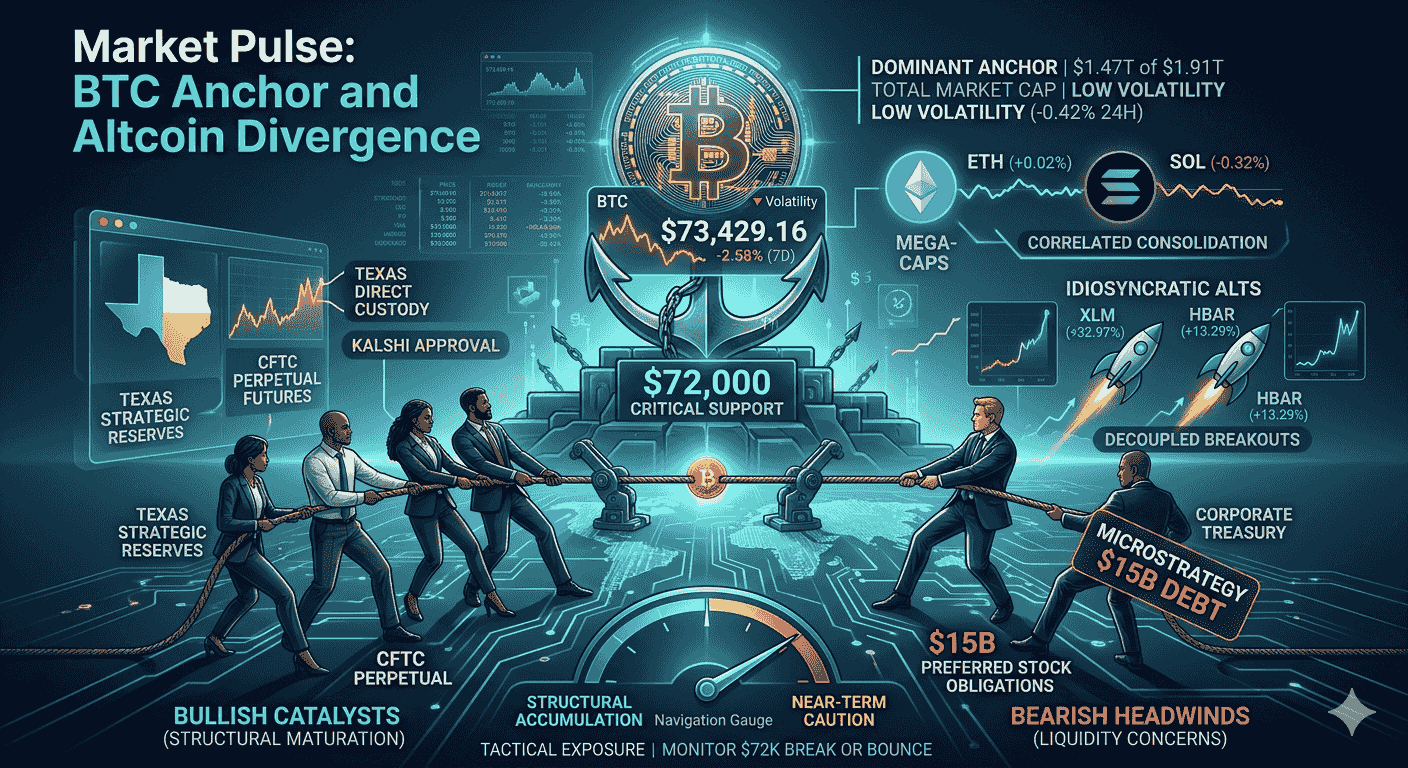
Bitcoin currently trades around $73,429.16, exhibiting a modest 24-hour decline of approximately 0.42%. Over the past seven days, BTC has seen a 2.58% decrease, indicating a period of consolidation or slight retraction following previous movements. Bitcoin maintains its rank as the leading cryptocurrency by market capitalization, accounting for roughly $1.47 trillion of the total global market capitalization of $1.91 trillion. This significant share underscores its pivotal role in determining overall market sentiment and direction.
Compared to the average 24-hour price movement across the broader market, which stands at an average of 5.61%, Bitcoin's relatively flat performance suggests a period of internal price discovery rather than participation in a widespread market rally. This observation aligns with recent market commentary questioning whether investors will "buy the $72K dip, or jump ship," indicating that the $72,000 level has become a significant focal point for market participants. The current price action around this range reflects a tug-of-war between potential buying interest and profit-taking or short-term bearish sentiment. The lack of a decisive breakout or breakdown points to an ongoing consolidation phase, where Bitcoin's next major move is likely to set the tone for the entire digital asset space.
Why Bitcoin Is Driving The Tape
The primary drivers behind Bitcoin's influence on the market are a confluence of institutional adoption, regulatory clarity, and the implications of significant corporate holdings. Recent headlines highlight several key developments that are shaping Bitcoin's fundamental outlook.
Firstly, institutional engagement continues to evolve. The state of Texas, for instance, is reportedly planning to shift its $10 million Strategic Bitcoin Reserve from BlackRock’s IBIT ETF to direct custody. This move, while modest in scale, signifies a deepening understanding and preference for direct ownership of Bitcoin by governmental entities, potentially setting a precedent for other states or institutions to follow. It reflects a growing confidence in securing and managing Bitcoin directly, moving beyond the wrapper of an ETF product.
Further regulatory advancements are also contributing to Bitcoin's expanding market infrastructure. The Commodity Futures Trading Commission (CFTC) has approved Bitcoin perpetual futures on the prediction market Kalshi. This regulatory green light allows for new avenues of price discovery and risk management for Bitcoin in the U.S. market, expanding its accessibility to a broader range of sophisticated investors and traders. Such approvals are crucial for Bitcoin's maturation as a recognized financial asset.
However, not all news signals are unilaterally positive. Concerns have emerged regarding the capital structure of a major corporate Bitcoin holder, MicroStrategy (referred to as "Strategy" in market analysis). An executive from Arca highlighted a significant burden of $15 billion in preferred stock obligations, with the CEO commenting on possible Bitcoin sales. While no sales have been confirmed, the potential for a large corporate holder to liquidate portions of its Bitcoin reserves due to financial pressure introduces a notable element of uncertainty into the market. This situation underscores the potential impact of corporate treasury strategies on Bitcoin's supply dynamics and price.
Lastly, while not directly a BTC-specific catalyst, the news that Cash App now supports stablecoin transactions on networks like Ethereum and Solana, despite its Bitcoin-maxi founder Jack Dorsey's previous stances, indicates a broader evolution in the crypto ecosystem. This development, while primarily benefiting altcoins, reflects a pragmatic approach to user demand and functionality, even within platforms historically rooted in Bitcoin. It subtly reinforces Bitcoin's foundational role while acknowledging the growing utility and acceptance of other digital assets.
These factors — robust institutional adoption and regulatory expansion tempered by potential corporate selling pressure — collectively frame why Bitcoin remains the central figure in current market dynamics, with its price action reflecting these diverse and sometimes conflicting forces.
How The Rest Of The Market Is Responding
The broader cryptocurrency market is exhibiting a mixed response to Bitcoin's current consolidation phase, with some major altcoins largely mirroring BTC's subdued movements, while others are experiencing significant, often uncorrelated, rallies. The overall selected editorial asset basket shows a mildly positive short-term bias, but this positive average is heavily skewed by a few high-performing assets.
Looking at the core major altcoins, Ethereum (ETH) has seen a negligible 24-hour change of just 0.02%, closely tracking Bitcoin's minor dip. Similarly, Solana (SOL) recorded a slight decline of 0.32% over the same period. BNB (BNB) showed a modest positive movement of 0.85%. These movements suggest that, for the most part, large-cap altcoins are either consolidating alongside Bitcoin or experiencing minor independent fluctuations, rather than leading a distinct market trend. Their performance indicates a market largely awaiting a clearer directional signal from BTC.
In contrast to the majors, a select group of altcoins has demonstrated remarkable independent strength and volatility. The strongest 24-hour moves are concentrated in Stellar (XLM), Hedera Hashgraph (HBAR), and Monero (XMR).
Stellar (XLM) stands out with an impressive 32.97% surge in 24 hours, extending its weekly gains to over 83.14%. This significant breakout suggests asset-specific catalysts are at play, potentially related to network developments, partnerships, or speculative interest, rather than a broad market uplift.
Hedera Hashgraph (HBAR) also experienced a substantial increase, up 13.29% in 24 hours and 15.73% over seven days. Monero (XMR), a privacy-focused cryptocurrency, posted an 11.66% gain in 24 hours and a 5.37% gain over the week. These movements in XLM, HBAR, and XMR indicate pockets of strong bullish sentiment or specific news driving these assets, largely decoupled from Bitcoin's more measured trading range. The Cash App news, which directly impacts Ethereum and Solana by enabling stablecoin transactions, serves as a prime example of how specific protocol-level developments can drive altcoin activity, even when Bitcoin itself is consolidating.
This divergence highlights a bifurcated market: a leading asset (Bitcoin) in a phase of price discovery influenced by macro and institutional factors, and a subset of altcoins driven by their unique narratives, technical developments, or speculative flows.
Conclusion and Risk Management
Bitcoin currently stands at a critical juncture, with its price structure reflecting an ongoing battle between bullish institutional adoption narratives and potential selling pressure from significant corporate holders. The market's thesis that Bitcoin is setting the tone for overall crypto direction holds, with major altcoins largely tracking its movements, albeit with some notable exceptions in smaller-cap, high-volatility assets.
On one hand, the continued institutional interest, exemplified by Texas's move towards direct BTC custody and the CFTC's approval of Bitcoin perpetual futures, paints a fundamentally positive long-term picture. These developments expand Bitcoin's reach and legitimacy within traditional finance. On the other hand, the specter of potential Bitcoin sales from large corporate entities, as hinted by the MicroStrategy-related discussions, introduces a near-term headwind that could weigh on price action. The current market debate around the $72,000 support level for Bitcoin underscores this delicate balance.
For market participants, this environment necessitates a measured approach. While the overall selected asset basket shows a mildly positive short-term bias, Bitcoin's own performance is flat to slightly negative, and the significant gains observed in assets like XLM, HBAR, and XMR appear to be isolated, asset-specific rallies rather than a broad market surge.
From a risk management perspective, investors should recognize that while Bitcoin's long-term trajectory remains compelling due to increasing institutional integration, its short-term price action is subject to volatility from both fundamental and technical factors. Altcoin rallies, particularly those demonstrating high volatility, may offer significant returns but often come with elevated risks, especially when not underpinned by a strong, clear trend in Bitcoin. Diversification and careful position sizing remain paramount. Monitoring Bitcoin's ability to decisively break above or below its current consolidation range will be key to understanding the next phase for the broader crypto market.
Source Data Reference
Market Snapshot Input
| Asset | Symbol | Price (USD) | 24h Change | Market Cap (USD) |
|---|---|---|---|---|
| Stellar | XLM | 0.263992 | 32.97% | 8,872,042,287 |
| Bitcoin | BTC | 73,429.155233 | -0.42% | 1,471,250,418,722 |
| Solana | SOL | 82.016335 | -0.32% | 47,442,566,818 |
| Hedera Hashgraph | HBAR | 0.101893 | 13.29% | 4,419,453,581 |
| Monero | XMR | 399.850212 | 11.66% | 7,375,934,492 |
| Ethereum | ETH | 2,012.736545 | 0.02% | 242,386,447,169 |
| Hyperliquid | HYPE | 64.281923 | 3.31% | 21,465,545,432 |
| Zcash | ZEC | 530.976829 | -5.40% | 8,669,932,489 |
| Bitcoin Cash | BCH | 302.889812 | 0.18% | 6,017,144,488 |
| BNB | BNB | 643.435328 | 0.85% | 89,556,187,117 |
Trending Headlines Input
- Texas Bitcoin reserve plans shift from ETF to direct BTC custody
- Strategy situation ‘out of hand,’ says Arca exec on $15B preferred stock burden
- Buy $72K dip, or jump ship: What will Bitcoin bulls do?
- Cash App Now Supports Stablecoins, Despite Bitcoin Maxi Jack Dorsey's 'Gatekeeper' Gripes
- CFTC Approves Bitcoin Perpetual Futures on Prediction Market Kalshi
- ‘Extraordinarily unusual’ for CFTC to reverse Gemini settlement deal: Ex-chair