Bitcoin Price Structure
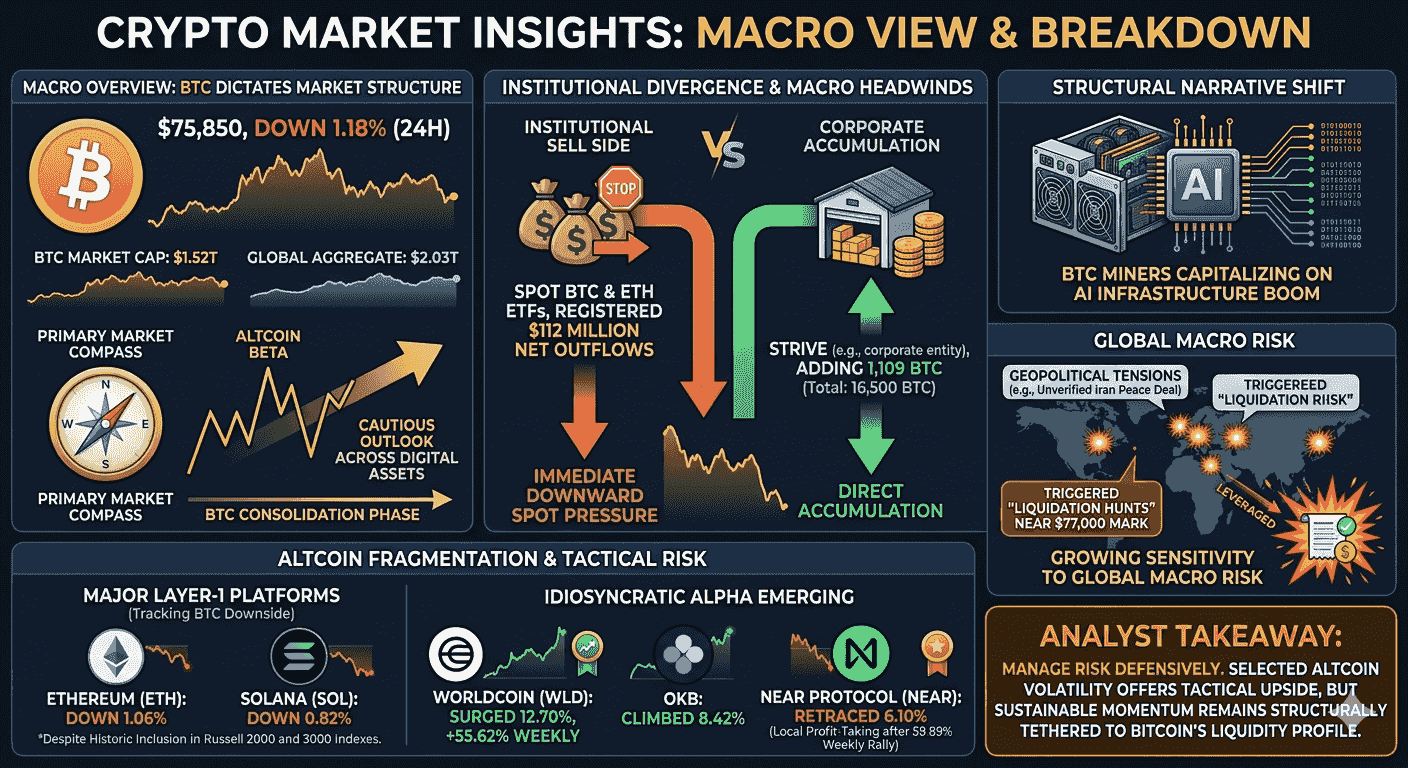
Bitcoin (BTC) is observed trading at approximately $75,850.23, reflecting a modest downturn of around 1.18% over the past 24 hours. This slight negative movement extends to its weekly performance, showing a 1.22% decline over the last seven days. With a market capitalization of approximately $1.52 trillion, Bitcoin maintains its dominant position within a global crypto market cap of $2.03 trillion.
Comparing this performance to the broader market, the average 24-hour price change across a snapshot of major assets is near flat, at roughly 0.005%. This suggests that while the overall market is largely treading water, Bitcoin itself has experienced a slight cooling period, pulling the weighted average down despite some individual altcoin surges. Bitcoin's substantial market capitalization means its movements disproportionately influence the overall market sentiment, even during periods of relatively minor price adjustments. The current price structure indicates a phase where BTC is consolidating or facing minor headwinds, setting a cautious tone for other digital assets.
Why Bitcoin Is Driving The Tape
Bitcoin's recent price action appears to be a response to a confluence of institutional flows, evolving regulatory dynamics, and broader macroeconomic considerations. These factors collectively contribute to Bitcoin's role in setting the market's direction.
One notable development is the observed outflow from Bitcoin and Ethereum spot ETFs, which collectively shed $112 million. This suggests a period of selling pressure from institutional investment vehicles, potentially contributing to Bitcoin's slight 24-hour decline. Such outflows are often interpreted as a direct indicator of institutional sentiment and can exert downward pressure on prices.
However, this is juxtaposed with signals of continued institutional accumulation. Strive, for instance, reportedly added 1,109 Bitcoin to its holdings, increasing its total to 16,500 BTC. This move highlights ongoing direct institutional interest in accumulating Bitcoin, particularly as "digital credit" products like SATA and Strategy’s STRC gain traction. This divergence between ETF flows and direct corporate accumulation indicates a complex institutional landscape where different strategies are at play.
The Bitcoin mining sector is also experiencing renewed momentum, driven by an unexpected linkage to the artificial intelligence (AI) infrastructure boom. Bitcoin mining stocks have reportedly jumped, as the power-heavy infrastructure required for mining is seen by some as potentially adaptable to support AI operations. This narrative connects Bitcoin to a high-growth technological sector, potentially boosting investor confidence in the long-term utility and value of the underlying network.
On the macroeconomic front, Bitcoin's price movements have also been influenced by external global events. Reports of "liquidation hunts" around the $77,000 mark for BTC coincided with doubts surrounding a new Iran peace deal. Such geopolitical uncertainties can introduce volatility and lead to speculative trading activity, where large orders are executed to trigger liquidations, contributing to price fluctuations that are not directly tied to crypto-specific fundamentals. This underscores Bitcoin's increasing sensitivity to global macro narratives, acting as both a risk-on asset and, at times, a safe haven, depending on the specific context.
Furthermore, broader adoption pathways continue to emerge. The integration of MoonPay with ChatGPT, allowing users to buy cryptocurrencies including Bitcoin and XRP through the chatbot, represents a step towards greater accessibility. While not an immediate price driver, such developments enhance Bitcoin's reach and ease of use, contributing to its long-term adoption narrative.
How The Rest Of The Market Is Responding
The broader cryptocurrency market is reacting to Bitcoin's lead with a mixed performance, largely mirroring BTC's modest downturn in the major assets while exhibiting distinct volatility in certain altcoins.
Ethereum (ETH), the second-largest cryptocurrency by market capitalization, has seen a 1.06% decline over the past 24 hours and a 1.80% drop over seven days, closely tracking Bitcoin's trajectory. Similarly, Solana (SOL) is down 0.82% in 24 hours and 0.64% over seven days, indicating that these major smart contract platforms largely follow Bitcoin's general market sentiment. Despite this, both Ethereum firm Sharplink and Solana Treasury Forward Industries are reportedly joining the Russell 2000 and 3000 indexes. This institutional inclusion is a positive long-term signal for both ecosystems, although it has not translated into immediate upward price momentum in the current environment where Bitcoin is experiencing slight headwinds.
Beyond the major assets, the market presents a more fragmented picture with significant individual asset volatility. The strongest 24-hour moves are concentrated in specific altcoins, suggesting that while Bitcoin sets the overall tone, unique narratives or market dynamics are driving these individual performances.
Worldcoin (WLD) has notably surged by approximately 12.70% in 24 hours, building on a substantial 55.62% gain over the past week. This strong upward momentum indicates specific interest or catalysts driving WLD's performance, detached from the general market cooling. Conversely, Zcash (ZEC) has experienced a significant downturn, dropping by about 10.43% in 24 hours, though its 7-day change is a more modest -1.44%. This sharp daily decline suggests localized selling pressure or profit-taking. OKB, the native token of the OKX exchange, has also shown strength, rising by 8.42% in 24 hours and 12.97% over seven days, potentially reflecting exchange-specific developments or utility.
Near Protocol (NEAR), despite a remarkable 59.89% gain over the last seven days, has seen a sharp 6.10% decline in the past 24 hours. This could be interpreted as profit-taking after a period of significant appreciation, rather than a reflection of broader market weakness.
These divergent movements among altcoins highlight that while Bitcoin provides a directional anchor, the altcoin market is not uniformly correlated. Specific projects can exhibit independent strength or weakness based on their unique fundamentals, ecosystem developments, or speculative interest, creating pockets of high volatility even when the leading asset is in a period of consolidation.
Conclusion and Risk Management
The current cryptocurrency market is demonstrably Bitcoin-led, with BTC's price structure and associated catalysts primarily influencing the overall market sentiment. While the selected editorial asset basket shows a mildly positive short-term bias due to strong individual altcoin performances, the leading assets, particularly Bitcoin and Ethereum, are navigating a period of slight downturn. This indicates a market that is not uniformly bullish but rather one where Bitcoin's influence is paramount, with other assets reacting around its core movements.
The mixed signals from institutional activity—ETF outflows juxtaposed with direct corporate accumulation—suggest a complex environment for Bitcoin. Macroeconomic factors, such as geopolitical uncertainties, are also playing an increasingly visible role in shaping Bitcoin's short-term volatility.
For market participants, understanding these dynamics is crucial. Bitcoin's movements will likely continue to dictate the broader market's trajectory. Therefore, monitoring key Bitcoin-specific catalysts, including ETF flow data, significant institutional investment announcements, and relevant macroeconomic indicators, remains essential. While some altcoins may offer opportunities for independent gains or losses due to their unique narratives, their sustainability is often tethered to the underlying health and direction set by Bitcoin.
Risk management in this environment involves acknowledging Bitcoin's central role. Investors might consider a balanced approach that accounts for Bitcoin's potential for both consolidation and renewed upward momentum, while recognizing that altcoins, especially those exhibiting high volatility, carry elevated risks and rewards. Diversification and a clear understanding of individual asset catalysts are prudent, but with a constant eye on Bitcoin as the market's primary compass.
Source Data Reference
Market Snapshot Input
| Asset | Symbol | Price (USD) | 24h Change | Market Cap (USD) |
|---|---|---|---|---|
| Bitcoin | BTC | 75,850.232512 | -1.18% | 1,519,655,843,416 |
| Ethereum | ETH | 2,074.765132 | -1.06% | 249,856,321,377 |
| Solana | SOL | 83.729282 | -0.82% | 48,413,647,090 |
| Near Protocol | NEAR | 2.550045 | -6.10% | 3,022,225,263 |
| Worldcoin | WLD | 0.37254 | 12.70% | 1,272,053,887 |
| XRP | XRP | 1.328958 | -1.00% | 82,207,124,686 |
| Zcash | ZEC | 570.667274 | -10.43% | 9,318,008,765 |
| Hyperliquid | HYPE | 60.090579 | -0.10% | 20,065,937,619 |
| OKB | OKB | 90.266116 | 8.42% | 5,415,966,959 |
| BNB | BNB | 656.145894 | -0.38% | 91,325,300,063 |
Trending Headlines Input
- Bitcoin, Ethereum ETFs Shed $112M as Hyperliquid Funds Extend 8-Day Win Streak
- Strive adds 1,109 Bitcoin as digital credit products gain traction
- Ethereum Firm Sharplink, Solana Treasury Forward Industries Joining Russell 2000, 3000 Indexes
- Bitcoin mining stocks jump as AI infrastructure boom boosts sector outlook
- Bitcoin 'liquidation hunts' control BTC at $77K amid new Iran peace deal doubts
- Now You Can Buy Bitcoin, XRP and More in ChatGPT via MoonPay